 Add to Chrome
 Add to Firefox
 Add to Edge
On-Policy Distillation with Best-of-N Teacher Rollout Selection
May 10, 2026
On-policy distillation (OPD), which supervises a student on its own sampled trajectories, has emerged as a data-efficient post-training method for improving reasoning while avoiding the reward dependence of reinforcement learning and the catastrophic forgetting often observed in standard supervised fine-tuning. However, standard OPD typically computes teacher supervision under noisy student-generated contexts and often relies on a single stochastic teacher rollout per prompt. As a result, the supervision signal can be high-variance: the sampled teacher trajectory can be incorrect, uninformative, or poorly matched to the student's current reasoning behavior. To address this limitation, we propose BRTS, a Best-of-N Rollout Teacher Selection framework for on-policy distillation. BRTS augments standard student-context OPD with a teacher-context supervision branch constructed from the curated teacher trajectory. Rather than distilling from the first sampled teacher rollout, BRTS samples a small pool of teacher trajectories and selects the auxiliary trajectory using a simple priority rule: correctness first, student alignment second. When multiple correct teacher trajectories are available, BRTS chooses the one most aligned with the student's current behavior; when unconditioned teacher samples fail on harder prompts, it invokes a ground-truth-conditioned recovery step to elicit a natural derivation. The selected trajectory is then used to provide reliable teacher-context supervision inside the OPD loop, augmented with an auxiliary loss on the teacher trajectory. Experiments on AIME 2024, AIME 2025, and AMC 2023 show that BRTS improves over standard OPD on challenging reasoning benchmarks, with the largest gains on harder datasets. Our code is available at https://github.com/BWGZK-keke/BRTS.

Shot-Aware Frame Sampling for Video Understanding
Mar 18, 2026Video frame sampling is essential for efficient long-video understanding with Vision-Language Models (VLMs), since dense inputs are costly and often exceed context limits. Yet when only a small number of frames can be retained, existing samplers often fail to balance broad video coverage with brief but critical events, which can lead to unreliable downstream predictions. To address this issue, we present InfoShot, a task-agnostic, shot-aware frame sampler for long-video understanding. InfoShot first partitions a video into semantically consistent shots, and then selects two complementary keyframes from each shot: one to represent the main content and one to capture unusual within-shot changes. This design is guided by an information-theoretic objective that encourages the sampled set to retain high information about both shot structure and sparse within-shot deviations. In this way, it improves the chance of preserving both overall video context and short decision-critical moments without requiring any retraining. To better evaluate such short-lived events, we further introduce SynFlash, a synthetic benchmark with controllable sub-second anomaly patterns and frame-level ground truth, and we also evaluate InfoShot on existing anomaly datasets and general video understanding tasks. Experiments show that InfoShot improves anomaly hit rate and downstream Video-QA accuracy under frame number constraints, while matching or outperforming strong baselines on standard video understanding benchmarks.
From Imitation to Intuition: Intrinsic Reasoning for Open-Instance Video Classification
Mar 11, 2026Conventional video classification models, acting as effective imitators, excel in scenarios with homogeneous data distributions. However, real-world applications often present an open-instance challenge, where intra-class variations are vast and complex, beyond existing benchmarks. While traditional video encoder models struggle to fit these diverse distributions, vision-language models (VLMs) offer superior generalization but have not fully leveraged their reasoning capabilities (intuition) for such tasks. In this paper, we bridge this gap with an intrinsic reasoning framework that evolves open-instance video classification from imitation to intuition. Our approach, namely DeepIntuit, begins with a cold-start supervised alignment to initialize reasoning capability, followed by refinement using Group Relative Policy Optimization (GRPO) to enhance reasoning coherence through reinforcement learning. Crucially, to translate this reasoning into accurate classification, DeepIntuit then introduces an intuitive calibration stage. In this stage, a classifier is trained on this intrinsic reasoning traces generated by the refined VLM, ensuring stable knowledge transfer without distribution mismatch. Extensive experiments demonstrate that for open-instance video classification, DeepIntuit benefits significantly from transcending simple feature imitation and evolving toward intrinsic reasoning. Our project is available at https://bwgzk-keke.github.io/DeepIntuit/.
Advancing User-Voice Interaction: Exploring Emotion-Aware Voice Assistants Through a Role-Swapping Approach
Feb 21, 2025As voice assistants (VAs) become increasingly integrated into daily life, the need for emotion-aware systems that can recognize and respond appropriately to user emotions has grown. While significant progress has been made in speech emotion recognition (SER) and sentiment analysis, effectively addressing user emotions-particularly negative ones-remains a challenge. This study explores human emotional response strategies in VA interactions using a role-swapping approach, where participants regulate AI emotions rather than receiving pre-programmed responses. Through speech feature analysis and natural language processing (NLP), we examined acoustic and linguistic patterns across various emotional scenarios. Results show that participants favor neutral or positive emotional responses when engaging with negative emotional cues, highlighting a natural tendency toward emotional regulation and de-escalation. Key acoustic indicators such as root mean square (RMS), zero-crossing rate (ZCR), and jitter were identified as sensitive to emotional states, while sentiment polarity and lexical diversity (TTR) distinguished between positive and negative responses. These findings provide valuable insights for developing adaptive, context-aware VAs capable of delivering empathetic, culturally sensitive, and user-aligned responses. By understanding how humans naturally regulate emotions in AI interactions, this research contributes to the design of more intuitive and emotionally intelligent voice assistants, enhancing user trust and engagement in human-AI interactions.
The 1st InterAI Workshop: Interactive AI for Human-centered Robotics
Sep 17, 2024The workshop is affiliated with 33nd IEEE International Conference on Robot and Human Interactive Communication (RO-MAN 2024) August 26~30, 2023 / Pasadena, CA, USA. It is designed as a half-day event, extending over four hours from 9:00 to 12:30 PST time. It accommodates both in-person and virtual attendees (via Zoom), ensuring a flexible participation mode. The agenda is thoughtfully crafted to include a diverse range of sessions: two keynote speeches that promise to provide insightful perspectives, two dedicated paper presentation sessions, an interactive panel discussion to foster dialogue among experts which facilitates deeper dives into specific topics, and a 15-minute coffee break. The workshop website: https://sites.google.com/view/interaiworkshops/home.
MultiMath: Bridging Visual and Mathematical Reasoning for Large Language Models
Aug 30, 2024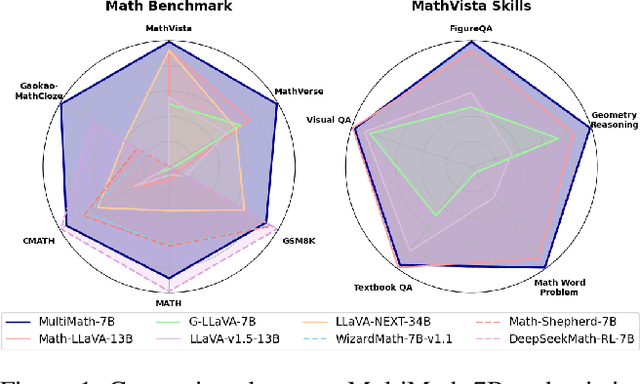
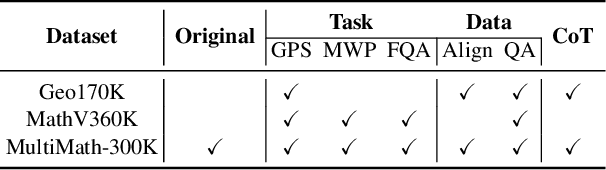
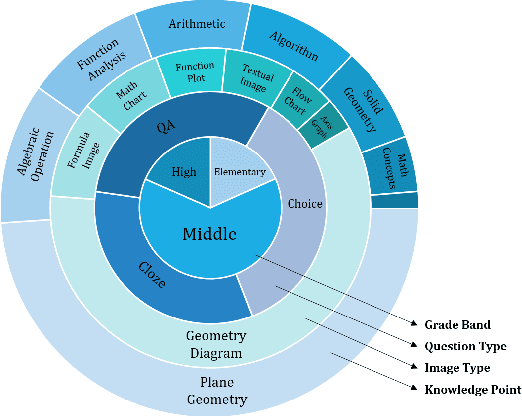
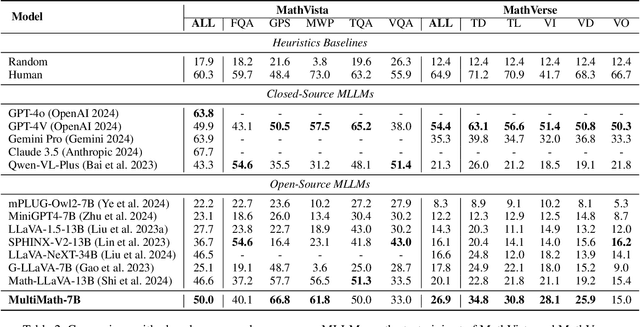
The rapid development of large language models (LLMs) has spurred extensive research into their domain-specific capabilities, particularly mathematical reasoning. However, most open-source LLMs focus solely on mathematical reasoning, neglecting the integration with visual injection, despite the fact that many mathematical tasks rely on visual inputs such as geometric diagrams, charts, and function plots. To fill this gap, we introduce \textbf{MultiMath-7B}, a multimodal large language model that bridges the gap between math and vision. \textbf{MultiMath-7B} is trained through a four-stage process, focusing on vision-language alignment, visual and math instruction-tuning, and process-supervised reinforcement learning. We also construct a novel, diverse and comprehensive multimodal mathematical dataset, \textbf{MultiMath-300K}, which spans K-12 levels with image captions and step-wise solutions. MultiMath-7B achieves state-of-the-art (SOTA) performance among open-source models on existing multimodal mathematical benchmarks and also excels on text-only mathematical benchmarks. Our model and dataset are available at {\textcolor{blue}{\url{https://github.com/pengshuai-rin/MultiMath}}}.
Vote&Mix: Plug-and-Play Token Reduction for Efficient Vision Transformer
Aug 30, 2024
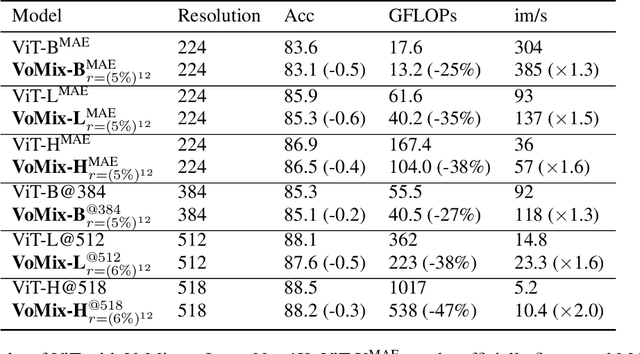
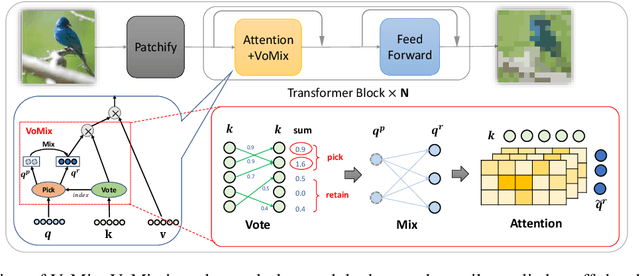
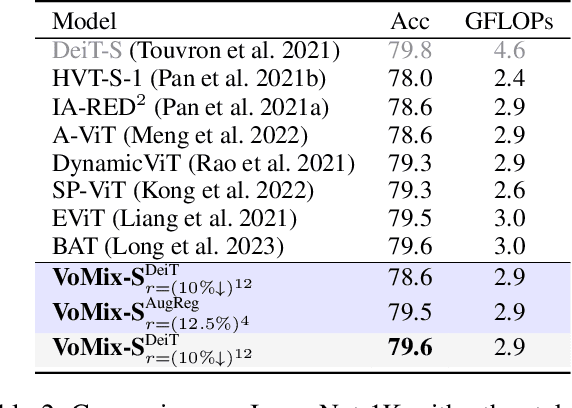
Despite the remarkable success of Vision Transformers (ViTs) in various visual tasks, they are often hindered by substantial computational cost. In this work, we introduce Vote\&Mix (\textbf{VoMix}), a plug-and-play and parameter-free token reduction method, which can be readily applied to off-the-shelf ViT models \textit{without any training}. VoMix tackles the computational redundancy of ViTs by identifying tokens with high homogeneity through a layer-wise token similarity voting mechanism. Subsequently, the selected tokens are mixed into the retained set, thereby preserving visual information. Experiments demonstrate VoMix significantly improves the speed-accuracy tradeoff of ViTs on both images and videos. Without any training, VoMix achieves a 2$\times$ increase in throughput of existing ViT-H on ImageNet-1K and a 2.4$\times$ increase in throughput of existing ViT-L on Kinetics-400 video dataset, with a mere 0.3\% drop in top-1 accuracy.
Shot Segmentation Based on Von Neumann Entropy for Key Frame Extraction
Aug 29, 2024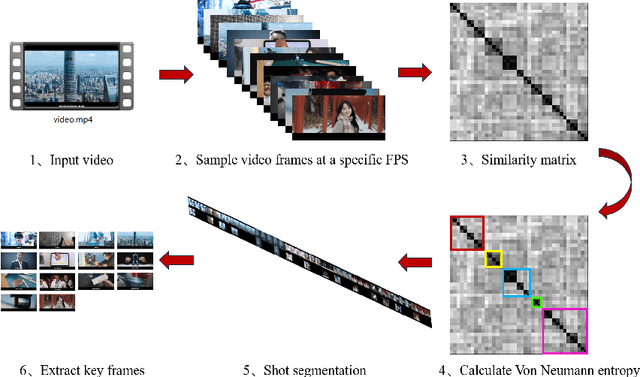
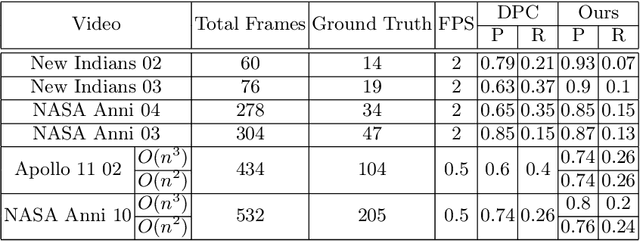

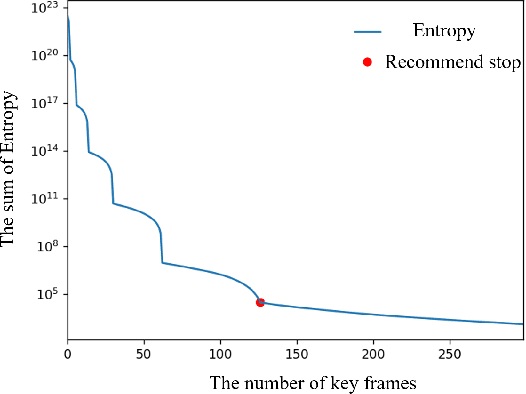
Video key frame extraction is important in various fields, such as video summary, retrieval, and compression. Therefore, we suggest a video key frame extraction algorithm based on shot segmentation using Von Neumann entropy. The segmentation of shots is achieved through the computation of Von Neumann entropy of the similarity matrix among frames within the video sequence. The initial frame of each shot is selected as key frames, which combines the temporal sequence information of frames. The experimental results show the extracted key frames can fully and accurately represent the original video content while minimizing the number of repeated frames.
Decoupled Prompt-Adapter Tuning for Continual Activity Recognition
Jul 20, 2024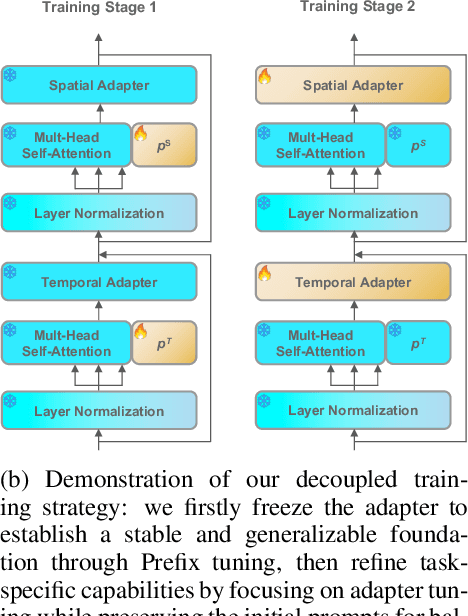
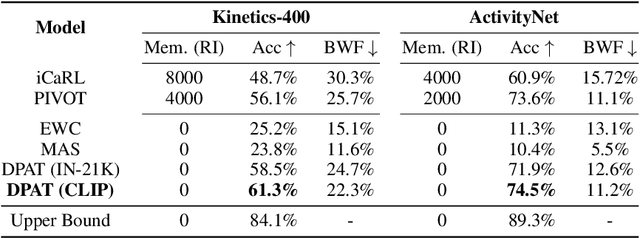
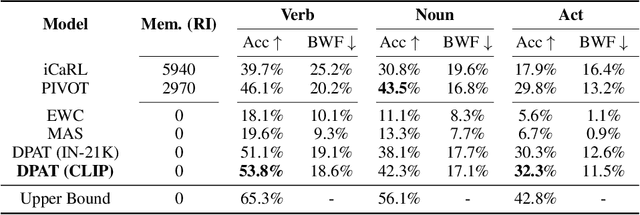
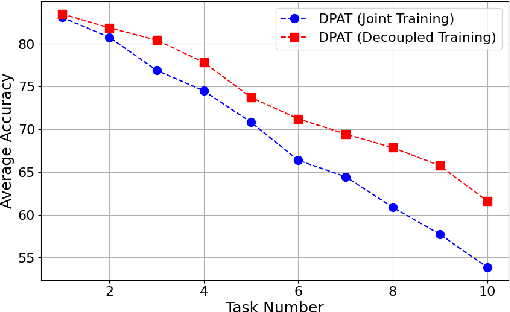
Action recognition technology plays a vital role in enhancing security through surveillance systems, enabling better patient monitoring in healthcare, providing in-depth performance analysis in sports, and facilitating seamless human-AI collaboration in domains such as manufacturing and assistive technologies. The dynamic nature of data in these areas underscores the need for models that can continuously adapt to new video data without losing previously acquired knowledge, highlighting the critical role of advanced continual action recognition. To address these challenges, we propose Decoupled Prompt-Adapter Tuning (DPAT), a novel framework that integrates adapters for capturing spatial-temporal information and learnable prompts for mitigating catastrophic forgetting through a decoupled training strategy. DPAT uniquely balances the generalization benefits of prompt tuning with the plasticity provided by adapters in pretrained vision models, effectively addressing the challenge of maintaining model performance amidst continuous data evolution without necessitating extensive finetuning. DPAT consistently achieves state-of-the-art performance across several challenging action recognition benchmarks, thus demonstrating the effectiveness of our model in the domain of continual action recognition.
Unified Dynamic Scanpath Predictors Outperform Individually Trained Neural Models
May 07, 2024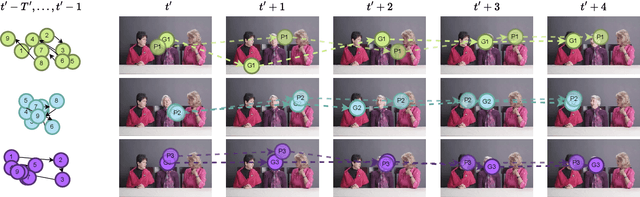
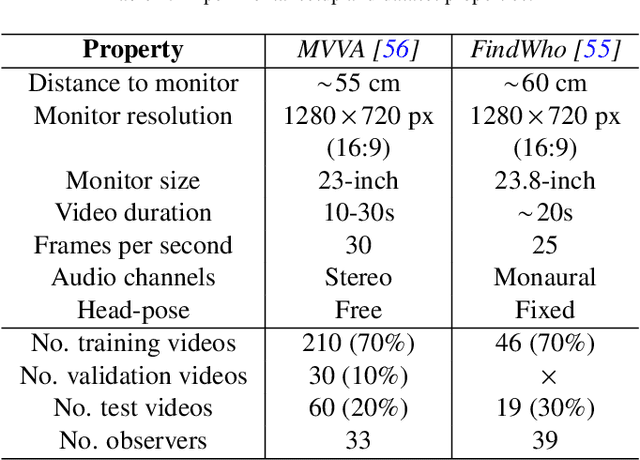
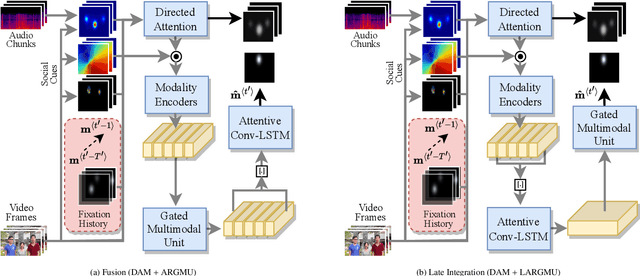
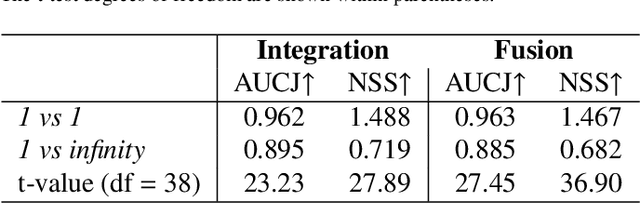
Previous research on scanpath prediction has mainly focused on group models, disregarding the fact that the scanpaths and attentional behaviors of individuals are diverse. The disregard of these differences is especially detrimental to social human-robot interaction, whereby robots commonly emulate human gaze based on heuristics or predefined patterns. However, human gaze patterns are heterogeneous and varying behaviors can significantly affect the outcomes of such human-robot interactions. To fill this gap, we developed a deep learning-based social cue integration model for saliency prediction to instead predict scanpaths in videos. Our model learned scanpaths by recursively integrating fixation history and social cues through a gating mechanism and sequential attention. We evaluated our approach on gaze datasets of dynamic social scenes, observed under the free-viewing condition. The introduction of fixation history into our models makes it possible to train a single unified model rather than the resource-intensive approach of training individual models for each set of scanpaths. We observed that the late neural integration approach surpasses early fusion when training models on a large dataset, in comparison to a smaller dataset with a similar distribution. Results also indicate that a single unified model, trained on all the observers' scanpaths, performs on par or better than individually trained models. We hypothesize that this outcome is a result of the group saliency representations instilling universal attention in the model, while the supervisory signal and fixation history guide it to learn personalized attentional behaviors, providing the unified model a benefit over individual models due to its implicit representation of universal attention.