 Add to Chrome
 Add to Firefox
 Add to Edge
HumanCLAW: Can Vision-Language Models Act Through a Body?
Jul 29, 2026
Evaluating whether a vision-language model (VLM) can act through a physical body is challenging. The outcome of an action couples the VLM's decision with motor control. When a task fails, it is hard to tell whether the VLM made a bad choice or the motor controller simply failed to execute it, e.g., losing balance and falling. In this work, we introduce HumanCLAW, an evaluation framework that decouples action decision-making from low-level execution. At every step, a harnessed, off-the-shelf VLM issues an atomic skill command, and the command is translated into a sub-second chunk of continuous full-body motion with real physical consequences, including gravity and collisions. The body can therefore act freely in the physical world, while execution-side disturbances, balance and motor errors, are factored out. What remains measurable is the model's action intelligence: its moment-to-moment choice of what the body should execute next. Based on this framework, we build HumanCLAW-Bench: 1,218 long-horizon, egocentric find-navigate-interact episodes across 41 indoor scenes. We test nine state-of-the-art VLMs and find that none solves the benchmark; the best model reaches only a 16.8% success rate. Recognizing the target is not the bottleneck. What current VLMs lack is embodied self-awareness: they lose track of their own body, failing to tell where it is, whether it has reached the goal, or whether it has hit an obstacle.

Apple-$π$: Benchmarking Thinking with Video Towards Law-Grounded Physical Intelligence
Jul 17, 2026Modern video generation models are increasingly hailed as emerging world models with an internalized grasp of physical law. Yet existing benchmarks largely evaluate physical plausibility only at the output level, without verifying whether the model arrives there through a faithful, law-grounded reasoning process. We introduce Apple-PI, the first benchmark that anchors video-model evaluation explicitly in physical laws. Apple-PI comprises three components. 1) Orchard: a dataset of 400 videos covering ten canonical tasks in classical mechanics. It separates single-law tasks for confounder-free diagnosis from multi-law tasks for probing generalization. 2) Benchmark Protocol: a three-stage protocol based on scientific reasoning, including Perception, Formulation, and Deduction. It uses chain-of-frames prompting on infographic-annotated first frames, treating the generated video as the model's visible reasoning trace. 3) Evaluation Suite: a hybrid evaluation suite that combines MLLM-based subjective scoring with physics-law-grounded objective measures. This enables stage-resolved diagnosis of not only whether a model fails, but where it fails. Benchmarking 11 models shows that current video models remain far from reliable law-grounded world simulators, with the best video model scoring only 0.473. Our stage-, pillar-, and source-resolved analyses further expose a Perception-to-Formulation-to-Deduction bottleneck, weak multi-law state transfer, and a persistent Sim-to-Real gap. These findings position Apple-PI as a diagnostic foundation for guiding future video models toward world models with law-grounded physical intelligence.
FileGram: Grounding Agent Personalization in File-System Behavioral Traces
Apr 06, 2026Coworking AI agents operating within local file systems are rapidly emerging as a paradigm in human-AI interaction; however, effective personalization remains limited by severe data constraints, as strict privacy barriers and the difficulty of jointly collecting multimodal real-world traces prevent scalable training and evaluation, and existing methods remain interaction-centric while overlooking dense behavioral traces in file-system operations; to address this gap, we propose FileGram, a comprehensive framework that grounds agent memory and personalization in file-system behavioral traces, comprising three core components: (1) FileGramEngine, a scalable persona-driven data engine that simulates realistic workflows and generates fine-grained multimodal action sequences at scale; (2) FileGramBench, a diagnostic benchmark grounded in file-system behavioral traces for evaluating memory systems on profile reconstruction, trace disentanglement, persona drift detection, and multimodal grounding; and (3) FileGramOS, a bottom-up memory architecture that builds user profiles directly from atomic actions and content deltas rather than dialogue summaries, encoding these traces into procedural, semantic, and episodic channels with query-time abstraction; extensive experiments show that FileGramBench remains challenging for state-of-the-art memory systems and that FileGramEngine and FileGramOS are effective, and by open-sourcing the framework, we hope to support future research on personalized memory-centric file-system agents.
HippoCamp: Benchmarking Contextual Agents on Personal Computers
Apr 01, 2026We present HippoCamp, a new benchmark designed to evaluate agents' capabilities on multimodal file management. Unlike existing agent benchmarks that focus on tasks like web interaction, tool use, or software automation in generic settings, HippoCamp evaluates agents in user-centric environments to model individual user profiles and search massive personal files for context-aware reasoning. Our benchmark instantiates device-scale file systems over real-world profiles spanning diverse modalities, comprising 42.4 GB of data across over 2K real-world files. Building upon the raw files, we construct 581 QA pairs to assess agents' capabilities in search, evidence perception, and multi-step reasoning. To facilitate fine-grained analysis, we provide 46.1K densely annotated structured trajectories for step-wise failure diagnosis. We evaluate a wide range of state-of-the-art multimodal large language models (MLLMs) and agentic methods on HippoCamp. Our comprehensive experiments reveal a significant performance gap: even the most advanced commercial models achieve only 48.3% accuracy in user profiling, struggling particularly with long-horizon retrieval and cross-modal reasoning within dense personal file systems. Furthermore, our step-wise failure diagnosis identifies multimodal perception and evidence grounding as the primary bottlenecks. Ultimately, HippoCamp exposes the critical limitations of current agents in realistic, user-centric environments and provides a robust foundation for developing next-generation personal AI assistants.
Video-MMMU: Evaluating Knowledge Acquisition from Multi-Discipline Professional Videos
Jan 23, 2025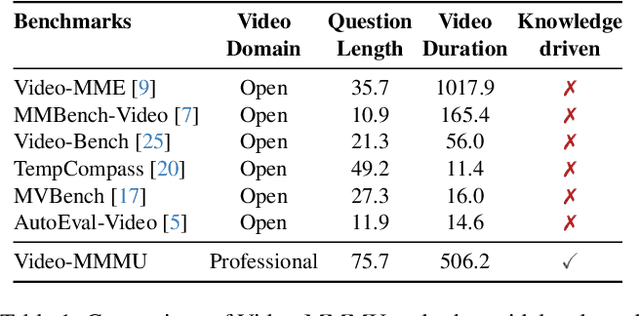
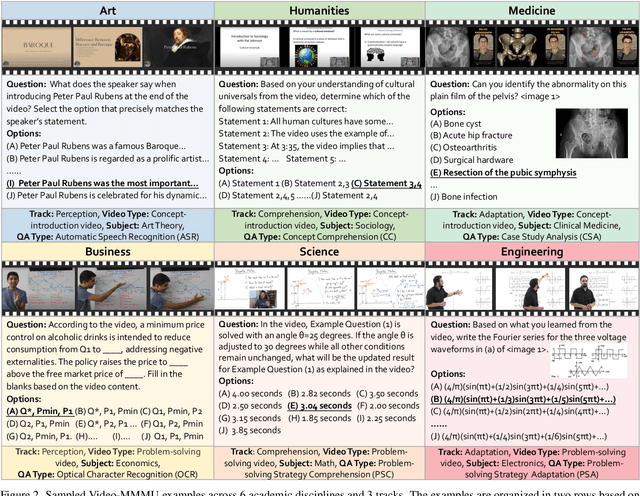
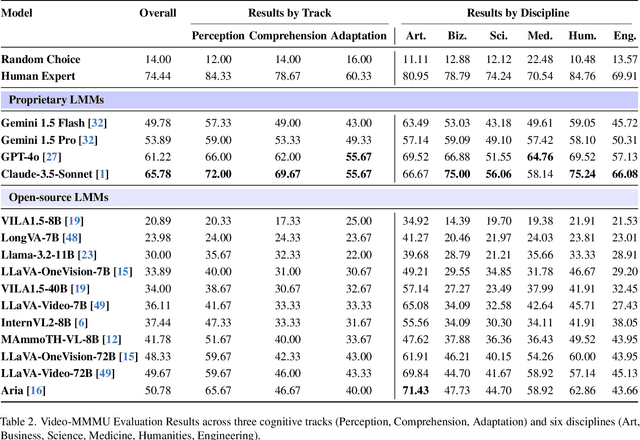

Humans acquire knowledge through three cognitive stages: perceiving information, comprehending knowledge, and adapting knowledge to solve novel problems. Videos serve as an effective medium for this learning process, facilitating a progression through these cognitive stages. However, existing video benchmarks fail to systematically evaluate the knowledge acquisition capabilities in Large Multimodal Models (LMMs). To address this gap, we introduce Video-MMMU, a multi-modal, multi-disciplinary benchmark designed to assess LMMs' ability to acquire and utilize knowledge from videos. Video-MMMU features a curated collection of 300 expert-level videos and 900 human-annotated questions across six disciplines, evaluating knowledge acquisition through stage-aligned question-answer pairs: Perception, Comprehension, and Adaptation. A proposed knowledge gain metric, {\Delta}knowledge, quantifies improvement in performance after video viewing. Evaluation of LMMs reveals a steep decline in performance as cognitive demands increase and highlights a significant gap between human and model knowledge acquisition, underscoring the need for methods to enhance LMMs' capability to learn and adapt from videos.
LMMs-Eval: Reality Check on the Evaluation of Large Multimodal Models
Jul 17, 2024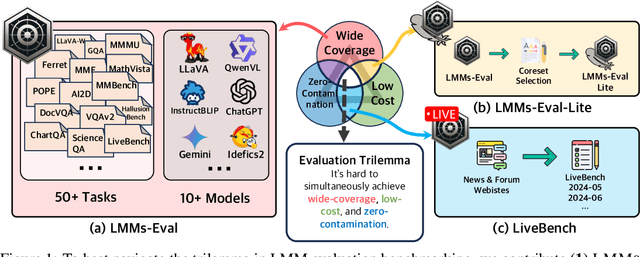
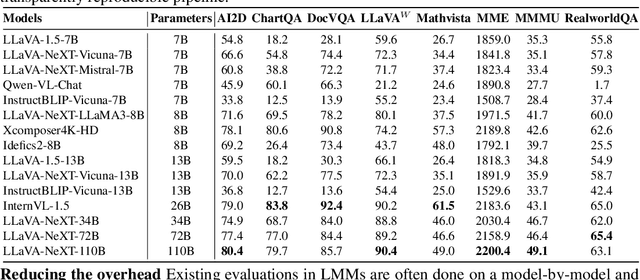
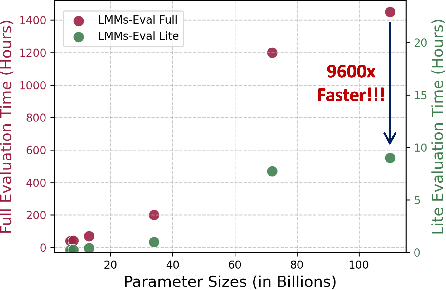
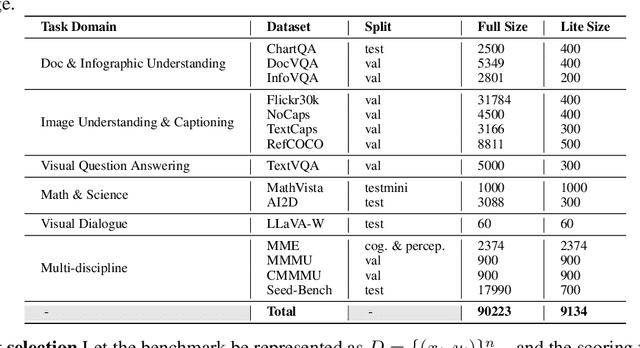
The advances of large foundation models necessitate wide-coverage, low-cost, and zero-contamination benchmarks. Despite continuous exploration of language model evaluations, comprehensive studies on the evaluation of Large Multi-modal Models (LMMs) remain limited. In this work, we introduce LMMS-EVAL, a unified and standardized multimodal benchmark framework with over 50 tasks and more than 10 models to promote transparent and reproducible evaluations. Although LMMS-EVAL offers comprehensive coverage, we find it still falls short in achieving low cost and zero contamination. To approach this evaluation trilemma, we further introduce LMMS-EVAL LITE, a pruned evaluation toolkit that emphasizes both coverage and efficiency. Additionally, we present Multimodal LIVEBENCH that utilizes continuously updating news and online forums to assess models' generalization abilities in the wild, featuring a low-cost and zero-contamination evaluation approach. In summary, our work highlights the importance of considering the evaluation trilemma and provides practical solutions to navigate the trade-offs in evaluating large multi-modal models, paving the way for more effective and reliable benchmarking of LMMs. We opensource our codebase and maintain leaderboard of LIVEBENCH at https://github.com/EvolvingLMMs-Lab/lmms-eval and https://huggingface.co/spaces/lmms-lab/LiveBench.
Ladder-of-Thought: Using Knowledge as Steps to Elevate Stance Detection
Sep 07, 2023Stance detection aims to identify the attitude expressed in a document towards a given target. Techniques such as Chain-of-Thought (CoT) prompting have advanced this task, enhancing a model's reasoning capabilities through the derivation of intermediate rationales. However, CoT relies primarily on a model's pre-trained internal knowledge during reasoning, thereby neglecting the valuable external information that is previously unknown to the model. This omission, especially within the unsupervised reasoning process, can affect the model's overall performance. Moreover, while CoT enhances Large Language Models (LLMs), smaller LMs, though efficient operationally, face challenges in delivering nuanced reasoning. In response to these identified gaps, we introduce the Ladder-of-Thought (LoT) for the stance detection task. Constructed through a dual-phase Progressive Optimization Framework, LoT directs the small LMs to assimilate high-quality external knowledge, refining the intermediate rationales produced. These bolstered rationales subsequently serve as the foundation for more precise predictions - akin to how a ladder facilitates reaching elevated goals. LoT achieves a balance between efficiency and performance. Our empirical evaluations underscore LoT's efficacy, marking a 16% improvement over GPT-3.5 and a 10% enhancement compared to GPT-3.5 with CoT on stance detection task.