 Add to Chrome
 Add to Firefox
 Add to Edge
Real-Time LiDAR Point Cloud Compression and Transmission for Resource-constrained Robots
Feb 10, 2025


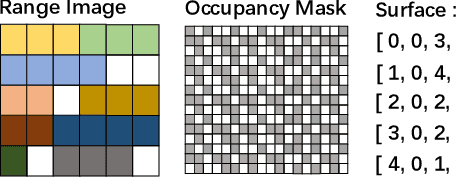

LiDARs are widely used in autonomous robots due to their ability to provide accurate environment structural information. However, the large size of point clouds poses challenges in terms of data storage and transmission. In this paper, we propose a novel point cloud compression and transmission framework for resource-constrained robotic applications, called RCPCC. We iteratively fit the surface of point clouds with a similar range value and eliminate redundancy through their spatial relationships. Then, we use Shape-adaptive DCT (SA-DCT) to transform the unfit points and reduce the data volume by quantizing the transformed coefficients. We design an adaptive bitrate control strategy based on QoE as the optimization goal to control the quality of the transmitted point cloud. Experiments show that our framework achieves compression rates of 40$\times$ to 80$\times$ while maintaining high accuracy for downstream applications. our method significantly outperforms other baselines in terms of accuracy when the compression rate exceeds 70$\times$. Furthermore, in situations of reduced communication bandwidth, our adaptive bitrate control strategy demonstrates significant QoE improvements. The code will be available at https://github.com/HITSZ-NRSL/RCPCC.git.

Examining False Positives under Inference Scaling for Mathematical Reasoning
Feb 10, 2025Recent advancements in language models have led to significant improvements in mathematical reasoning across various benchmarks. However, most of these benchmarks rely on automatic evaluation methods that only compare final answers using heuristics, without verifying the underlying reasoning steps. This limitation results in false positive solutions, where models may produce correct final answers but with flawed deduction paths. In this paper, we systematically examine the prevalence of false positive solutions in mathematical problem solving for language models. We analyze the characteristics and extent of this issue across different open-source models, datasets of varying difficulty levels, and decoding strategies. Specifically, we explore how false positives influence the inference time scaling behavior of language models. Our experimental results reveal that: (1) false positive solutions persist across different models, datasets, and decoding methods, (2) sampling-based inference time scaling methods do not alleviate the problem, and (3) the pass@N evaluation metric is more susceptible to false positives, suggesting a significantly lower scaling ceiling than what automatic evaluations indicate. Additionally, we analyze specific instances of false positives and discuss potential limitations in self-improvement techniques and synthetic data generation under such conditions.
Towards Trustworthy Retrieval Augmented Generation for Large Language Models: A Survey
Feb 08, 2025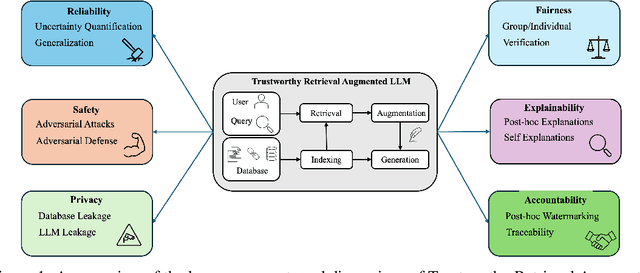
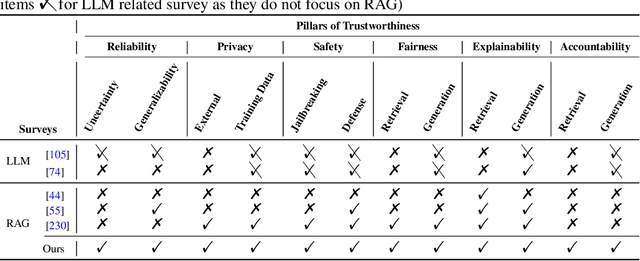
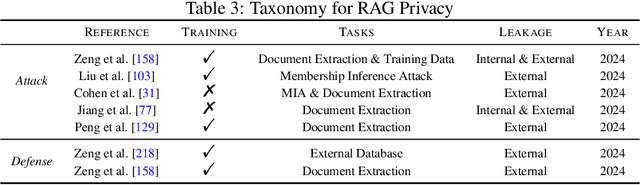
Retrieval-Augmented Generation (RAG) is an advanced technique designed to address the challenges of Artificial Intelligence-Generated Content (AIGC). By integrating context retrieval into content generation, RAG provides reliable and up-to-date external knowledge, reduces hallucinations, and ensures relevant context across a wide range of tasks. However, despite RAG's success and potential, recent studies have shown that the RAG paradigm also introduces new risks, including robustness issues, privacy concerns, adversarial attacks, and accountability issues. Addressing these risks is critical for future applications of RAG systems, as they directly impact their trustworthiness. Although various methods have been developed to improve the trustworthiness of RAG methods, there is a lack of a unified perspective and framework for research in this topic. Thus, in this paper, we aim to address this gap by providing a comprehensive roadmap for developing trustworthy RAG systems. We place our discussion around five key perspectives: reliability, privacy, safety, fairness, explainability, and accountability. For each perspective, we present a general framework and taxonomy, offering a structured approach to understanding the current challenges, evaluating existing solutions, and identifying promising future research directions. To encourage broader adoption and innovation, we also highlight the downstream applications where trustworthy RAG systems have a significant impact.
Learning Strategic Language Agents in the Werewolf Game with Iterative Latent Space Policy Optimization
Feb 07, 2025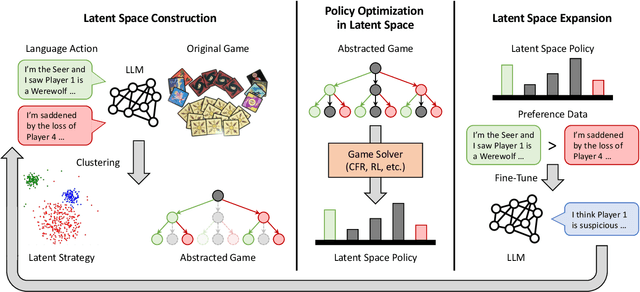
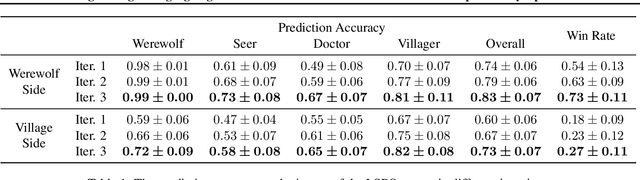
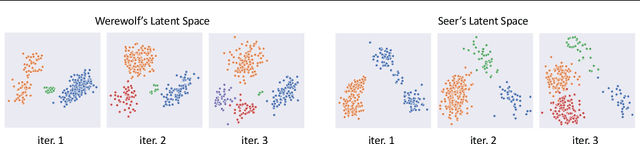

Large language model (LLM)-based agents have recently shown impressive progress in a variety of domains, including open-ended conversation and multi-step decision-making. However, applying these agents to social deduction games such as Werewolf, which requires both strategic decision-making and free-form language interaction, remains non-trivial. Traditional methods based on Counterfactual Regret Minimization (CFR) or reinforcement learning (RL) typically depend on a predefined action space, making them unsuitable for language games with unconstrained text action space. Meanwhile, pure LLM-based agents often suffer from intrinsic biases and require prohibitively large datasets for fine-tuning. We propose Latent Space Policy Optimization (LSPO), an iterative framework that addresses these challenges by first mapping free-form text to a discrete latent space, where methods like CFR and RL can learn strategic policy more effectively. We then translate the learned policy back into natural language dialogues, which are used to fine-tune an LLM via Direct Preference Optimization (DPO). By iteratively alternating between these stages, our LSPO agent progressively enhances both strategic reasoning and language communication. Experiment results on the Werewolf game show that our method improves the agent's performance in each iteration and outperforms existing Werewolf agents, underscoring its promise for free-form language decision-making.
Intent Representation Learning with Large Language Model for Recommendation
Feb 05, 2025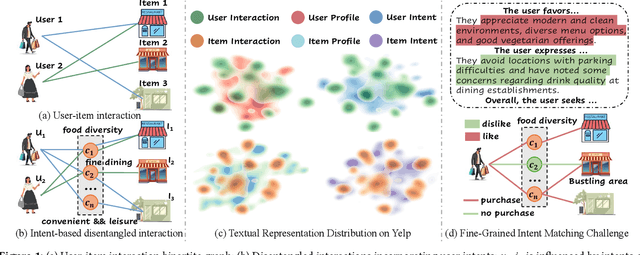

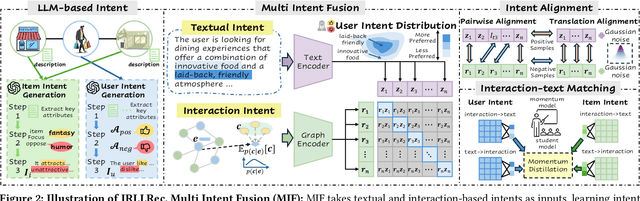

Intent-based recommender systems have garnered significant attention for uncovering latent fine-grained preferences. Intents, as underlying factors of interactions, are crucial for improving recommendation interpretability. Most methods define intents as learnable parameters updated alongside interactions. However, existing frameworks often overlook textual information (e.g., user reviews, item descriptions), which is crucial for alleviating the sparsity of interaction intents. Exploring these multimodal intents, especially the inherent differences in representation spaces, poses two key challenges: i) How to align multimodal intents and effectively mitigate noise issues; ii) How to extract and match latent key intents across modalities. To tackle these challenges, we propose a model-agnostic framework, Intent Representation Learning with Large Language Model (IRLLRec), which leverages large language models (LLMs) to construct multimodal intents and enhance recommendations. Specifically, IRLLRec employs a dual-tower architecture to learn multimodal intent representations. Next, we propose pairwise and translation alignment to eliminate inter-modal differences and enhance robustness against noisy input features. Finally, to better match textual and interaction-based intents, we employ momentum distillation to perform teacher-student learning on fused intent representations. Empirical evaluations on three datasets show that our IRLLRec framework outperforms baselines. The implementation is available at https://github.com/wangyu0627/IRLLRec.
VolleyBots: A Testbed for Multi-Drone Volleyball Game Combining Motion Control and Strategic Play
Feb 04, 2025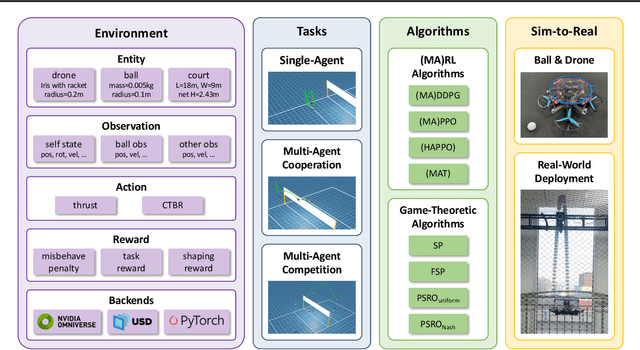
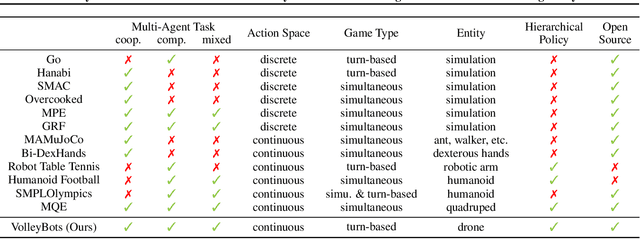
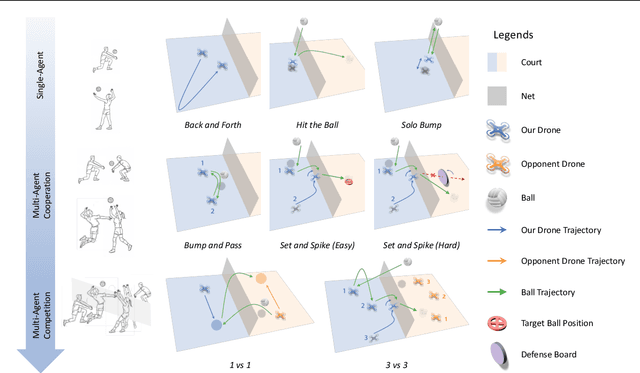

Multi-agent reinforcement learning (MARL) has made significant progress, largely fueled by the development of specialized testbeds that enable systematic evaluation of algorithms in controlled yet challenging scenarios. However, existing testbeds often focus on purely virtual simulations or limited robot morphologies such as robotic arms, quadrupeds, and humanoids, leaving high-mobility platforms with real-world physical constraints like drones underexplored. To bridge this gap, we present VolleyBots, a new MARL testbed where multiple drones cooperate and compete in the sport of volleyball under physical dynamics. VolleyBots features a turn-based interaction model under volleyball rules, a hierarchical decision-making process that combines motion control and strategic play, and a high-fidelity simulation for seamless sim-to-real transfer. We provide a comprehensive suite of tasks ranging from single-drone drills to multi-drone cooperative and competitive tasks, accompanied by baseline evaluations of representative MARL and game-theoretic algorithms. Results in simulation show that while existing algorithms handle simple tasks effectively, they encounter difficulty in complex tasks that require both low-level control and high-level strategy. We further demonstrate zero-shot deployment of a simulation-learned policy to real-world drones, highlighting VolleyBots' potential to propel MARL research involving agile robotic platforms. The project page is at https://sites.google.com/view/volleybots/home.
Reflections on "Can AI Understand Our Universe?"
Jan 29, 2025This article briefly discusses the philosophical and technical aspects of AI. It focuses on two concepts of understanding: intuition and causality, and highlights three AI technologies: Transformers, chain-of-thought reasoning, and multimodal processing. We anticipate that in principle AI could form understanding, with these technologies representing promising advancements.
360Brew: A Decoder-only Foundation Model for Personalized Ranking and Recommendation
Jan 27, 2025
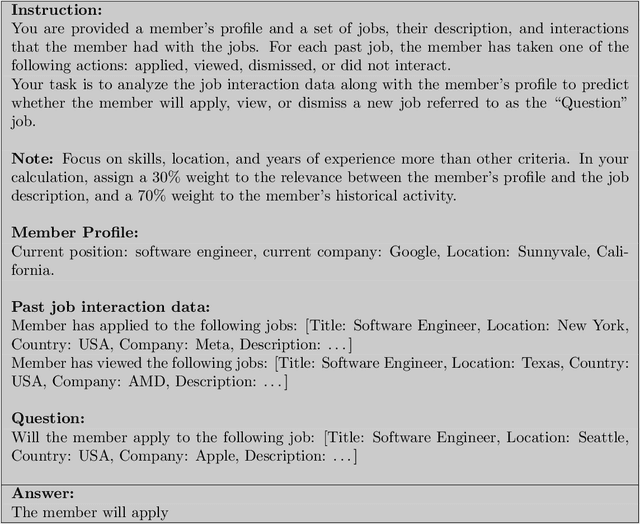


Ranking and recommendation systems are the foundation for numerous online experiences, ranging from search results to personalized content delivery. These systems have evolved into complex, multilayered architectures that leverage vast datasets and often incorporate thousands of predictive models. The maintenance and enhancement of these models is a labor intensive process that requires extensive feature engineering. This approach not only exacerbates technical debt but also hampers innovation in extending these systems to emerging problem domains. In this report, we present our research to address these challenges by utilizing a large foundation model with a textual interface for ranking and recommendation tasks. We illustrate several key advantages of our approach: (1) a single model can manage multiple predictive tasks involved in ranking and recommendation, (2) decoder models with textual interface due to their comprehension of reasoning capabilities, can generalize to new recommendation surfaces and out-of-domain problems, and (3) by employing natural language interfaces for task definitions and verbalizing member behaviors and their social connections, we eliminate the need for feature engineering and the maintenance of complex directed acyclic graphs of model dependencies. We introduce our research pre-production model, 360Brew V1.0, a 150B parameter, decoder-only model that has been trained and fine-tuned on LinkedIn's data and tasks. This model is capable of solving over 30 predictive tasks across various segments of the LinkedIn platform, achieving performance levels comparable to or exceeding those of current production systems based on offline metrics, without task-specific fine-tuning. Notably, each of these tasks is conventionally addressed by dedicated models that have been developed and maintained over multiple years by teams of a similar or larger size than our own.
WanJuanSiLu: A High-Quality Open-Source Webtext Dataset for Low-Resource Languages
Jan 24, 2025


This paper introduces the open-source dataset WanJuanSiLu, designed to provide high-quality training corpora for low-resource languages, thereby advancing the research and development of multilingual models. To achieve this, we have developed a systematic data processing framework tailored for low-resource languages. This framework encompasses key stages such as data extraction, corpus cleaning, content deduplication, security filtering, quality evaluation, and theme classification. Through the implementation of this framework, we have significantly improved both the quality and security of the dataset, while maintaining its linguistic diversity. As of now, data for all five languages have been fully open-sourced. The dataset can be accessed at https://opendatalab.com/applyMultilingualCorpus, and GitHub repository is available at https://github.com/opendatalab/WanJuan3.0
MedS$^3$: Towards Medical Small Language Models with Self-Evolved Slow Thinking
Jan 21, 2025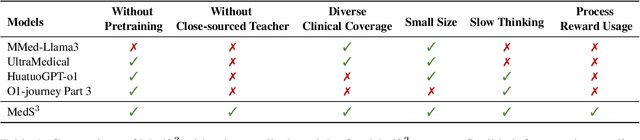

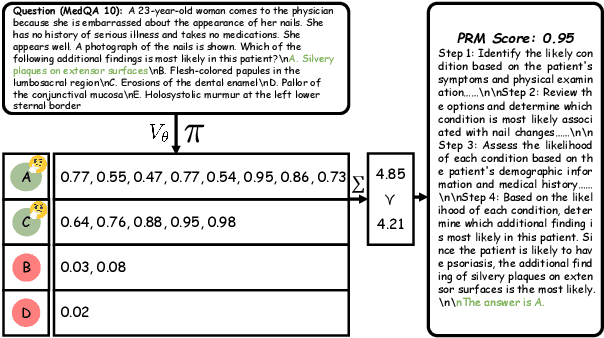
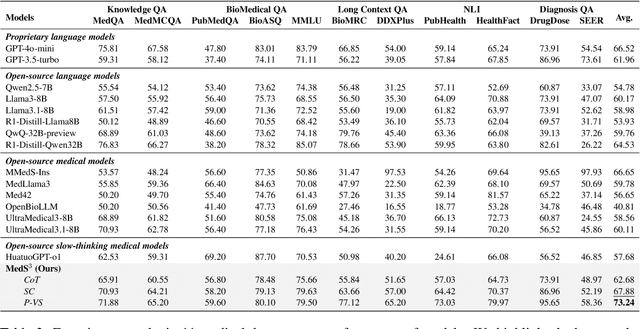
Medical language models (MLMs) have become pivotal in advancing medical natural language processing. However, prior models that rely on pre-training or supervised fine-tuning often exhibit low data efficiency and limited practicality in real-world clinical applications. While OpenAIs O1 highlights test-time scaling in mathematics, attempts to replicate this approach in medicine typically distill responses from GPT-series models to open-source models, focusing primarily on multiple-choice tasks. This strategy, though straightforward, neglects critical concerns like data privacy and realistic deployment in clinical settings. In this work, we present a deployable, small-scale medical language model, \mone, designed for long-chain reasoning in clinical tasks using a self-evolution paradigm. Starting with a seed dataset of around 8,000 instances spanning five domains and 16 datasets, we prompt a base policy model to perform Monte Carlo Tree Search (MCTS) to construct verifiable reasoning chains. Each reasoning step is assigned an evolution rollout value, allowing verified trajectories to train the policy model and the reward model. During inference, the policy model generates multiple responses, and the reward model selects the one with the highest reward score. Experiments on eleven evaluation datasets demonstrate that \mone outperforms prior open-source models by 2 points, with the addition of the reward model further boosting performance ($\sim$13 points), surpassing GPT-4o-mini. Code and data are available at \url{https://github.com/pixas/MedSSS}.