 Add to Chrome
 Add to Firefox
 Add to Edge
Verifiable Process Rewards for Agentic Reasoning
May 11, 2026
Reinforcement learning from verifiable rewards (RLVR) has improved the reasoning abilities of large language models (LLMs), but most existing approaches rely on sparse outcome-level feedback. This sparsity creates a credit assignment challenge in long-horizon agentic reasoning: a trajectory may fail despite containing many correct intermediate decisions, or succeed despite containing flawed ones. In this work, we study a class of densely-verifiable agentic reasoning problems, where intermediate actions can be objectively checked by symbolic or algorithmic oracles. We propose Verifiable Process Rewards (VPR), a framework that converts such oracles into dense turn-level supervision for reinforcement learning, and instantiate it in three representative settings: search-based verification for dynamic deduction, constraint-based verification for logical reasoning, and posterior-based verification for probabilistic inference. We further provide a theoretical analysis showing that dense verifier-grounded rewards can improve long-horizon credit assignment by providing more localized learning signals, with the benefit depending on the reliability of the verifier. Empirically, VPR outperforms outcome-level reward and rollout-based process reward baselines across controlled environments, and more importantly, transfers to both general and agentic reasoning benchmarks, suggesting that verifiable process supervision can foster general reasoning skills applicable beyond the training environments. Our results indicate that VPR is a promising approach for enhancing LLM agents whenever reliable intermediate verification is available, while also highlighting its dependence on oracle quality and the open challenge of extending VPR to less structured, open-ended environments.

VolleyBots: A Testbed for Multi-Drone Volleyball Game Combining Motion Control and Strategic Play
Feb 04, 2025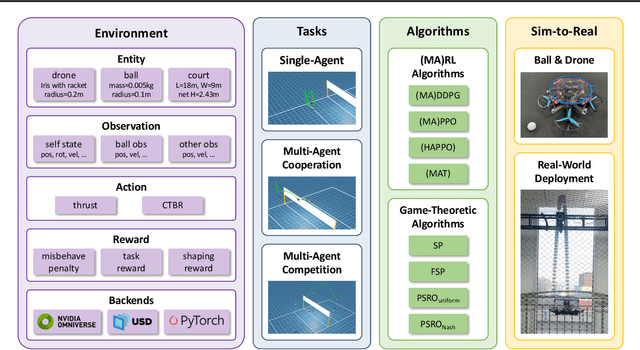
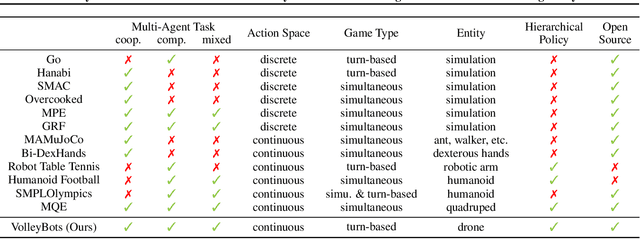
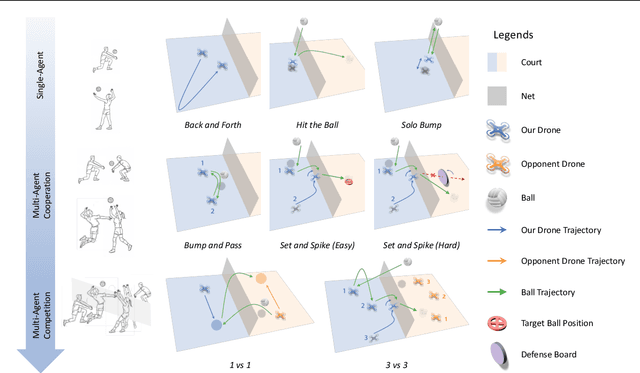

Multi-agent reinforcement learning (MARL) has made significant progress, largely fueled by the development of specialized testbeds that enable systematic evaluation of algorithms in controlled yet challenging scenarios. However, existing testbeds often focus on purely virtual simulations or limited robot morphologies such as robotic arms, quadrupeds, and humanoids, leaving high-mobility platforms with real-world physical constraints like drones underexplored. To bridge this gap, we present VolleyBots, a new MARL testbed where multiple drones cooperate and compete in the sport of volleyball under physical dynamics. VolleyBots features a turn-based interaction model under volleyball rules, a hierarchical decision-making process that combines motion control and strategic play, and a high-fidelity simulation for seamless sim-to-real transfer. We provide a comprehensive suite of tasks ranging from single-drone drills to multi-drone cooperative and competitive tasks, accompanied by baseline evaluations of representative MARL and game-theoretic algorithms. Results in simulation show that while existing algorithms handle simple tasks effectively, they encounter difficulty in complex tasks that require both low-level control and high-level strategy. We further demonstrate zero-shot deployment of a simulation-learned policy to real-world drones, highlighting VolleyBots' potential to propel MARL research involving agile robotic platforms. The project page is at https://sites.google.com/view/volleybots/home.