 Add to Chrome
 Add to Firefox
 Add to Edge
SAIN: Structure-Aware Interactive Navigation with Active Dialogue Grounding for Mobile Robot
Aug 10, 2026
Most existing vision-language navigation tasks assume that instructions are complete and unambiguous. However, real-world robots often encounter natural human instructions that are ambiguous, underspecified, or incomplete, requiring them to resolve such uncertainties through active questioning. Interactive Instance Goal Navigation (IIGN) requires an embodied agent to find the specific instance under an ambiguous category-level instruction through active dialogue. However, existing dialogue-enabled methods often consume oracle answers as transient textual context for immediate decisions, rather than persistent spatial or object-centric structured state. We present SAIN, a zero-shot framework that turns active dialogue into persistent navigation state. Instead of consuming oracle answers as one-step text hints, SAIN compiles them into target evidence, route-level corridor memory, and object-candidate labels. These states are stored in structured value, room, graph, and object memories, then consumed by a unified policy for frontier ranking and final target approach. On the VL-LN IIGN benchmark, SAIN improves SR from 20.2 to 25.4 and SPL from 13.07 to 14.17 over the strongest reported dialogue-enabled baseline, while requiring no task-specific policy training. The results support dialogue-to-state conversion as an effective zero-shot mechanism for long-horizon interactive instance navigation. Project website: https://zorattc.github.io/SAIN/

Real-Time LiDAR Point Cloud Compression and Transmission for Resource-constrained Robots
Feb 10, 2025

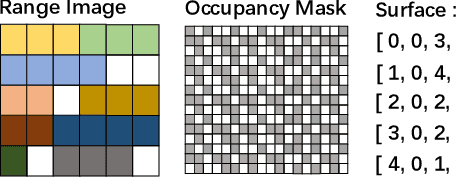

LiDARs are widely used in autonomous robots due to their ability to provide accurate environment structural information. However, the large size of point clouds poses challenges in terms of data storage and transmission. In this paper, we propose a novel point cloud compression and transmission framework for resource-constrained robotic applications, called RCPCC. We iteratively fit the surface of point clouds with a similar range value and eliminate redundancy through their spatial relationships. Then, we use Shape-adaptive DCT (SA-DCT) to transform the unfit points and reduce the data volume by quantizing the transformed coefficients. We design an adaptive bitrate control strategy based on QoE as the optimization goal to control the quality of the transmitted point cloud. Experiments show that our framework achieves compression rates of 40$\times$ to 80$\times$ while maintaining high accuracy for downstream applications. our method significantly outperforms other baselines in terms of accuracy when the compression rate exceeds 70$\times$. Furthermore, in situations of reduced communication bandwidth, our adaptive bitrate control strategy demonstrates significant QoE improvements. The code will be available at https://github.com/HITSZ-NRSL/RCPCC.git.