 Add to Chrome
 Add to Firefox
 Add to Edge
Transferable and Forecastable User Targeting Foundation Model
Dec 17, 2024
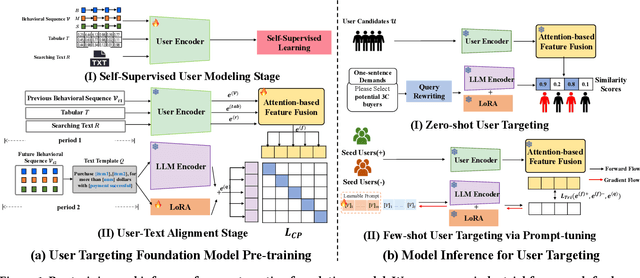
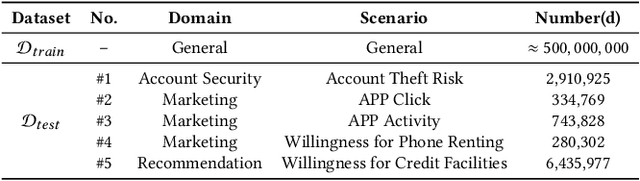
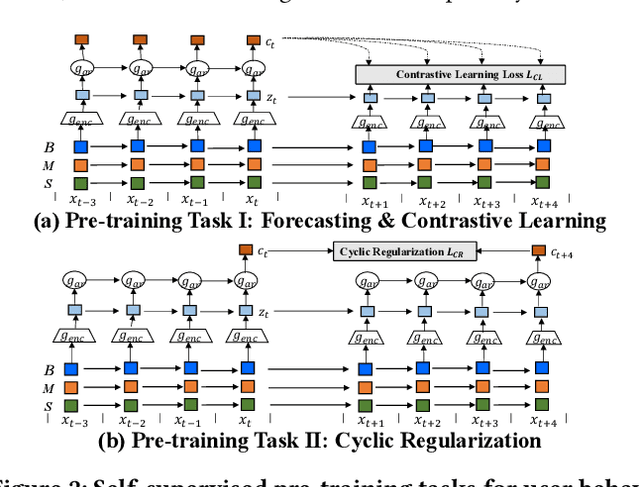

User targeting, the process of selecting targeted users from a pool of candidates for non-expert marketers, has garnered substantial attention with the advancements in digital marketing. However, existing user targeting methods encounter two significant challenges: (i) Poor cross-domain and cross-scenario transferability and generalization, and (ii) Insufficient forecastability in real-world applications. These limitations hinder their applicability across diverse industrial scenarios. In this work, we propose FIND, an industrial-grade, transferable, and forecastable user targeting foundation model. To enhance cross-domain transferability, our framework integrates heterogeneous multi-scenario user data, aligning them with one-sentence targeting demand inputs through contrastive pre-training. For improved forecastability, the text description of each user is derived based on anticipated future behaviors, while user representations are constructed from historical information. Experimental results demonstrate that our approach significantly outperforms existing baselines in cross-domain, real-world user targeting scenarios, showcasing the superior capabilities of FIND. Moreover, our method has been successfully deployed on the Alipay platform and is widely utilized across various scenarios.

A Consolidated Volatility Prediction with Back Propagation Neural Network and Genetic Algorithm
Dec 10, 2024

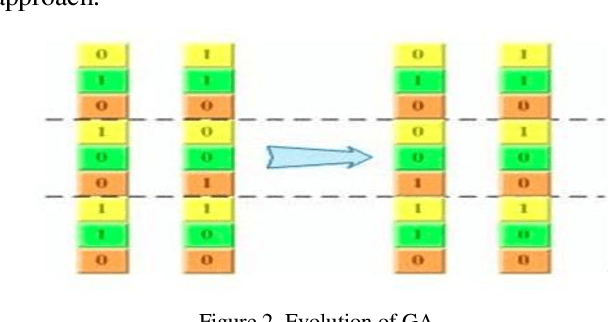

This paper provides a unique approach with AI algorithms to predict emerging stock markets volatility. Traditionally, stock volatility is derived from historical volatility,Monte Carlo simulation and implied volatility as well. In this paper, the writer designs a consolidated model with back-propagation neural network and genetic algorithm to predict future volatility of emerging stock markets and found that the results are quite accurate with low errors.
Research on Optimizing Real-Time Data Processing in High-Frequency Trading Algorithms using Machine Learning
Dec 02, 2024High-frequency trading (HFT) represents a pivotal and intensely competitive domain within the financial markets. The velocity and accuracy of data processing exert a direct influence on profitability, underscoring the significance of this field. The objective of this work is to optimise the real-time processing of data in high-frequency trading algorithms. The dynamic feature selection mechanism is responsible for monitoring and analysing market data in real time through clustering and feature weight analysis, with the objective of automatically selecting the most relevant features. This process employs an adaptive feature extraction method, which enables the system to respond and adjust its feature set in a timely manner when the data input changes, thus ensuring the efficient utilisation of data. The lightweight neural networks are designed in a modular fashion, comprising fast convolutional layers and pruning techniques that facilitate the expeditious completion of data processing and output prediction. In contrast to conventional deep learning models, the neural network architecture has been specifically designed to minimise the number of parameters and computational complexity, thereby markedly reducing the inference time. The experimental results demonstrate that the model is capable of maintaining consistent performance in the context of varying market conditions, thereby illustrating its advantages in terms of processing speed and revenue enhancement.
LLaMA-MoE v2: Exploring Sparsity of LLaMA from Perspective of Mixture-of-Experts with Post-Training
Nov 24, 2024Recently, inspired by the concept of sparsity, Mixture-of-Experts (MoE) models have gained increasing popularity for scaling model size while keeping the number of activated parameters constant. In this study, we thoroughly investigate the sparsity of the dense LLaMA model by constructing MoE for both the attention (i.e., Attention MoE) and MLP (i.e., MLP MoE) modules in the transformer blocks. Specifically, we investigate different expert construction methods and granularities under the same activation conditions to analyze the impact of sparsifying the model. Additionally, to comprehensively evaluate the model's capabilities across various domains (e.g., conversation, code, math) after sparsification, we apply sparsity to the instructed large language models (LLMs) and construct instructed MoE models. To counteract the performance degradation resulting from increased sparsity, we design a two-stage post-training strategy to enhance model performance. Experiments on the LLaMA3 model demonstrate the potential effectiveness of this approach for future developments of instructed MoE models. The source codes and models are available at: \url{https://github.com/OpenSparseLLMs/LLaMA-MoE-v2}.
MoE-I$^2$: Compressing Mixture of Experts Models through Inter-Expert Pruning and Intra-Expert Low-Rank Decomposition
Nov 01, 2024

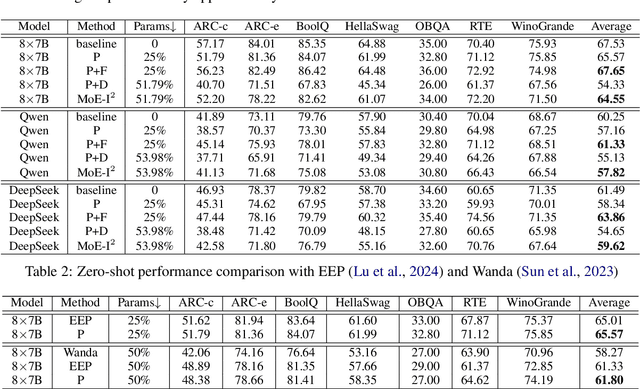

The emergence of Mixture of Experts (MoE) LLMs has significantly advanced the development of language models. Compared to traditional LLMs, MoE LLMs outperform traditional LLMs by achieving higher performance with considerably fewer activated parameters. Despite this efficiency, their enormous parameter size still leads to high deployment costs. In this paper, we introduce a two-stage compression method tailored for MoE to reduce the model size and decrease the computational cost. First, in the inter-expert pruning stage, we analyze the importance of each layer and propose the Layer-wise Genetic Search and Block-wise KT-Reception Field with the non-uniform pruning ratio to prune the individual expert. Second, in the intra-expert decomposition stage, we apply the low-rank decomposition to further compress the parameters within the remaining experts. Extensive experiments on Qwen1.5-MoE-A2.7B, DeepSeek-V2-Lite, and Mixtral-8$\times$7B demonstrate that our proposed methods can both reduce the model size and enhance inference efficiency while maintaining performance in various zero-shot tasks. The code will be available at \url{https://github.com/xiaochengsky/MoEI-2.git}
Continuous Speech Tokenizer in Text To Speech
Oct 22, 2024The fusion of speech and language in the era of large language models has garnered significant attention. Discrete speech token is often utilized in text-to-speech tasks for speech compression and portability, which is convenient for joint training with text and have good compression efficiency. However, we found that the discrete speech tokenizer still suffers from information loss. Therefore, we propose a simple yet effective continuous speech tokenizer and a text-to-speech model based on continuous speech tokens. Our results show that the speech language model based on the continuous speech tokenizer has better continuity and higher estimated Mean Opinion Scores (MoS). This enhancement is attributed to better information preservation rate of the continuous speech tokenizer across both low and high frequencies in the frequency domain.
RoRA-VLM: Robust Retrieval-Augmented Vision Language Models
Oct 11, 2024


Current vision-language models (VLMs) still exhibit inferior performance on knowledge-intensive tasks, primarily due to the challenge of accurately encoding all the associations between visual objects and scenes to their corresponding entities and background knowledge. While retrieval augmentation methods offer an efficient way to integrate external knowledge, extending them to vision-language domain presents unique challenges in (1) precisely retrieving relevant information from external sources due to the inherent discrepancy within the multimodal queries, and (2) being resilient to the irrelevant, extraneous and noisy information contained in the retrieved multimodal knowledge snippets. In this work, we introduce RORA-VLM, a novel and robust retrieval augmentation framework specifically tailored for VLMs, with two key innovations: (1) a 2-stage retrieval process with image-anchored textual-query expansion to synergistically combine the visual and textual information in the query and retrieve the most relevant multimodal knowledge snippets; and (2) a robust retrieval augmentation method that strengthens the resilience of VLMs against irrelevant information in the retrieved multimodal knowledge by injecting adversarial noises into the retrieval-augmented training process, and filters out extraneous visual information, such as unrelated entities presented in images, via a query-oriented visual token refinement strategy. We conduct extensive experiments to validate the effectiveness and robustness of our proposed methods on three widely adopted benchmark datasets. Our results demonstrate that with a minimal amount of training instance, RORA-VLM enables the base model to achieve significant performance improvement and constantly outperform state-of-the-art retrieval-augmented VLMs on all benchmarks while also exhibiting a novel zero-shot domain transfer capability.
What makes your model a low-empathy or warmth person: Exploring the Origins of Personality in LLMs
Oct 07, 2024


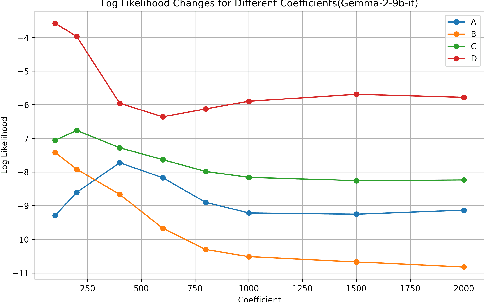
Large language models (LLMs) have demonstrated remarkable capabilities in generating human-like text and exhibiting personality traits similar to those in humans. However, the mechanisms by which LLMs encode and express traits such as agreeableness and impulsiveness remain poorly understood. Drawing on the theory of social determinism, we investigate how long-term background factors, such as family environment and cultural norms, interact with short-term pressures like external instructions, shaping and influencing LLMs' personality traits. By steering the output of LLMs through the utilization of interpretable features within the model, we explore how these background and pressure factors lead to changes in the model's traits without the need for further fine-tuning. Additionally, we suggest the potential impact of these factors on model safety from the perspective of personality.
Towards World Simulator: Crafting Physical Commonsense-Based Benchmark for Video Generation
Oct 07, 2024Text-to-video (T2V) models like Sora have made significant strides in visualizing complex prompts, which is increasingly viewed as a promising path towards constructing the universal world simulator. Cognitive psychologists believe that the foundation for achieving this goal is the ability to understand intuitive physics. However, the capacity of these models to accurately represent intuitive physics remains largely unexplored. To bridge this gap, we introduce PhyGenBench, a comprehensive \textbf{Phy}sics \textbf{Gen}eration \textbf{Ben}chmark designed to evaluate physical commonsense correctness in T2V generation. PhyGenBench comprises 160 carefully crafted prompts across 27 distinct physical laws, spanning four fundamental domains, which could comprehensively assesses models' understanding of physical commonsense. Alongside PhyGenBench, we propose a novel evaluation framework called PhyGenEval. This framework employs a hierarchical evaluation structure utilizing appropriate advanced vision-language models and large language models to assess physical commonsense. Through PhyGenBench and PhyGenEval, we can conduct large-scale automated assessments of T2V models' understanding of physical commonsense, which align closely with human feedback. Our evaluation results and in-depth analysis demonstrate that current models struggle to generate videos that comply with physical commonsense. Moreover, simply scaling up models or employing prompt engineering techniques is insufficient to fully address the challenges presented by PhyGenBench (e.g., dynamic scenarios). We hope this study will inspire the community to prioritize the learning of physical commonsense in these models beyond entertainment applications. We will release the data and codes at https://github.com/OpenGVLab/PhyGenBench
Grounded-VideoLLM: Sharpening Fine-grained Temporal Grounding in Video Large Language Models
Oct 04, 2024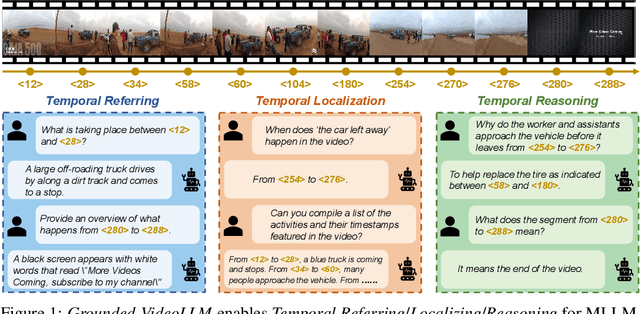
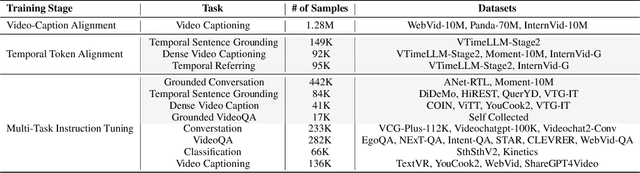
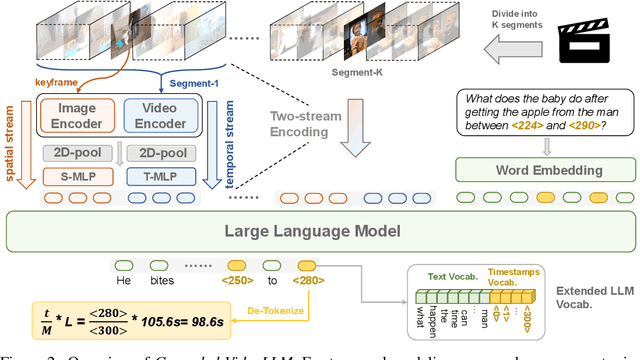

Video Large Language Models (Video-LLMs) have demonstrated remarkable capabilities in coarse-grained video understanding, however, they struggle with fine-grained temporal grounding. In this paper, we introduce Grounded-VideoLLM, a novel Video-LLM adept at perceiving and reasoning over specific video moments in a fine-grained manner. We identify that current Video-LLMs have limitations for fine-grained video understanding since they lack effective temporal modeling and timestamp representation. In light of this, we sharpen our model by incorporating (1) an additional temporal stream to encode the relationships between frames and (2) discrete temporal tokens enriched with specific time knowledge to represent timestamps. To optimize the training of Grounded-VideoLLM, we employ a multi-stage training scheme, beginning with simple video-captioning tasks and progressively introducing video temporal grounding tasks of increasing complexity. To further enhance Grounded-VideoLLM's temporal reasoning capability, we also curate a grounded VideoQA dataset by an automatic annotation pipeline. Extensive experiments demonstrate that Grounded-VideoLLM not only excels in fine-grained grounding tasks such as temporal sentence grounding, dense video captioning, and grounded VideoQA, but also shows great potential as a versatile video assistant for general video understanding.