 Add to Chrome
 Add to Firefox
 Add to Edge
Query as Anchor: Scenario-Adaptive User Representation via Large Language Model
Feb 17, 2026
Industrial-scale user representation learning requires balancing robust universality with acute task-sensitivity. However, existing paradigms primarily yield static, task-agnostic embeddings that struggle to reconcile the divergent requirements of downstream scenarios within unified vector spaces. Furthermore, heterogeneous multi-source data introduces inherent noise and modality conflicts, degrading representation. We propose Query-as-Anchor, a framework shifting user modeling from static encoding to dynamic, query-aware synthesis. To empower Large Language Models (LLMs) with deep user understanding, we first construct UserU, an industrial-scale pre-training dataset that aligns multi-modal behavioral sequences with user understanding semantics, and our Q-Anchor Embedding architecture integrates hierarchical coarse-to-fine encoders into dual-tower LLMs via joint contrastive-autoregressive optimization for query-aware user representation. To bridge the gap between general pre-training and specialized business logic, we further introduce Cluster-based Soft Prompt Tuning to enforce discriminative latent structures, effectively aligning model attention with scenario-specific modalities. For deployment, anchoring queries at sequence termini enables KV-cache-accelerated inference with negligible incremental latency. Evaluations on 10 Alipay industrial benchmarks show consistent SOTA performance, strong scalability, and efficient deployment. Large-scale online A/B testing in Alipay's production system across two real-world scenarios further validates its practical effectiveness. Our code is prepared for public release and will be available at: https://github.com/JhCircle/Q-Anchor.

How Do Decoder-Only LLMs Perceive Users? Rethinking Attention Masking for User Representation Learning
Feb 11, 2026Decoder-only large language models are increasingly used as behavioral encoders for user representation learning, yet the impact of attention masking on the quality of user embeddings remains underexplored. In this work, we conduct a systematic study of causal, hybrid, and bidirectional attention masks within a unified contrastive learning framework trained on large-scale real-world Alipay data that integrates long-horizon heterogeneous user behaviors. To improve training dynamics when transitioning from causal to bidirectional attention, we propose Gradient-Guided Soft Masking, a gradient-based pre-warmup applied before a linear scheduler that gradually opens future attention during optimization. Evaluated on 9 industrial user cognition benchmarks covering prediction, preference, and marketing sensitivity tasks, our approach consistently yields more stable training and higher-quality bidirectional representations compared with causal, hybrid, and scheduler-only baselines, while remaining compatible with decoder pretraining. Overall, our findings highlight the importance of masking design and training transition in adapting decoder-only LLMs for effective user representation learning. Our code is available at https://github.com/JhCircle/Deepfind-GGSM.
Transferable and Forecastable User Targeting Foundation Model
Dec 17, 2024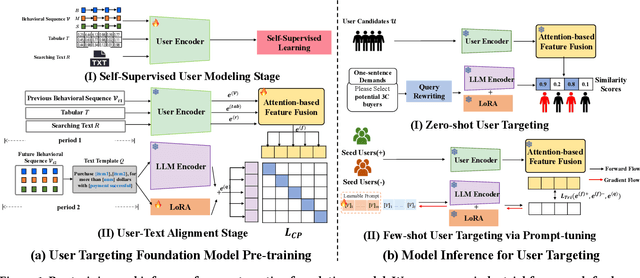
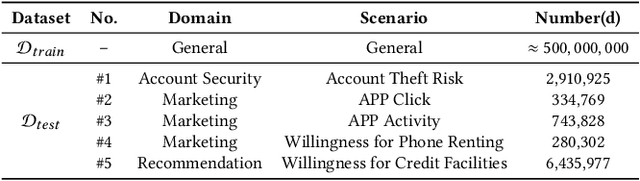
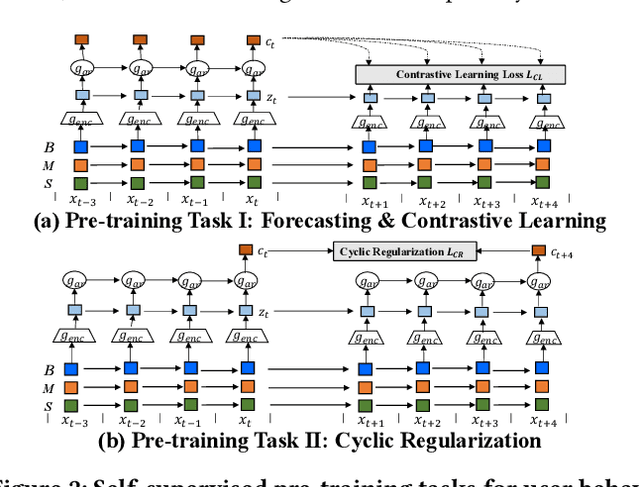

User targeting, the process of selecting targeted users from a pool of candidates for non-expert marketers, has garnered substantial attention with the advancements in digital marketing. However, existing user targeting methods encounter two significant challenges: (i) Poor cross-domain and cross-scenario transferability and generalization, and (ii) Insufficient forecastability in real-world applications. These limitations hinder their applicability across diverse industrial scenarios. In this work, we propose FIND, an industrial-grade, transferable, and forecastable user targeting foundation model. To enhance cross-domain transferability, our framework integrates heterogeneous multi-scenario user data, aligning them with one-sentence targeting demand inputs through contrastive pre-training. For improved forecastability, the text description of each user is derived based on anticipated future behaviors, while user representations are constructed from historical information. Experimental results demonstrate that our approach significantly outperforms existing baselines in cross-domain, real-world user targeting scenarios, showcasing the superior capabilities of FIND. Moreover, our method has been successfully deployed on the Alipay platform and is widely utilized across various scenarios.