 Add to Chrome
 Add to Firefox
 Add to Edge
A Role-Based LLM Framework for Structured Information Extraction from Healthy Food Policies
Apr 02, 2026
Current Large Language Model (LLM) approaches for information extraction (IE) in the healthy food policy domain are often hindered by various factors, including misinformation, specifically hallucinations, misclassifications, and omissions that result from the structural diversity and inconsistency of policy documents. To address these limitations, this study proposes a role-based LLM framework that automates the IE from unstructured policy data by assigning specialized roles: an LLM policy analyst for metadata and mechanism classification, an LLM legal strategy specialist for identifying complex legal approaches, and an LLM food system expert for categorizing food system stages. This framework mimics expert analysis workflows by incorporating structured domain knowledge, including explicit definitions of legal mechanisms and classification criteria, into role-specific prompts. We evaluate the framework using 608 healthy food policies from the Healthy Food Policy Project (HFPP) database, comparing its performance against zero-shot, few-shot, and chain-of-thought (CoT) baselines using Llama-3.3-70B. Our proposed framework demonstrates superior performance in complex reasoning tasks, offering a reliable and transparent methodology for automating IE from health policies.

Team, Then Trim: An Assembly-Line LLM Framework for High-Quality Tabular Data Generation
Feb 04, 2026While tabular data is fundamental to many real-world machine learning (ML) applications, acquiring high-quality tabular data is usually labor-intensive and expensive. Limited by the scarcity of observations, tabular datasets often exhibit critical deficiencies, such as class imbalance, selection bias, and low fidelity. To address these challenges, building on recent advances in Large Language Models (LLMs), this paper introduces Team-then-Trim (T$^2$), a framework that synthesizes high-quality tabular data through a collaborative team of LLMs, followed by a rigorous three-stage plug-in data quality control (QC) pipeline. In T$^2$, tabular data generation is conceptualized as a manufacturing process: specialized LLMs, guided by domain knowledge, are tasked with generating different data components sequentially, and the resulting products, i.e., the synthetic data, are systematically evaluated across multiple dimensions of QC. Empirical results on both simulated and real-world datasets demonstrate that T$^2$ outperforms state-of-the-art methods in producing high-quality tabular data, highlighting its potential to support downstream models when direct data collection is practically infeasible.
What makes your model a low-empathy or warmth person: Exploring the Origins of Personality in LLMs
Oct 07, 2024


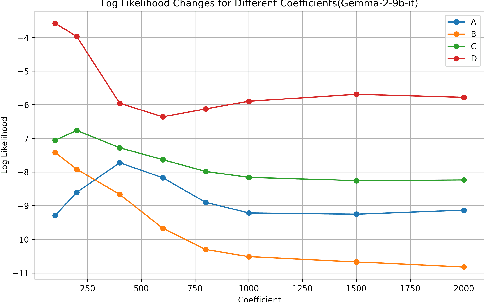
Large language models (LLMs) have demonstrated remarkable capabilities in generating human-like text and exhibiting personality traits similar to those in humans. However, the mechanisms by which LLMs encode and express traits such as agreeableness and impulsiveness remain poorly understood. Drawing on the theory of social determinism, we investigate how long-term background factors, such as family environment and cultural norms, interact with short-term pressures like external instructions, shaping and influencing LLMs' personality traits. By steering the output of LLMs through the utilization of interpretable features within the model, we explore how these background and pressure factors lead to changes in the model's traits without the need for further fine-tuning. Additionally, we suggest the potential impact of these factors on model safety from the perspective of personality.