 Add to Chrome
 Add to Firefox
 Add to Edge
ArborMem: Navigating Interaction States with Memory Forests
Aug 18, 2026
Large language models increasingly serve as persistent conversational assistants, requiring memory that preserves relevant experience and maintains continuity across interactions. Existing methods improve access to conversational history through long-context processing, selective retrieval, and structured memory organization. However, most systems treat memory access as retrieving relevant past information without first determining which prior interaction state the current turn resumes. This limitation becomes particularly important when conversations interleave multiple tasks, people, and plans that may be interrupted and later revisited. We introduce ArborMem, an online memory framework that represents a long-running conversation as a navigable forest of interaction states. Each branch preserves a locally coherent trajectory, while the forest maintains multiple trajectories that may later be resumed. For each new input, ArborMem localizes the relevant state, restores its branch-local context, and augments it with reusable evidence retrieved across branches, preserving interaction continuity without conflating semantically related but structurally distinct trajectories. Existing long-term memory benchmarks cover diverse memory and reasoning capabilities but do not explicitly isolate branch-structured challenges. We therefore introduce BranchMemEval, a controlled diagnostic benchmark for interleaved and resumable interaction trajectories. Experiments on LongMemEval, LoCoMo, BEAM 100K, and BranchMemEval show that ArborMem outperforms the strongest baselines by 3.36 to 10.31 percentage points on the three established benchmarks and by 5.0 points on BranchMemEval. Its advantage grows under constrained read budgets, while complete memory queries remain below half a second.

SignVLA: Real-Time Sign Language-Guided Robotic Manipulation via Attention LSTM and Vision-Language-Action Models
Jun 18, 2026Vision-Language-Action (VLA) models enable robots to execute manipulation tasks from natural-language instructions grounded in visual observations. However, existing VLA interfaces primarily rely on speech or text input, limiting accessibility for deaf, hard-of-hearing, and speech-impaired users. We present SignVLA, a real-time sign-language-guided VLA framework for accessible human-robot interaction. The system introduces a modular sign-to-text interface that converts visual sign gestures into semantic instructions compatible with downstream VLA policies. Given video streams, SignVLA extracts hand landmark features and employs an attention-enhanced Long Short-Term Memory (LSTM) network to capture temporal gesture dynamics for alphabet- and command-level sign recognition. A temporal stabilization module further improves prediction consistency in real-time interaction settings.The generated instruction sequence is then passed to a downstream VLA policy for sign-conditioned robotic manipulation. Experimental results demonstrate stable real-time sign recognition and successful execution of manipulation tasks driven by sign-language inputs. Our findings suggest that lightweight temporal sign recognition can serve as an effective and practical accessibility layer for multimodal embodied intelligence.
Elastic Queries Reinforcement Learning: Self-Aware Policy Execution for VLA Models
Jun 12, 2026Vision-language-action (VLA) models are powerful action generators for robot manipulation, but they are typically executed with fixed inference and replanning schedules. This rigidity ignores the uneven difficulty of robot control: contact-rich or uncertain states may need more computation and fresher feedback, while easier states can often be handled with fewer inference steps and longer open-loop execution. We propose Elastic Queries Reinforcement Learning (EQRL), a framework that makes each VLA policy query elastic. A lightweight latent-schedule adaptor jointly selects the latent input, denoising budget, and action chunk length, without fine-tuning the underlying VLA model. To make scheduling difficulty-aware, EQRL trains a critic over the joint latent-schedule action and derives a state difficulty signal from critic ensemble disagreement. This signal guides compute toward difficult states, while a learned residual allows task-driven correction. We formulate variable chunk execution as query-level macro-action RL with chunk-dependent discounting and an amortized number-of-function-evaluations (NFE) budget. Across simulation and real-robot manipulation, EQRL reduces amortized inference cost while preserving or improving task success.
Harness-Bench: Measuring Harness Effects across Models in Realistic Agent Workflows
May 27, 2026LLM agents are increasingly deployed as executable systems that use tools, modify workspaces, and produce concrete artifacts. In such workflows, performance depends not only on the base model, but also on the harness: the system layer that manages context, tools, state, constraints, permissions, tracing, and recovery. However, existing benchmarks typically abstract away execution, compare complete agent systems, or hold the harness fixed, making execution-layer variation difficult to study. We introduce Harness-Bench, a diagnostic benchmark for evaluating configuration-level harness effects in realistic agent workflows. Harness-Bench evaluates representative harness configurations across multiple model backends under shared task environments, budgets, and evaluation protocols, while preserving each harness's native execution behavior. The benchmark contains 106 sandboxed offline tasks constructed from practical agent-use patterns and manually reviewed for realism, solvability, oracle-checkability, and integrity. Each run records final artifacts, execution traces, usage statistics, and validator outputs, enabling analysis beyond final completion. Across 5,194 execution trajectories, we observe substantial variation in completion, process quality, efficiency, and failure behavior across model-harness pairings. These results suggest that agent capability should be reported at the model-harness configuration level rather than attributed to the base model alone. Our analysis further identifies recurring execution-alignment failures, where plausible reasoning becomes decoupled from tool feedback, workspace state, evidence, or verifiable output contracts. Harness-Bench provides a reproducible foundation for diagnosing and improving reliable, efficient, and auditable agent execution stacks.
Formal Skill: Programmable Runtime Skills for Efficient and Accurate LLM Agents
May 19, 2026Large Language Model (LLM) agents increasingly act inside real workspaces, where tools and skills determine whether model reasoning becomes reliable action. Existing skills remain largely informal: Markdown skills and instruction packs encode procedures as long natural-language documents, while function calling, Model Context Protocol (MCP) servers, and framework tools structure individual actions but usually leave workflow state, policy enforcement, and completion discipline outside the skill itself. We introduce Formal Skill, a runtime-native abstraction that represents reusable capability with JSON metadata and action schemas, reliable Python executors, hook-governed control logic, Formal Skill routing, and skill-local runtime state. By moving reusable procedure from repeated prompt text into executable state machines and hook policies, Formal Skill gives agents a token-efficient and enforceable control surface. We implement the abstraction in FairyClaw, an open-source event-driven runtime for executable, observable, and composable Formal Skills. On Harness-Bench, FairyClaw obtains highly competitive average scores while using substantially fewer tokens, with especially strong results on tasks that expose the role of Formal Skill.
SignVLA: A Gloss-Free Vision-Language-Action Framework for Real-Time Sign Language-Guided Robotic Manipulation
Feb 26, 2026We present, to our knowledge, the first sign language-driven Vision-Language-Action (VLA) framework for intuitive and inclusive human-robot interaction. Unlike conventional approaches that rely on gloss annotations as intermediate supervision, the proposed system adopts a gloss-free paradigm and directly maps visual sign gestures to semantic instructions. This design reduces annotation cost and avoids the information loss introduced by gloss representations, enabling more natural and scalable multimodal interaction. In this work, we focus on a real-time alphabet-level finger-spelling interface that provides a robust and low-latency communication channel for robotic control. Compared with large-scale continuous sign language recognition, alphabet-level interaction offers improved reliability, interpretability, and deployment feasibility in safety-critical embodied environments. The proposed pipeline transforms continuous gesture streams into coherent language commands through geometric normalization, temporal smoothing, and lexical refinement, ensuring stable and consistent interaction. Furthermore, the framework is designed to support future integration of transformer-based gloss-free sign language models, enabling scalable word-level and sentence-level semantic understanding. Experimental results demonstrate the effectiveness of the proposed system in grounding sign-derived instructions into precise robotic actions under diverse interaction scenarios. These results highlight the potential of the framework to advance accessible, scalable, and multimodal embodied intelligence.
Towards World Simulator: Crafting Physical Commonsense-Based Benchmark for Video Generation
Oct 07, 2024Text-to-video (T2V) models like Sora have made significant strides in visualizing complex prompts, which is increasingly viewed as a promising path towards constructing the universal world simulator. Cognitive psychologists believe that the foundation for achieving this goal is the ability to understand intuitive physics. However, the capacity of these models to accurately represent intuitive physics remains largely unexplored. To bridge this gap, we introduce PhyGenBench, a comprehensive \textbf{Phy}sics \textbf{Gen}eration \textbf{Ben}chmark designed to evaluate physical commonsense correctness in T2V generation. PhyGenBench comprises 160 carefully crafted prompts across 27 distinct physical laws, spanning four fundamental domains, which could comprehensively assesses models' understanding of physical commonsense. Alongside PhyGenBench, we propose a novel evaluation framework called PhyGenEval. This framework employs a hierarchical evaluation structure utilizing appropriate advanced vision-language models and large language models to assess physical commonsense. Through PhyGenBench and PhyGenEval, we can conduct large-scale automated assessments of T2V models' understanding of physical commonsense, which align closely with human feedback. Our evaluation results and in-depth analysis demonstrate that current models struggle to generate videos that comply with physical commonsense. Moreover, simply scaling up models or employing prompt engineering techniques is insufficient to fully address the challenges presented by PhyGenBench (e.g., dynamic scenarios). We hope this study will inspire the community to prioritize the learning of physical commonsense in these models beyond entertainment applications. We will release the data and codes at https://github.com/OpenGVLab/PhyGenBench
Flint Water Crisis: Data-Driven Risk Assessment Via Residential Water Testing
Sep 30, 2016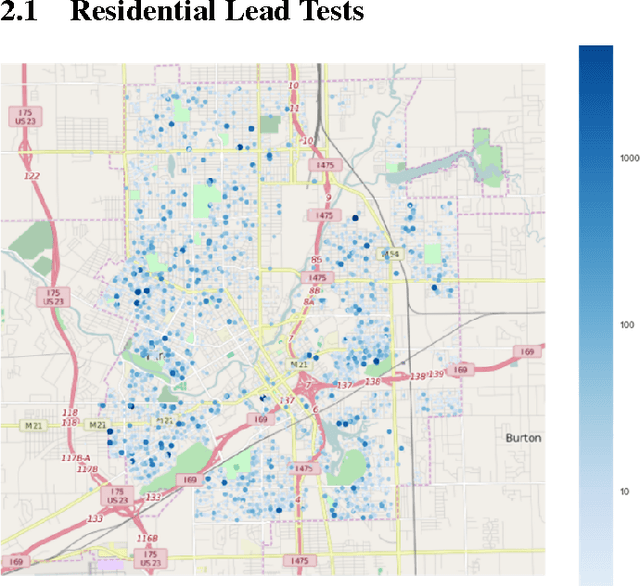
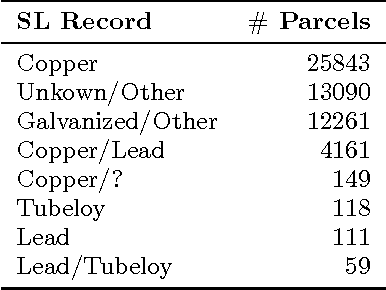
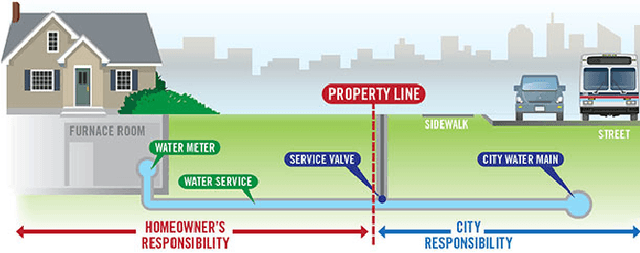
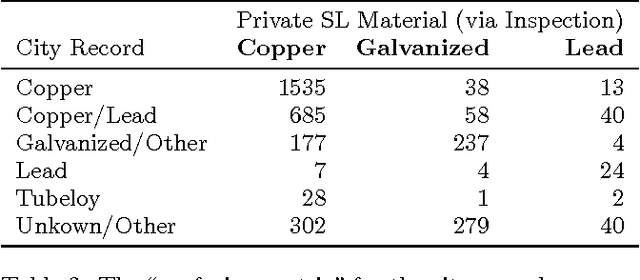
Recovery from the Flint Water Crisis has been hindered by uncertainty in both the water testing process and the causes of contamination. In this work, we develop an ensemble of predictive models to assess the risk of lead contamination in individual homes and neighborhoods. To train these models, we utilize a wide range of data sources, including voluntary residential water tests, historical records, and city infrastructure data. Additionally, we use our models to identify the most prominent factors that contribute to a high risk of lead contamination. In this analysis, we find that lead service lines are not the only factor that is predictive of the risk of lead contamination of water. These results could be used to guide the long-term recovery efforts in Flint, minimize the immediate damages, and improve resource-allocation decisions for similar water infrastructure crises.