 Add to Chrome
 Add to Firefox
 Add to Edge
GEM-Occ: From Visual Geometry Evidence to Embodied Semantic Occupancy Memory
Jul 06, 2026
Semantic occupancy provides a structured spatial memory for embodied indoor agents by jointly representing occupied regions, observed free space, unknown areas, and object semantics. However, existing indoor occupancy benchmarks and methods mainly focus on single-view prediction or room-level online perception, leaving long-horizon semantic mapping across connected indoor spaces underexplored. We introduce HIOcc, a hierarchical indoor occupancy benchmark that unifies ScanNet, ScanNet++, and Matterport3D under a common sparse semantic occupancy format while preserving their native observation geometries, including perspective RGB-D frames and pano-centric observation groups. HIOcc supports three complementary evaluation regimes: local semantic occupancy prediction, room-level online occupancy mapping, and building-level mapping across connected panoramic environments. We further propose GEM-Occ, a Gaussian Evidence Memory framework for semantic occupancy mapping. Rather than using pointmaps as persistent map states, GEM-Occ treats local visual geometry predictions as transient evidence, converts them into semantic Gaussian occupancy evidence and free-space ray evidence, and fuses them into a persistent hierarchical memory through visibility- and uncertainty-aware causal updates. The memory is organized into local caches, room-level submaps, and a building-level graph, and can be queried at any time through Gaussian-to-occupancy splatting. Experiments on HIOcc show that GEM-Occ improves local occupancy prediction, online map stability, free-space reasoning, revisit consistency, and building-level scalability over prior indoor occupancy and Gaussian-based mapping baselines.

Is Your Driving World Model an All-Around Player?
May 11, 2026Today's driving world models can generate remarkably realistic dash-cam videos, yet no single model excels universally. Some generate photorealistic textures but violate basic physics; others maintain geometric consistency but fail when subjected to closed-loop planning. This disconnect exposes a critical gap: the field evaluates how real generated worlds appear, but rarely whether they behave realistically. We introduce WorldLens, a unified benchmark that measures world-model fidelity across the full spectrum, from pixel quality and 4D geometry to closed-loop driving and human perceptual alignment, through five complementary aspects and 24 standardized dimensions. Our evaluation of six representative models reveals that no existing approach dominates across all axes: texture-rich models violate geometry, geometry-aware models lack behavioral fidelity, and even the strongest performers achieve only 2-3 out of 10 on human realism ratings. To bridge algorithmic metrics with human perception, we further contribute WorldLens-26K, a 26,808-entry human-annotated preference dataset pairing numerical scores with textual rationales, and WorldLens-Agent, a vision-language evaluator distilled from these judgments that enables scalable, explainable auto-assessment. Together, the benchmark, dataset, and agent form a unified ecosystem for assessing generated worlds not merely by visual appeal, but by physical and behavioral fidelity.
ReWorld: Multi-Dimensional Reward Modeling for Embodied World Models
Jan 18, 2026Recently, video-based world models that learn to simulate the dynamics have gained increasing attention in robot learning. However, current approaches primarily emphasize visual generative quality while overlooking physical fidelity, dynamic consistency, and task logic, especially for contact-rich manipulation tasks, which limits their applicability to downstream tasks. To this end, we introduce ReWorld, a framework aimed to employ reinforcement learning to align the video-based embodied world models with physical realism, task completion capability, embodiment plausibility and visual quality. Specifically, we first construct a large-scale (~235K) video preference dataset and employ it to train a hierarchical reward model designed to capture multi-dimensional reward consistent with human preferences. We further propose a practical alignment algorithm that post-trains flow-based world models using this reward through a computationally efficient PPO-style algorithm. Comprehensive experiments and theoretical analysis demonstrate that ReWorld significantly improves the physical fidelity, logical coherence, embodiment and visual quality of generated rollouts, outperforming previous methods.
WorldLens: Full-Spectrum Evaluations of Driving World Models in Real World
Dec 11, 2025Generative world models are reshaping embodied AI, enabling agents to synthesize realistic 4D driving environments that look convincing but often fail physically or behaviorally. Despite rapid progress, the field still lacks a unified way to assess whether generated worlds preserve geometry, obey physics, or support reliable control. We introduce WorldLens, a full-spectrum benchmark evaluating how well a model builds, understands, and behaves within its generated world. It spans five aspects -- Generation, Reconstruction, Action-Following, Downstream Task, and Human Preference -- jointly covering visual realism, geometric consistency, physical plausibility, and functional reliability. Across these dimensions, no existing world model excels universally: those with strong textures often violate physics, while geometry-stable ones lack behavioral fidelity. To align objective metrics with human judgment, we further construct WorldLens-26K, a large-scale dataset of human-annotated videos with numerical scores and textual rationales, and develop WorldLens-Agent, an evaluation model distilled from these annotations to enable scalable, explainable scoring. Together, the benchmark, dataset, and agent form a unified ecosystem for measuring world fidelity -- standardizing how future models are judged not only by how real they look, but by how real they behave.
Scaling Up Occupancy-centric Driving Scene Generation: Dataset and Method
Oct 27, 2025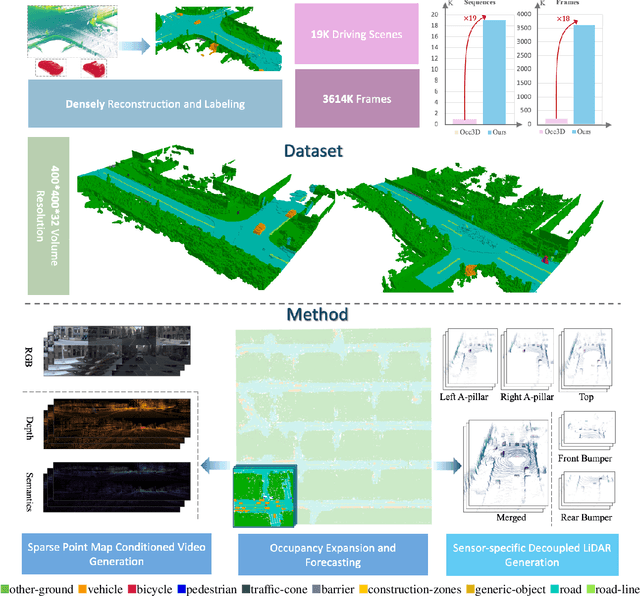
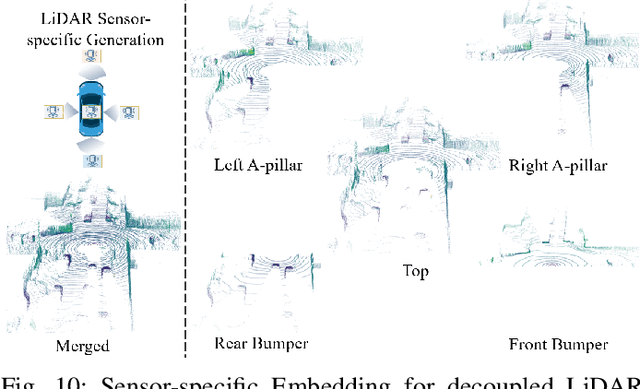
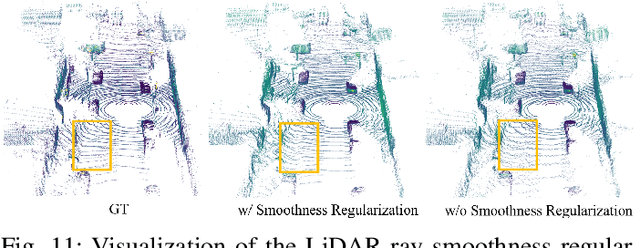
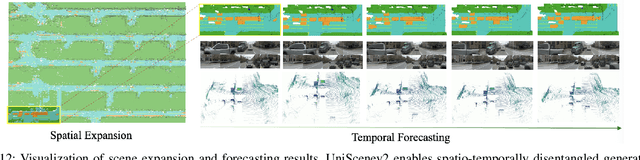
Driving scene generation is a critical domain for autonomous driving, enabling downstream applications, including perception and planning evaluation. Occupancy-centric methods have recently achieved state-of-the-art results by offering consistent conditioning across frames and modalities; however, their performance heavily depends on annotated occupancy data, which still remains scarce. To overcome this limitation, we curate Nuplan-Occ, the largest semantic occupancy dataset to date, constructed from the widely used Nuplan benchmark. Its scale and diversity facilitate not only large-scale generative modeling but also autonomous driving downstream applications. Based on this dataset, we develop a unified framework that jointly synthesizes high-quality semantic occupancy, multi-view videos, and LiDAR point clouds. Our approach incorporates a spatio-temporal disentangled architecture to support high-fidelity spatial expansion and temporal forecasting of 4D dynamic occupancy. To bridge modal gaps, we further propose two novel techniques: a Gaussian splatting-based sparse point map rendering strategy that enhances multi-view video generation, and a sensor-aware embedding strategy that explicitly models LiDAR sensor properties for realistic multi-LiDAR simulation. Extensive experiments demonstrate that our method achieves superior generation fidelity and scalability compared to existing approaches, and validates its practical value in downstream tasks. Repo: https://github.com/Arlo0o/UniScene-Unified-Occupancy-centric-Driving-Scene-Generation/tree/v2
UniScene: Unified Occupancy-centric Driving Scene Generation
Dec 06, 2024Generating high-fidelity, controllable, and annotated training data is critical for autonomous driving. Existing methods typically generate a single data form directly from a coarse scene layout, which not only fails to output rich data forms required for diverse downstream tasks but also struggles to model the direct layout-to-data distribution. In this paper, we introduce UniScene, the first unified framework for generating three key data forms - semantic occupancy, video, and LiDAR - in driving scenes. UniScene employs a progressive generation process that decomposes the complex task of scene generation into two hierarchical steps: (a) first generating semantic occupancy from a customized scene layout as a meta scene representation rich in both semantic and geometric information, and then (b) conditioned on occupancy, generating video and LiDAR data, respectively, with two novel transfer strategies of Gaussian-based Joint Rendering and Prior-guided Sparse Modeling. This occupancy-centric approach reduces the generation burden, especially for intricate scenes, while providing detailed intermediate representations for the subsequent generation stages. Extensive experiments demonstrate that UniScene outperforms previous SOTAs in the occupancy, video, and LiDAR generation, which also indeed benefits downstream driving tasks.
MSSF: A 4D Radar and Camera Fusion Framework With Multi-Stage Sampling for 3D Object Detection in Autonomous Driving
Nov 22, 2024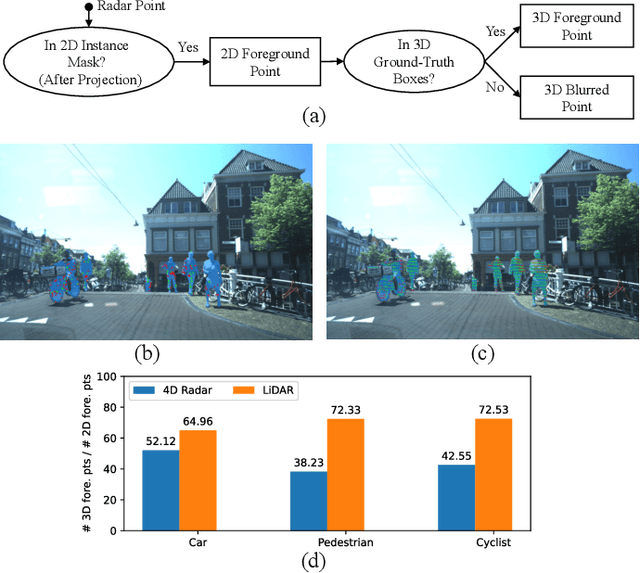
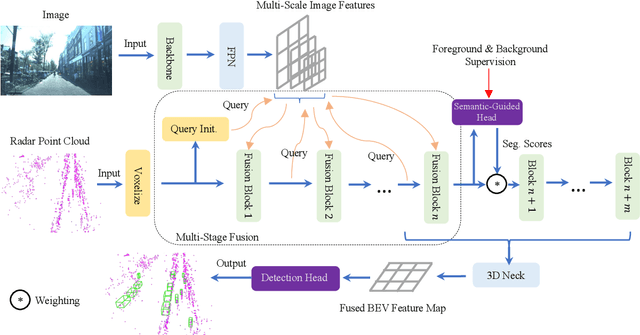
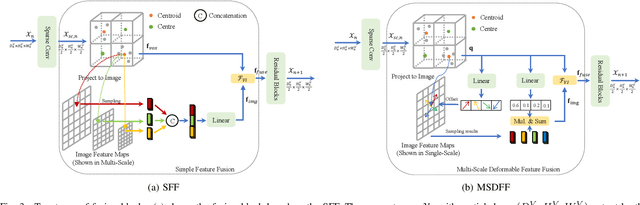
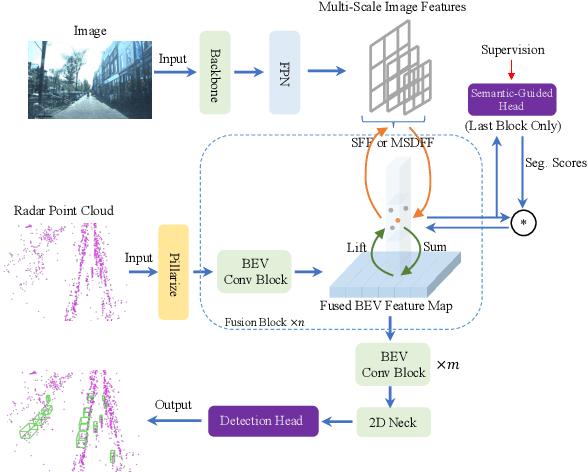
As one of the automotive sensors that have emerged in recent years, 4D millimeter-wave radar has a higher resolution than conventional 3D radar and provides precise elevation measurements. But its point clouds are still sparse and noisy, making it challenging to meet the requirements of autonomous driving. Camera, as another commonly used sensor, can capture rich semantic information. As a result, the fusion of 4D radar and camera can provide an affordable and robust perception solution for autonomous driving systems. However, previous radar-camera fusion methods have not yet been thoroughly investigated, resulting in a large performance gap compared to LiDAR-based methods. Specifically, they ignore the feature-blurring problem and do not deeply interact with image semantic information. To this end, we present a simple but effective multi-stage sampling fusion (MSSF) network based on 4D radar and camera. On the one hand, we design a fusion block that can deeply interact point cloud features with image features, and can be applied to commonly used single-modal backbones in a plug-and-play manner. The fusion block encompasses two types, namely, simple feature fusion (SFF) and multiscale deformable feature fusion (MSDFF). The SFF is easy to implement, while the MSDFF has stronger fusion abilities. On the other hand, we propose a semantic-guided head to perform foreground-background segmentation on voxels with voxel feature re-weighting, further alleviating the problem of feature blurring. Extensive experiments on the View-of-Delft (VoD) and TJ4DRadset datasets demonstrate the effectiveness of our MSSF. Notably, compared to state-of-the-art methods, MSSF achieves a 7.0% and 4.0% improvement in 3D mean average precision on the VoD and TJ4DRadSet datasets, respectively. It even surpasses classical LiDAR-based methods on the VoD dataset.