 Add to Chrome
 Add to Firefox
 Add to Edge
You Only Need One Color Space: An Efficient Network for Low-light Image Enhancement
Feb 08, 2024
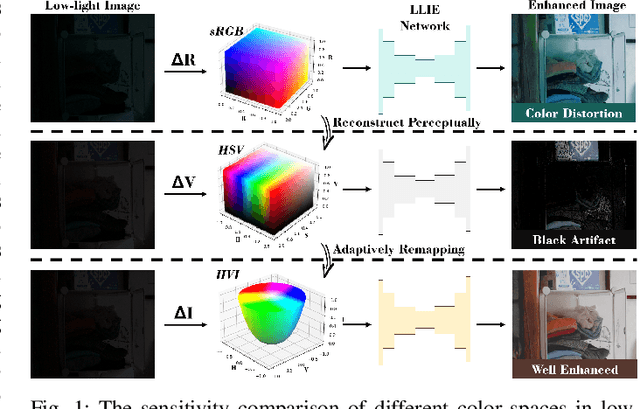
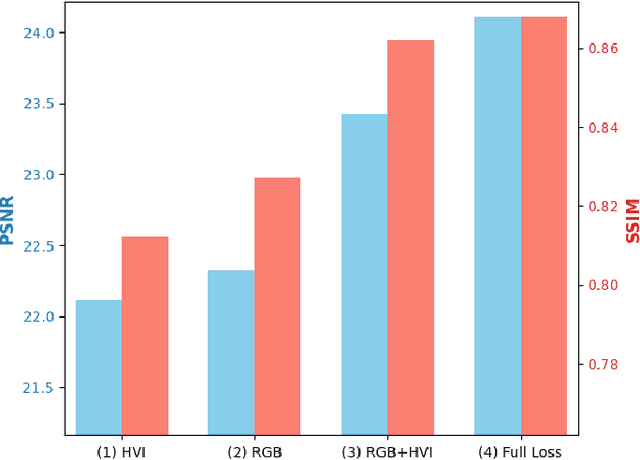
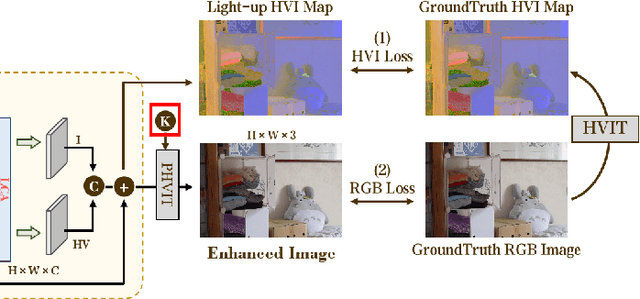
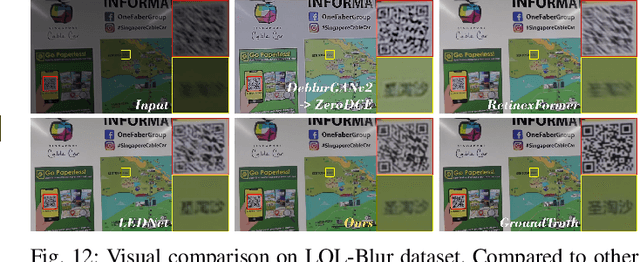
Low-Light Image Enhancement (LLIE) task tends to restore the details and visual information from corrupted low-light images. Most existing methods learn the mapping function between low/normal-light images by Deep Neural Networks (DNNs) on sRGB and HSV color space. Nevertheless, enhancement involves amplifying image signals, and applying these color spaces to low-light images with a low signal-to-noise ratio can introduce sensitivity and instability into the enhancement process. Consequently, this results in the presence of color artifacts and brightness artifacts in the enhanced images. To alleviate this problem, we propose a novel trainable color space, named Horizontal/Vertical-Intensity (HVI). It not only decouples brightness and color from RGB channels to mitigate the instability during enhancement but also adapts to low-light images in different illumination ranges due to the trainable parameters. Further, we design a novel Color and Intensity Decoupling Network (CIDNet) with two branches dedicated to processing the decoupled image brightness and color in the HVI space. Within CIDNet, we introduce the Lightweight Cross-Attention (LCA) module to facilitate interaction between image structure and content information in both branches, while also suppressing noise in low-light images. Finally, we conducted 22 quantitative and qualitative experiments to show that the proposed CIDNet outperforms the state-of-the-art methods on 11 datasets. The code will be available at https://github.com/Fediory/HVI-CIDNet.

Instance by Instance: An Iterative Framework for Multi-instance 3D Registration
Feb 06, 2024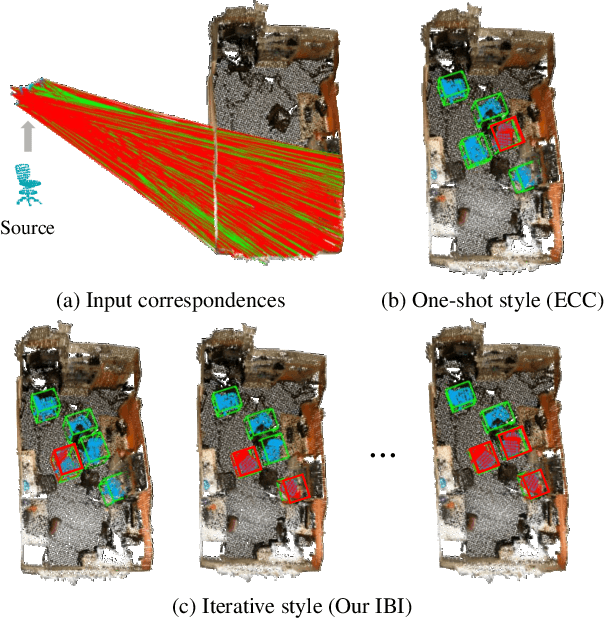
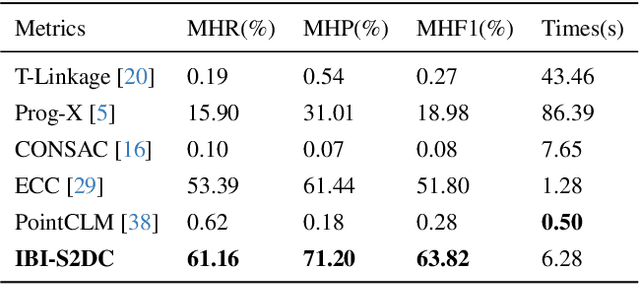

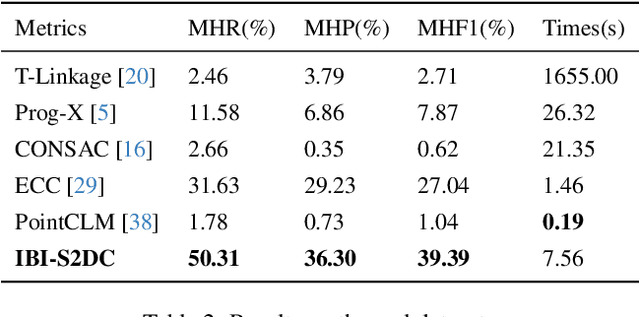
Multi-instance registration is a challenging problem in computer vision and robotics, where multiple instances of an object need to be registered in a standard coordinate system. In this work, we propose the first iterative framework called instance-by-instance (IBI) for multi-instance 3D registration (MI-3DReg). It successively registers all instances in a given scenario, starting from the easiest and progressing to more challenging ones. Throughout the iterative process, outliers are eliminated continuously, leading to an increasing inlier rate for the remaining and more challenging instances. Under the IBI framework, we further propose a sparse-to-dense-correspondence-based multi-instance registration method (IBI-S2DC) to achieve robust MI-3DReg. Experiments on the synthetic and real datasets have demonstrated the effectiveness of IBI and suggested the new state-of-the-art performance of IBI-S2DC, e.g., our MHF1 is 12.02%/12.35% higher than the existing state-of-the-art method ECC on the synthetic/real datasets.
Boosting Multi-view Stereo with Late Cost Aggregation
Jan 24, 2024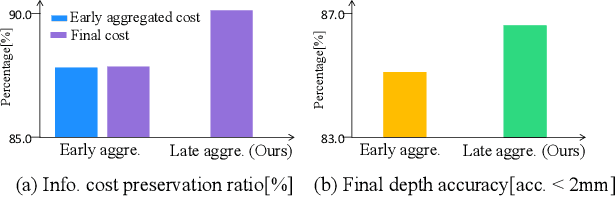
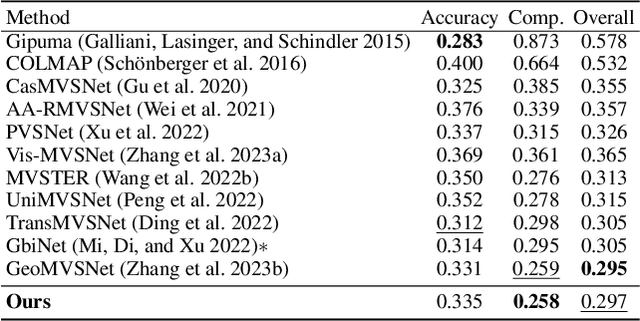
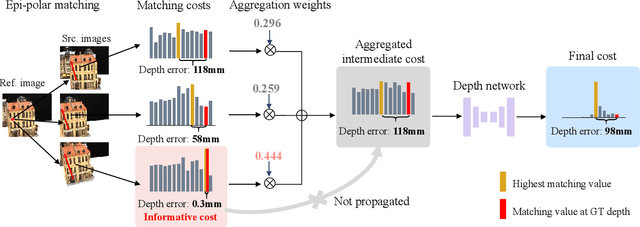
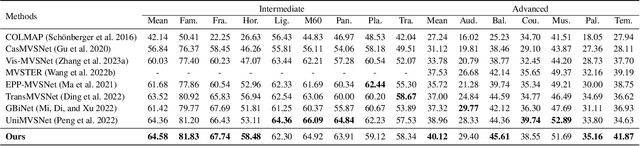
Pairwise matching cost aggregation is a crucial step for modern learning-based Multi-view Stereo (MVS). Prior works adopt an early aggregation scheme, which adds up pairwise costs into an intermediate cost. However, we analyze that this process can degrade informative pairwise matchings, thereby blocking the depth network from fully utilizing the original geometric matching cues. To address this challenge, we present a late aggregation approach that allows for aggregating pairwise costs throughout the network feed-forward process, achieving accurate estimations with only minor changes of the plain CasMVSNet. Instead of building an intermediate cost by weighted sum, late aggregation preserves all pairwise costs along a distinct view channel. This enables the succeeding depth network to fully utilize the crucial geometric cues without loss of cost fidelity. Grounded in the new aggregation scheme, we propose further techniques addressing view order dependence inside the preserved cost, handling flexible testing views, and improving the depth filtering process. Despite its technical simplicity, our method improves significantly upon the baseline cascade-based approach, achieving comparable results with state-of-the-art methods with favorable computation overhead.
CrossDiff: Exploring Self-Supervised Representation of Pansharpening via Cross-Predictive Diffusion Model
Jan 13, 2024

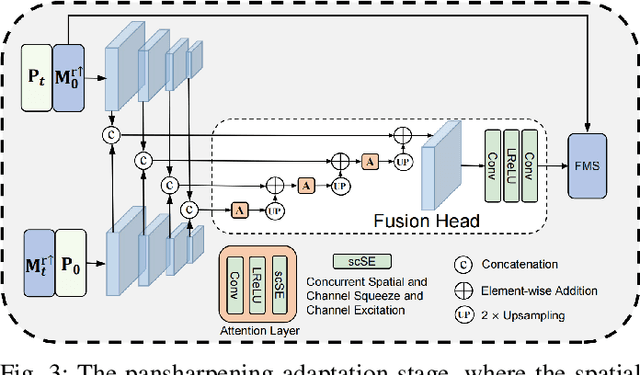

Fusion of a panchromatic (PAN) image and corresponding multispectral (MS) image is also known as pansharpening, which aims to combine abundant spatial details of PAN and spectral information of MS. Due to the absence of high-resolution MS images, available deep-learning-based methods usually follow the paradigm of training at reduced resolution and testing at both reduced and full resolution. When taking original MS and PAN images as inputs, they always obtain sub-optimal results due to the scale variation. In this paper, we propose to explore the self-supervised representation of pansharpening by designing a cross-predictive diffusion model, named CrossDiff. It has two-stage training. In the first stage, we introduce a cross-predictive pretext task to pre-train the UNet structure based on conditional DDPM, while in the second stage, the encoders of the UNets are frozen to directly extract spatial and spectral features from PAN and MS, and only the fusion head is trained to adapt for pansharpening task. Extensive experiments show the effectiveness and superiority of the proposed model compared with state-of-the-art supervised and unsupervised methods. Besides, the cross-sensor experiments also verify the generalization ability of proposed self-supervised representation learners for other satellite's datasets. We will release our code for reproducibility.
DifAugGAN: A Practical Diffusion-style Data Augmentation for GAN-based Single Image Super-resolution
Nov 30, 2023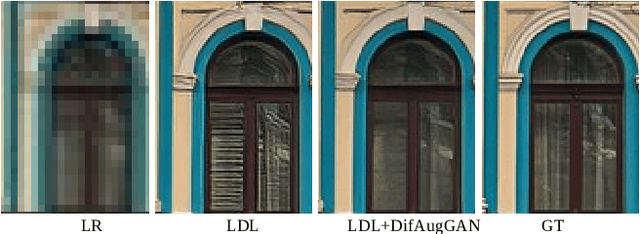
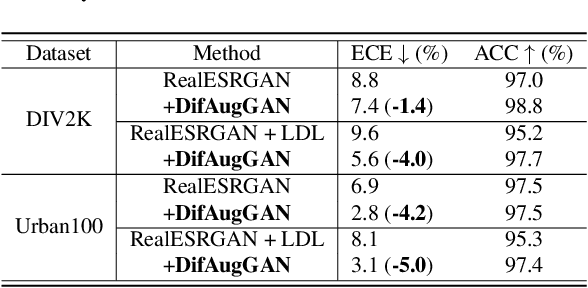
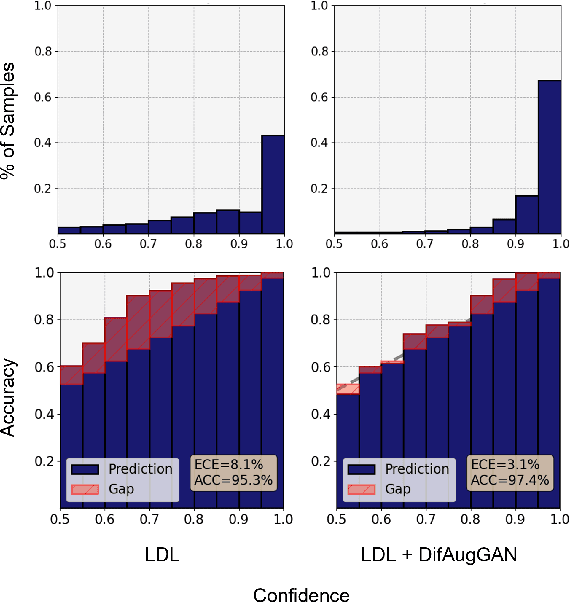

It is well known the adversarial optimization of GAN-based image super-resolution (SR) methods makes the preceding SR model generate unpleasant and undesirable artifacts, leading to large distortion. We attribute the cause of such distortions to the poor calibration of the discriminator, which hampers its ability to provide meaningful feedback to the generator for learning high-quality images. To address this problem, we propose a simple but non-travel diffusion-style data augmentation scheme for current GAN-based SR methods, known as DifAugGAN. It involves adapting the diffusion process in generative diffusion models for improving the calibration of the discriminator during training motivated by the successes of data augmentation schemes in the field to achieve good calibration. Our DifAugGAN can be a Plug-and-Play strategy for current GAN-based SISR methods to improve the calibration of the discriminator and thus improve SR performance. Extensive experimental evaluations demonstrate the superiority of DifAugGAN over state-of-the-art GAN-based SISR methods across both synthetic and real-world datasets, showcasing notable advancements in both qualitative and quantitative results.
Open-Vocabulary Video Anomaly Detection
Nov 15, 2023Video anomaly detection (VAD) with weak supervision has achieved remarkable performance in utilizing video-level labels to discriminate whether a video frame is normal or abnormal. However, current approaches are inherently limited to a closed-set setting and may struggle in open-world applications where there can be anomaly categories in the test data unseen during training. A few recent studies attempt to tackle a more realistic setting, open-set VAD, which aims to detect unseen anomalies given seen anomalies and normal videos. However, such a setting focuses on predicting frame anomaly scores, having no ability to recognize the specific categories of anomalies, despite the fact that this ability is essential for building more informed video surveillance systems. This paper takes a step further and explores open-vocabulary video anomaly detection (OVVAD), in which we aim to leverage pre-trained large models to detect and categorize seen and unseen anomalies. To this end, we propose a model that decouples OVVAD into two mutually complementary tasks -- class-agnostic detection and class-specific classification -- and jointly optimizes both tasks. Particularly, we devise a semantic knowledge injection module to introduce semantic knowledge from large language models for the detection task, and design a novel anomaly synthesis module to generate pseudo unseen anomaly videos with the help of large vision generation models for the classification task. These semantic knowledge and synthesis anomalies substantially extend our model's capability in detecting and categorizing a variety of seen and unseen anomalies. Extensive experiments on three widely-used benchmarks demonstrate our model achieves state-of-the-art performance on OVVAD task.
Multiple Object Tracking based on Occlusion-Aware Embedding Consistency Learning
Nov 05, 2023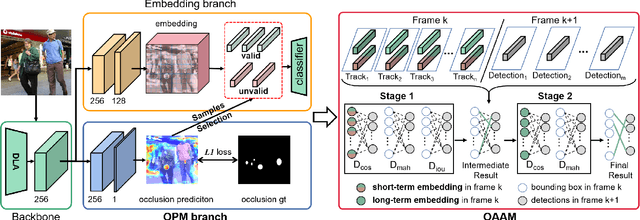
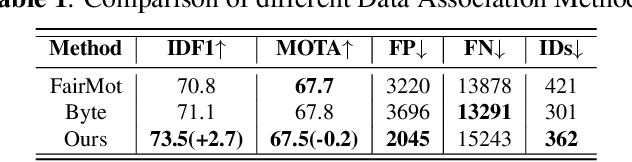
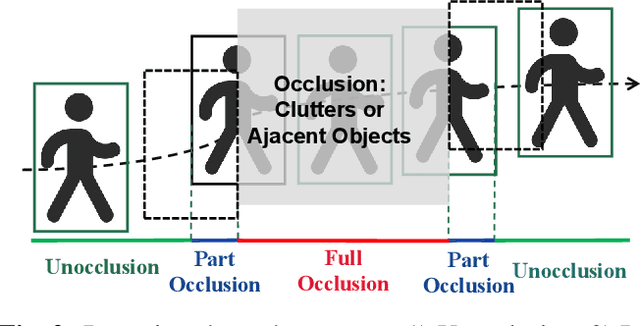
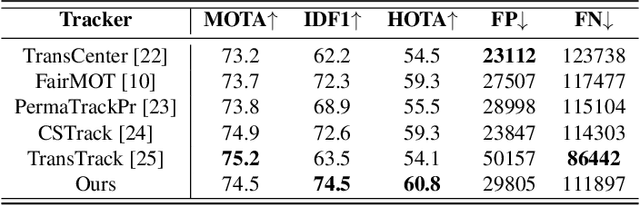
The Joint Detection and Embedding (JDE) framework has achieved remarkable progress for multiple object tracking. Existing methods often employ extracted embeddings to re-establish associations between new detections and previously disrupted tracks. However, the reliability of embeddings diminishes when the region of the occluded object frequently contains adjacent objects or clutters, especially in scenarios with severe occlusion. To alleviate this problem, we propose a novel multiple object tracking method based on visual embedding consistency, mainly including: 1) Occlusion Prediction Module (OPM) and 2) Occlusion-Aware Association Module (OAAM). The OPM predicts occlusion information for each true detection, facilitating the selection of valid samples for consistency learning of the track's visual embedding. The OAAM leverages occlusion cues and visual embeddings to generate two separate embeddings for each track, guaranteeing consistency in both unoccluded and occluded detections. By integrating these two modules, our method is capable of addressing track interruptions caused by occlusion in online tracking scenarios. Extensive experimental results demonstrate that our approach achieves promising performance levels in both unoccluded and occluded tracking scenarios.
Towards High-quality HDR Deghosting with Conditional Diffusion Models
Nov 02, 2023High Dynamic Range (HDR) images can be recovered from several Low Dynamic Range (LDR) images by existing Deep Neural Networks (DNNs) techniques. Despite the remarkable progress, DNN-based methods still generate ghosting artifacts when LDR images have saturation and large motion, which hinders potential applications in real-world scenarios. To address this challenge, we formulate the HDR deghosting problem as an image generation that leverages LDR features as the diffusion model's condition, consisting of the feature condition generator and the noise predictor. Feature condition generator employs attention and Domain Feature Alignment (DFA) layer to transform the intermediate features to avoid ghosting artifacts. With the learned features as conditions, the noise predictor leverages a stochastic iterative denoising process for diffusion models to generate an HDR image by steering the sampling process. Furthermore, to mitigate semantic confusion caused by the saturation problem of LDR images, we design a sliding window noise estimator to sample smooth noise in a patch-based manner. In addition, an image space loss is proposed to avoid the color distortion of the estimated HDR results. We empirically evaluate our model on benchmark datasets for HDR imaging. The results demonstrate that our approach achieves state-of-the-art performances and well generalization to real-world images.
Adapt Anything: Tailor Any Image Classifiers across Domains And Categories Using Text-to-Image Diffusion Models
Oct 25, 2023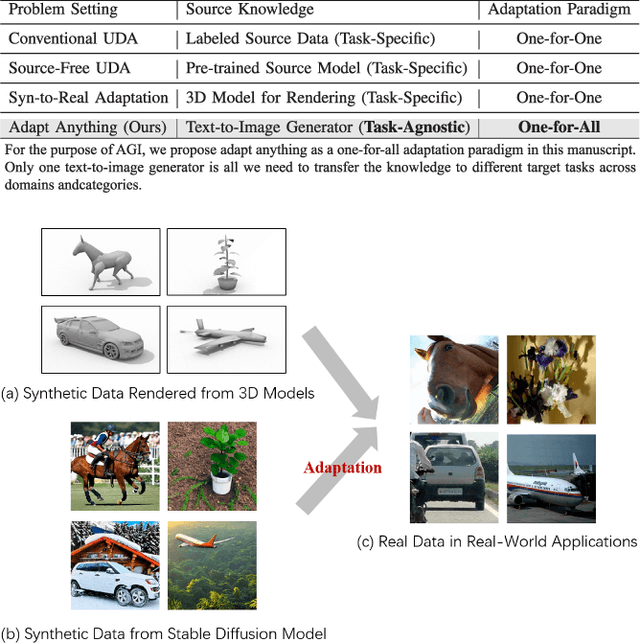
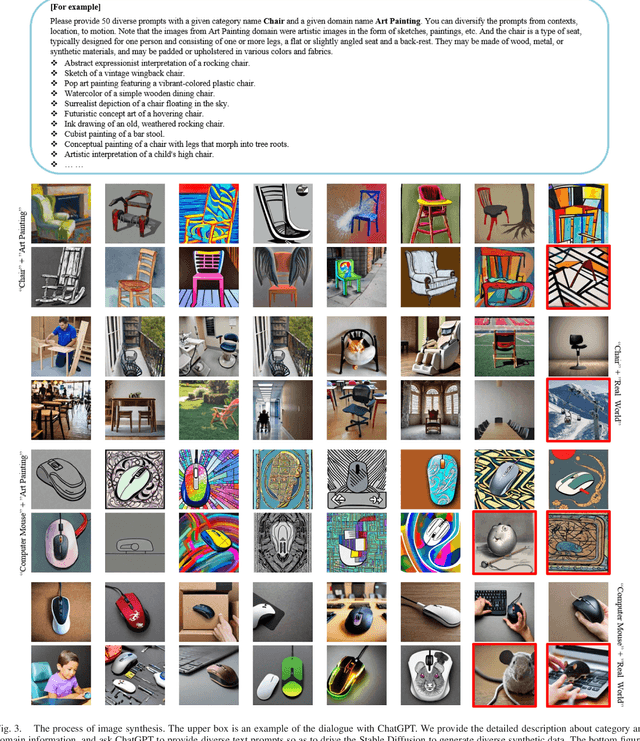
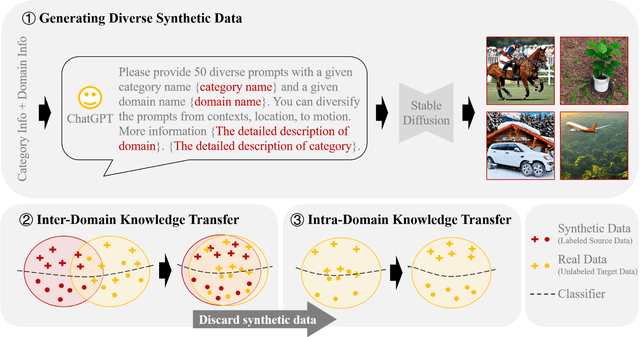
We do not pursue a novel method in this paper, but aim to study if a modern text-to-image diffusion model can tailor any task-adaptive image classifier across domains and categories. Existing domain adaptive image classification works exploit both source and target data for domain alignment so as to transfer the knowledge learned from the labeled source data to the unlabeled target data. However, as the development of the text-to-image diffusion model, we wonder if the high-fidelity synthetic data from the text-to-image generator can serve as a surrogate of the source data in real world. In this way, we do not need to collect and annotate the source data for each domain adaptation task in a one-for-one manner. Instead, we utilize only one off-the-shelf text-to-image model to synthesize images with category labels derived from the corresponding text prompts, and then leverage the surrogate data as a bridge to transfer the knowledge embedded in the task-agnostic text-to-image generator to the task-oriented image classifier via domain adaptation. Such a one-for-all adaptation paradigm allows us to adapt anything in the world using only one text-to-image generator as well as the corresponding unlabeled target data. Extensive experiments validate the feasibility of the proposed idea, which even surpasses the state-of-the-art domain adaptation works using the source data collected and annotated in real world.
A cross Transformer for image denoising
Oct 16, 2023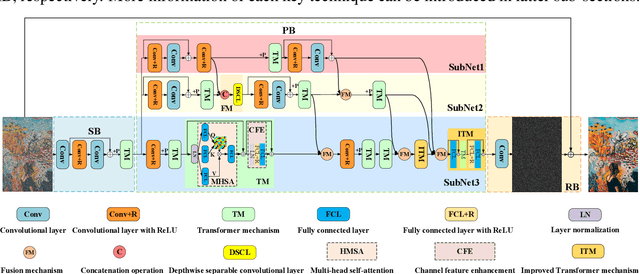

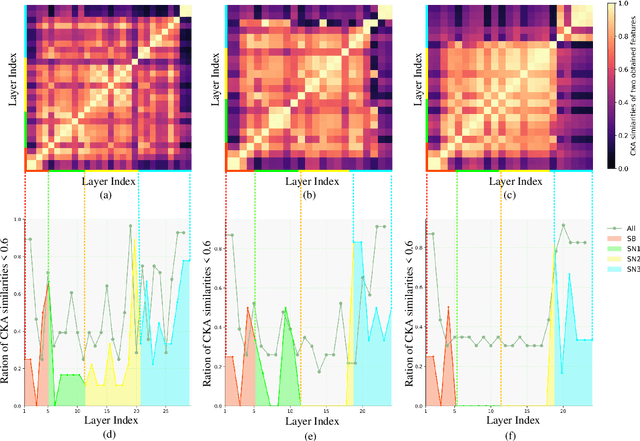

Deep convolutional neural networks (CNNs) depend on feedforward and feedback ways to obtain good performance in image denoising. However, how to obtain effective structural information via CNNs to efficiently represent given noisy images is key for complex scenes. In this paper, we propose a cross Transformer denoising CNN (CTNet) with a serial block (SB), a parallel block (PB), and a residual block (RB) to obtain clean images for complex scenes. A SB uses an enhanced residual architecture to deeply search structural information for image denoising. To avoid loss of key information, PB uses three heterogeneous networks to implement multiple interactions of multi-level features to broadly search for extra information for improving the adaptability of an obtained denoiser for complex scenes. Also, to improve denoising performance, Transformer mechanisms are embedded into the SB and PB to extract complementary salient features for effectively removing noise in terms of pixel relations. Finally, a RB is applied to acquire clean images. Experiments illustrate that our CTNet is superior to some popular denoising methods in terms of real and synthetic image denoising. It is suitable to mobile digital devices, i.e., phones. Codes can be obtained at https://github.com/hellloxiaotian/CTNet.