 Add to Chrome
 Add to Firefox
 Add to Edge
MeanSR: Restoration Trajectory Learning for One-Step Perceptual Super-Resolution
Aug 10, 2026
Diffusion-based super-resolution (SR) achieves strong perceptual quality but requires costly iterative denoising. Existing one-step distillation methods reduce inference time but depend on expensive pretrained teachers, whereas CTMSR avoids distillation through PF-ODE consistency training yet does not explicitly model the restoration dynamics from low-resolution (LR) inputs to high-resolution (HR) images. We propose MeanSR, a one-step perceptual SR method that learns an LR-conditioned average velocity field to directly capture the finite-time transition from degraded or noisy inputs to plausible HR outputs. We further reformulate distribution trajectory matching for average-velocity generation and introduce a Stage-Aware Temporal Sampling strategy to improve trajectory learning. Experiments on synthetic and real-world benchmarks show that MeanSR outperforms CTMSR on CLIPIQA, MUSIQ, and MANIQA while substantially reducing FLOPs and inference latency. MeanSR also reconstructs sharper structures and more realistic textures with fewer perceptual artifacts.

Coupled Continuous-Discrete Generation for Scene Text Image Super-Resolution
Aug 05, 2026Scene text image super-resolution (STISR) aims to recover visually plausible appearance while preserving character semantics from degraded inputs. Existing STISR systems often rely on externally generated priors or separate image and text models, resulting in error propagation and costly multi-stage inference. We present DualTSR, a unified framework that formulates STISR as coupled continuous-discrete generation. Conditional flow matching restores continuous image latents, while absorbing-state discrete diffusion reconstructs text tokens. Both processes share a multimodal transformer backbone, allowing the evolving image and text states to interact throughout generation without an external OCR prior at inference. On CTR-TSR, DualTSR achieves the best FID, LPIPS, ACC, and NED among the compared methods at both X2 and X4. On an aligned RealCE subset, it obtains the best FID, ACC, and NED with competitive LPIPS. Compared with DiffTSR at X4, DualTSR improves ACC by 12.78 percentage points while reducing the parameter count from 1.23B to 203M and end-to-end latency from 13.3s to 132ms. These results establish DualTSR as an accurate and efficient method for STISR.
FaithIR: Rethinking Infrared Image Super-Resolution from Perceptual Sharpness to Task Relevant Fidelity
Aug 04, 2026Infrared image super-resolution (IISR) is important for downstream tasks such as object detection and semantic segmentation. Existing IISR methods often produce artificial textures, over-sharpened edges, and spurious high-frequency details that distort authentic thermal structures and semantic information. To address this issue, we propose FaithIR, a faithful infrared super-resolution framework for reliable machine perception. FaithIR consists of a patch-level conditioning branch that captures global thermal and structural information and a pixel-level restoration branch that performs dense local reconstruction under structural guidance. The entire restoration process is performed directly in the pixel domain to preserve infrared-specific structures and task-relevant information. Extensive experiments on FLIR-IISR, M3FD, and FMB demonstrate strong reconstruction fidelity, cross-dataset generalization, and superior performance in object detection and semantic segmentation. These results show that demonstrate that preserving faithful infrared structure preservations is more important for reliable machine perception than merely pursuing perceptual sharpness alone.
Unleashing the Power of Text: Text-Guided Flow Matching for Image Fusion under Complex Degradations
Aug 01, 2026Infrared-visible image fusion under realistic degradation scenarios is a challenging task, as degradations not only cause a loss of reliable modality-specific information in observed images but also hinder the fusion process. Recent studies indicate that text can provide prior information about degradation characteristics, complementing the limited evidence available from corrupted input images and facilitating fusion. However, existing methods typically inject fixed global text representations into visual features, making it difficult for textual guidance to adapt to spatially varying degradations, local structures, and thermal saliency. To this end, we propose TGFusion, a text-guided latent-space flow matching framework that unifies degradation suppression and cross-modal fusion. TGFusion encodes task, degradation, and generation cues into structured prompts. To fully exploit these priors, we design a Prompt-conditioned Multi-stream Joint Flow Transformer that represents text as an independent semantic stream alongside fusion, visible, and infrared streams. Joint attention enables token-level bidirectional interaction and layer-wise updating among semantic and visual representations, allowing degradation semantics to dynamically guide reliable information selection and fusion latent generation. Extensive experiments on public benchmarks and complex degradation scenarios demonstrate that TGFusion achieves superior or competitive performance in perceptual quality, image naturalness, structural-detail preservation, and infrared-saliency retention, while remaining robust across diverse single and compound degradations.
The Second Challenge on Real-World Face Restoration at NTIRE 2026: Methods and Results
Apr 12, 2026This paper provides a review of the NTIRE 2026 challenge on real-world face restoration, highlighting the proposed solutions and the resulting outcomes. The challenge focuses on generating natural and realistic outputs while maintaining identity consistency. Its goal is to advance state-of-the-art solutions for perceptual quality and realism, without imposing constraints on computational resources or training data. Performance is evaluated using a weighted image quality assessment (IQA) score and employs the AdaFace model as an identity checker. The competition attracted 96 registrants, with 10 teams submitting valid models; ultimately, 9 teams achieved valid scores in the final ranking. This collaborative effort advances the performance of real-world face restoration while offering an in-depth overview of the latest trends in the field.
DualTSR: Unified Dual-Diffusion Transformer for Scene Text Image Super-Resolution
Mar 15, 2026Scene Text Image Super-Resolution (STISR) aims to restore high-resolution details in low-resolution text images, which is crucial for both human readability and machine recognition. Existing methods, however, often depend on external Optical Character Recognition (OCR) models for textual priors or rely on complex multi-component architectures that are difficult to train and reproduce. In this paper, we introduce DualTSR, a unified end-to-end framework that addresses both issues. DualTSR employs a single multimodal transformer backbone trained with a dual diffusion objective. It simultaneously models the continuous distribution of high-resolution images via Conditional Flow Matching and the discrete distribution of textual content via discrete diffusion. This shared design enables visual and textual information to interact at every layer, allowing the model to infer text priors internally instead of relying on an external OCR module. Compared with prior multi-branch diffusion systems, DualTSR offers a simpler end-to-end formulation with fewer hand-crafted components. Experiments on synthetic Chinese benchmarks and a curated real-world evaluation protocol show that DualTSR achieves strong perceptual quality and text fidelity.
Sparse2DGS: Geometry-Prioritized Gaussian Splatting for Surface Reconstruction from Sparse Views
Apr 29, 2025We present a Gaussian Splatting method for surface reconstruction using sparse input views. Previous methods relying on dense views struggle with extremely sparse Structure-from-Motion points for initialization. While learning-based Multi-view Stereo (MVS) provides dense 3D points, directly combining it with Gaussian Splatting leads to suboptimal results due to the ill-posed nature of sparse-view geometric optimization. We propose Sparse2DGS, an MVS-initialized Gaussian Splatting pipeline for complete and accurate reconstruction. Our key insight is to incorporate the geometric-prioritized enhancement schemes, allowing for direct and robust geometric learning under ill-posed conditions. Sparse2DGS outperforms existing methods by notable margins while being ${2}\times$ faster than the NeRF-based fine-tuning approach.
HVI: A New Color Space for Low-light Image Enhancement
Feb 28, 2025


Low-Light Image Enhancement (LLIE) is a crucial computer vision task that aims to restore detailed visual information from corrupted low-light images. Many existing LLIE methods are based on standard RGB (sRGB) space, which often produce color bias and brightness artifacts due to inherent high color sensitivity in sRGB. While converting the images using Hue, Saturation and Value (HSV) color space helps resolve the brightness issue, it introduces significant red and black noise artifacts. To address this issue, we propose a new color space for LLIE, namely Horizontal/Vertical-Intensity (HVI), defined by polarized HS maps and learnable intensity. The former enforces small distances for red coordinates to remove the red artifacts, while the latter compresses the low-light regions to remove the black artifacts. To fully leverage the chromatic and intensity information, a novel Color and Intensity Decoupling Network (CIDNet) is further introduced to learn accurate photometric mapping function under different lighting conditions in the HVI space. Comprehensive results from benchmark and ablation experiments show that the proposed HVI color space with CIDNet outperforms the state-of-the-art methods on 10 datasets. The code is available at https://github.com/Fediory/HVI-CIDNet.
C-Drag: Chain-of-Thought Driven Motion Controller for Video Generation
Feb 27, 2025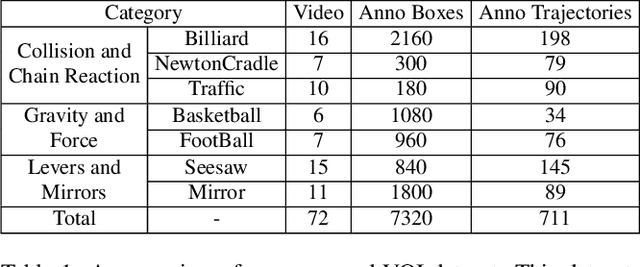
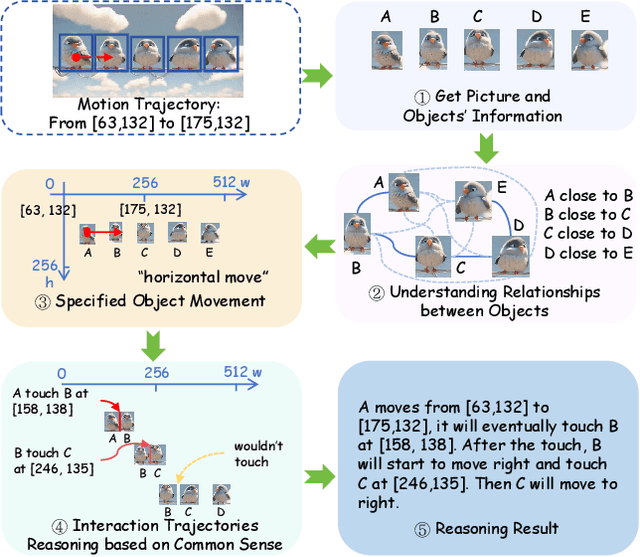
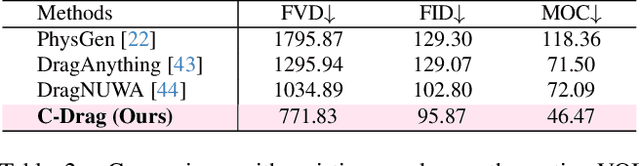
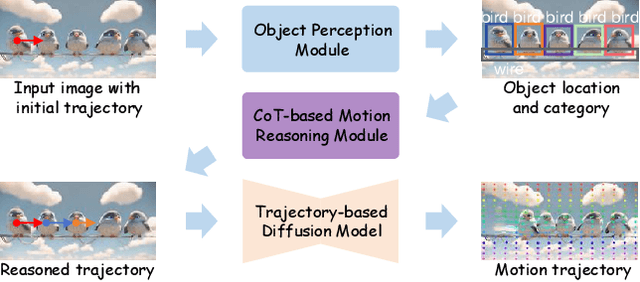
Trajectory-based motion control has emerged as an intuitive and efficient approach for controllable video generation. However, the existing trajectory-based approaches are usually limited to only generating the motion trajectory of the controlled object and ignoring the dynamic interactions between the controlled object and its surroundings. To address this limitation, we propose a Chain-of-Thought-based motion controller for controllable video generation, named C-Drag. Instead of directly generating the motion of some objects, our C-Drag first performs object perception and then reasons the dynamic interactions between different objects according to the given motion control of the objects. Specifically, our method includes an object perception module and a Chain-of-Thought-based motion reasoning module. The object perception module employs visual language models to capture the position and category information of various objects within the image. The Chain-of-Thought-based motion reasoning module takes this information as input and conducts a stage-wise reasoning process to generate motion trajectories for each of the affected objects, which are subsequently fed to the diffusion model for video synthesis. Furthermore, we introduce a new video object interaction (VOI) dataset to evaluate the generation quality of motion controlled video generation methods. Our VOI dataset contains three typical types of interactions and provides the motion trajectories of objects that can be used for accurate performance evaluation. Experimental results show that C-Drag achieves promising performance across multiple metrics, excelling in object motion control. Our benchmark, codes, and models will be available at https://github.com/WesLee88524/C-Drag-Official-Repo.
UIR-LoRA: Achieving Universal Image Restoration through Multiple Low-Rank Adaptation
Sep 30, 2024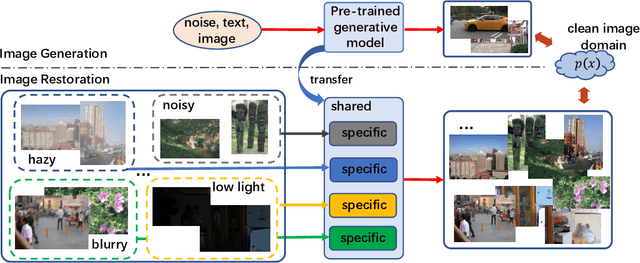
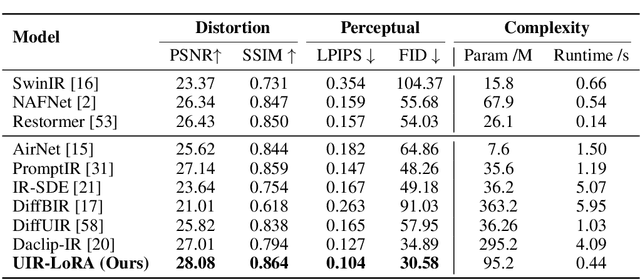

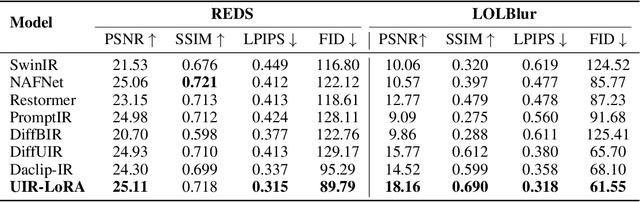
Existing unified methods typically treat multi-degradation image restoration as a multi-task learning problem. Despite performing effectively compared to single degradation restoration methods, they overlook the utilization of commonalities and specificities within multi-task restoration, thereby impeding the model's performance. Inspired by the success of deep generative models and fine-tuning techniques, we proposed a universal image restoration framework based on multiple low-rank adapters (LoRA) from multi-domain transfer learning. Our framework leverages the pre-trained generative model as the shared component for multi-degradation restoration and transfers it to specific degradation image restoration tasks using low-rank adaptation. Additionally, we introduce a LoRA composing strategy based on the degradation similarity, which adaptively combines trained LoRAs and enables our model to be applicable for mixed degradation restoration. Extensive experiments on multiple and mixed degradations demonstrate that the proposed universal image restoration method not only achieves higher fidelity and perceptual image quality but also has better generalization ability than other unified image restoration models. Our code is available at https://github.com/Justones/UIR-LoRA.