 Add to Chrome
 Add to Firefox
 Add to Edge
AutoFLUKA: A Large Language Model Based Framework for Automating Monte Carlo Simulations in FLUKA
Oct 19, 2024
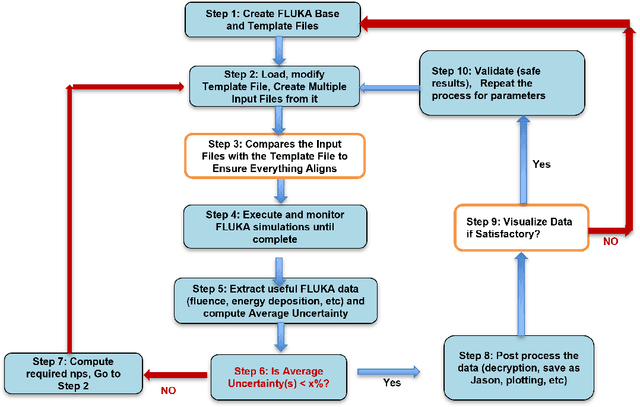


Monte Carlo (MC) simulations, particularly using FLUKA, are essential for replicating real-world scenarios across scientific and engineering fields. Despite the robustness and versatility, FLUKA faces significant limitations in automation and integration with external post-processing tools, leading to workflows with a steep learning curve, which are time-consuming and prone to human errors. Traditional methods involving the use of shell and Python scripts, MATLAB, and Microsoft Excel require extensive manual intervention and lack flexibility, adding complexity to evolving scenarios. This study explores the potential of Large Language Models (LLMs) and AI agents to address these limitations. AI agents, integrate natural language processing with autonomous reasoning for decision-making and adaptive planning, making them ideal for automation. We introduce AutoFLUKA, an AI agent application developed using the LangChain Python Framework to automate typical MC simulation workflows in FLUKA. AutoFLUKA can modify FLUKA input files, execute simulations, and efficiently process results for visualization, significantly reducing human labor and error. Our case studies demonstrate that AutoFLUKA can handle both generalized and domain-specific cases, such as Microdosimetry, with an streamlined automated workflow, showcasing its scalability and flexibility. The study also highlights the potential of Retrieval Augmentation Generation (RAG) tools to act as virtual assistants for FLUKA, further improving user experience, time and efficiency. In conclusion, AutoFLUKA represents a significant advancement in automating MC simulation workflows, offering a robust solution to the inherent limitations. This innovation not only saves time and resources but also opens new paradigms for research and development in high energy physics, medical physics, nuclear engineering space and environmental science.

On the Role of Attention Heads in Large Language Model Safety
Oct 17, 2024

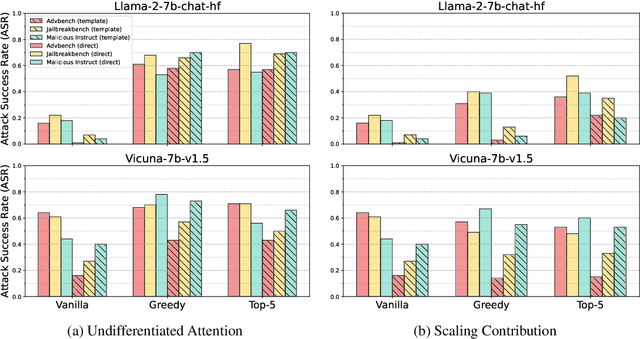
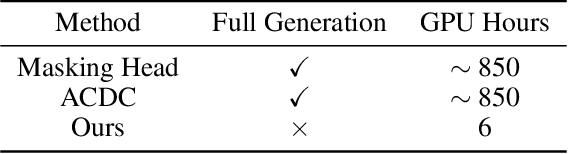
Large language models (LLMs) achieve state-of-the-art performance on multiple language tasks, yet their safety guardrails can be circumvented, leading to harmful generations. In light of this, recent research on safety mechanisms has emerged, revealing that when safety representations or component are suppressed, the safety capability of LLMs are compromised. However, existing research tends to overlook the safety impact of multi-head attention mechanisms, despite their crucial role in various model functionalities. Hence, in this paper, we aim to explore the connection between standard attention mechanisms and safety capability to fill this gap in the safety-related mechanistic interpretability. We propose a novel metric which tailored for multi-head attention, the Safety Head ImPortant Score (Ships), to assess the individual heads' contributions to model safety. Based on this, we generalize Ships to the dataset level and further introduce the Safety Attention Head AttRibution Algorithm (Sahara) to attribute the critical safety attention heads inside the model. Our findings show that the special attention head has a significant impact on safety. Ablating a single safety head allows aligned model (e.g., Llama-2-7b-chat) to respond to 16 times more harmful queries, while only modifying 0.006% of the parameters, in contrast to the ~ 5% modification required in previous studies. More importantly, we demonstrate that attention heads primarily function as feature extractors for safety and models fine-tuned from the same base model exhibit overlapping safety heads through comprehensive experiments. Together, our attribution approach and findings provide a novel perspective for unpacking the black box of safety mechanisms within large models.
FlashAudio: Rectified Flows for Fast and High-Fidelity Text-to-Audio Generation
Oct 16, 2024

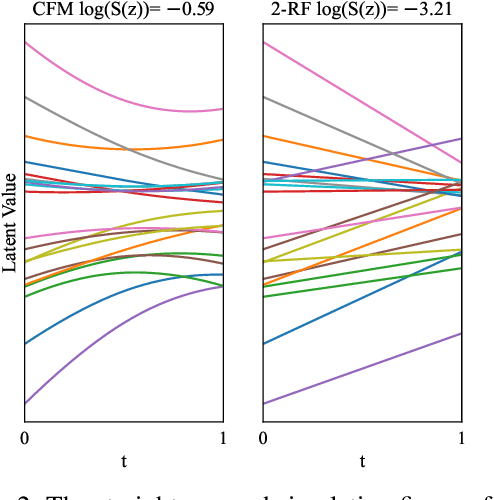

Recent advancements in latent diffusion models (LDMs) have markedly enhanced text-to-audio generation, yet their iterative sampling processes impose substantial computational demands, limiting practical deployment. While recent methods utilizing consistency-based distillation aim to achieve few-step or single-step inference, their one-step performance is constrained by curved trajectories, preventing them from surpassing traditional diffusion models. In this work, we introduce FlashAudio with rectified flows to learn straight flow for fast simulation. To alleviate the inefficient timesteps allocation and suboptimal distribution of noise, FlashAudio optimizes the time distribution of rectified flow with Bifocal Samplers and proposes immiscible flow to minimize the total distance of data-noise pairs in a batch vias assignment. Furthermore, to address the amplified accumulation error caused by the classifier-free guidance (CFG), we propose Anchored Optimization, which refines the guidance scale by anchoring it to a reference trajectory. Experimental results on text-to-audio generation demonstrate that FlashAudio's one-step generation performance surpasses the diffusion-based models with hundreds of sampling steps on audio quality and enables a sampling speed of 400x faster than real-time on a single NVIDIA 4090Ti GPU.
Federated Temporal Graph Clustering
Oct 16, 2024


Temporal graph clustering is a complex task that involves discovering meaningful structures in dynamic graphs where relationships and entities change over time. Existing methods typically require centralized data collection, which poses significant privacy and communication challenges. In this work, we introduce a novel Federated Temporal Graph Clustering (FTGC) framework that enables decentralized training of graph neural networks (GNNs) across multiple clients, ensuring data privacy throughout the process. Our approach incorporates a temporal aggregation mechanism to effectively capture the evolution of graph structures over time and a federated optimization strategy to collaboratively learn high-quality clustering representations. By preserving data privacy and reducing communication overhead, our framework achieves competitive performance on temporal graph datasets, making it a promising solution for privacy-sensitive, real-world applications involving dynamic data.
Super-resolving Real-world Image Illumination Enhancement: A New Dataset and A Conditional Diffusion Model
Oct 16, 2024


Most existing super-resolution methods and datasets have been developed to improve the image quality in well-lighted conditions. However, these methods do not work well in real-world low-light conditions as the images captured in such conditions lose most important information and contain significant unknown noises. To solve this problem, we propose a SRRIIE dataset with an efficient conditional diffusion probabilistic models-based method. The proposed dataset contains 4800 paired low-high quality images. To ensure that the dataset are able to model the real-world image degradation in low-illumination environments, we capture images using an ILDC camera and an optical zoom lens with exposure levels ranging from -6 EV to 0 EV and ISO levels ranging from 50 to 12800. We comprehensively evaluate with various reconstruction and perceptual metrics and demonstrate the practicabilities of the SRRIIE dataset for deep learning-based methods. We show that most existing methods are less effective in preserving the structures and sharpness of restored images from complicated noises. To overcome this problem, we revise the condition for Raw sensor data and propose a novel time-melding condition for diffusion probabilistic model. Comprehensive quantitative and qualitative experimental results on the real-world benchmark datasets demonstrate the feasibility and effectivenesses of the proposed conditional diffusion probabilistic model on Raw sensor data. Code and dataset will be available at https://github.com/Yaofang-Liu/Super-Resolving
FaceChain-FACT: Face Adapter with Decoupled Training for Identity-preserved Personalization
Oct 16, 2024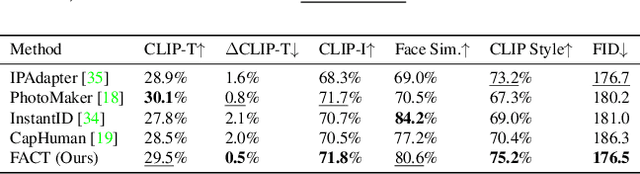
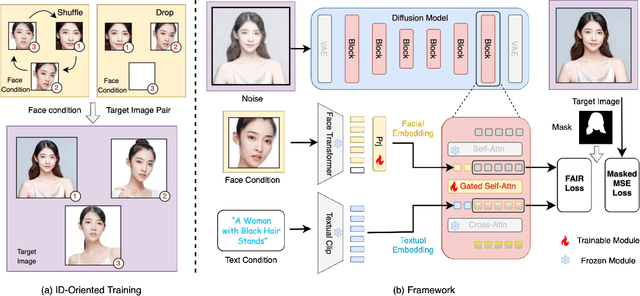
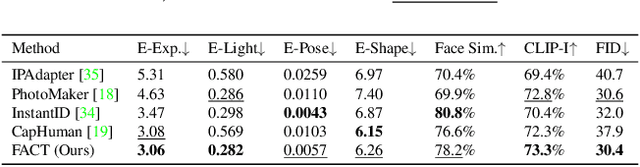
In the field of human-centric personalized image generation, the adapter-based method obtains the ability to customize and generate portraits by text-to-image training on facial data. This allows for identity-preserved personalization without additional fine-tuning in inference. Although there are improvements in efficiency and fidelity, there is often a significant performance decrease in test following ability, controllability, and diversity of generated faces compared to the base model. In this paper, we analyze that the performance degradation is attributed to the failure to decouple identity features from other attributes during extraction, as well as the failure to decouple the portrait generation training from the overall generation task. To address these issues, we propose the Face Adapter with deCoupled Training (FACT) framework, focusing on both model architecture and training strategy. To decouple identity features from others, we leverage a transformer-based face-export encoder and harness fine-grained identity features. To decouple the portrait generation training, we propose Face Adapting Increment Regularization~(FAIR), which effectively constrains the effect of face adapters on the facial region, preserving the generative ability of the base model. Additionally, we incorporate a face condition drop and shuffle mechanism, combined with curriculum learning, to enhance facial controllability and diversity. As a result, FACT solely learns identity preservation from training data, thereby minimizing the impact on the original text-to-image capabilities of the base model. Extensive experiments show that FACT has both controllability and fidelity in both text-to-image generation and inpainting solutions for portrait generation.
Efficient and Effective Universal Adversarial Attack against Vision-Language Pre-training Models
Oct 15, 2024Vision-language pre-training (VLP) models, trained on large-scale image-text pairs, have become widely used across a variety of downstream vision-and-language (V+L) tasks. This widespread adoption raises concerns about their vulnerability to adversarial attacks. Non-universal adversarial attacks, while effective, are often impractical for real-time online applications due to their high computational demands per data instance. Recently, universal adversarial perturbations (UAPs) have been introduced as a solution, but existing generator-based UAP methods are significantly time-consuming. To overcome the limitation, we propose a direct optimization-based UAP approach, termed DO-UAP, which significantly reduces resource consumption while maintaining high attack performance. Specifically, we explore the necessity of multimodal loss design and introduce a useful data augmentation strategy. Extensive experiments conducted on three benchmark VLP datasets, six popular VLP models, and three classical downstream tasks demonstrate the efficiency and effectiveness of DO-UAP. Specifically, our approach drastically decreases the time consumption by 23-fold while achieving a better attack performance.
VidEgoThink: Assessing Egocentric Video Understanding Capabilities for Embodied AI
Oct 15, 2024Recent advancements in Multi-modal Large Language Models (MLLMs) have opened new avenues for applications in Embodied AI. Building on previous work, EgoThink, we introduce VidEgoThink, a comprehensive benchmark for evaluating egocentric video understanding capabilities. To bridge the gap between MLLMs and low-level control in Embodied AI, we design four key interrelated tasks: video question-answering, hierarchy planning, visual grounding and reward modeling. To minimize manual annotation costs, we develop an automatic data generation pipeline based on the Ego4D dataset, leveraging the prior knowledge and multimodal capabilities of GPT-4o. Three human annotators then filter the generated data to ensure diversity and quality, resulting in the VidEgoThink benchmark. We conduct extensive experiments with three types of models: API-based MLLMs, open-source image-based MLLMs, and open-source video-based MLLMs. Experimental results indicate that all MLLMs, including GPT-4o, perform poorly across all tasks related to egocentric video understanding. These findings suggest that foundation models still require significant advancements to be effectively applied to first-person scenarios in Embodied AI. In conclusion, VidEgoThink reflects a research trend towards employing MLLMs for egocentric vision, akin to human capabilities, enabling active observation and interaction in the complex real-world environments.
3DArticCyclists: Generating Simulated Dynamic 3D Cyclists for Human-Object Interaction (HOI) and Autonomous Driving Applications
Oct 14, 2024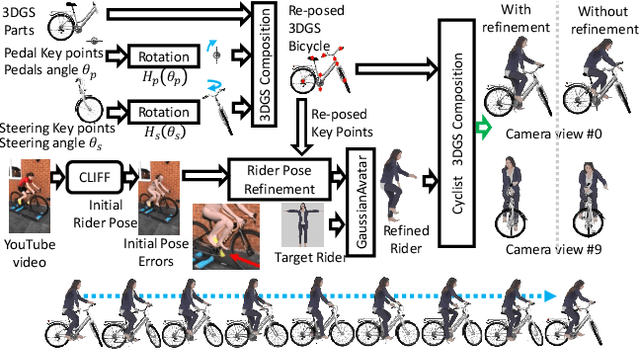
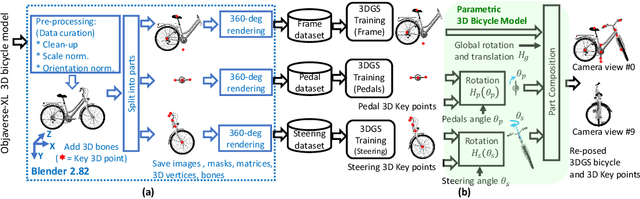
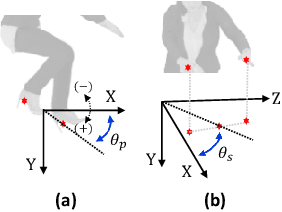
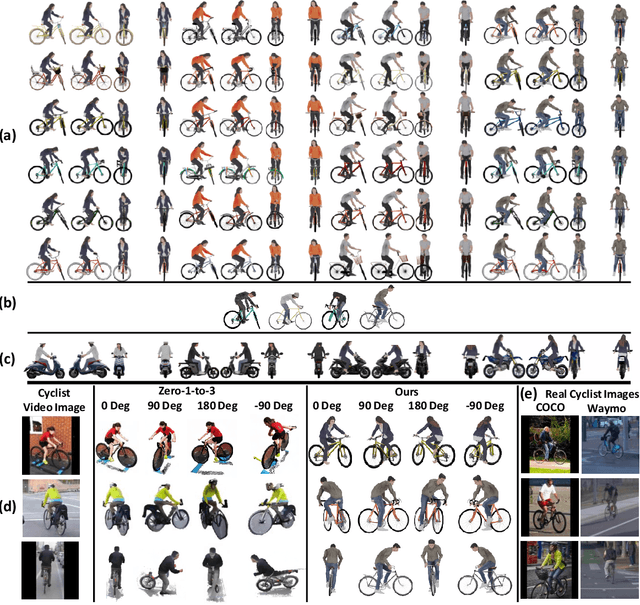
Human-object interaction (HOI) and human-scene interaction (HSI) are crucial for human-centric scene understanding applications in Embodied Artificial Intelligence (EAI), robotics, and augmented reality (AR). A common limitation faced in these research areas is the data scarcity problem: insufficient labeled human-scene object pairs on the input images, and limited interaction complexity and granularity between them. Recent HOI and HSI methods have addressed this issue by generating dynamic interactions with rigid objects. But more complex dynamic interactions such as a human rider pedaling an articulated bicycle have been unexplored. To address this limitation, and to enable research on complex dynamic human-articulated object interactions, in this paper we propose a method to generate simulated 3D dynamic cyclist assets and interactions. We designed a methodology for creating a new part-based multi-view articulated synthetic 3D bicycle dataset that we call 3DArticBikes that can be used to train NeRF and 3DGS-based 3D reconstruction methods. We then propose a 3DGS-based parametric bicycle composition model to assemble 8-DoF pose-controllable 3D bicycles. Finally, using dynamic information from cyclist videos, we build a complete synthetic dynamic 3D cyclist (rider pedaling a bicycle) by re-posing a selectable synthetic 3D person while automatically placing the rider onto one of our new articulated 3D bicycles using a proposed 3D Keypoint optimization-based Inverse Kinematics pose refinement. We present both, qualitative and quantitative results where we compare our generated cyclists against those from a recent stable diffusion-based method.
TopoFR: A Closer Look at Topology Alignment on Face Recognition
Oct 14, 2024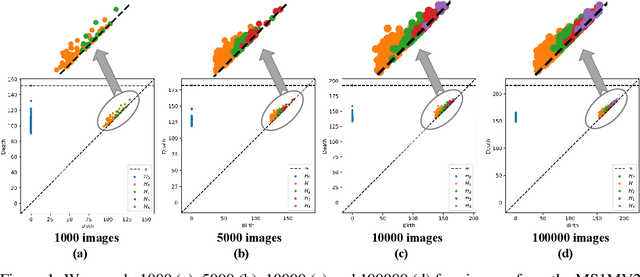

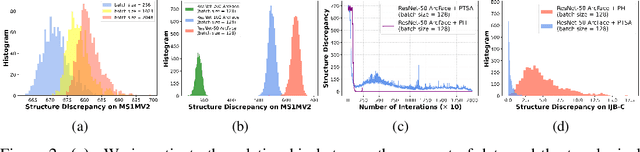
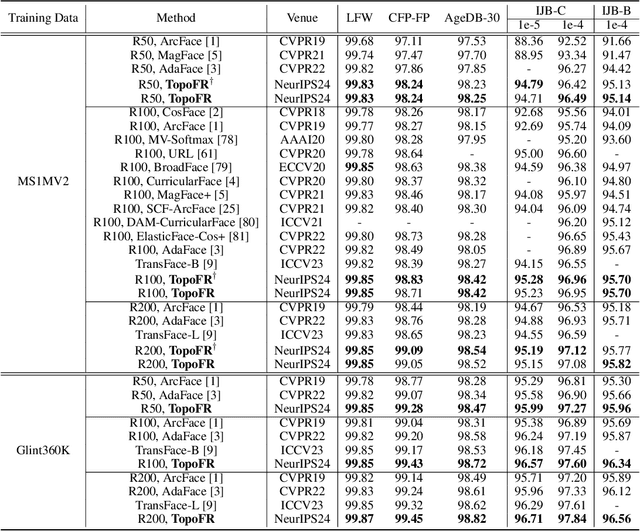
The field of face recognition (FR) has undergone significant advancements with the rise of deep learning. Recently, the success of unsupervised learning and graph neural networks has demonstrated the effectiveness of data structure information. Considering that the FR task can leverage large-scale training data, which intrinsically contains significant structure information, we aim to investigate how to encode such critical structure information into the latent space. As revealed from our observations, directly aligning the structure information between the input and latent spaces inevitably suffers from an overfitting problem, leading to a structure collapse phenomenon in the latent space. To address this problem, we propose TopoFR, a novel FR model that leverages a topological structure alignment strategy called PTSA and a hard sample mining strategy named SDE. Concretely, PTSA uses persistent homology to align the topological structures of the input and latent spaces, effectively preserving the structure information and improving the generalization performance of FR model. To mitigate the impact of hard samples on the latent space structure, SDE accurately identifies hard samples by automatically computing structure damage score (SDS) for each sample, and directs the model to prioritize optimizing these samples. Experimental results on popular face benchmarks demonstrate the superiority of our TopoFR over the state-of-the-art methods. Code and models are available at: https://github.com/modelscope/facechain/tree/main/face_module/TopoFR.