 Add to Chrome
 Add to Firefox
 Add to Edge
Adaptive Bregman Proximal Stochastic Gradient with a Stabilized Barzilai--Borwein Step Size
Aug 12, 2026
Bregman proximal stochastic gradient (BPSG) methods bring variance-reduced composite optimization to objectives whose geometry is poorly captured by Euclidean smoothness. Their performance, however, remains sensitive to the step size: raw stochastic curvature estimates can fluctuate sharply, whereas line searches add repeated proximal evaluations. We introduce Ada-BPSG, a line-search-free BPSG method that couples the SAGA gradient table with a stabilized Barzilai--Borwein (BB) candidate. A mediant aggregates incremental secant information so that nearly singular local ratios receive little weight, and an explicit safeguard translates the resulting curvature estimate into the bounded step-size sequence required for convergence. This design yields a direct analytical chain from relative smoothness and component-wise variance control to convergence in finite-dimensional normed spaces. We prove an $O(n/K)$ ergodic rate for convex objectives, a restarted linear rate under relative quadratic growth, and an $O(1/K)$ bound for a Bregman proximal residual in the nonconvex setting. On logistic regression and sparse nonnegative matrix factorization, Ada-BPSG combines low objective values with substantially less sensitivity to the initial step size than standard variance-reduced baselines, while avoiding line search.

OrderDP: A Theoretically Guaranteed Lossless Dynamic Data Pruning Framework
Jun 07, 2026Data pruning (DP), as an oft-stated strategy to alleviate heavy training burdens, reduces the volume of training samples according to a well-defined pruning method while striving for near-lossless performance. However, existing approaches, which commonly select highly informative samples, can lead to biased gradient estimation compared to full-dataset training. Furthermore, the analysis of this bias and its impact on final performance remains ambiguous. To address these challenges, we propose OrderDP, a plug-and-play framework that aims to obtain stable, unbiased, and near-lossless training acceleration with theoretical guarantees. Specifically, OrderDP first randomly selects a subset and then chooses the top-$q$ samples, where unbiasedness is established with respect to a surrogate loss. This ensures that OrderDP conducts unbiased training in terms of the surrogate objective. We further establish convergence and generalization analyses, elucidating how OrderDP affects optimal performance and enables well-controlled acceleration while ensuring guaranteed final performance. Empirically, we evaluate OrderDP against comprehensive baselines on CIFAR-10, CIFAR-100, and ImageNet-1K, demonstrating competitive accuracy, stable convergence, and exact control -- all with a simpler design and faster runtime, while reducing training cost by over 40%. Delivering both strong performance and computational efficiency, our method serves as a robust and easily adaptable tool for data-efficient learning. The code is publicly available at https://github.com/shengze-xu/OrderDP.
* Published as a conference paper at ICLR 2026
UniLab: A Heterogeneous Architecture for Robot RL Beyond GPU-Dominant Paradigms
Jun 02, 2026Simulation-based RL for contemporary robot control is increasingly organized around GPU-resident simulation: physics, rollout collection, and learning are placed on a single GPU-centric execution path. This paradigm has greatly improved training speed, but it has also encouraged a default assumption that efficient training requires physics to reside on the GPU. We revisit this assumption. Our view is that, in simulation-dominated robot control, the essential question is not which processor runs physics, but whether simulation throughput, policy learning, and runtime synchronization form an efficient end-to-end loop. We present UniLab, a heterogeneous CPU-simulation / GPU-learning architecture that decouples CPU-parallel simulation from GPU policy updates through a unified runtime for data movement, buffering, and synchronization. UniLab is implemented as a complete and extensible training system using MuJoCoUni and MotrixSim CPU-batched physics backends, supporting PPO, FastSAC, FlashSAC, and APPO. On representative simulation-based robot control tasks, UniLab improves end-to-end training efficiency by 3--10$\times$ under the same hardware configuration, while reducing dependence on the NVIDIA CUDA-based software stack and supporting cross-platform execution on the Apple macOS platform and the AMD ROCm and Intel XPU accelerator backends. These results show that GPU simulation is an effective path to efficient training, but not a necessary one, broadening the practical system choices available for robot RL training. Project page: https://unilabsim.github.io.
A Heterogeneous Architecture for Robot RL Beyond GPU-Dominant Paradigms
May 28, 2026Simulation-based RL for contemporary robot control is increasingly organized around GPU-resident simulation: physics, rollout collection, and learning are placed on a single GPU-centric execution path. This paradigm has greatly improved training speed, but it has also encouraged a default assumption that efficient training requires physics to reside on the GPU. We revisit this assumption. Our view is that, in simulation-dominated robot control, the essential question is not which processor runs physics, but whether simulation throughput, policy learning, and runtime synchronization form an efficient end-to-end loop. We present UniLab, a heterogeneous CPU-simulation / GPU-learning architecture that decouples CPU-parallel simulation from GPU policy updates through a unified runtime for data movement, buffering, and synchronization. UniLab is implemented as a complete and extensible training system using MuJoCoUni and MotrixSim CPU-batched physics backends, supporting PPO, SAC, FlashSAC, TD3, and APPO. On representative simulation-based robot control tasks, UniLab improves end-to-end training efficiency by 3--10$\times$ under the same hardware configuration, while reducing dependence on the NVIDIA CUDA-based software stack and supporting cross-platform execution on the Apple macOS platform and the AMD ROCm and Intel XPU accelerator backends. These results show that GPU simulation is an effective path to efficient training, but not a necessary one, broadening the practical system choices available for robot RL training. Project page: https://github.com/unilabsim/UniLab.
DM0: An Embodied-Native Vision-Language-Action Model towards Physical AI
Feb 16, 2026Moving beyond the traditional paradigm of adapting internet-pretrained models to physical tasks, we present DM0, an Embodied-Native Vision-Language-Action (VLA) framework designed for Physical AI. Unlike approaches that treat physical grounding as a fine-tuning afterthought, DM0 unifies embodied manipulation and navigation by learning from heterogeneous data sources from the onset. Our methodology follows a comprehensive three-stage pipeline: Pretraining, Mid-Training, and Post-Training. First, we conduct large-scale unified pretraining on the Vision-Language Model (VLM) using diverse corpora--seamlessly integrating web text, autonomous driving scenarios, and embodied interaction logs-to jointly acquire semantic knowledge and physical priors. Subsequently, we build a flow-matching action expert atop the VLM. To reconcile high-level reasoning with low-level control, DM0 employs a hybrid training strategy: for embodied data, gradients from the action expert are not backpropagated to the VLM to preserve generalized representations, while the VLM remains trainable on non-embodied data. Furthermore, we introduce an Embodied Spatial Scaffolding strategy to construct spatial Chain-of-Thought (CoT) reasoning, effectively constraining the action solution space. Experiments on the RoboChallenge benchmark demonstrate that DM0 achieves state-of-the-art performance in both Specialist and Generalist settings on Table30.
Split4D: Decomposed 4D Scene Reconstruction Without Video Segmentation
Dec 28, 2025This paper addresses the problem of decomposed 4D scene reconstruction from multi-view videos. Recent methods achieve this by lifting video segmentation results to a 4D representation through differentiable rendering techniques. Therefore, they heavily rely on the quality of video segmentation maps, which are often unstable, leading to unreliable reconstruction results. To overcome this challenge, our key idea is to represent the decomposed 4D scene with the Freetime FeatureGS and design a streaming feature learning strategy to accurately recover it from per-image segmentation maps, eliminating the need for video segmentation. Freetime FeatureGS models the dynamic scene as a set of Gaussian primitives with learnable features and linear motion ability, allowing them to move to neighboring regions over time. We apply a contrastive loss to Freetime FeatureGS, forcing primitive features to be close or far apart based on whether their projections belong to the same instance in the 2D segmentation map. As our Gaussian primitives can move across time, it naturally extends the feature learning to the temporal dimension, achieving 4D segmentation. Furthermore, we sample observations for training in a temporally ordered manner, enabling the streaming propagation of features over time and effectively avoiding local minima during the optimization process. Experimental results on several datasets show that the reconstruction quality of our method outperforms recent methods by a large margin.
StreamingTalker: Audio-driven 3D Facial Animation with Autoregressive Diffusion Model
Nov 19, 2025


This paper focuses on the task of speech-driven 3D facial animation, which aims to generate realistic and synchronized facial motions driven by speech inputs. Recent methods have employed audio-conditioned diffusion models for 3D facial animation, achieving impressive results in generating expressive and natural animations. However, these methods process the whole audio sequences in a single pass, which poses two major challenges: they tend to perform poorly when handling audio sequences that exceed the training horizon and will suffer from significant latency when processing long audio inputs. To address these limitations, we propose a novel autoregressive diffusion model that processes input audio in a streaming manner. This design ensures flexibility with varying audio lengths and achieves low latency independent of audio duration. Specifically, we select a limited number of past frames as historical motion context and combine them with the audio input to create a dynamic condition. This condition guides the diffusion process to iteratively generate facial motion frames, enabling real-time synthesis with high-quality results. Additionally, we implemented a real-time interactive demo, highlighting the effectiveness and efficiency of our approach. We will release the code at https://zju3dv.github.io/StreamingTalker/.
RAGNet: Large-scale Reasoning-based Affordance Segmentation Benchmark towards General Grasping
Jul 31, 2025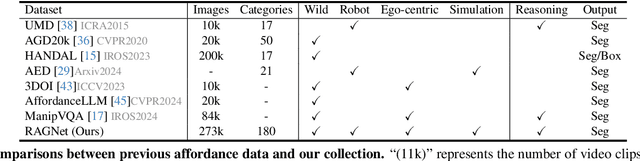
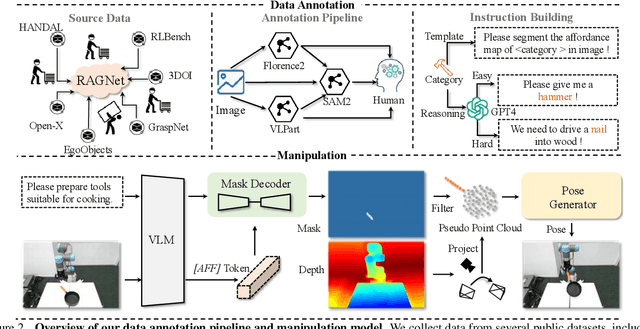
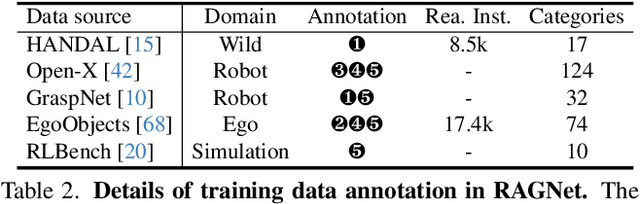
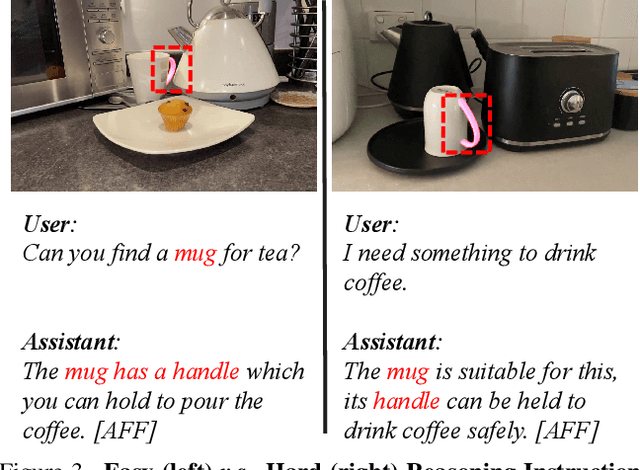
General robotic grasping systems require accurate object affordance perception in diverse open-world scenarios following human instructions. However, current studies suffer from the problem of lacking reasoning-based large-scale affordance prediction data, leading to considerable concern about open-world effectiveness. To address this limitation, we build a large-scale grasping-oriented affordance segmentation benchmark with human-like instructions, named RAGNet. It contains 273k images, 180 categories, and 26k reasoning instructions. The images cover diverse embodied data domains, such as wild, robot, ego-centric, and even simulation data. They are carefully annotated with an affordance map, while the difficulty of language instructions is largely increased by removing their category name and only providing functional descriptions. Furthermore, we propose a comprehensive affordance-based grasping framework, named AffordanceNet, which consists of a VLM pre-trained on our massive affordance data and a grasping network that conditions an affordance map to grasp the target. Extensive experiments on affordance segmentation benchmarks and real-robot manipulation tasks show that our model has a powerful open-world generalization ability. Our data and code is available at https://github.com/wudongming97/AffordanceNet.
PADriver: Towards Personalized Autonomous Driving
May 08, 2025In this paper, we propose PADriver, a novel closed-loop framework for personalized autonomous driving (PAD). Built upon Multi-modal Large Language Model (MLLM), PADriver takes streaming frames and personalized textual prompts as inputs. It autoaggressively performs scene understanding, danger level estimation and action decision. The predicted danger level reflects the risk of the potential action and provides an explicit reference for the final action, which corresponds to the preset personalized prompt. Moreover, we construct a closed-loop benchmark named PAD-Highway based on Highway-Env simulator to comprehensively evaluate the decision performance under traffic rules. The dataset contains 250 hours videos with high-quality annotation to facilitate the development of PAD behavior analysis. Experimental results on the constructed benchmark show that PADriver outperforms state-of-the-art approaches on different evaluation metrics, and enables various driving modes.
LMS-Net: A Learned Mumford-Shah Network For Few-Shot Medical Image Segmentation
Feb 08, 2025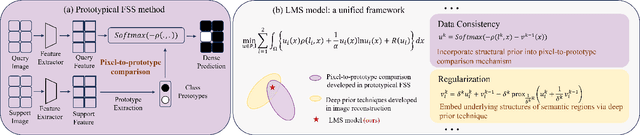
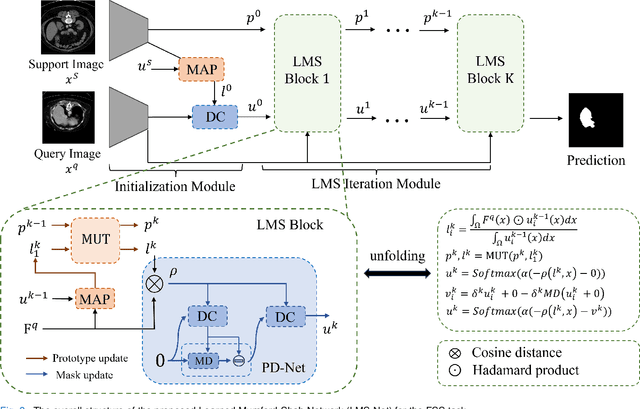
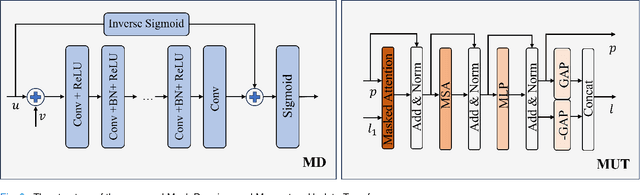
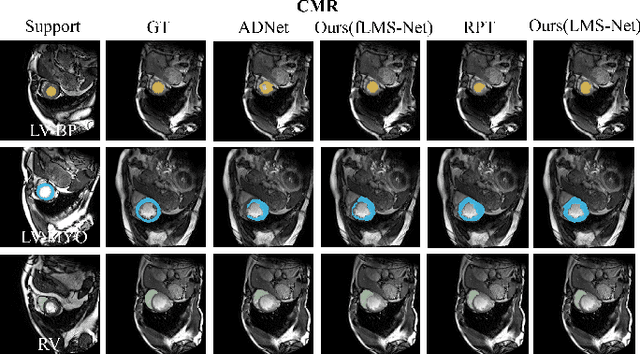
Few-shot semantic segmentation (FSS) methods have shown great promise in handling data-scarce scenarios, particularly in medical image segmentation tasks. However, most existing FSS architectures lack sufficient interpretability and fail to fully incorporate the underlying physical structures of semantic regions. To address these issues, in this paper, we propose a novel deep unfolding network, called the Learned Mumford-Shah Network (LMS-Net), for the FSS task. Specifically, motivated by the effectiveness of pixel-to-prototype comparison in prototypical FSS methods and the capability of deep priors to model complex spatial structures, we leverage our learned Mumford-Shah model (LMS model) as a mathematical foundation to integrate these insights into a unified framework. By reformulating the LMS model into prototype update and mask update tasks, we propose an alternating optimization algorithm to solve it efficiently. Further, the iterative steps of this algorithm are unfolded into corresponding network modules, resulting in LMS-Net with clear interpretability. Comprehensive experiments on three publicly available medical segmentation datasets verify the effectiveness of our method, demonstrating superior accuracy and robustness in handling complex structures and adapting to challenging segmentation scenarios. These results highlight the potential of LMS-Net to advance FSS in medical imaging applications. Our code will be available at: https://github.com/SDZhang01/LMSNet