 Add to Chrome
 Add to Firefox
 Add to Edge
AutoSAM: an Agentic Framework for Automating Input File Generation for the SAM Code with Multi-Modal Retrieval-Augmented Generation
Mar 25, 2026
In the design and safety analysis of advanced reactor systems, constructing input files for system-level thermal-hydraulics codes such as the System Analysis Module (SAM) remains a labor-intensive task. Analysts must extract and reconcile design data from heterogeneous engineering documents and manually translate it into solver-specific syntax. In this paper, we present AutoSAM, an agentic framework that automates SAM input file generation. The framework combines a large language model agent with retrieval-augmented generation over the solver's user guide and theory manual, together with specialized tools for analyzing PDFs, images, spreadsheets, and text files. AutoSAM ingests unstructured engineering documents, including system diagrams, design reports, and data tables, extracts simulation-relevant parameters into a human-auditable intermediate representation, and synthesizes validated, solver-compatible input decks. Its multimodal retrieval pipeline integrates scientific text extraction, vision-based figure interpretation, semantic embedding, and query answering. We evaluate AutoSAM on four case studies of increasing complexity: a single-pipe steady-state model, a solid-fuel channel with temperature reactivity feedback, the Advanced Burner Test Reactor core, and the Molten Salt Reactor Experiment primary loop. Across all cases, the agent produces runnable SAM models consistent with expected thermal-hydraulic behavior while explicitly identifying missing data and labeling assumed values. The framework achieves 100% utilization of structured inputs, about 88% extraction from PDF text, and 100% completeness in vision-based geometric extraction. These results demonstrate a practical path toward prompt-driven reactor modeling, in which analysts provide system descriptions and supporting documentation while the agent translates them into transparent, and executable, SAM simulations.

An AI-Driven Thermal-Fluid Testbed for Advanced Small Modular Reactors: Integration of Digital Twin and Large Language Models
Jul 08, 2025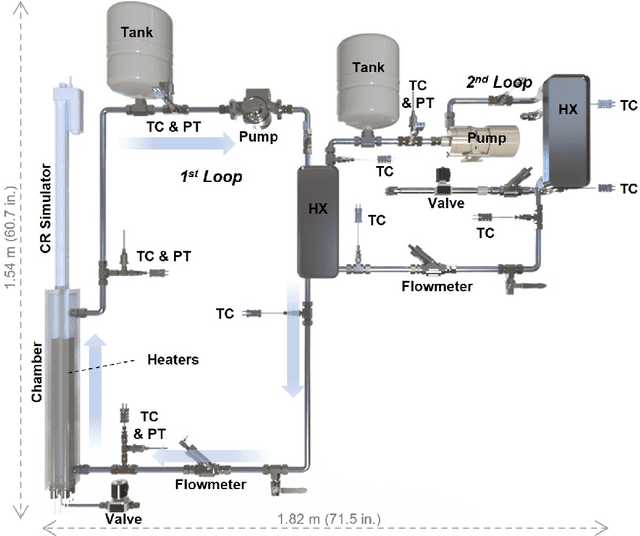
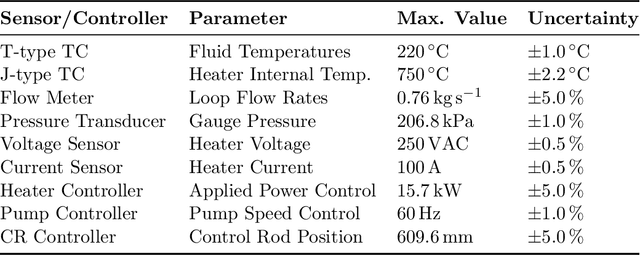
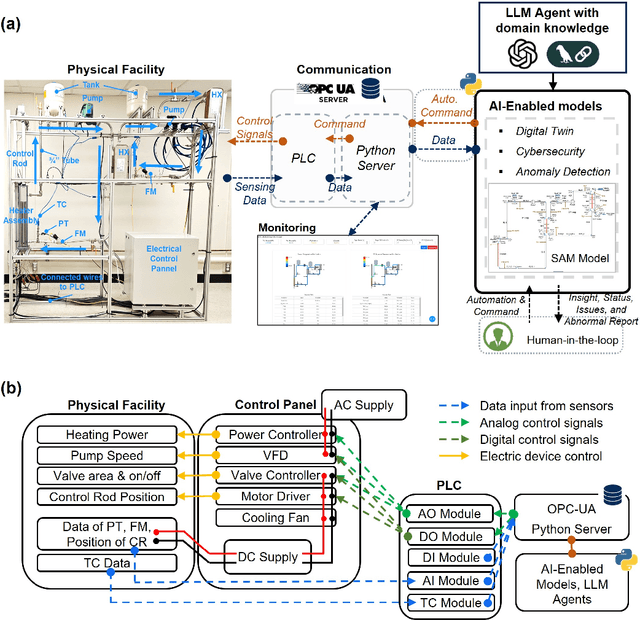
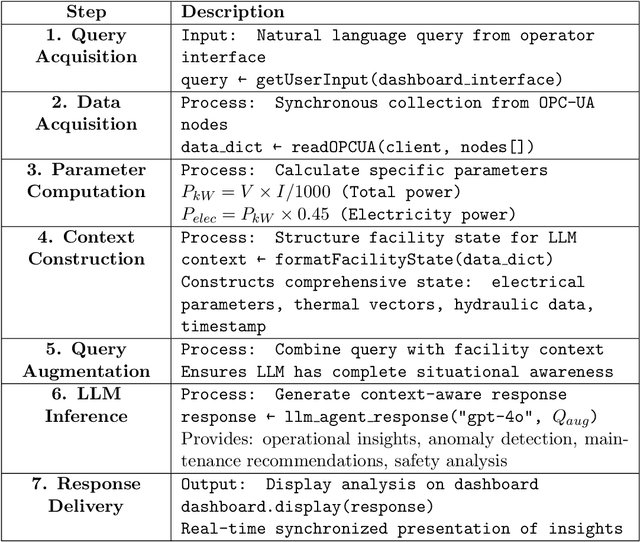
This paper presents a multipurpose artificial intelligence (AI)-driven thermal-fluid testbed designed to advance Small Modular Reactor technologies by seamlessly integrating physical experimentation with advanced computational intelligence. The platform uniquely combines a versatile three-loop thermal-fluid facility with a high-fidelity digital twin and sophisticated AI frameworks for real-time prediction, control, and operational assistance. Methodologically, the testbed's digital twin, built upon the System Analysis Module code, is coupled with a Gated Recurrent Unit (GRU) neural network. This machine learning model, trained on experimental data, enables faster-than-real-time simulation, providing predictive insights into the system's dynamic behavior. The practical application of this AI integration is showcased through case studies. An AI-driven control framework where the GRU model accurately forecasts future system states and the corresponding control actions required to meet operational demands. Furthermore, an intelligent assistant, powered by a large language model, translates complex sensor data and simulation outputs into natural language, offering operators actionable analysis and safety recommendations. Comprehensive validation against experimental transients confirms the platform's high fidelity, with the GRU model achieving a temperature prediction root mean square error of 1.42 K. This work establishes an integrated research environment at the intersection of AI and thermal-fluid science, showcasing how AI-driven methodologies in modeling, control, and operator support can accelerate the innovation and deployment of next-generation nuclear systems.
AutoFLUKA: A Large Language Model Based Framework for Automating Monte Carlo Simulations in FLUKA
Oct 19, 2024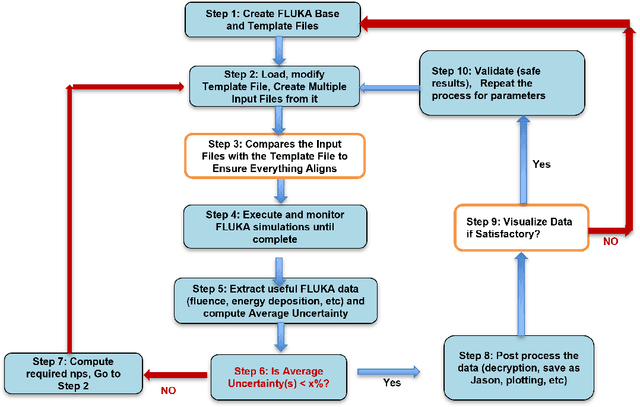


Monte Carlo (MC) simulations, particularly using FLUKA, are essential for replicating real-world scenarios across scientific and engineering fields. Despite the robustness and versatility, FLUKA faces significant limitations in automation and integration with external post-processing tools, leading to workflows with a steep learning curve, which are time-consuming and prone to human errors. Traditional methods involving the use of shell and Python scripts, MATLAB, and Microsoft Excel require extensive manual intervention and lack flexibility, adding complexity to evolving scenarios. This study explores the potential of Large Language Models (LLMs) and AI agents to address these limitations. AI agents, integrate natural language processing with autonomous reasoning for decision-making and adaptive planning, making them ideal for automation. We introduce AutoFLUKA, an AI agent application developed using the LangChain Python Framework to automate typical MC simulation workflows in FLUKA. AutoFLUKA can modify FLUKA input files, execute simulations, and efficiently process results for visualization, significantly reducing human labor and error. Our case studies demonstrate that AutoFLUKA can handle both generalized and domain-specific cases, such as Microdosimetry, with an streamlined automated workflow, showcasing its scalability and flexibility. The study also highlights the potential of Retrieval Augmentation Generation (RAG) tools to act as virtual assistants for FLUKA, further improving user experience, time and efficiency. In conclusion, AutoFLUKA represents a significant advancement in automating MC simulation workflows, offering a robust solution to the inherent limitations. This innovation not only saves time and resources but also opens new paradigms for research and development in high energy physics, medical physics, nuclear engineering space and environmental science.