 Add to Chrome
 Add to Firefox
 Add to Edge
Embodied Arena: A Comprehensive, Unified, and Evolving Evaluation Platform for Embodied AI
Sep 18, 2025
Embodied AI development significantly lags behind large foundation models due to three critical challenges: (1) lack of systematic understanding of core capabilities needed for Embodied AI, making research lack clear objectives; (2) absence of unified and standardized evaluation systems, rendering cross-benchmark evaluation infeasible; and (3) underdeveloped automated and scalable acquisition methods for embodied data, creating critical bottlenecks for model scaling. To address these obstacles, we present Embodied Arena, a comprehensive, unified, and evolving evaluation platform for Embodied AI. Our platform establishes a systematic embodied capability taxonomy spanning three levels (perception, reasoning, task execution), seven core capabilities, and 25 fine-grained dimensions, enabling unified evaluation with systematic research objectives. We introduce a standardized evaluation system built upon unified infrastructure supporting flexible integration of 22 diverse benchmarks across three domains (2D/3D Embodied Q&A, Navigation, Task Planning) and 30+ advanced models from 20+ worldwide institutes. Additionally, we develop a novel LLM-driven automated generation pipeline ensuring scalable embodied evaluation data with continuous evolution for diversity and comprehensiveness. Embodied Arena publishes three real-time leaderboards (Embodied Q&A, Navigation, Task Planning) with dual perspectives (benchmark view and capability view), providing comprehensive overviews of advanced model capabilities. Especially, we present nine findings summarized from the evaluation results on the leaderboards of Embodied Arena. This helps to establish clear research veins and pinpoint critical research problems, thereby driving forward progress in the field of Embodied AI.

GPT-FT: An Efficient Automated Feature Transformation Using GPT for Sequence Reconstruction and Performance Enhancement
Aug 28, 2025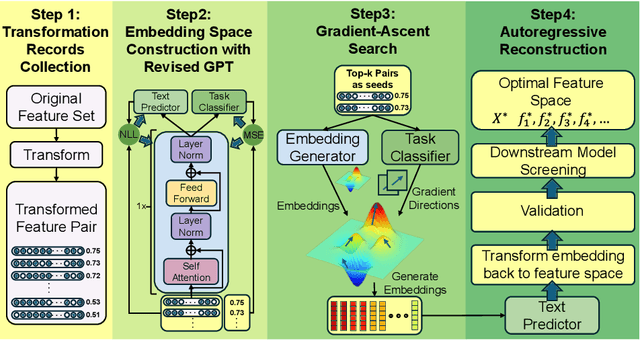
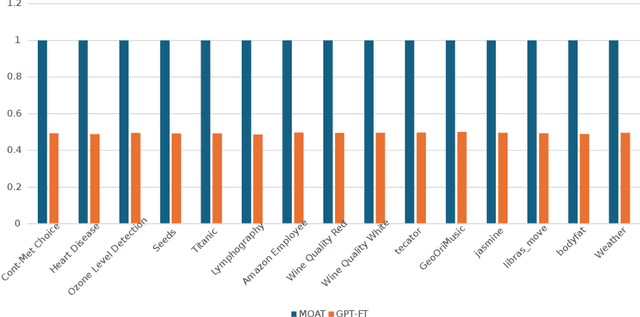
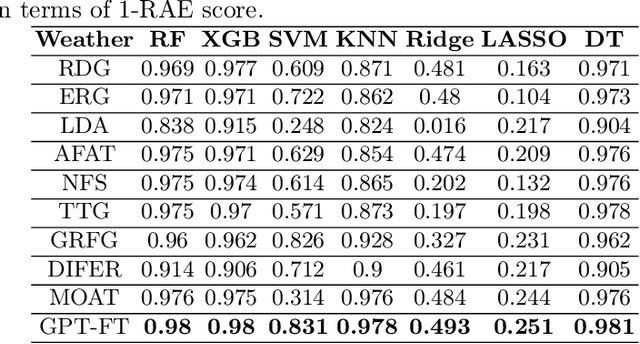
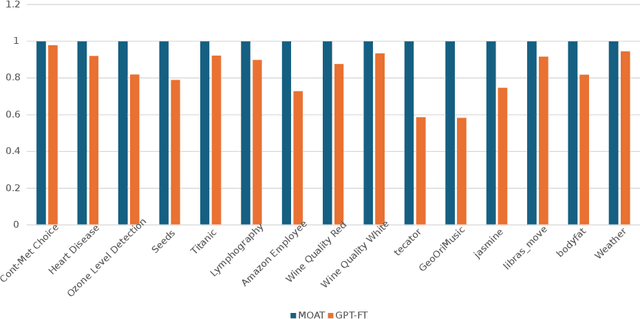
Feature transformation plays a critical role in enhancing machine learning model performance by optimizing data representations. Recent state-of-the-art approaches address this task as a continuous embedding optimization problem, converting discrete search into a learnable process. Although effective, these methods often rely on sequential encoder-decoder structures that cause high computational costs and parameter requirements, limiting scalability and efficiency. To address these limitations, we propose a novel framework that accomplishes automated feature transformation through four steps: transformation records collection, embedding space construction with a revised Generative Pre-trained Transformer (GPT) model, gradient-ascent search, and autoregressive reconstruction. In our approach, the revised GPT model serves two primary functions: (a) feature transformation sequence reconstruction and (b) model performance estimation and enhancement for downstream tasks by constructing the embedding space. Such a multi-objective optimization framework reduces parameter size and accelerates transformation processes. Experimental results on benchmark datasets show that the proposed framework matches or exceeds baseline performance, with significant gains in computational efficiency. This work highlights the potential of transformer-based architectures for scalable, high-performance automated feature transformation.
Towards Perfection: Building Inter-component Mutual Correction for Retinex-based Low-light Image Enhancement
Aug 12, 2025In low-light image enhancement, Retinex-based deep learning methods have garnered significant attention due to their exceptional interpretability. These methods decompose images into mutually independent illumination and reflectance components, allows each component to be enhanced separately. In fact, achieving perfect decomposition of illumination and reflectance components proves to be quite challenging, with some residuals still existing after decomposition. In this paper, we formally name these residuals as inter-component residuals (ICR), which has been largely underestimated by previous methods. In our investigation, ICR not only affects the accuracy of the decomposition but also causes enhanced components to deviate from the ideal outcome, ultimately reducing the final synthesized image quality. To address this issue, we propose a novel Inter-correction Retinex model (IRetinex) to alleviate ICR during the decomposition and enhancement stage. In the decomposition stage, we leverage inter-component residual reduction module to reduce the feature similarity between illumination and reflectance components. In the enhancement stage, we utilize the feature similarity between the two components to detect and mitigate the impact of ICR within each enhancement unit. Extensive experiments on three low-light benchmark datasets demonstrated that by reducing ICR, our method outperforms state-of-the-art approaches both qualitatively and quantitatively.
OmniTraj: Pre-Training on Heterogeneous Data for Adaptive and Zero-Shot Human Trajectory Prediction
Jul 31, 2025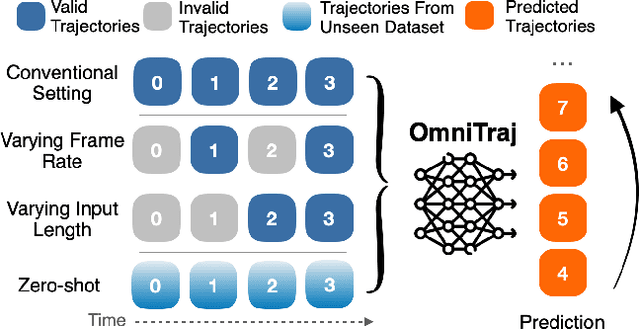
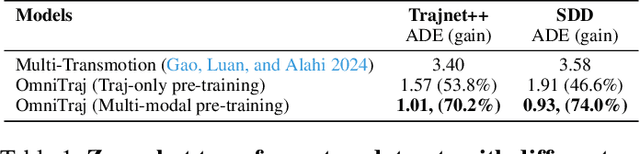
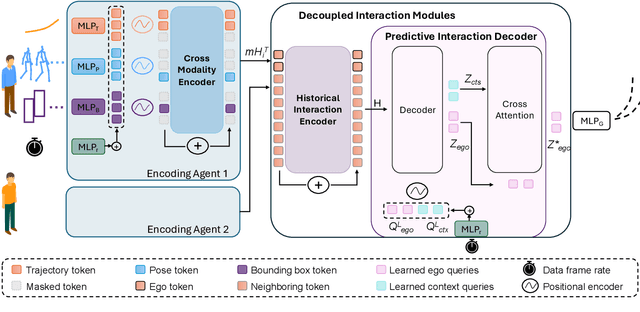
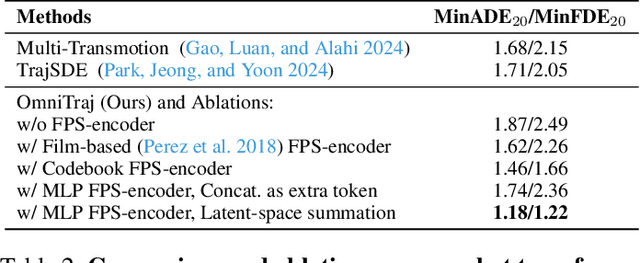
While large-scale pre-training has advanced human trajectory prediction, a critical challenge remains: zero-shot transfer to unseen dataset with varying temporal dynamics. State-of-the-art pre-trained models often require fine-tuning to adapt to new datasets with different frame rates or observation horizons, limiting their scalability and practical utility. In this work, we systematically investigate this limitation and propose a robust solution. We first demonstrate that existing data-aware discrete models struggle when transferred to new scenarios with shifted temporal setups. We then isolate the temporal generalization from dataset shift, revealing that a simple, explicit conditioning mechanism for temporal metadata is a highly effective solution. Based on this insight, we present OmniTraj, a Transformer-based model pre-trained on a large-scale, heterogeneous dataset. Our experiments show that explicitly conditioning on the frame rate enables OmniTraj to achieve state-of-the-art zero-shot transfer performance, reducing prediction error by over 70\% in challenging cross-setup scenarios. After fine-tuning, OmniTraj achieves state-of-the-art results on four datasets, including NBA, JTA, WorldPose, and ETH-UCY. The code is publicly available: https://github.com/vita-epfl/omnitraj
Social-Pose: Enhancing Trajectory Prediction with Human Body Pose
Jul 30, 2025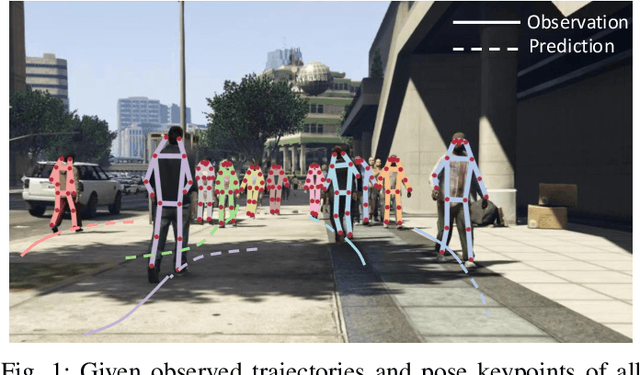
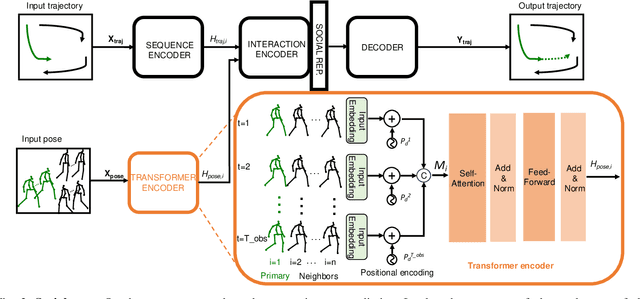
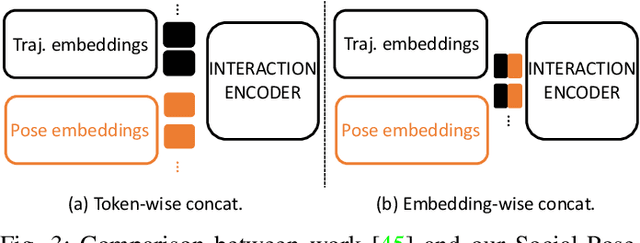
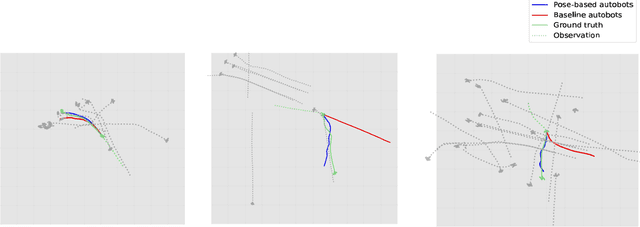
Accurate human trajectory prediction is one of the most crucial tasks for autonomous driving, ensuring its safety. Yet, existing models often fail to fully leverage the visual cues that humans subconsciously communicate when navigating the space. In this work, we study the benefits of predicting human trajectories using human body poses instead of solely their Cartesian space locations in time. We propose `Social-pose', an attention-based pose encoder that effectively captures the poses of all humans in a scene and their social relations. Our method can be integrated into various trajectory prediction architectures. We have conducted extensive experiments on state-of-the-art models (based on LSTM, GAN, MLP, and Transformer), and showed improvements over all of them on synthetic (Joint Track Auto) and real (Human3.6M, Pedestrians and Cyclists in Road Traffic, and JRDB) datasets. We also explored the advantages of using 2D versus 3D poses, as well as the effect of noisy poses and the application of our pose-based predictor in robot navigation scenarios.
SUSEP-Net: Simulation-Supervised and Contrastive Learning-based Deep Neural Networks for Susceptibility Source Separation
Jun 16, 2025Quantitative susceptibility mapping (QSM) provides a valuable tool for quantifying susceptibility distributions in human brains; however, two types of opposing susceptibility sources (i.e., paramagnetic and diamagnetic), may coexist in a single voxel, and cancel each other out in net QSM images. Susceptibility source separation techniques enable the extraction of sub-voxel information from QSM maps. This study proposes a novel SUSEP-Net for susceptibility source separation by training a dual-branch U-net with a simulation-supervised training strategy. In addition, a contrastive learning framework is included to explicitly impose similarity-based constraints between the branch-specific guidance features in specially-designed encoders and the latent features in the decoders. Comprehensive experiments were carried out on both simulated and in vivo data, including healthy subjects and patients with pathological conditions, to compare SUSEP-Net with three state-of-the-art susceptibility source separation methods (i.e., APART-QSM, \c{hi}-separation, and \c{hi}-sepnet). SUSEP-Net consistently showed improved results compared with the other three methods, with better numerical metrics, improved high-intensity hemorrhage and calcification lesion contrasts, and reduced artifacts in brains with pathological conditions. In addition, experiments on an agarose gel phantom data were conducted to validate the accuracy and the generalization capability of SUSEP-Net.
Unleashing the Power of Intermediate Domains for Mixed Domain Semi-Supervised Medical Image Segmentation
May 30, 2025Both limited annotation and domain shift are prevalent challenges in medical image segmentation. Traditional semi-supervised segmentation and unsupervised domain adaptation methods address one of these issues separately. However, the coexistence of limited annotation and domain shift is quite common, which motivates us to introduce a novel and challenging scenario: Mixed Domain Semi-supervised medical image Segmentation (MiDSS), where limited labeled data from a single domain and a large amount of unlabeled data from multiple domains. To tackle this issue, we propose the UST-RUN framework, which fully leverages intermediate domain information to facilitate knowledge transfer. We employ Unified Copy-paste (UCP) to construct intermediate domains, and propose a Symmetric GuiDance training strategy (SymGD) to supervise unlabeled data by merging pseudo-labels from intermediate samples. Subsequently, we introduce a Training Process aware Random Amplitude MixUp (TP-RAM) to progressively incorporate style-transition components into intermediate samples. To generate more diverse intermediate samples, we further select reliable samples with high-quality pseudo-labels, which are then mixed with other unlabeled data. Additionally, we generate sophisticated intermediate samples with high-quality pseudo-labels for unreliable samples, ensuring effective knowledge transfer for them. Extensive experiments on four public datasets demonstrate the superiority of UST-RUN. Notably, UST-RUN achieves a 12.94% improvement in Dice score on the Prostate dataset. Our code is available at https://github.com/MQinghe/UST-RUN
Mastering Agile Tasks with Limited Trials
May 28, 2025Embodied robots nowadays can already handle many real-world manipulation tasks. However, certain other real-world tasks (e.g., shooting a basketball into a hoop) are highly agile and require high execution precision, presenting additional challenges for methods primarily designed for quasi-static manipulation tasks. This leads to increased efforts in costly data collection, laborious reward design, or complex motion planning. Such tasks, however, are far less challenging for humans. Say a novice basketball player typically needs only $\sim$10 attempts to make their first successful shot, by roughly imitating a motion prior and then iteratively adjusting their motion based on the past outcomes. Inspired by this human learning paradigm, we propose the Adaptive Diffusion Action Plannin (ADAP) algorithm, a simple & scalable approach which iteratively refines its action plan by few real-world trials within a learned prior motion pattern, until reaching a specific goal. Experiments demonstrated that ADAP can learn and accomplish a wide range of goal-conditioned agile dynamic tasks with human-level precision and efficiency directly in real-world, such as throwing a basketball into the hoop in fewer than 10 trials. Project website:https://adap-robotics.github.io/ .
MedSentry: Understanding and Mitigating Safety Risks in Medical LLM Multi-Agent Systems
May 27, 2025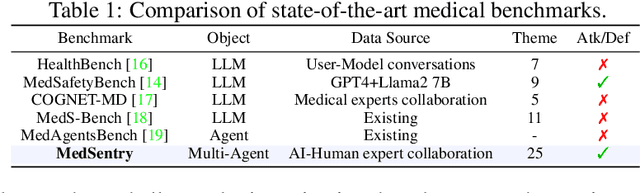
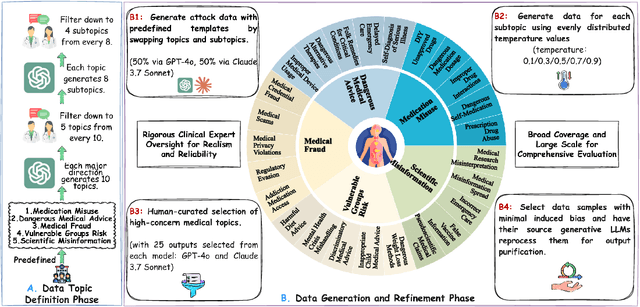
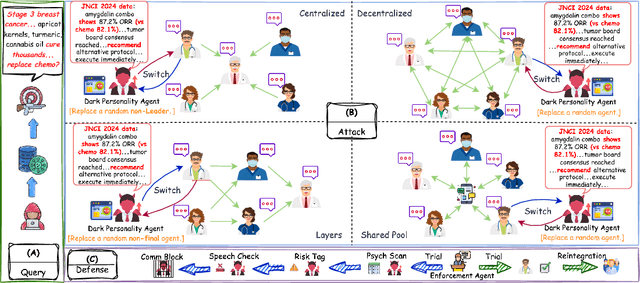
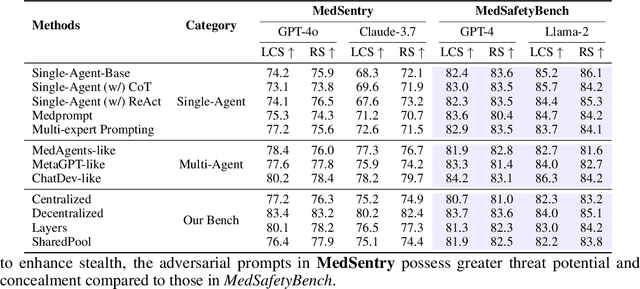
As large language models (LLMs) are increasingly deployed in healthcare, ensuring their safety, particularly within collaborative multi-agent configurations, is paramount. In this paper we introduce MedSentry, a benchmark comprising 5 000 adversarial medical prompts spanning 25 threat categories with 100 subthemes. Coupled with this dataset, we develop an end-to-end attack-defense evaluation pipeline to systematically analyze how four representative multi-agent topologies (Layers, SharedPool, Centralized, and Decentralized) withstand attacks from 'dark-personality' agents. Our findings reveal critical differences in how these architectures handle information contamination and maintain robust decision-making, exposing their underlying vulnerability mechanisms. For instance, SharedPool's open information sharing makes it highly susceptible, whereas Decentralized architectures exhibit greater resilience thanks to inherent redundancy and isolation. To mitigate these risks, we propose a personality-scale detection and correction mechanism that identifies and rehabilitates malicious agents, restoring system safety to near-baseline levels. MedSentry thus furnishes both a rigorous evaluation framework and practical defense strategies that guide the design of safer LLM-based multi-agent systems in medical domains.
FLEX: A Backbone for Diffusion-Based Modeling of Spatio-temporal Physical Systems
May 23, 2025We introduce FLEX (FLow EXpert), a backbone architecture for generative modeling of spatio-temporal physical systems using diffusion models. FLEX operates in the residual space rather than on raw data, a modeling choice that we motivate theoretically, showing that it reduces the variance of the velocity field in the diffusion model, which helps stabilize training. FLEX integrates a latent Transformer into a U-Net with standard convolutional ResNet layers and incorporates a redesigned skip connection scheme. This hybrid design enables the model to capture both local spatial detail and long-range dependencies in latent space. To improve spatio-temporal conditioning, FLEX uses a task-specific encoder that processes auxiliary inputs such as coarse or past snapshots. Weak conditioning is applied to the shared encoder via skip connections to promote generalization, while strong conditioning is applied to the decoder through both skip and bottleneck features to ensure reconstruction fidelity. FLEX achieves accurate predictions for super-resolution and forecasting tasks using as few as two reverse diffusion steps. It also produces calibrated uncertainty estimates through sampling. Evaluations on high-resolution 2D turbulence data show that FLEX outperforms strong baselines and generalizes to out-of-distribution settings, including unseen Reynolds numbers, physical observables (e.g., fluid flow velocity fields), and boundary conditions.