 Add to Chrome
 Add to Firefox
 Add to Edge
GoldenRetriever: Non-Interactive Homomorphic Encrypted Retrieval for Privacy-Preserving RAG
Jul 31, 2026
Retrieval-Augmented Generation (RAG) enhances large language models by incorporating external knowledge, but existing pipelines typically operate on plaintext data, raising significant privacy concerns. Prior work on privacy-preserving retrieval leverages cryptographic techniques such as homomorphic encryption (HE) and private information retrieval (PIR), but often relies on interactive protocols or ranking-based selection mechanisms that incur high latency and potential information leakage. In this paper, we propose a practical non-interactive encrypted retrieval framework for RAG based on threshold selection. Instead of performing expensive top-$k$ ranking under encryption, our approach selects documents whose similarity scores exceed a predefined threshold, reducing computational complexity from quadratic to linear in the corpus size. We implement this design using CKKS-based homomorphic computation, enabling fully encrypted similarity evaluation and document selection without revealing query content, intermediate scores, or selected indices. To bridge the gap between approximate encrypted computation and discrete token reconstruction, we introduce a precision-stable mask polarization method that ensures accurate recovery of selected documents. Experiments on standard retrieval benchmarks demonstrate that our approach achieves competitive retrieval effectiveness while significantly reducing latency compared to ranking-based encrypted methods. These results highlight threshold-based selection as a practical foundation for scalable and secure RAG systems.

Improving MPI Error Detection and Repair with Large Language Models and Bug References
Apr 02, 2026Message Passing Interface (MPI) is a foundational technology in high-performance computing (HPC), widely used for large-scale simulations and distributed training (e.g., in machine learning frameworks such as PyTorch and TensorFlow). However, maintaining MPI programs remains challenging due to their complex interplay among processes and the intricacies of message passing and synchronization. With the advancement of large language models like ChatGPT, it is tempting to adopt such technology for automated error detection and repair. Yet, our studies reveal that directly applying large language models (LLMs) yields suboptimal results, largely because these models lack essential knowledge about correct and incorrect usage, particularly the bugs found in MPI programs. In this paper, we design a bug detection and repair technique alongside Few-Shot Learning (FSL), Chain-of-Thought (CoT) reasoning, and Retrieval Augmented Generation (RAG) techniques in LLMs to enhance the large language model's ability to detect and repair errors. Surprisingly, such enhancements lead to a significant improvement, from 44% to 77%, in error detection accuracy compared to baseline methods that use ChatGPT directly. Additionally, our experiments demonstrate our bug referencing technique generalizes well to other large language models.
* 41 pages, 8 figures
GPT-FT: An Efficient Automated Feature Transformation Using GPT for Sequence Reconstruction and Performance Enhancement
Aug 28, 2025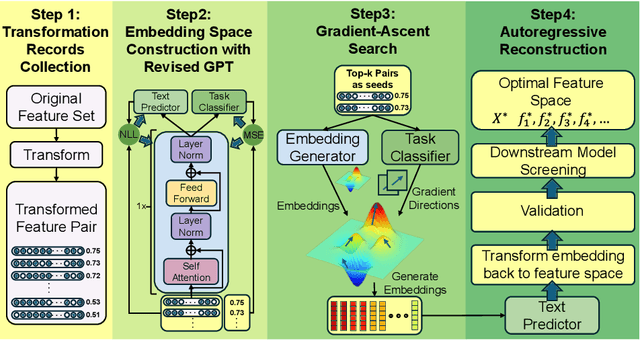
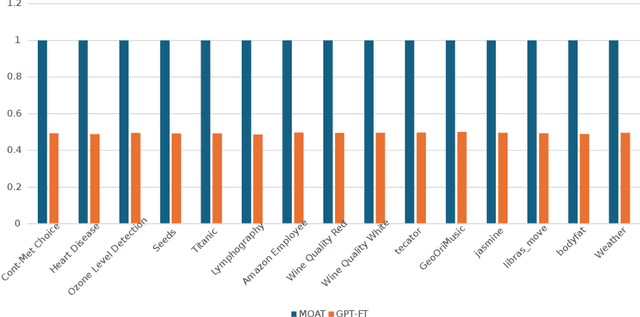
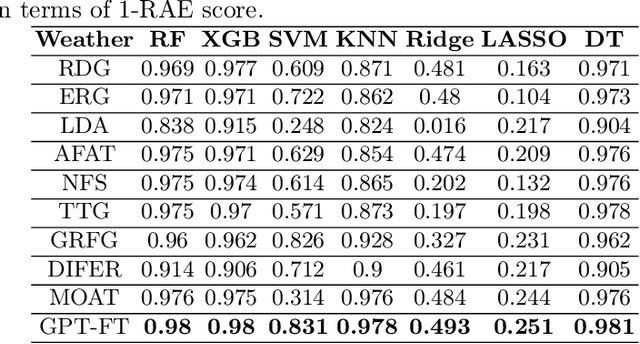
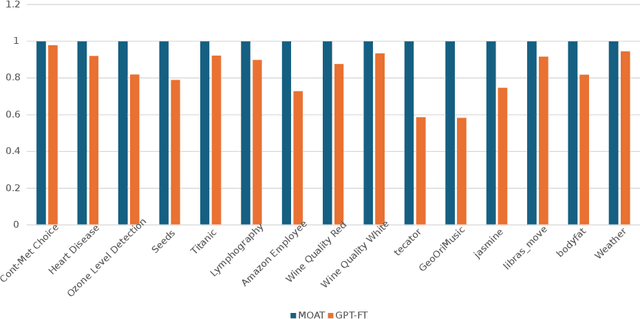
Feature transformation plays a critical role in enhancing machine learning model performance by optimizing data representations. Recent state-of-the-art approaches address this task as a continuous embedding optimization problem, converting discrete search into a learnable process. Although effective, these methods often rely on sequential encoder-decoder structures that cause high computational costs and parameter requirements, limiting scalability and efficiency. To address these limitations, we propose a novel framework that accomplishes automated feature transformation through four steps: transformation records collection, embedding space construction with a revised Generative Pre-trained Transformer (GPT) model, gradient-ascent search, and autoregressive reconstruction. In our approach, the revised GPT model serves two primary functions: (a) feature transformation sequence reconstruction and (b) model performance estimation and enhancement for downstream tasks by constructing the embedding space. Such a multi-objective optimization framework reduces parameter size and accelerates transformation processes. Experimental results on benchmark datasets show that the proposed framework matches or exceeds baseline performance, with significant gains in computational efficiency. This work highlights the potential of transformer-based architectures for scalable, high-performance automated feature transformation.