 Add to Chrome
 Add to Firefox
 Add to Edge
Are Tools Always Beneficial? Learning to Invoke Tools Adaptively for Dual-Mode Multimodal LLM Reasoning
May 19, 2026
Tool-augmented reasoning has emerged as a promising direction for enhancing the reasoning capabilities of multimodal large language models (MLLMs). However, existing studies mainly focus on enabling models to perform tool invocation, while neglecting the necessity of invoking tools. We argue that tool usage is not always beneficial, as redundant or inappropriate invocations largely increase reasoning overhead and even mislead model predictions. To address this issue, we introduce AutoTool, a model that adaptively decides whether to invoke tools according to the characteristics of each query. Within a reinforcement learning framework, we design an explicit dual-mode reasoning strategy with mode-specific reward functions to guide the model toward producing accurate responses. Moreover, to prevent premature bias toward a single reasoning mode, AutoTool jointly explores and balances tool-assisted and text-centric reasoning throughout training, and promotes free exploration in later stages. Extensive experiments demonstrate that AutoTool exhibits outstanding performance and high efficiency, yielding a 21.8\% accuracy gain on V* benchmark compared to the base model, and a 44.9\% improvement in efficiency over existing tool-augmented methods on POPE benchmark. Code is available at https://github.com/MQinghe/AutoTool.

Unleashing the Power of Intermediate Domains for Mixed Domain Semi-Supervised Medical Image Segmentation
May 30, 2025Both limited annotation and domain shift are prevalent challenges in medical image segmentation. Traditional semi-supervised segmentation and unsupervised domain adaptation methods address one of these issues separately. However, the coexistence of limited annotation and domain shift is quite common, which motivates us to introduce a novel and challenging scenario: Mixed Domain Semi-supervised medical image Segmentation (MiDSS), where limited labeled data from a single domain and a large amount of unlabeled data from multiple domains. To tackle this issue, we propose the UST-RUN framework, which fully leverages intermediate domain information to facilitate knowledge transfer. We employ Unified Copy-paste (UCP) to construct intermediate domains, and propose a Symmetric GuiDance training strategy (SymGD) to supervise unlabeled data by merging pseudo-labels from intermediate samples. Subsequently, we introduce a Training Process aware Random Amplitude MixUp (TP-RAM) to progressively incorporate style-transition components into intermediate samples. To generate more diverse intermediate samples, we further select reliable samples with high-quality pseudo-labels, which are then mixed with other unlabeled data. Additionally, we generate sophisticated intermediate samples with high-quality pseudo-labels for unreliable samples, ensuring effective knowledge transfer for them. Extensive experiments on four public datasets demonstrate the superiority of UST-RUN. Notably, UST-RUN achieves a 12.94% improvement in Dice score on the Prostate dataset. Our code is available at https://github.com/MQinghe/UST-RUN
Constructing and Exploring Intermediate Domains in Mixed Domain Semi-supervised Medical Image Segmentation
Apr 13, 2024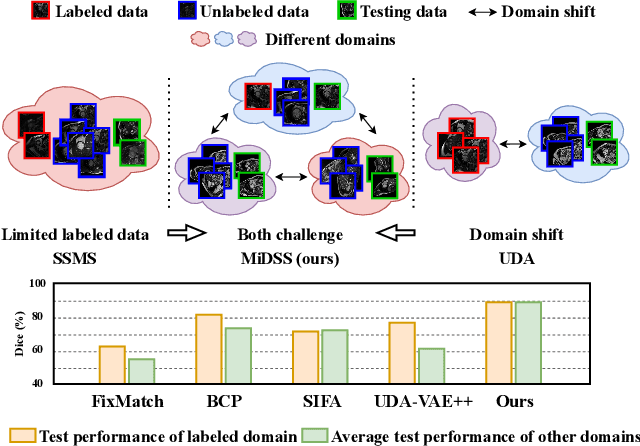

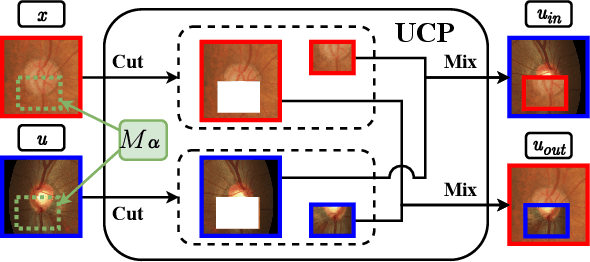
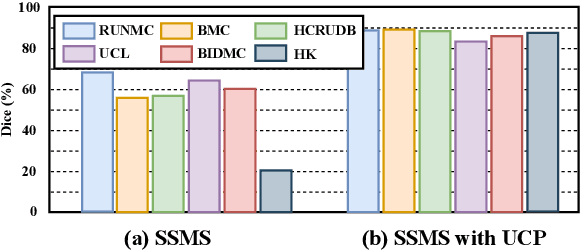
Both limited annotation and domain shift are prevalent challenges in medical image segmentation. Traditional semi-supervised segmentation and unsupervised domain adaptation methods address one of these issues separately. However, the coexistence of limited annotation and domain shift is quite common, which motivates us to introduce a novel and challenging scenario: Mixed Domain Semi-supervised medical image Segmentation (MiDSS). In this scenario, we handle data from multiple medical centers, with limited annotations available for a single domain and a large amount of unlabeled data from multiple domains. We found that the key to solving the problem lies in how to generate reliable pseudo labels for the unlabeled data in the presence of domain shift with labeled data. To tackle this issue, we employ Unified Copy-Paste (UCP) between images to construct intermediate domains, facilitating the knowledge transfer from the domain of labeled data to the domains of unlabeled data. To fully utilize the information within the intermediate domain, we propose a symmetric Guidance training strategy (SymGD), which additionally offers direct guidance to unlabeled data by merging pseudo labels from intermediate samples. Subsequently, we introduce a Training Process aware Random Amplitude MixUp (TP-RAM) to progressively incorporate style-transition components into intermediate samples. Compared with existing state-of-the-art approaches, our method achieves a notable 13.57% improvement in Dice score on Prostate dataset, as demonstrated on three public datasets. Our code is available at https://github.com/MQinghe/MiDSS .