 Add to Chrome
 Add to Firefox
 Add to Edge
Are We Ready for AI-Driven Discovery? AI Verification Before the Next Fundamental Physics Breakthrough
Jul 10, 2026
Machine learning (ML) has become integral to fundamental physics, accelerating statistical workflows from data acquisition through inference and hypothesis testing. As ML systems grow increasingly autonomous, ensuring their reliability for discovery claims becomes critical. This review synthesizes the VERaiPHY (Validation & Evaluation for Robust AI in PHYsics) initiative's frameworks for rigorous ML assessment across particle physics, astrophysics, and cosmology. We establish when verification is essential by contextualizing ML within the statistical discovery workflow. We emphasize fundamental limitations: inductive bias is unavoidable, sample complexity bounds learning, and experimental constraints limit discovery. We reflect on physicists' evolving role as both experimental designers and evaluators whose judgments encode scientific rigor into AI systems. Responsible integration requires understanding ML's transformative potential alongside its intrinsic boundaries.

Pre-Training for Simulation-Based Science: A Study on Jet Foundation Model Training Objectives
Jun 12, 2026Foundation models (FMs) trained on large datasets and fine-tuned on downstream tasks have emerged as a powerful paradigm in AI for science. Industrial FMs are typically trained using self-supervision with masking due to the lack of labels. In many scientific domains, accurate simulations are plentiful and facilitate large, labeled datasets. This opens up new possibilities for pre-training. We present a systematic comparison of pre-training methods using the OmniLearned High Energy Physics FM framework. We test supervised classification, flow-matching generation, and self-supervised masked particle modeling. All models are pre-trained on the JetClass dataset and fine-tuned on two representative downstream tasks, top jet classification and JetNet conditional generation. Among other observations, for classification tasks, we find that pure classifier pre-training is optimal when downstream labels and model capacity are plentiful, but combining it with self-supervised masked particle modeling (MPM) is uniquely powerful in the low-finetuning label regime. Flow matching-based generative pre-training seems to provide little benefit for downstream classification, and interestingly, for downstream generation, we find that flow matching must be in the pre-training objective to see a significant finetuning advantage, hinting at the orthogonality of classification and generation tasks. That is, for a model to transfer to both generative and classification downstream tasks, it must be pre-trained on both. This study provides a template for controlled scaling analysis of pre-training objectives for foundation models in simulation-based sciences.
Cross-Domain Transfer with Particle Physics Foundation Models: From Jets to Neutrino Interactions
Apr 14, 2026Future AI-based studies in particle physics will likely start from a foundation model to accelerate training and enhance sensitivity. As a step towards a general-purpose foundation model for particle physics, we investigate whether the OmniLearned foundation model pre-trained on diverse high-$Q^2$ simulated and real $pp$ and $ep$ collisions can be effectively transferred to a few-GeV fixed-target neutrino experiment. We process MINERvA neutrino--nucleus scattering events and evaluate pre-trained models on two types of tasks: regression of available energy and binary classification of charged-current pion final states ($\mathrm{CC1π^{\pm}}$, $\mathrm{CCNπ^{\pm}}$, and $\mathrm{CC1π^{0}}$). Pre-trained OmniLearned models consistently outperform similarly sized models trained from scratch, achieving better overall performance at the same compute budget, as well as achieving better performance at the same number of training steps. These results suggest that particle-level foundation models acquire inductive biases that generalize across large differences in energy scale, detector technology, and underlying physics processes, pointing toward a paradigm of detector-agnostic inference in particle physics.
EveNet: A Foundation Model for Particle Collision Data Analysis
Jan 23, 2026While deep learning is transforming data analysis in high-energy physics, computational challenges limit its potential. We address these challenges in the context of collider physics by introducing EveNet, an event-level foundation model pretrained on 500 million simulated collision events using a hybrid objective of self-supervised learning and physics-informed supervision. By leveraging a shared particle-cloud representation, EveNet outperforms state-of-the-art baselines across diverse tasks, including searches for heavy resonances and exotic Higgs decays, and demonstrates exceptional data efficiency in low-statistics regimes. Crucially, we validate the transferability of the model to experimental data by rediscovering the $Υ$ meson in CMS Open Data and show its capacity for precision physics through the robust extraction of quantum correlation observables stable against systematic uncertainties. These results indicate that EveNet can successfully encode the fundamental physical structure of particle interactions, which offers a unified and resource-efficient framework to accelerate discovery at current and future colliders.
FLEX: A Backbone for Diffusion-Based Modeling of Spatio-temporal Physical Systems
May 23, 2025We introduce FLEX (FLow EXpert), a backbone architecture for generative modeling of spatio-temporal physical systems using diffusion models. FLEX operates in the residual space rather than on raw data, a modeling choice that we motivate theoretically, showing that it reduces the variance of the velocity field in the diffusion model, which helps stabilize training. FLEX integrates a latent Transformer into a U-Net with standard convolutional ResNet layers and incorporates a redesigned skip connection scheme. This hybrid design enables the model to capture both local spatial detail and long-range dependencies in latent space. To improve spatio-temporal conditioning, FLEX uses a task-specific encoder that processes auxiliary inputs such as coarse or past snapshots. Weak conditioning is applied to the shared encoder via skip connections to promote generalization, while strong conditioning is applied to the decoder through both skip and bottleneck features to ensure reconstruction fidelity. FLEX achieves accurate predictions for super-resolution and forecasting tasks using as few as two reverse diffusion steps. It also produces calibrated uncertainty estimates through sampling. Evaluations on high-resolution 2D turbulence data show that FLEX outperforms strong baselines and generalizes to out-of-distribution settings, including unseen Reynolds numbers, physical observables (e.g., fluid flow velocity fields), and boundary conditions.
Generative Unfolding with Distribution Mapping
Nov 04, 2024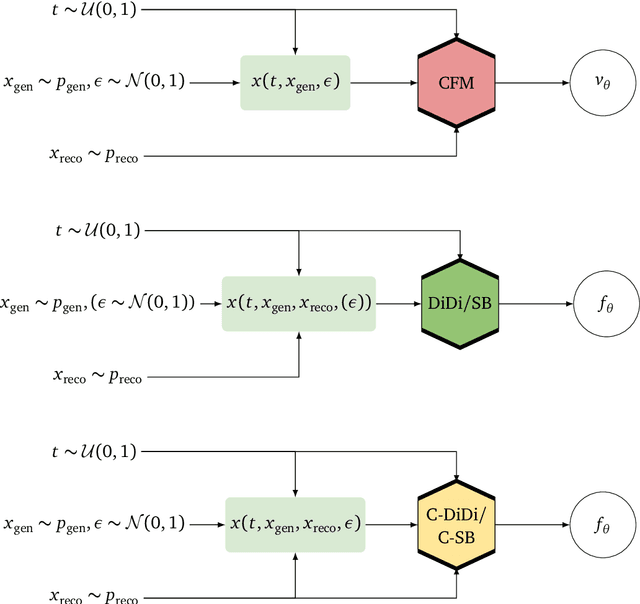
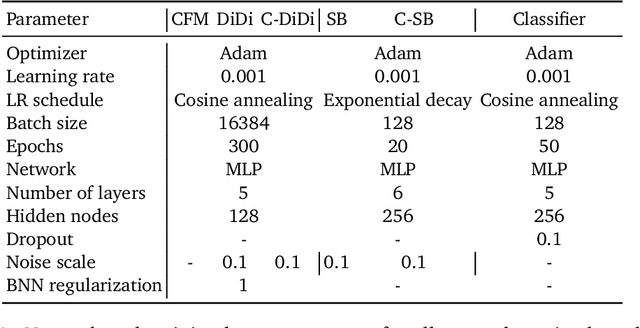
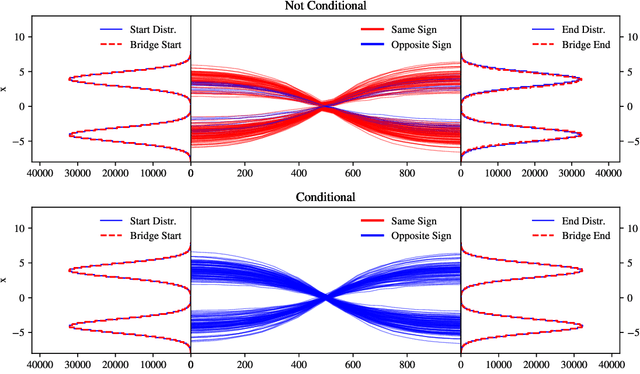
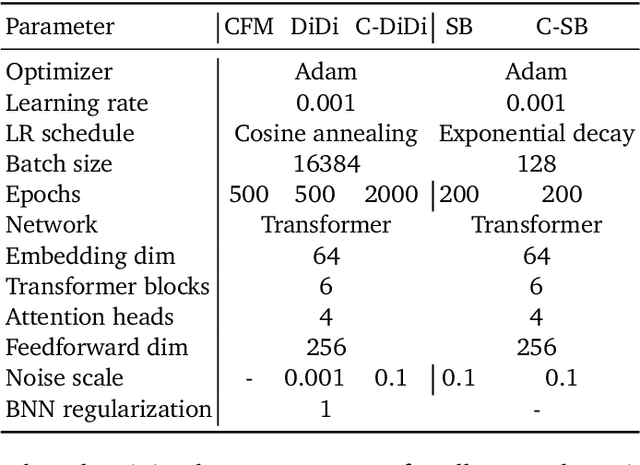
Machine learning enables unbinned, highly-differential cross section measurements. A recent idea uses generative models to morph a starting simulation into the unfolded data. We show how to extend two morphing techniques, Schr\"odinger Bridges and Direct Diffusion, in order to ensure that the models learn the correct conditional probabilities. This brings distribution mapping to a similar level of accuracy as the state-of-the-art conditional generative unfolding methods. Numerical results are presented with a standard benchmark dataset of single jet substructure as well as for a new dataset describing a 22-dimensional phase space of Z + 2-jets.
CaloChallenge 2022: A Community Challenge for Fast Calorimeter Simulation
Oct 28, 2024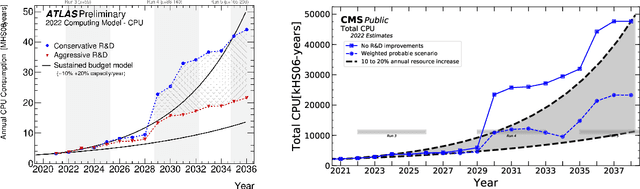
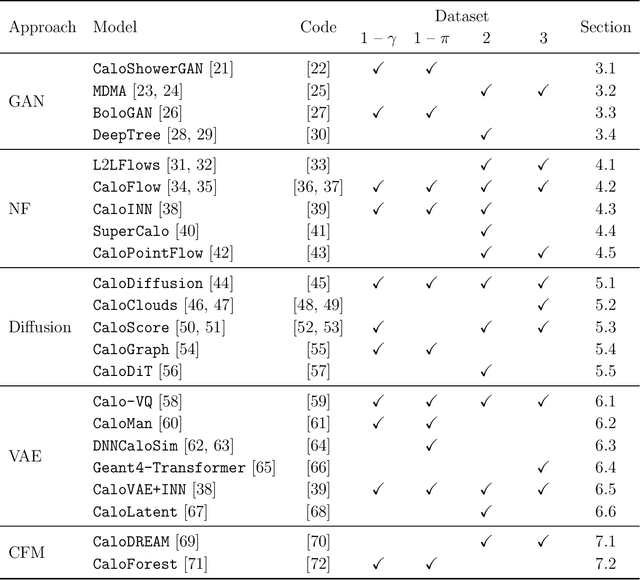
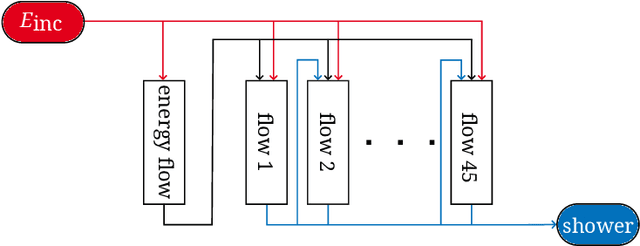
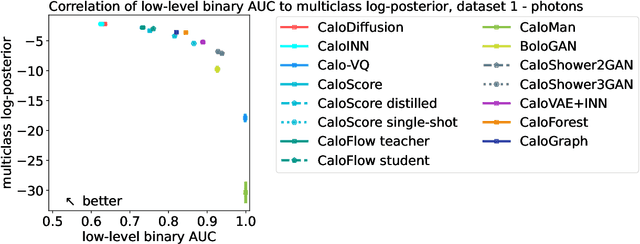
We present the results of the "Fast Calorimeter Simulation Challenge 2022" - the CaloChallenge. We study state-of-the-art generative models on four calorimeter shower datasets of increasing dimensionality, ranging from a few hundred voxels to a few tens of thousand voxels. The 31 individual submissions span a wide range of current popular generative architectures, including Variational AutoEncoders (VAEs), Generative Adversarial Networks (GANs), Normalizing Flows, Diffusion models, and models based on Conditional Flow Matching. We compare all submissions in terms of quality of generated calorimeter showers, as well as shower generation time and model size. To assess the quality we use a broad range of different metrics including differences in 1-dimensional histograms of observables, KPD/FPD scores, AUCs of binary classifiers, and the log-posterior of a multiclass classifier. The results of the CaloChallenge provide the most complete and comprehensive survey of cutting-edge approaches to calorimeter fast simulation to date. In addition, our work provides a uniquely detailed perspective on the important problem of how to evaluate generative models. As such, the results presented here should be applicable for other domains that use generative AI and require fast and faithful generation of samples in a large phase space.
Multidimensional Deconvolution with Profiling
Sep 16, 2024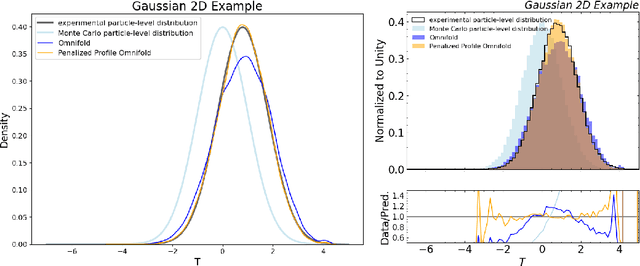
In many experimental contexts, it is necessary to statistically remove the impact of instrumental effects in order to physically interpret measurements. This task has been extensively studied in particle physics, where the deconvolution task is called unfolding. A number of recent methods have shown how to perform high-dimensional, unbinned unfolding using machine learning. However, one of the assumptions in all of these methods is that the detector response is accurately modeled in the Monte Carlo simulation. In practice, the detector response depends on a number of nuisance parameters that can be constrained with data. We propose a new algorithm called Profile OmniFold (POF), which works in a similar iterative manner as the OmniFold (OF) algorithm while being able to simultaneously profile the nuisance parameters. We illustrate the method with a Gaussian example as a proof of concept highlighting its promising capabilities.
The Landscape of Unfolding with Machine Learning
Apr 29, 2024

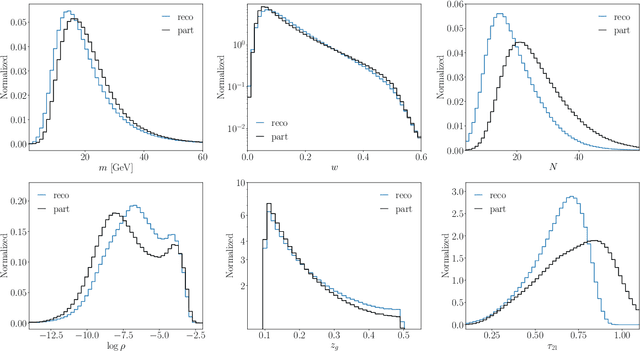

Recent innovations from machine learning allow for data unfolding, without binning and including correlations across many dimensions. We describe a set of known, upgraded, and new methods for ML-based unfolding. The performance of these approaches are evaluated on the same two datasets. We find that all techniques are capable of accurately reproducing the particle-level spectra across complex observables. Given that these approaches are conceptually diverse, they offer an exciting toolkit for a new class of measurements that can probe the Standard Model with an unprecedented level of detail and may enable sensitivity to new phenomena.
Unifying Simulation and Inference with Normalizing Flows
Apr 29, 2024

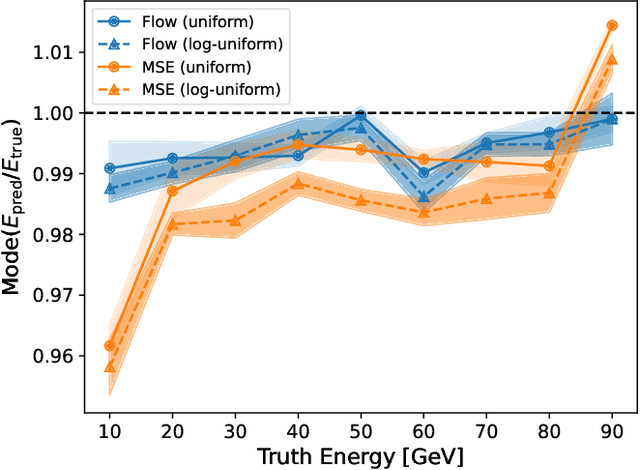

There have been many applications of deep neural networks to detector calibrations and a growing number of studies that propose deep generative models as automated fast detector simulators. We show that these two tasks can be unified by using maximum likelihood estimation (MLE) from conditional generative models for energy regression. Unlike direct regression techniques, the MLE approach is prior-independent and non-Gaussian resolutions can be determined from the shape of the likelihood near the maximum. Using an ATLAS-like calorimeter simulation, we demonstrate this concept in the context of calorimeter energy calibration.