 Add to Chrome
 Add to Firefox
 Add to Edge
UniAudio: An Audio Foundation Model Toward Universal Audio Generation
Oct 11, 2023
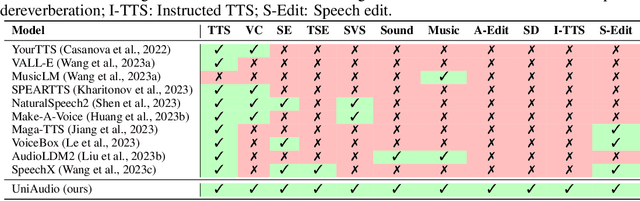
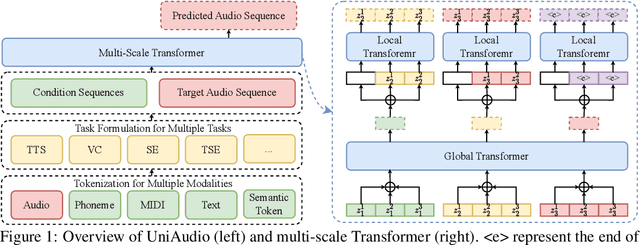
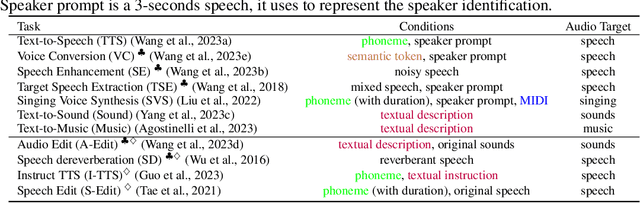
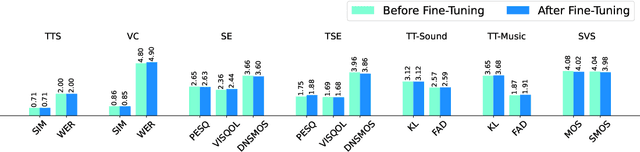
Large Language models (LLM) have demonstrated the capability to handle a variety of generative tasks. This paper presents the UniAudio system, which, unlike prior task-specific approaches, leverages LLM techniques to generate multiple types of audio (including speech, sounds, music, and singing) with given input conditions. UniAudio 1) first tokenizes all types of target audio along with other condition modalities, 2) concatenates source-target pair as a single sequence, and 3) performs next-token prediction using LLM. Also, a multi-scale Transformer model is proposed to handle the overly long sequences caused by the residual vector quantization based neural codec in tokenization. Training of UniAudio is scaled up to 165K hours of audio and 1B parameters, based on all generative tasks, aiming to obtain sufficient prior knowledge not only in the intrinsic properties of audio but also the inter-relationship between audio and other modalities. Therefore, the trained UniAudio model has the potential to become a foundation model for universal audio generation: it shows strong capability in all trained tasks and can seamlessly support new audio generation tasks after simple fine-tuning. Experiments demonstrate that UniAudio achieves state-of-the-art or at least competitive results on most of the 11 tasks. Demo and code are released at https://github.com/yangdongchao/UniAudio

Findings of the 2023 ML-SUPERB Challenge: Pre-Training and Evaluation over More Languages and Beyond
Oct 09, 2023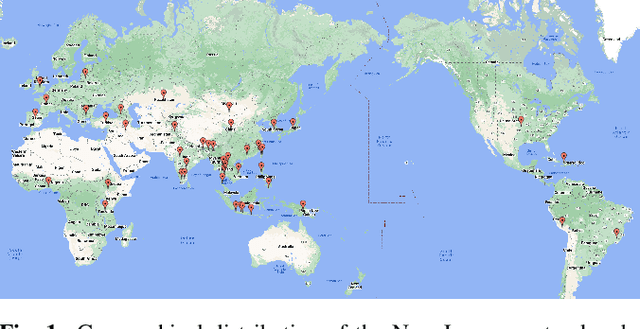

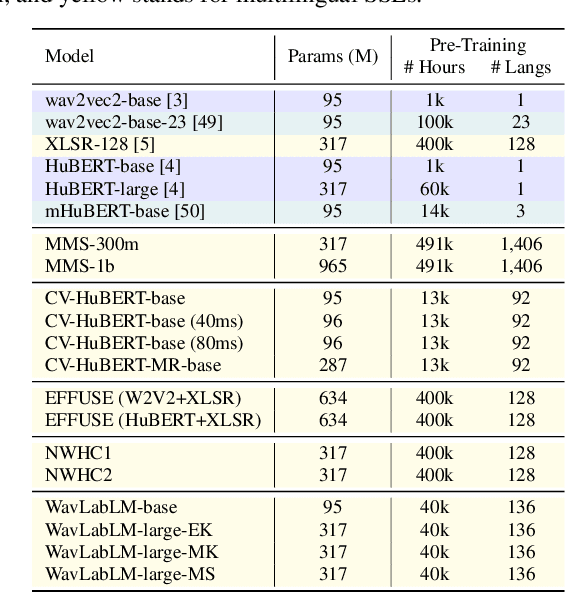
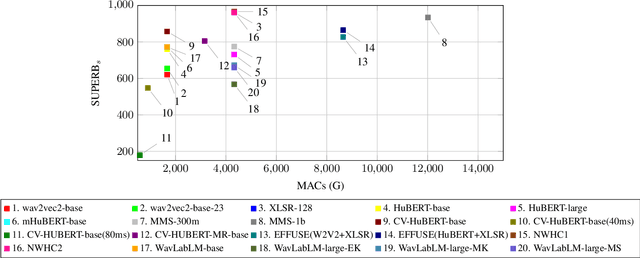
The 2023 Multilingual Speech Universal Performance Benchmark (ML-SUPERB) Challenge expands upon the acclaimed SUPERB framework, emphasizing self-supervised models in multilingual speech recognition and language identification. The challenge comprises a research track focused on applying ML-SUPERB to specific multilingual subjects, a Challenge Track for model submissions, and a New Language Track where language resource researchers can contribute and evaluate their low-resource language data in the context of the latest progress in multilingual speech recognition. The challenge garnered 12 model submissions and 54 language corpora, resulting in a comprehensive benchmark encompassing 154 languages. The findings indicate that merely scaling models is not the definitive solution for multilingual speech tasks, and a variety of speech/voice types present significant challenges in multilingual speech processing.
HuBERTopic: Enhancing Semantic Representation of HuBERT through Self-supervision Utilizing Topic Model
Oct 06, 2023Recently, the usefulness of self-supervised representation learning (SSRL) methods has been confirmed in various downstream tasks. Many of these models, as exemplified by HuBERT and WavLM, use pseudo-labels generated from spectral features or the model's own representation features. From previous studies, it is known that the pseudo-labels contain semantic information. However, the masked prediction task, the learning criterion of HuBERT, focuses on local contextual information and may not make effective use of global semantic information such as speaker, theme of speech, and so on. In this paper, we propose a new approach to enrich the semantic representation of HuBERT. We apply topic model to pseudo-labels to generate a topic label for each utterance. An auxiliary topic classification task is added to HuBERT by using topic labels as teachers. This allows additional global semantic information to be incorporated in an unsupervised manner. Experimental results demonstrate that our method achieves comparable or better performance than the baseline in most tasks, including automatic speech recognition and five out of the eight SUPERB tasks. Moreover, we find that topic labels include various information about utterance, such as gender, speaker, and its theme. This highlights the effectiveness of our approach in capturing multifaceted semantic nuances.
Reproducing Whisper-Style Training Using an Open-Source Toolkit and Publicly Available Data
Oct 02, 2023Pre-training speech models on large volumes of data has achieved remarkable success. OpenAI Whisper is a multilingual multitask model trained on 680k hours of supervised speech data. It generalizes well to various speech recognition and translation benchmarks even in a zero-shot setup. However, the full pipeline for developing such models (from data collection to training) is not publicly accessible, which makes it difficult for researchers to further improve its performance and address training-related issues such as efficiency, robustness, fairness, and bias. This work presents an Open Whisper-style Speech Model (OWSM), which reproduces Whisper-style training using an open-source toolkit and publicly available data. OWSM even supports more translation directions and can be more efficient to train. We will publicly release all scripts used for data preparation, training, inference, and scoring as well as pre-trained models and training logs to promote open science.
Improving Audio Captioning Models with Fine-grained Audio Features, Text Embedding Supervision, and LLM Mix-up Augmentation
Sep 29, 2023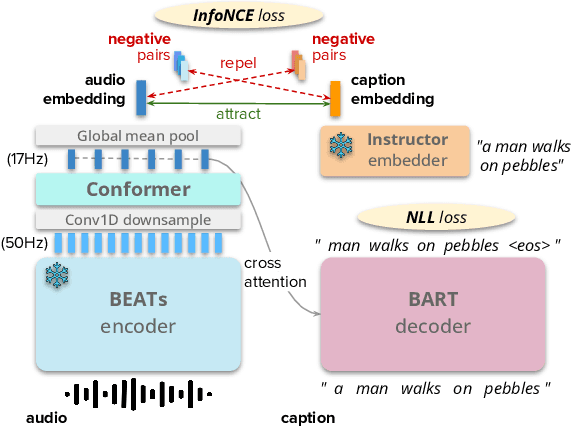

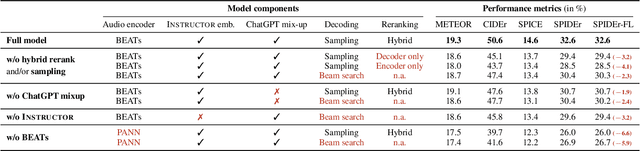
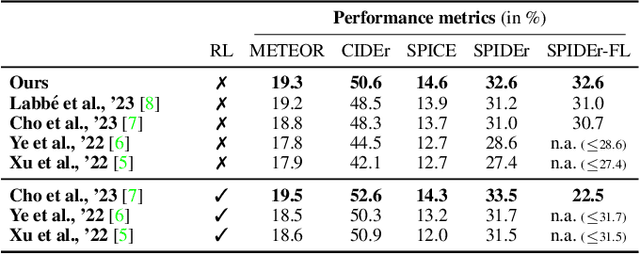
Automated audio captioning (AAC) aims to generate informative descriptions for various sounds from nature and/or human activities. In recent years, AAC has quickly attracted research interest, with state-of-the-art systems now relying on a sequence-to-sequence (seq2seq) backbone powered by strong models such as Transformers. Following the macro-trend of applied machine learning research, in this work, we strive to improve the performance of seq2seq AAC models by extensively leveraging pretrained models and large language models (LLMs). Specifically, we utilize BEATs to extract fine-grained audio features. Then, we employ Instructor LLM to fetch text embeddings of captions, and infuse their language-modality knowledge into BEATs audio features via an auxiliary InfoNCE loss function. Moreover, we propose a novel data augmentation method that uses ChatGPT to produce caption mix-ups (i.e., grammatical and compact combinations of two captions) which, together with the corresponding audio mixtures, increase not only the amount but also the complexity and diversity of training data. During inference, we propose to employ nucleus sampling and a hybrid reranking algorithm, which has not been explored in AAC research. Combining our efforts, our model achieves a new state-of-the-art 32.6 SPIDEr-FL score on the Clotho evaluation split, and wins the 2023 DCASE AAC challenge.
Joint Prediction and Denoising for Large-scale Multilingual Self-supervised Learning
Sep 28, 2023Multilingual self-supervised learning (SSL) has often lagged behind state-of-the-art (SOTA) methods due to the expenses and complexity required to handle many languages. This further harms the reproducibility of SSL, which is already limited to few research groups due to its resource usage. We show that more powerful techniques can actually lead to more efficient pre-training, opening SSL to more research groups. We propose WavLabLM, which extends WavLM's joint prediction and denoising to 40k hours of data across 136 languages. To build WavLabLM, we devise a novel multi-stage pre-training method, designed to address the language imbalance of multilingual data. WavLabLM achieves comparable performance to XLS-R on ML-SUPERB with less than 10% of the training data, making SSL realizable with academic compute. We show that further efficiency can be achieved with a vanilla HuBERT Base model, which can maintain 94% of XLS-R's performance with only 3% of the data, 4 GPUs, and limited trials. We open-source all code and models in ESPnet.
Cross-Modal Multi-Tasking for Speech-to-Text Translation via Hard Parameter Sharing
Sep 27, 2023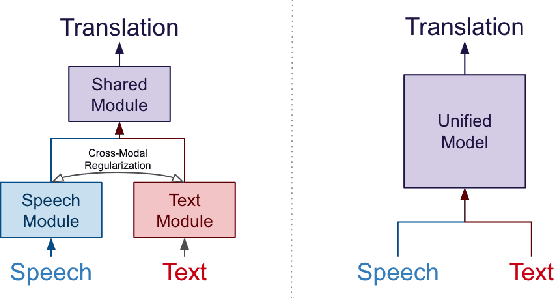
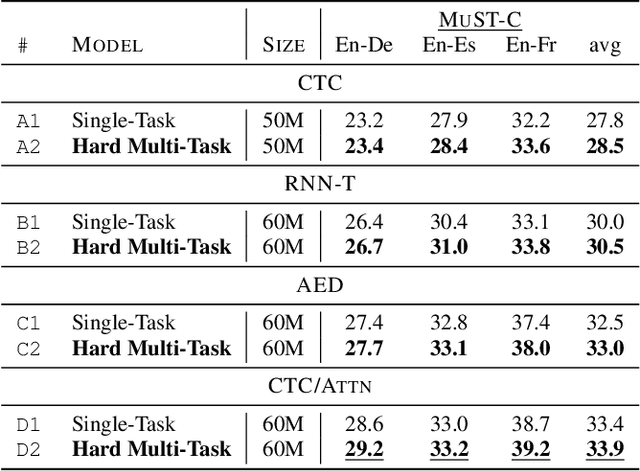
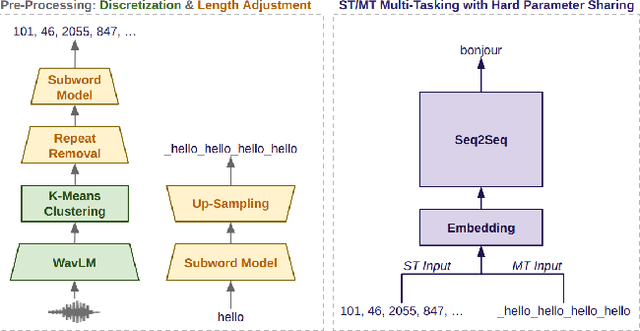
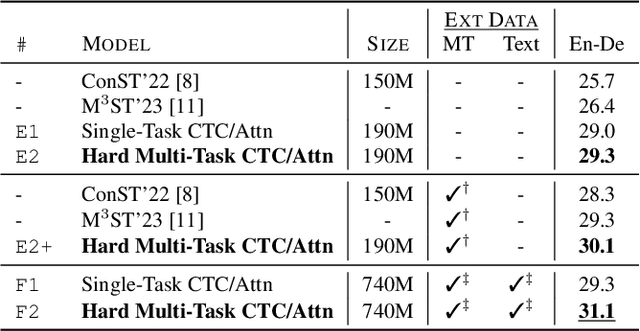
Recent works in end-to-end speech-to-text translation (ST) have proposed multi-tasking methods with soft parameter sharing which leverage machine translation (MT) data via secondary encoders that map text inputs to an eventual cross-modal representation. In this work, we instead propose a ST/MT multi-tasking framework with hard parameter sharing in which all model parameters are shared cross-modally. Our method reduces the speech-text modality gap via a pre-processing stage which converts speech and text inputs into two discrete token sequences of similar length -- this allows models to indiscriminately process both modalities simply using a joint vocabulary. With experiments on MuST-C, we demonstrate that our multi-tasking framework improves attentional encoder-decoder, Connectionist Temporal Classification (CTC), transducer, and joint CTC/attention models by an average of +0.5 BLEU without any external MT data. Further, we show that this framework incorporates external MT data, yielding +0.8 BLEU, and also improves transfer learning from pre-trained textual models, yielding +1.8 BLEU.
Exploring Speech Recognition, Translation, and Understanding with Discrete Speech Units: A Comparative Study
Sep 27, 2023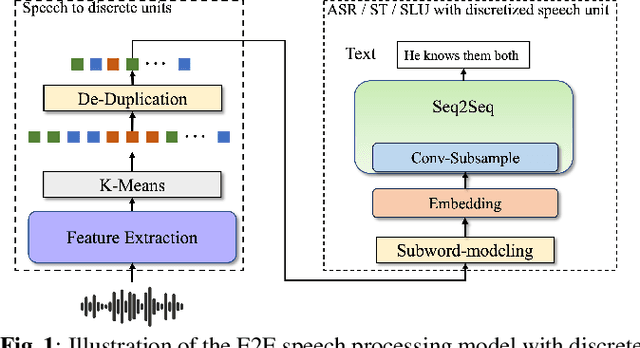
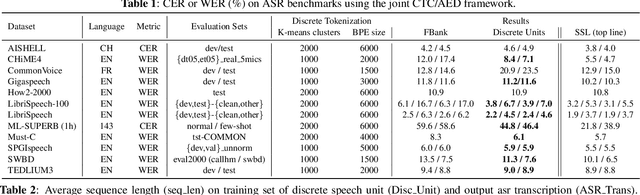
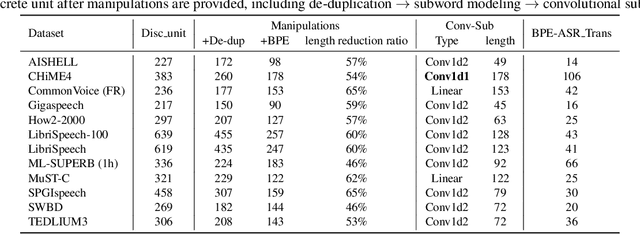
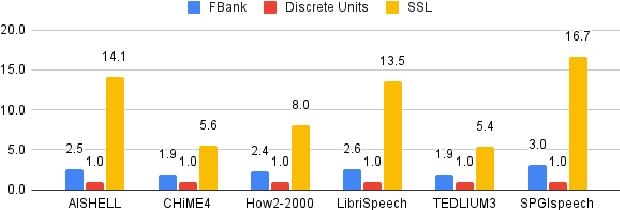
Speech signals, typically sampled at rates in the tens of thousands per second, contain redundancies, evoking inefficiencies in sequence modeling. High-dimensional speech features such as spectrograms are often used as the input for the subsequent model. However, they can still be redundant. Recent investigations proposed the use of discrete speech units derived from self-supervised learning representations, which significantly compresses the size of speech data. Applying various methods, such as de-duplication and subword modeling, can further compress the speech sequence length. Hence, training time is significantly reduced while retaining notable performance. In this study, we undertake a comprehensive and systematic exploration into the application of discrete units within end-to-end speech processing models. Experiments on 12 automatic speech recognition, 3 speech translation, and 1 spoken language understanding corpora demonstrate that discrete units achieve reasonably good results in almost all the settings. We intend to release our configurations and trained models to foster future research efforts.
Voxtlm: unified decoder-only models for consolidating speech recognition/synthesis and speech/text continuation tasks
Sep 18, 2023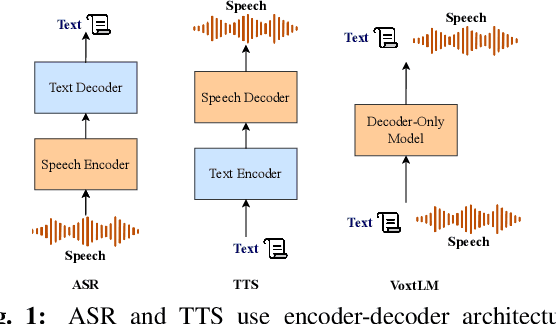
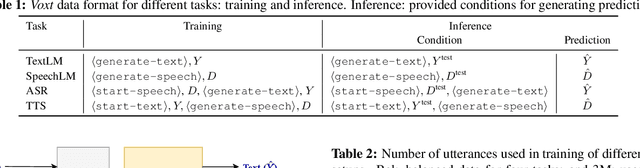
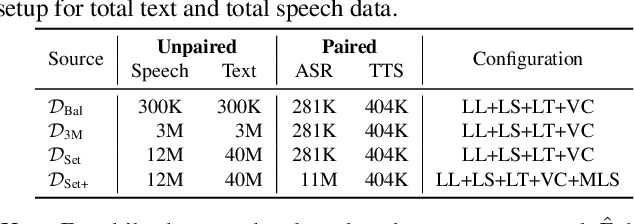

We propose a decoder-only language model, \textit{VoxtLM}, that can perform four tasks: speech recognition, speech synthesis, text generation, and speech continuation. VoxtLM integrates text vocabulary with discrete speech tokens from self-supervised speech features and uses special tokens to enable multitask learning. Compared to a single-task model, VoxtLM exhibits a significant improvement in speech synthesis, with improvements in both speech intelligibility from 28.9 to 5.6 and objective quality from 2.68 to 3.90. VoxtLM also improves speech generation and speech recognition performance over the single-task counterpart. VoxtLM is trained with publicly available data and training recipes and model checkpoints will be open-sourced to make fully reproducible work.
TokenSplit: Using Discrete Speech Representations for Direct, Refined, and Transcript-Conditioned Speech Separation and Recognition
Aug 21, 2023
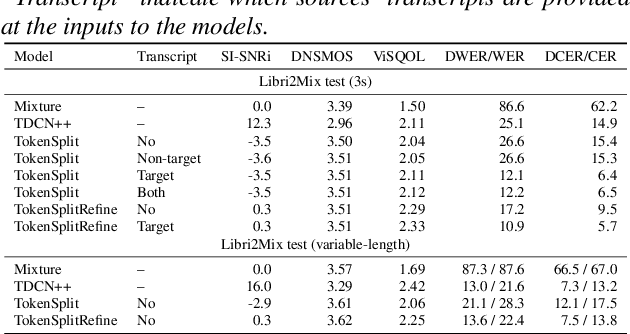

We present TokenSplit, a speech separation model that acts on discrete token sequences. The model is trained on multiple tasks simultaneously: separate and transcribe each speech source, and generate speech from text. The model operates on transcripts and audio token sequences and achieves multiple tasks through masking of inputs. The model is a sequence-to-sequence encoder-decoder model that uses the Transformer architecture. We also present a "refinement" version of the model that predicts enhanced audio tokens from the audio tokens of speech separated by a conventional separation model. Using both objective metrics and subjective MUSHRA listening tests, we show that our model achieves excellent performance in terms of separation, both with or without transcript conditioning. We also measure the automatic speech recognition (ASR) performance and provide audio samples of speech synthesis to demonstrate the additional utility of our model.