 Add to Chrome
 Add to Firefox
 Add to Edge
CAAD: Contrastive Audio-Aware Distillation for Efficient Speech Language Models
Jun 22, 2026
Speech Language Models achieve reasoning capabilities, but are often hindered by massive parameter counts and a tendency to prioritize linguistic priors over acoustic features. While contrastive decoding enhances grounding by contrasting audio-aware and text-only logits, it increases inference latency. We propose Contrastive Audio-Aware Distillation (CAAD), a framework that internalizes the teacher's contrastive reasoning into the student model's weights. To overcome the high computational training overhead in the dual-path token-by-token contrastive distillation process, we introduce a synchronized teacher-forcing strategy. Anchored by unified Pseudo-Ground Truths, this mechanism enables simultaneous full-sequence generation of the teacher's contrastive distributions, allowing student to distill the audio-aware signal efficiently. Overall, CAAD yields a ~8% relative gain over standard knowledge distillation on Dynamic-SUPERB and successfully reduces linguistic bias in MCR-BENCH.

Walking Through Uncertainty: An Empirical Study of Uncertainty Estimation for Audio-Aware Large Language Models
Apr 28, 2026Recent audio-aware large language models (ALLMs) have demonstrated strong capabilities across diverse audio understanding and reasoning tasks, but they still frequently produce hallucinated or overly confident outputs. While uncertainty estimation has been extensively studied in text-only LLMs, it remains largely unexplored for ALLMs, where audio-conditioned generation introduces additional challenges such as perceptual ambiguity and cross-modal grounding. In this work, we present the first systematic empirical study of uncertainty estimation in ALLMs. We benchmark five representative methods, including predictive entropy, length-normalized entropy, semantic entropy, discrete semantic entropy, and P(True), across multiple models and diverse evaluation settings spanning general audio understanding, reasoning, hallucination detection, and unanswerable question answering. Our results reveal two key findings. First, semantic-level and verification-based methods consistently outperform token-level baselines on general audio reasoning benchmarks. Second, on trustworthiness-oriented benchmarks, the relative effectiveness of uncertainty methods becomes notably more model- and benchmark-dependent, indicating that conclusions drawn from general reasoning settings do not straightforwardly transfer to hallucination and unanswerable-question scenarios. We further explore uncertainty-based adaptive inference as a potential downstream application. We hope this study provides a foundation for future research on reliable, uncertainty-aware audio-language systems.
How Contrastive Decoding Enhances Large Audio Language Models?
Mar 10, 2026While Contrastive Decoding (CD) has proven effective at enhancing Large Audio Language Models (LALMs), the underlying mechanisms driving its success and the comparative efficacy of different strategies remain unclear. This study systematically evaluates four distinct CD strategies across diverse LALM architectures. We identify Audio-Aware Decoding and Audio Contrastive Decoding as the most effective methods. However, their impact varies significantly by model. To explain this variability, we introduce a Transition Matrix framework to map error pattern shifts during inference. Our analysis demonstrates that CD reliably rectifies errors in which models falsely claim an absence of audio or resort to uncertainty-driven guessing. Conversely, it fails to correct flawed reasoning or confident misassertions. Ultimately, these findings provide a clear guideline for determining which LALM architectures are most suitable for CD enhancement based on their baseline error profiles.
DeSTA2.5-Audio: Toward General-Purpose Large Audio Language Model with Self-Generated Cross-Modal Alignment
Jul 03, 2025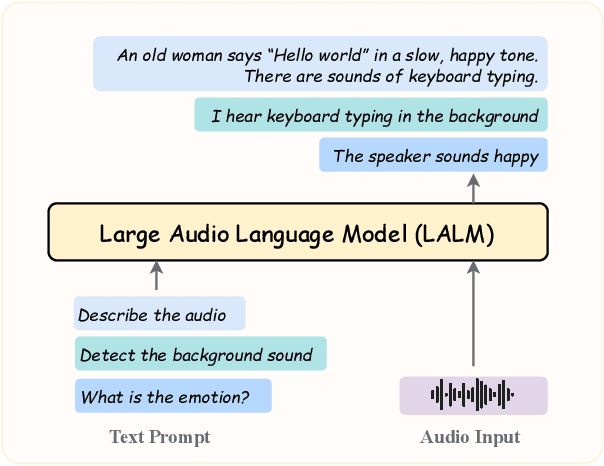
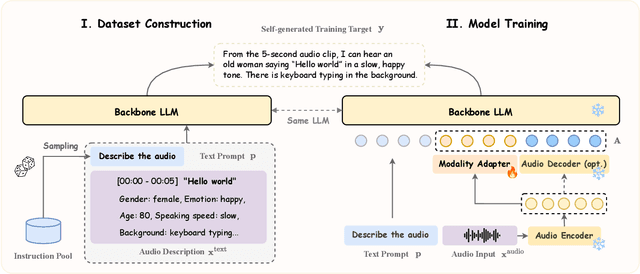
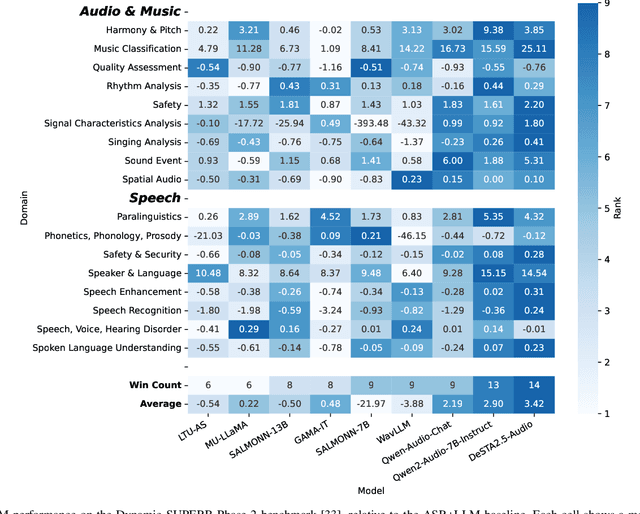
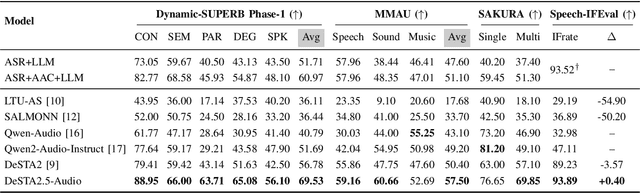
We introduce DeSTA2.5-Audio, a general-purpose Large Audio Language Model (LALM) designed for robust auditory perception and instruction-following, without requiring task-specific audio instruction-tuning. Recent LALMs typically augment Large Language Models (LLMs) with auditory capabilities by training on large-scale, manually curated or LLM-synthesized audio-instruction datasets. However, these approaches have often suffered from the catastrophic forgetting of the LLM's original language abilities. To address this, we revisit the data construction pipeline and propose DeSTA, a self-generated cross-modal alignment strategy in which the backbone LLM generates its own training targets. This approach preserves the LLM's native language proficiency while establishing effective audio-text alignment, thereby enabling zero-shot generalization without task-specific tuning. Using DeSTA, we construct DeSTA-AQA5M, a large-scale, task-agnostic dataset containing 5 million training samples derived from 7,000 hours of audio spanning 50 diverse datasets, including speech, environmental sounds, and music. DeSTA2.5-Audio achieves state-of-the-art or competitive performance across a wide range of audio-language benchmarks, including Dynamic-SUPERB, MMAU, SAKURA, Speech-IFEval, and VoiceBench. Comprehensive comparative studies demonstrate that our self-generated strategy outperforms widely adopted data construction and training strategies in both auditory perception and instruction-following capabilities. Our findings underscore the importance of carefully designed data construction in LALM development and offer practical insights for building robust, general-purpose LALMs.
Speech-FT: A Fine-tuning Strategy for Enhancing Speech Representation Models Without Compromising Generalization Ability
Feb 18, 2025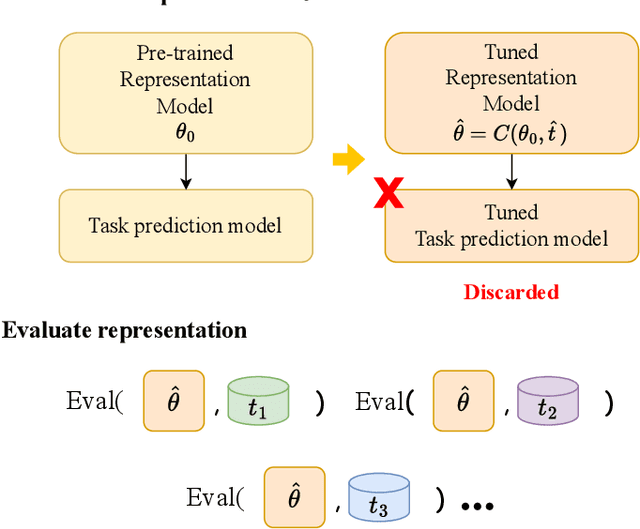
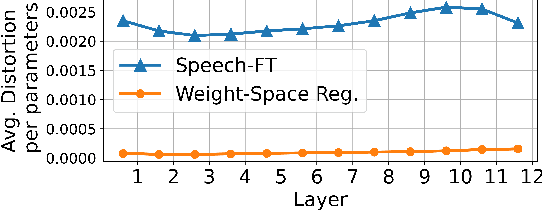
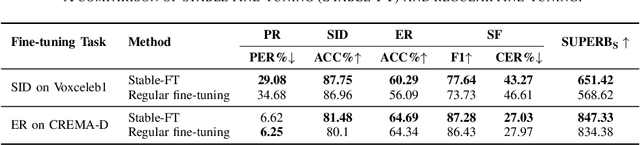

Speech representation models are highly effective at extracting general features for various tasks. While fine-tuning can enhance these representations for specific applications, it often compromises their generalization ability. To address this challenge, we propose Speech-FT, a fine-tuning strategy for speech representation models that leverages model merging to preserve generalization ability while still benefiting from fine-tuning. Speech-FT is effective across different fine-tuning scenarios and is compatible with various types of speech representation models, providing a versatile solution. Speech-FT offers an efficient and practical approach to further improving general speech representations after pre-training.
Building a Taiwanese Mandarin Spoken Language Model: A First Attempt
Nov 11, 2024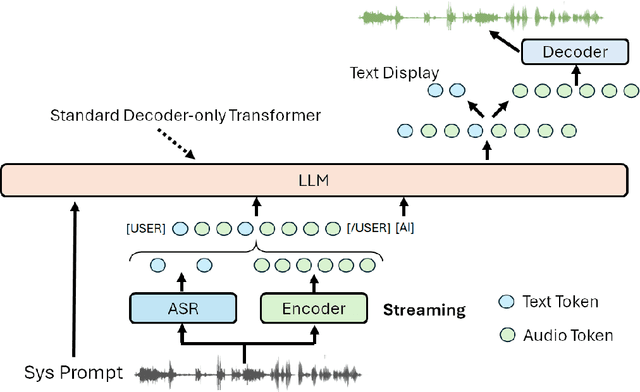


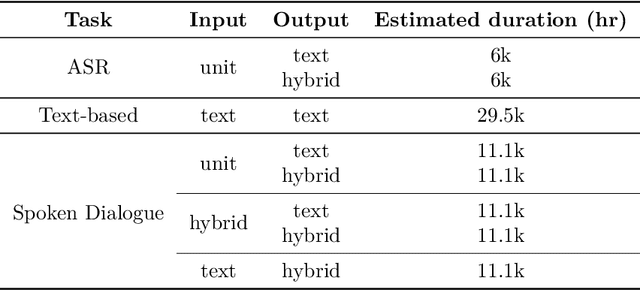
This technical report presents our initial attempt to build a spoken large language model (LLM) for Taiwanese Mandarin, specifically tailored to enable real-time, speech-to-speech interaction in multi-turn conversations. Our end-to-end model incorporates a decoder-only transformer architecture and aims to achieve seamless interaction while preserving the conversational flow, including full-duplex capabilities allowing simultaneous speaking and listening. The paper also details the training process, including data preparation with synthesized dialogues and adjustments for real-time interaction. We also developed a platform to evaluate conversational fluency and response coherence in multi-turn dialogues. We hope the release of the report can contribute to the future development of spoken LLMs in Taiwanese Mandarin.
Speech-Copilot: Leveraging Large Language Models for Speech Processing via Task Decomposition, Modularization, and Program Generation
Jul 13, 2024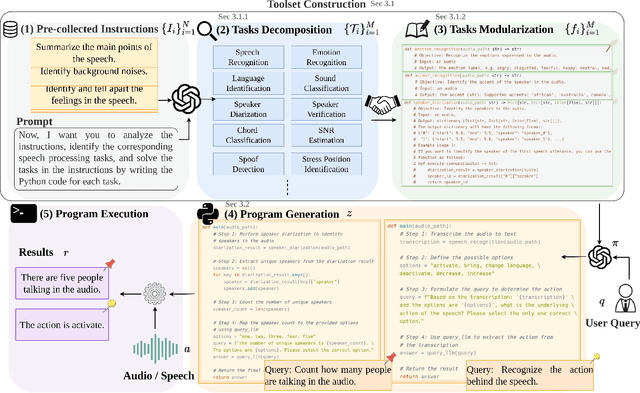
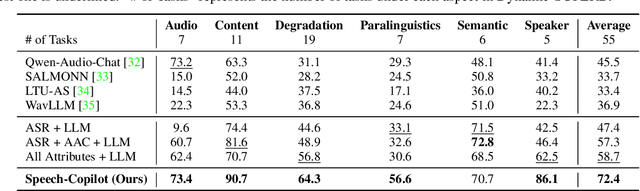

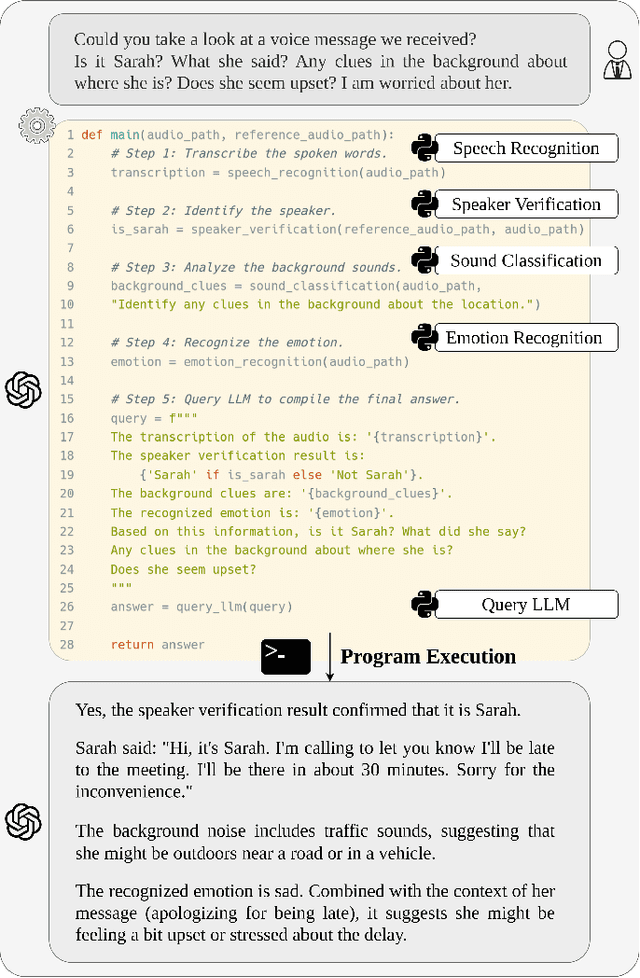
In this work, we introduce Speech-Copilot, a modular framework for instruction-oriented speech-processing tasks that minimizes human effort in toolset construction. Unlike end-to-end methods using large audio-language models, Speech-Copilot builds speech processing-specific toolsets by analyzing pre-collected task instructions and breaking tasks into manageable sub-tasks. It features a flexible agent based on large language models that performs tasks through program generation. Our approach achieves state-of-the-art performance on the Dynamic-SUPERB benchmark, demonstrating its effectiveness across diverse speech-processing tasks. Key contributions include: 1) developing an innovative framework for speech processing-specific toolset construction, 2) establishing a high-performing agent based on large language models, and 3) offering a new perspective on addressing challenging instruction-oriented speech-processing tasks. Without additional training processes required by end-to-end approaches, our method provides a flexible and extendable solution for a wide range of speech-processing applications.
Continual Test-time Adaptation for End-to-end Speech Recognition on Noisy Speech
Jun 16, 2024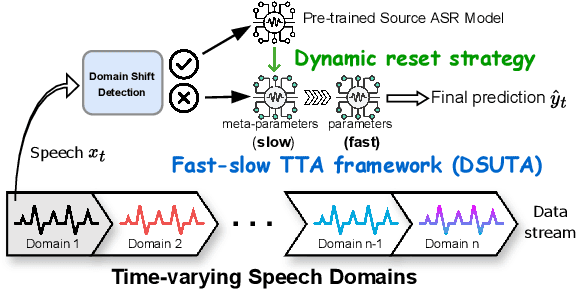
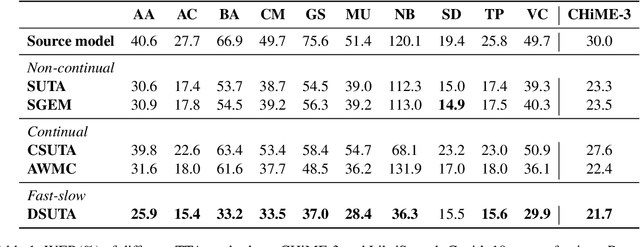
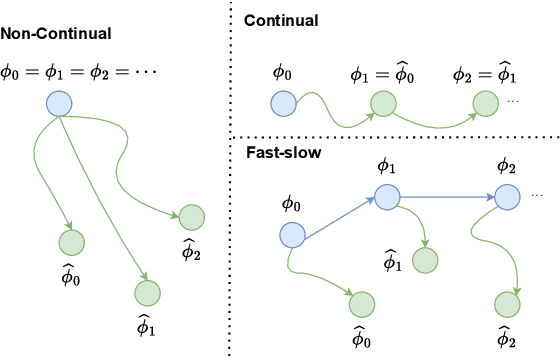
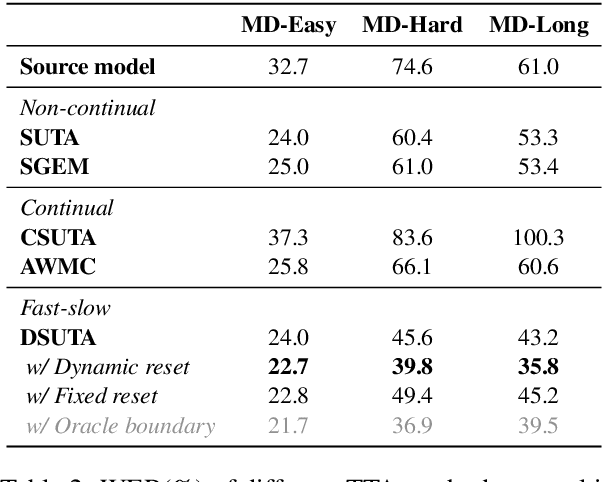
Deep learning-based end-to-end automatic speech recognition (ASR) has made significant strides but still struggles with performance on out-of-domain (OOD) samples due to domain shifts in real-world scenarios. Test-Time Adaptation (TTA) methods address this issue by adapting models using test samples at inference time. However, current ASR TTA methods have largely focused on non-continual TTA, which limits cross-sample knowledge learning compared to continual TTA. In this work, we propose a Fast-slow TTA framework for ASR, which leverages the advantage of continual and non-continual TTA. Within this framework, we introduce Dynamic SUTA (DSUTA), an entropy-minimization-based continual TTA method for ASR. To enhance DSUTA's robustness on time-varying data, we propose a dynamic reset strategy that automatically detects domain shifts and resets the model, making it more effective at handling multi-domain data. Our method demonstrates superior performance on various noisy ASR datasets, outperforming both non-continual and continual TTA baselines while maintaining robustness to domain changes without requiring domain boundary information.
Understanding Sounds, Missing the Questions: The Challenge of Object Hallucination in Large Audio-Language Models
Jun 12, 2024
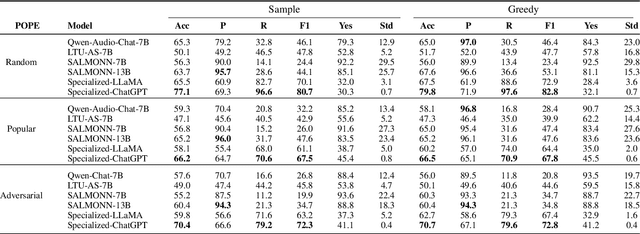
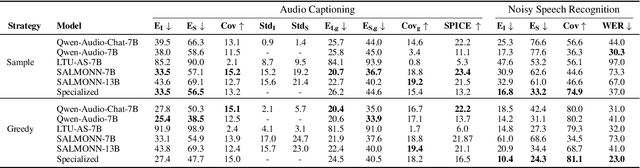
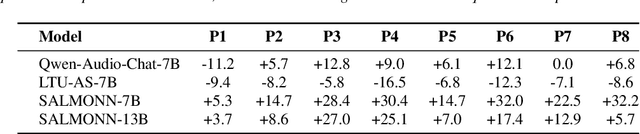
Large audio-language models (LALMs) enhance traditional large language models by integrating audio perception capabilities, allowing them to tackle audio-related tasks. Previous research has primarily focused on assessing the performance of LALMs across various tasks, yet overlooking their reliability, particularly concerning issues like object hallucination. In our study, we introduce methods to assess the extent of object hallucination of publicly available LALMs. Our findings reveal that LALMs are comparable to specialized audio captioning models in their understanding of audio content, but struggle to answer discriminative questions, specifically those requiring the identification of the presence of particular object sounds within an audio clip. This limitation highlights a critical weakness in current LALMs: their inadequate understanding of discriminative queries. Moreover, we explore the potential of prompt engineering to enhance LALMs' performance on discriminative questions.
Maximizing Data Efficiency for Cross-Lingual TTS Adaptation by Self-Supervised Representation Mixing and Embedding Initialization
Jan 23, 2024This paper presents an effective transfer learning framework for language adaptation in text-to-speech systems, with a focus on achieving language adaptation using minimal labeled and unlabeled data. While many works focus on reducing the usage of labeled data, very few consider minimizing the usage of unlabeled data. By utilizing self-supervised features in the pretraining stage, replacing the noisy portion of pseudo labels with these features during fine-tuning, and incorporating an embedding initialization trick, our method leverages more information from unlabeled data compared to conventional approaches. Experimental results show that our framework is able to synthesize intelligible speech in unseen languages with only 4 utterances of labeled data and 15 minutes of unlabeled data. Our methodology continues to surpass conventional techniques, even when a greater volume of data is accessible. These findings highlight the potential of our data-efficient language adaptation framework.