 Add to Chrome
 Add to Firefox
 Add to Edge
Prosodic ABX: A Language-Agnostic Method for Measuring Prosodic Contrast in Speech Representations
Apr 02, 2026
Speech representations from self-supervised speech models (S3Ms) are known to be sensitive to phonemic contrasts, but their sensitivity to prosodic contrasts has not been directly measured. The ABX discrimination task has been used to measure phonemic contrast in S3M representations via minimal pairs. We introduce prosodic ABX, an extension of this framework to evaluate prosodic contrast with only a handful of examples and no explicit labels. Also, we build and release a dataset of English and Japanese minimal pairs and use it along with a Mandarin dataset to evaluate contrast in English stress, Japanese pitch accent, and Mandarin tone. Finally, we show that model and layer rankings are often preserved across several experimental conditions, making it practical for low-resource settings.

An Empirical Recipe for Universal Phone Recognition
Mar 30, 2026Phone recognition (PR) is a key enabler of multilingual and low-resource speech processing tasks, yet robust performance remains elusive. Highly performant English-focused models do not generalize across languages, while multilingual models underutilize pretrained representations. It also remains unclear how data scale, architecture, and training objective contribute to multilingual PR. We present PhoneticXEUS -- trained on large-scale multilingual data and achieving state-of-the-art performance on both multilingual (17.7% PFER) and accented English speech (10.6% PFER). Through controlled ablations with evaluations across 100+ languages under a unified scheme, we empirically establish our training recipe and quantify the impact of SSL representations, data scale, and loss objectives. In addition, we analyze error patterns across language families, accented speech, and articulatory features. All data and code are released openly.
Adapting Self-Supervised Speech Representations for Cross-lingual Dysarthria Detection in Parkinson's Disease
Mar 23, 2026The limited availability of dysarthric speech data makes cross-lingual detection an important but challenging problem. A key difficulty is that speech representations often encode language-dependent structure that can confound dysarthria detection. We propose a representation-level language shift (LS) that aligns source-language self-supervised speech representations with the target-language distribution using centroid-based vector adaptation estimated from healthy-control speech. We evaluate the approach on oral DDK recordings from Parkinson's disease speech datasets in Czech, German, and Spanish under both cross-lingual and multilingual settings. LS substantially improves sensitivity and F1 in cross-lingual settings, while yielding smaller but consistent gains in multilingual settings. Representation analysis further shows that LS reduces language identity in the embedding space, supporting the interpretation that LS removes language-dependent structure.
Self-Supervised Speech Models Encode Phonetic Context via Position-dependent Orthogonal Subspaces
Mar 13, 2026Transformer-based self-supervised speech models (S3Ms) are often described as contextualized, yet what this entails remains unclear. Here, we focus on how a single frame-level S3M representation can encode phones and their surrounding context. Prior work has shown that S3Ms represent phones compositionally; for example, phonological vectors such as voicing, bilabiality, and nasality vectors are superposed in the S3M representation of [m]. We extend this view by proposing that phonological information from a sequence of neighboring phones is also compositionally encoded in a single frame, such that vectors corresponding to previous, current, and next phones are superposed within a single frame-level representation. We show that this structure has several properties, including orthogonality between relative positions, and emergence of implicit phonetic boundaries. Together, our findings advance our understanding of context-dependent S3M representations.
The CMU-AIST submission for the ICME 2025 Audio Encoder Challenge
Jan 22, 2026This technical report describes our submission to the ICME 2025 audio encoder challenge. Our submitted system is built on BEATs, a masked speech token prediction based audio encoder. We extend the BEATs model using 74,000 hours of data derived from various speech, music, and sound corpora and scale its architecture upto 300 million parameters. We experiment with speech-heavy and balanced pre-training mixtures to study the impact of different domains on final performance. Our submitted system consists of an ensemble of the Dasheng 1.2 billion model with two custom scaled-up BEATs models trained on the aforementioned pre-training data mixtures. We also propose a simple ensembling technique that retains the best capabilities of constituent models and surpasses both the baseline and Dasheng 1.2B. For open science, we publicly release our trained checkpoints via huggingface at https://huggingface.co/shikhar7ssu/OpenBEATs-ICME-SOUND and https://huggingface.co/shikhar7ssu/OpenBEATs-ICME.
PRiSM: Benchmarking Phone Realization in Speech Models
Jan 20, 2026Phone recognition (PR) serves as the atomic interface for language-agnostic modeling for cross-lingual speech processing and phonetic analysis. Despite prolonged efforts in developing PR systems, current evaluations only measure surface-level transcription accuracy. We introduce PRiSM, the first open-source benchmark designed to expose blind spots in phonetic perception through intrinsic and extrinsic evaluation of PR systems. PRiSM standardizes transcription-based evaluation and assesses downstream utility in clinical, educational, and multilingual settings with transcription and representation probes. We find that diverse language exposure during training is key to PR performance, encoder-CTC models are the most stable, and specialized PR models still outperform Large Audio Language Models. PRiSM releases code, recipes, and datasets to move the field toward multilingual speech models with robust phonetic ability: https://github.com/changelinglab/prism.
Linear Script Representations in Speech Foundation Models Enable Zero-Shot Transliteration
Jan 06, 2026Multilingual speech foundation models such as Whisper are trained on web-scale data, where data for each language consists of a myriad of regional varieties. However, different regional varieties often employ different scripts to write the same language, rendering speech recognition output also subject to non-determinism in the output script. To mitigate this problem, we show that script is linearly encoded in the activation space of multilingual speech models, and that modifying activations at inference time enables direct control over output script. We find the addition of such script vectors to activations at test time can induce script change even in unconventional language-script pairings (e.g. Italian in Cyrillic and Japanese in Latin script). We apply this approach to inducing post-hoc control over the script of speech recognition output, where we observe competitive performance across all model sizes of Whisper.
CS-FLEURS: A Massively Multilingual and Code-Switched Speech Dataset
Sep 17, 2025We present CS-FLEURS, a new dataset for developing and evaluating code-switched speech recognition and translation systems beyond high-resourced languages. CS-FLEURS consists of 4 test sets which cover in total 113 unique code-switched language pairs across 52 languages: 1) a 14 X-English language pair set with real voices reading synthetically generated code-switched sentences, 2) a 16 X-English language pair set with generative text-to-speech 3) a 60 {Arabic, Mandarin, Hindi, Spanish}-X language pair set with the generative text-to-speech, and 4) a 45 X-English lower-resourced language pair test set with concatenative text-to-speech. Besides the four test sets, CS-FLEURS also provides a training set with 128 hours of generative text-to-speech data across 16 X-English language pairs. Our hope is that CS-FLEURS helps to broaden the scope of future code-switched speech research. Dataset link: https://huggingface.co/datasets/byan/cs-fleurs.
OpenBEATs: A Fully Open-Source General-Purpose Audio Encoder
Jul 18, 2025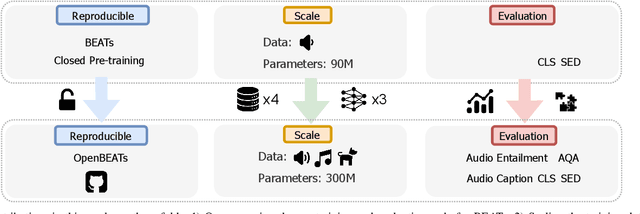

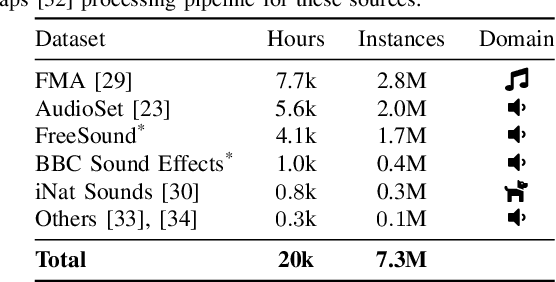
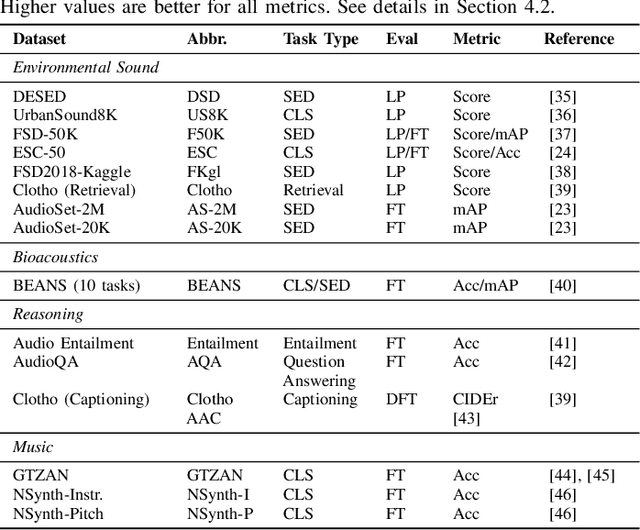
Masked token prediction has emerged as a powerful pre-training objective across language, vision, and speech, offering the potential to unify these diverse modalities through a single pre-training task. However, its application for general audio understanding remains underexplored, with BEATs being the only notable example. BEATs has seen limited modifications due to the absence of open-source pre-training code. Furthermore, BEATs was trained only on AudioSet, restricting its broader downstream applicability. To address these gaps, we present OpenBEATs, an open-source framework that extends BEATs via multi-domain audio pre-training. We conduct comprehensive evaluations across six types of tasks, twenty five datasets, and three audio domains, including audio reasoning tasks such as audio question answering, entailment, and captioning. OpenBEATs achieves state-of-the-art performance on six bioacoustics datasets, two environmental sound datasets and five reasoning datasets, performing better than models exceeding a billion parameters at one-fourth their parameter size. These results demonstrate the effectiveness of multi-domain datasets and masked token prediction task to learn general-purpose audio representations. To promote further research and reproducibility, we release all pre-training and evaluation code, pretrained and fine-tuned checkpoints, and training logs at https://shikhar-s.github.io/OpenBEATs
Towards Inclusive ASR: Investigating Voice Conversion for Dysarthric Speech Recognition in Low-Resource Languages
May 20, 2025Automatic speech recognition (ASR) for dysarthric speech remains challenging due to data scarcity, particularly in non-English languages. To address this, we fine-tune a voice conversion model on English dysarthric speech (UASpeech) to encode both speaker characteristics and prosodic distortions, then apply it to convert healthy non-English speech (FLEURS) into non-English dysarthric-like speech. The generated data is then used to fine-tune a multilingual ASR model, Massively Multilingual Speech (MMS), for improved dysarthric speech recognition. Evaluation on PC-GITA (Spanish), EasyCall (Italian), and SSNCE (Tamil) demonstrates that VC with both speaker and prosody conversion significantly outperforms the off-the-shelf MMS performance and conventional augmentation techniques such as speed and tempo perturbation. Objective and subjective analyses of the generated data further confirm that the generated speech simulates dysarthric characteristics.