 Add to Chrome
 Add to Firefox
 Add to Edge
Toward the Cognitive--Physical Limits of Embodied Intelligence through a World-Model-Centric Autonomous Racing Agent
Aug 11, 2026
Embodied artificial intelligence aims to develop agents that perceive, reason, and act through continuous interaction with the physical world. However, most embodied systems are still evaluated within conservative safety margins or moderate interaction regimes, leaving their capability boundaries under extreme conditions insufficiently understood. Autonomous racing provides a stringent testbed by combining high-frequency localization and perception, adversarial interaction, near-saturated vehicle dynamics, and strict safety constraints. Existing systems push high-speed performance but rarely model and refine cognitive and physical limits jointly. Here we show that a world-model-centric autonomous racing agent provides a concrete step toward exploring these coupled limits. The framework learns predictive world models from near-limit successes and failures to capture interaction evolution, ego dynamics, and feasible-motion boundaries, coupling world-state construction, future-aware reasoning, and near-limit control in a closed-loop refinement process. Training data were collected from real-vehicle autonomous racing, where the onboard system maintained robust localization and perception at speeds up to 256.3 km/h and peak lateral acceleration of 26.8 m/s$^2$. In full-scale simulated racing, the well trained world-model-centric agent achieves an 88.3% interaction success rate across various challenging simulated racing scenarios. Closed-loop refinement of the world model and policy further improved utilization of cognitive-physical limits, recovery from failure modes, and generalization across varying conditions and unseen circuits. These results suggest a boundary-aware methodology in which world models help embodied agents represent, predict, and continually refine their capability boundaries for safer real-world deployment.

Track-Guided Hierarchical Reinforcement Learning for Autonomous Vehicle Drifting with Minimum-Lap-Time Planning
Jul 31, 2026In Formula 1, drivers optimize racing lines within tire grip limits to minimize lap times; however, in rally racing, drivers intentionally break traction to drift on loose surfaces. This maneuver rapidly aligns the vehicle for corner exits, ultimately reducing lap time. Autonomously executing such maneuvers formulates a complex dual-objective control problem: stabilizing highly nonlinear drift dynamics while strictly minimizing lap time. Addressing this challenge motivates the development of advanced Minimum-Lap-Time (MLT) drift control architectures. This paper proposes a planning-control framework specifically designed for MLT drifting scenario. First, we formulate an optimal control problem to generate a MLT drift planning trajectory, which is used as prior data to train a deep reinforcement learning drift controller. Given that drifting involves extremely large sideslip angles and is therefore challenging to learn directly, a Track-guided Reinforcement Learning (TgRL) drift control method is proposed to enable progressive training in a step-by-step manner, from drift control policy, to drift corner policy, and finally to a comprehensive drift race policy. The reward function incorporates both an instant reward term and an end reward term derived from the Minimum-Lap-Time objective. Simulation results demonstrate that the proposed framework enables the agent to learn a drift racing policy that not only ensures vehicle motion control performance but also effectively reduces lap time.
Steeringless Drifting: Differential-Torque Control of a Four-Wheel Independently Driven Vehicle
Jul 26, 2026Control methods for emerging vehicle chassis architectures are important for autonomous driving near handling limits. Unlike conventional drift control, which relies on mechanical steering and rear-tire saturation, a steering-free four-wheel independently driven (4WID) vehicle can generate direct yaw moment through differential wheel torques. This paper proposes a differential-torque drift control method for such a vehicle. A double-track vehicle model incorporating four-wheel differential actuation is established, based on which a drift-equilibrium calculation method and a closed-loop drift controller are developed. The proposed approach is validated through simulations and experiments on a 1:10-scale vehicle. The results show that the vehicle can achieve steady circular drifting with a sideslip angle of approximately 20$^\circ$ and perform figure-eight drift tracking. This study demonstrates the feasibility of drift control using only differential wheel torques and provides a new perspective on near-limit control for steering-free vehicle architectures.
Investigating Group Relative Policy Optimization for Diffusion Transformer based Text-to-Audio Generation
Mar 02, 2026Text-to-audio (T2A) generation has advanced considerably in recent years, yet existing methods continue to face challenges in accurately rendering complex text prompts, particularly those involving intricate audio effects, and achieving precise text-audio alignment. While prior approaches have explored data augmentation, explicit timing conditioning, and reinforcement learning, overall synthesis quality remains constrained. In this work, we experiment with reinforcement learning to further enhance T2A generation quality, building on diffusion transformer (DiT)-based architectures. Our method first employs a large language model (LLM) to generate high-fidelity, richly detailed audio captions, substantially improving text-audio semantic alignment, especially for ambiguous or underspecified prompts. We then apply Group Relative Policy Optimization (GRPO), a recently introduced reinforcement learning algorithm, to fine-tune the T2A model. Through systematic experimentation with diverse reward functions (including CLAP, KL, FAD, and their combinations), we identify the key drivers of effective RL in audio synthesis and analyze how reward design impacts final audio quality. Experimental results demonstrate that GRPO-based fine-tuning yield substantial gains in synthesis fidelity and prompt adherence.
A Unified Neural Codec Language Model for Selective Editable Text to Speech Generation
Jan 18, 2026Neural codec language models achieve impressive zero-shot Text-to-Speech (TTS) by fully imitating the acoustic characteristics of a short speech prompt, including timbre, prosody, and paralinguistic information. However, such holistic imitation limits their ability to isolate and control individual attributes. In this paper, we present a unified codec language model SpeechEdit that extends zero-shot TTS with a selective control mechanism. By default, SpeechEdit reproduces the complete acoustic profile inferred from the speech prompt, but it selectively overrides only the attributes specified by explicit control instructions. To enable controllable modeling, SpeechEdit is trained on our newly constructed LibriEdit dataset, which provides delta (difference-aware) training pairs derived from LibriHeavy. Experimental results show that our approach maintains naturalness and robustness while offering flexible and localized control over desired attributes. Audio samples are available at https://speech-editing.github.io/speech-editing/.
Fine-Tuning Large Multimodal Models for Automatic Pronunciation Assessment
Sep 19, 2025Automatic Pronunciation Assessment (APA) is critical for Computer-Assisted Language Learning (CALL), requiring evaluation across multiple granularities and aspects. Large Multimodal Models (LMMs) present new opportunities for APA, but their effectiveness in fine-grained assessment remains uncertain. This work investigates fine-tuning LMMs for APA using the Speechocean762 dataset and a private corpus. Fine-tuning significantly outperforms zero-shot settings and achieves competitive results on single-granularity tasks compared to public and commercial systems. The model performs well at word and sentence levels, while phoneme-level assessment remains challenging. We also observe that the Pearson Correlation Coefficient (PCC) reaches 0.9, whereas Spearman's rank Correlation Coefficient (SCC) remains around 0.6, suggesting that SCC better reflects ordinal consistency. These findings highlight both the promise and limitations of LMMs for APA and point to future work on fine-grained modeling and rank-aware evaluation.
Next Tokens Denoising for Speech Synthesis
Jul 30, 2025While diffusion and autoregressive (AR) models have significantly advanced generative modeling, they each present distinct limitations. AR models, which rely on causal attention, cannot exploit future context and suffer from slow generation speeds. Conversely, diffusion models struggle with key-value (KV) caching. To overcome these challenges, we introduce Dragon-FM, a novel text-to-speech (TTS) design that unifies AR and flow-matching. This model processes 48 kHz audio codec tokens in chunks at a compact 12.5 tokens per second rate. This design enables AR modeling across chunks, ensuring global coherence, while parallel flow-matching within chunks facilitates fast iterative denoising. Consequently, the proposed model can utilize KV-cache across chunks and incorporate future context within each chunk. Furthermore, it bridges continuous and discrete feature modeling, demonstrating that continuous AR flow-matching can predict discrete tokens with finite scalar quantizers. This efficient codec and fast chunk-autoregressive architecture also makes the proposed model particularly effective for generating extended content. Experiment for demos of our work} on podcast datasets demonstrate its capability to efficiently generate high-quality zero-shot podcasts.
Medical-Knowledge Driven Multiple Instance Learning for Classifying Severe Abdominal Anomalies on Prenatal Ultrasound
Jul 02, 2025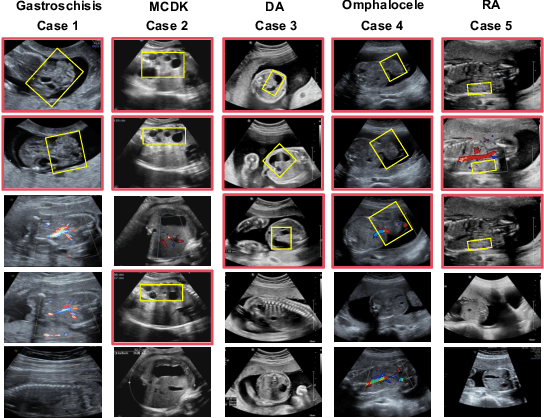
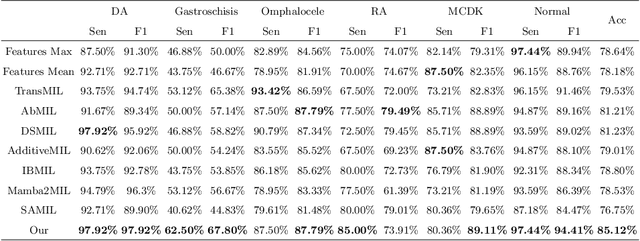
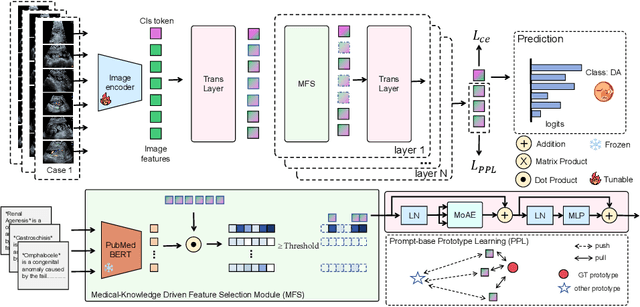

Fetal abdominal malformations are serious congenital anomalies that require accurate diagnosis to guide pregnancy management and reduce mortality. Although AI has demonstrated significant potential in medical diagnosis, its application to prenatal abdominal anomalies remains limited. Most existing studies focus on image-level classification and rely on standard plane localization, placing less emphasis on case-level diagnosis. In this paper, we develop a case-level multiple instance learning (MIL)-based method, free of standard plane localization, for classifying fetal abdominal anomalies in prenatal ultrasound. Our contribution is three-fold. First, we adopt a mixture-of-attention-experts module (MoAE) to weight different attention heads for various planes. Secondly, we propose a medical-knowledge-driven feature selection module (MFS) to align image features with medical knowledge, performing self-supervised image token selection at the case-level. Finally, we propose a prompt-based prototype learning (PPL) to enhance the MFS. Extensively validated on a large prenatal abdominal ultrasound dataset containing 2,419 cases, with a total of 24,748 images and 6 categories, our proposed method outperforms the state-of-the-art competitors. Codes are available at:https://github.com/LL-AC/AAcls.
Zero-Shot Streaming Text to Speech Synthesis with Transducer and Auto-Regressive Modeling
May 26, 2025Zero-shot streaming text-to-speech is an important research topic in human-computer interaction. Existing methods primarily use a lookahead mechanism, relying on future text to achieve natural streaming speech synthesis, which introduces high processing latency. To address this issue, we propose SMLLE, a streaming framework for generating high-quality speech frame-by-frame. SMLLE employs a Transducer to convert text into semantic tokens in real time while simultaneously obtaining duration alignment information. The combined outputs are then fed into a fully autoregressive (AR) streaming model to reconstruct mel-spectrograms. To further stabilize the generation process, we design a Delete < Bos > Mechanism that allows the AR model to access future text introducing as minimal delay as possible. Experimental results suggest that the SMLLE outperforms current streaming TTS methods and achieves comparable performance over sentence-level TTS systems. Samples are available on https://anonymous.4open.science/w/demo_page-48B7/.
Exploring Collaborative GenAI Agents in Synchronous Group Settings: Eliciting Team Perceptions and Design Considerations for the Future of Work
Apr 21, 2025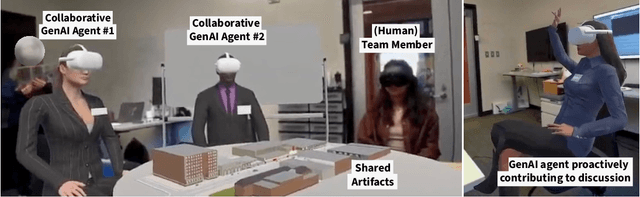
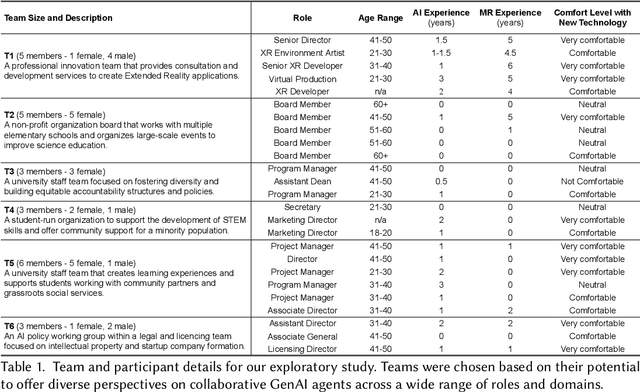
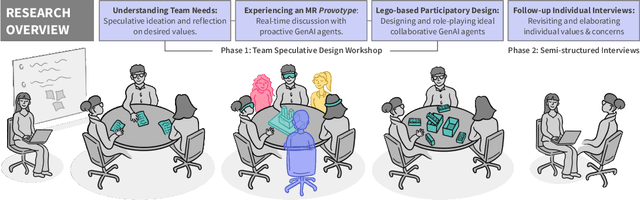
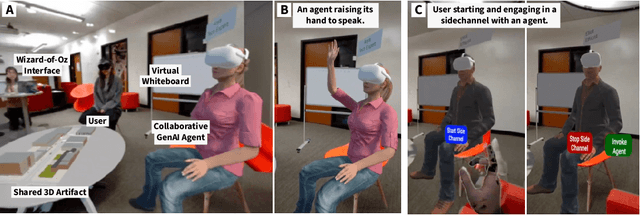
While generative artificial intelligence (GenAI) is finding increased adoption in workplaces, current tools are primarily designed for individual use. Prior work established the potential for these tools to enhance personal creativity and productivity towards shared goals; however, we don't know yet how to best take into account the nuances of group work and team dynamics when deploying GenAI in work settings. In this paper, we investigate the potential of collaborative GenAI agents to augment teamwork in synchronous group settings through an exploratory study that engaged 25 professionals across 6 teams in speculative design workshops and individual follow-up interviews. Our workshops included a mixed reality provotype to simulate embodied collaborative GenAI agents capable of actively participating in group discussions. Our findings suggest that, if designed well, collaborative GenAI agents offer valuable opportunities to enhance team problem-solving by challenging groupthink, bridging communication gaps, and reducing social friction. However, teams' willingness to integrate GenAI agents depended on its perceived fit across a number of individual, team, and organizational factors. We outline the key design tensions around agent representation, social prominence, and engagement and highlight the opportunities spatial and immersive technologies could offer to modulate GenAI influence on team outcomes and strike a balance between augmentation and agency.