 Add to Chrome
 Add to Firefox
 Add to Edge
Implicit Graph, Explicit Retrieval: Towards Efficient and Interpretable Long-horizon Memory for Large Language Models
Jan 06, 2026
Long-horizon applications increasingly require large language models (LLMs) to answer queries when relevant evidence is sparse and dispersed across very long contexts. Existing memory systems largely follow two paradigms: explicit structured memories offer interpretability but often become brittle under long-context overload, while latent memory mechanisms are efficient and stable yet difficult to inspect. We propose LatentGraphMem, a memory framework that combines implicit graph memory with explicit subgraph retrieval. LatentGraphMem stores a graph-structured memory in latent space for stability and efficiency, and exposes a task-specific subgraph retrieval interface that returns a compact symbolic subgraph under a fixed budget for downstream reasoning and human inspection. During training, an explicit graph view is materialized to interface with a frozen reasoner for question-answering supervision. At inference time, retrieval is performed in latent space and only the retrieved subgraph is externalized. Experiments on long-horizon benchmarks across multiple model scales show that LatentGraphMem consistently outperforms representative explicit-graph and latent-memory baselines, while enabling parameter-efficient adaptation and flexible scaling to larger reasoners without introducing large symbolic artifacts.

TeleWorld: Towards Dynamic Multimodal Synthesis with a 4D World Model
Dec 31, 2025World models aim to endow AI systems with the ability to represent, generate, and interact with dynamic environments in a coherent and temporally consistent manner. While recent video generation models have demonstrated impressive visual quality, they remain limited in real-time interaction, long-horizon consistency, and persistent memory of dynamic scenes, hindering their evolution into practical world models. In this report, we present TeleWorld, a real-time multimodal 4D world modeling framework that unifies video generation, dynamic scene reconstruction, and long-term world memory within a closed-loop system. TeleWorld introduces a novel generation-reconstruction-guidance paradigm, where generated video streams are continuously reconstructed into a dynamic 4D spatio-temporal representation, which in turn guides subsequent generation to maintain spatial, temporal, and physical consistency. To support long-horizon generation with low latency, we employ an autoregressive diffusion-based video model enhanced with Macro-from-Micro Planning (MMPL)--a hierarchical planning method that reduces error accumulation from frame-level to segment-level-alongside efficient Distribution Matching Distillation (DMD), enabling real-time synthesis under practical computational budgets. Our approach achieves seamless integration of dynamic object modeling and static scene representation within a unified 4D framework, advancing world models toward practical, interactive, and computationally accessible systems. Extensive experiments demonstrate that TeleWorld achieves strong performance in both static and dynamic world understanding, long-term consistency, and real-time generation efficiency, positioning it as a practical step toward interactive, memory-enabled world models for multimodal generation and embodied intelligence.
MiMo-Audio: Audio Language Models are Few-Shot Learners
Dec 29, 2025Existing audio language models typically rely on task-specific fine-tuning to accomplish particular audio tasks. In contrast, humans are able to generalize to new audio tasks with only a few examples or simple instructions. GPT-3 has shown that scaling next-token prediction pretraining enables strong generalization capabilities in text, and we believe this paradigm is equally applicable to the audio domain. By scaling MiMo-Audio's pretraining data to over one hundred million of hours, we observe the emergence of few-shot learning capabilities across a diverse set of audio tasks. We develop a systematic evaluation of these capabilities and find that MiMo-Audio-7B-Base achieves SOTA performance on both speech intelligence and audio understanding benchmarks among open-source models. Beyond standard metrics, MiMo-Audio-7B-Base generalizes to tasks absent from its training data, such as voice conversion, style transfer, and speech editing. MiMo-Audio-7B-Base also demonstrates powerful speech continuation capabilities, capable of generating highly realistic talk shows, recitations, livestreaming and debates. At the post-training stage, we curate a diverse instruction-tuning corpus and introduce thinking mechanisms into both audio understanding and generation. MiMo-Audio-7B-Instruct achieves open-source SOTA on audio understanding benchmarks (MMSU, MMAU, MMAR, MMAU-Pro), spoken dialogue benchmarks (Big Bench Audio, MultiChallenge Audio) and instruct-TTS evaluations, approaching or surpassing closed-source models. Model checkpoints and full evaluation suite are available at https://github.com/XiaomiMiMo/MiMo-Audio.
A Stepwise-Enhanced Reasoning Framework for Large Language Models Based on External Subgraph Generation
Dec 29, 2025Large Language Models (LLMs) have achieved strong performance across a wide range of natural language processing tasks in recent years, including machine translation, text generation, and question answering. As their applications extend to increasingly complex scenarios, however, LLMs continue to face challenges in tasks that require deep reasoning and logical inference. In particular, models trained on large scale textual corpora may incorporate noisy or irrelevant information during generation, which can lead to incorrect predictions or outputs that are inconsistent with factual knowledge. To address this limitation, we propose a stepwise reasoning enhancement framework for LLMs based on external subgraph generation, termed SGR. The proposed framework dynamically constructs query relevant subgraphs from external knowledge bases and leverages their semantic structure to guide the reasoning process. By performing reasoning in a step by step manner over structured subgraphs, SGR reduces the influence of noisy information and improves reasoning accuracy. Specifically, the framework first generates an external subgraph tailored to the input query, then guides the model to conduct multi step reasoning grounded in the subgraph, and finally integrates multiple reasoning paths to produce the final answer. Experimental results on multiple benchmark datasets demonstrate that SGR consistently outperforms strong baselines, indicating its effectiveness in enhancing the reasoning capabilities of LLMs.
Multi-Objective Bilevel Learning
Nov 11, 2025As machine learning (ML) applications grow increasingly complex in recent years, modern ML frameworks often need to address multiple potentially conflicting objectives with coupled decision variables across different layers. This creates a compelling need for multi-objective bilevel learning (MOBL). So far, however, the field of MOBL remains in its infancy and many important problems remain under-explored. This motivates us to fill this gap and systematically investigate the theoretical and algorithmic foundation of MOBL. Specifically, we consider MOBL problems with multiple conflicting objectives guided by preferences at the upper-level subproblem, where part of the inputs depend on the optimal solution of the lower-level subproblem. Our goal is to develop efficient MOBL optimization algorithms to (1) identify a preference-guided Pareto-stationary solution with low oracle complexity; and (2) enable systematic Pareto front exploration. To this end, we propose a unifying algorithmic framework called weighted-Chebyshev multi-hyper-gradient-descent (WC-MHGD) for both deterministic and stochastic settings with finite-time Pareto-stationarity convergence rate guarantees, which not only implies low oracle complexity but also induces systematic Pareto front exploration. We further conduct extensive experiments to confirm our theoretical results.
Cross-Field Interface-Aware Neural Operators for Multiphase Flow Simulation
Nov 09, 2025Multiphase flow systems, with their complex dynamics, field discontinuities, and interphase interactions, pose significant computational challenges for traditional numerical solvers. While neural operators offer efficient alternatives, they often struggle to achieve high-resolution numerical accuracy in these systems. This limitation primarily stems from the inherent spatial heterogeneity and the scarcity of high-quality training data in multiphase flows. In this work, we propose the Interface Information-Aware Neural Operator (IANO), a novel framework that explicitly leverages interface information as a physical prior to enhance the prediction accuracy. The IANO architecture introduces two key components: 1) An interface-aware multiple function encoding mechanism jointly models multiple physical fields and interfaces, thus capturing the high-frequency physical features at the interface. 2) A geometry-aware positional encoding mechanism further establishes the relationship between interface information, physical variables, and spatial positions, enabling it to achieve pointwise super-resolution prediction even in the low-data regimes. Experimental results demonstrate that IANO outperforms baselines by $\sim$10\% in accuracy for multiphase flow simulations while maintaining robustness under data-scarce and noise-perturbed conditions.
PVMark: Enabling Public Verifiability for LLM Watermarking Schemes
Oct 30, 2025Watermarking schemes for large language models (LLMs) have been proposed to identify the source of the generated text, mitigating the potential threats emerged from model theft. However, current watermarking solutions hardly resolve the trust issue: the non-public watermark detection cannot prove itself faithfully conducting the detection. We observe that it is attributed to the secret key mostly used in the watermark detection -- it cannot be public, or the adversary may launch removal attacks provided the key; nor can it be private, or the watermarking detection is opaque to the public. To resolve the dilemma, we propose PVMark, a plugin based on zero-knowledge proof (ZKP), enabling the watermark detection process to be publicly verifiable by third parties without disclosing any secret key. PVMark hinges upon the proof of `correct execution' of watermark detection on which a set of ZKP constraints are built, including mapping, random number generation, comparison, and summation. We implement multiple variants of PVMark in Python, Rust and Circom, covering combinations of three watermarking schemes, three hash functions, and four ZKP protocols, to show our approach effectively works under a variety of circumstances. By experimental results, PVMark efficiently enables public verifiability on the state-of-the-art LLM watermarking schemes yet without compromising the watermarking performance, promising to be deployed in practice.
CityRiSE: Reasoning Urban Socio-Economic Status in Vision-Language Models via Reinforcement Learning
Oct 25, 2025Harnessing publicly available, large-scale web data, such as street view and satellite imagery, urban socio-economic sensing is of paramount importance for achieving global sustainable development goals. With the emergence of Large Vision-Language Models (LVLMs), new opportunities have arisen to solve this task by treating it as a multi-modal perception and understanding problem. However, recent studies reveal that LVLMs still struggle with accurate and interpretable socio-economic predictions from visual data. To address these limitations and maximize the potential of LVLMs, we introduce \textbf{CityRiSE}, a novel framework for \textbf{R}eason\textbf{i}ng urban \textbf{S}ocio-\textbf{E}conomic status in LVLMs through pure reinforcement learning (RL). With carefully curated multi-modal data and verifiable reward design, our approach guides the LVLM to focus on semantically meaningful visual cues, enabling structured and goal-oriented reasoning for generalist socio-economic status prediction. Experiments demonstrate that CityRiSE with emergent reasoning process significantly outperforms existing baselines, improving both prediction accuracy and generalization across diverse urban contexts, particularly for prediction on unseen cities and unseen indicators. This work highlights the promise of combining RL and LVLMs for interpretable and generalist urban socio-economic sensing.
CCrepairBench: A High-Fidelity Benchmark and Reinforcement Learning Framework for C++ Compilation Repair
Sep 19, 2025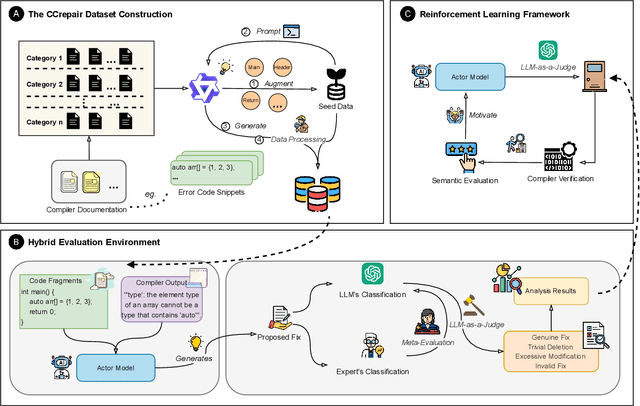
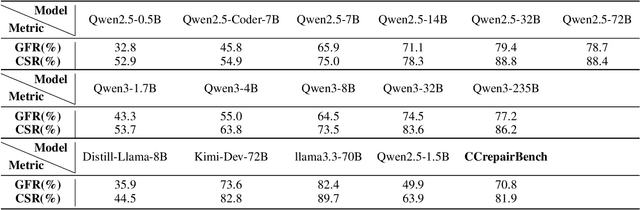
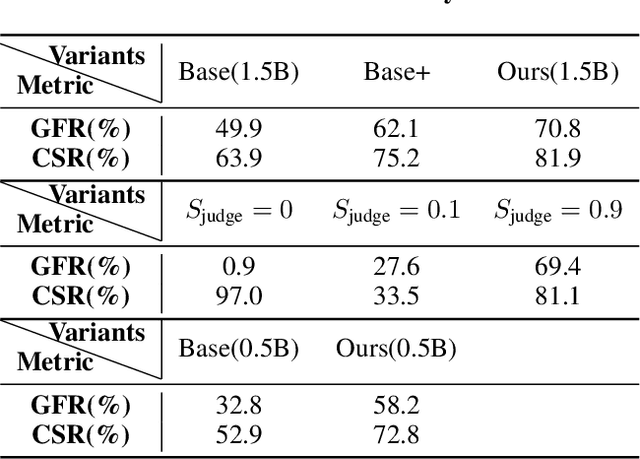
The automated repair of C++ compilation errors presents a significant challenge, the resolution of which is critical for developer productivity. Progress in this domain is constrained by two primary factors: the scarcity of large-scale, high-fidelity datasets and the limitations of conventional supervised methods, which often fail to generate semantically correct patches.This paper addresses these gaps by introducing a comprehensive framework with three core contributions. First, we present CCrepair, a novel, large-scale C++ compilation error dataset constructed through a sophisticated generate-and-verify pipeline. Second, we propose a Reinforcement Learning (RL) paradigm guided by a hybrid reward signal, shifting the focus from mere compilability to the semantic quality of the fix. Finally, we establish the robust, two-stage evaluation system providing this signal, centered on an LLM-as-a-Judge whose reliability has been rigorously validated against the collective judgments of a panel of human experts. This integrated approach aligns the training objective with generating high-quality, non-trivial patches that are both syntactically and semantically correct. The effectiveness of our approach was demonstrated experimentally. Our RL-trained Qwen2.5-1.5B-Instruct model achieved performance comparable to a Qwen2.5-14B-Instruct model, validating the efficiency of our training paradigm. Our work provides the research community with a valuable new dataset and a more effective paradigm for training and evaluating robust compilation repair models, paving the way for more practical and reliable automated programming assistants.
RPG: A Repository Planning Graph for Unified and Scalable Codebase Generation
Sep 19, 2025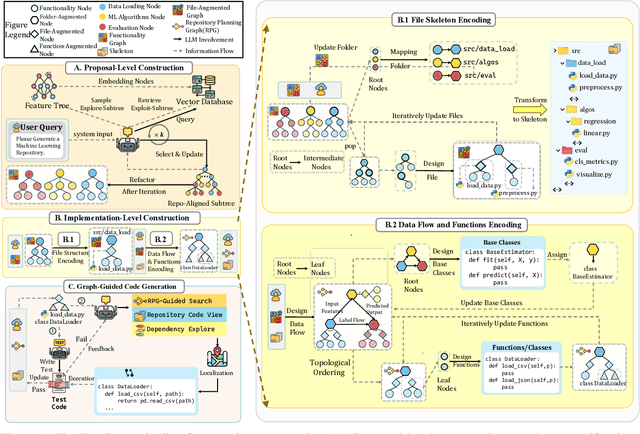
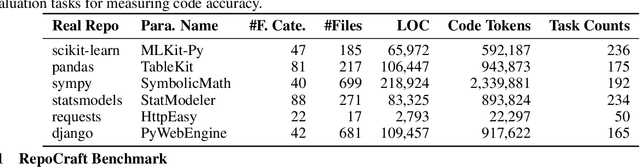
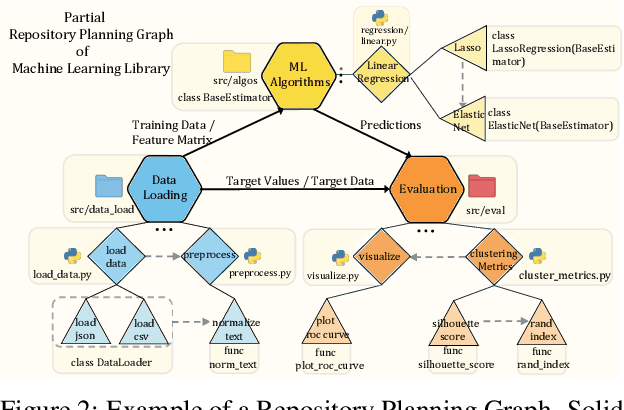
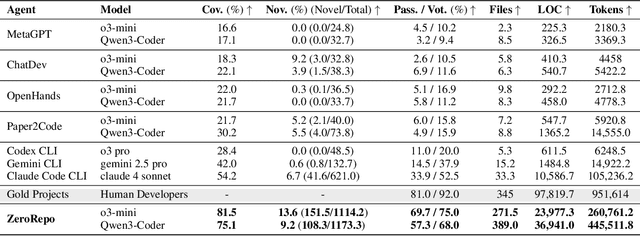
Large language models excel at function- and file-level code generation, yet generating complete repositories from scratch remains a fundamental challenge. This process demands coherent and reliable planning across proposal- and implementation-level stages, while natural language, due to its ambiguity and verbosity, is ill-suited for faithfully representing complex software structures. To address this, we introduce the Repository Planning Graph (RPG), a persistent representation that unifies proposal- and implementation-level planning by encoding capabilities, file structures, data flows, and functions in one graph. RPG replaces ambiguous natural language with an explicit blueprint, enabling long-horizon planning and scalable repository generation. Building on RPG, we develop ZeroRepo, a graph-driven framework for repository generation from scratch. It operates in three stages: proposal-level planning and implementation-level refinement to construct the graph, followed by graph-guided code generation with test validation. To evaluate this setting, we construct RepoCraft, a benchmark of six real-world projects with 1,052 tasks. On RepoCraft, ZeroRepo produces repositories averaging nearly 36K LOC, roughly 3.9$\times$ the strongest baseline (Claude Code) and about 64$\times$ other baselines. It attains 81.5% functional coverage and a 69.7% pass rate, exceeding Claude Code by 27.3 and 35.8 percentage points, respectively. Further analysis shows that RPG models complex dependencies, enables progressively more sophisticated planning through near-linear scaling, and enhances LLM understanding of repositories, thereby accelerating agent localization.