 Add to Chrome
 Add to Firefox
 Add to Edge
Anchoring and Steering Diffusion: Enhancing the Faithfulness of Text-to-Image Generation at Inference Time
Jul 29, 2026
While text-to-image diffusion models achieve impressive visual quality, they frequently struggle to maintain precise alignment with complex compositional prompts. An effective strategy is to improve the inference process of diffusion models, thereby better leveraging their pretrained priors to address misalignment. Existing training-free methods can be divided into two categories. The first category focuses on improving the randomly sampled initial noise, either performing costly search over noise pools or manipulating sampled noise without ensuring reliable semantic injection. The second category focuses on improving the denoising trajectory, lacking explicit mechanisms to timely diagnose and correct semantic errors. we propose \textbf{AnchorSteer}, a training-free framework that exerts fine-grained control over \textbf{both initialization} and \textbf{the denoising trajectory}. AnchorSteer consists of two synergistic components: \textbf{Semantic Anchoring} replaces uninformative Gaussian noise with text-aligned initializations via CLIP-based prior extraction and a novel Latent-Prior Score Distillation Sampling (LP-SDS) objective. Specifically, LP-SDS distills CLIP visual priors into the knowledge distribution of diffusion models, mitigating the domain gap between CLIP-based priors and diffusion-based priors. \textbf{Reflective Steering} transforms passive denoising with an active Think--Erase--Retouch loop that enables mid-generation self-correction. It leverages VLM-based diagnosis to detect semantic deviations and performs targeted latent refinement to suppress erroneous content and recover missing attributes. Extensive experiments on GenEval and T2I-CompBench++ demonstrate that AnchorSteer consistently outperforms existing baselines in text--image alignment while preserving high visual quality.

CineWeaver: Training-Free Reference-Controllable Multi-Shot Long Video Generation for Cinematic Storytelling
Jul 29, 2026Cinematic video generation is challenging for text-to-video diffusion models due to concurrent requirements on multi-shot generation, fine-grained controllability over characters and scenes, and long-form generation across extended temporal horizons. Existing methods rely on customization and retraining to separately address specific requirements, and cannot simultaneously fulfill all the requirements with a unified framework. In this paper, we shed light on the training-free paradigm with the key insight that the difficulty of multi-shot generation arises from a structural bias toward temporal continuity in pretrained video diffusion models, and consequently, propose a unified framework named CineWeaver to achieve reference-controllable multi-shot long-video generation without retraining. We manipulate positional encoding and attention patterns to break temporal continuity during inference to enable clear shot transitions using pretrained video diffusion models. Furthermore, we extend the proposed framework with a shot-routed reference conditioning mechanism for per-shot fine-grained controllability, and develop an anchor memory mechanism to allow long-form generation with consistent global appearance cues. To our best knowledge, CineWeaver is the first unified framework to simultaneously enable \textbf{long-form}, \textbf{reference-controllable}, and \textbf{multi-shot} video generation in a training-free fashion. Experimental results demonstrate that CineWeaver produces high-quality cinematic videos of long durations with consistent identities, stable global appearance, and clear shot transitions. The project page is available at: https://cineweaver.github.io.
Hessian-augmented Supervised Learning for Hamilton-Jacobi-Bellman PDEs
Jun 22, 2026A data-driven method is developed for approximating value functions in deterministic optimal control problems with nonlinear control-affine dynamics. The Pontryagin Maximum Principle optimality system is solved from multiple initial conditions to generate training data consisting of values, gradients, and Hessians of the value function, where Hessian information is obtained from a matrix Riccati equation along optimal trajectories. These quantities augment a weighted least-squares regression over sparse polynomial bases on hyperbolic cross index sets, with gradients and Hessians contributing additional linear equations per sample and substantially reducing sample complexity compared to value-only regression. Feedback laws are recovered analytically from the learned value function. In high dimensions, a partial Hessian strategy controls the cost of data generation. The approach is validated on problems of increasing state dimension, where second-order data augmentation is shown to improve approximation accuracy and closed-loop performance, with up to an order-of-magnitude reduction in the number of training samples required relative to lower-order methods.
Towards Holistic Modeling for Video Frame Interpolation with Auto-regressive Diffusion Transformers
Jan 21, 2026Existing video frame interpolation (VFI) methods often adopt a frame-centric approach, processing videos as independent short segments (e.g., triplets), which leads to temporal inconsistencies and motion artifacts. To overcome this, we propose a holistic, video-centric paradigm named \textbf{L}ocal \textbf{D}iffusion \textbf{F}orcing for \textbf{V}ideo \textbf{F}rame \textbf{I}nterpolation (LDF-VFI). Our framework is built upon an auto-regressive diffusion transformer that models the entire video sequence to ensure long-range temporal coherence. To mitigate error accumulation inherent in auto-regressive generation, we introduce a novel skip-concatenate sampling strategy that effectively maintains temporal stability. Furthermore, LDF-VFI incorporates sparse, local attention and tiled VAE encoding, a combination that not only enables efficient processing of long sequences but also allows generalization to arbitrary spatial resolutions (e.g., 4K) at inference without retraining. An enhanced conditional VAE decoder, which leverages multi-scale features from the input video, further improves reconstruction fidelity. Empirically, LDF-VFI achieves state-of-the-art performance on challenging long-sequence benchmarks, demonstrating superior per-frame quality and temporal consistency, especially in scenes with large motion. The source code is available at https://github.com/xypeng9903/LDF-VFI.
TeleWorld: Towards Dynamic Multimodal Synthesis with a 4D World Model
Dec 31, 2025World models aim to endow AI systems with the ability to represent, generate, and interact with dynamic environments in a coherent and temporally consistent manner. While recent video generation models have demonstrated impressive visual quality, they remain limited in real-time interaction, long-horizon consistency, and persistent memory of dynamic scenes, hindering their evolution into practical world models. In this report, we present TeleWorld, a real-time multimodal 4D world modeling framework that unifies video generation, dynamic scene reconstruction, and long-term world memory within a closed-loop system. TeleWorld introduces a novel generation-reconstruction-guidance paradigm, where generated video streams are continuously reconstructed into a dynamic 4D spatio-temporal representation, which in turn guides subsequent generation to maintain spatial, temporal, and physical consistency. To support long-horizon generation with low latency, we employ an autoregressive diffusion-based video model enhanced with Macro-from-Micro Planning (MMPL)--a hierarchical planning method that reduces error accumulation from frame-level to segment-level-alongside efficient Distribution Matching Distillation (DMD), enabling real-time synthesis under practical computational budgets. Our approach achieves seamless integration of dynamic object modeling and static scene representation within a unified 4D framework, advancing world models toward practical, interactive, and computationally accessible systems. Extensive experiments demonstrate that TeleWorld achieves strong performance in both static and dynamic world understanding, long-term consistency, and real-time generation efficiency, positioning it as a practical step toward interactive, memory-enabled world models for multimodal generation and embodied intelligence.
EVICPRESS: Joint KV-Cache Compression and Eviction for Efficient LLM Serving
Dec 16, 2025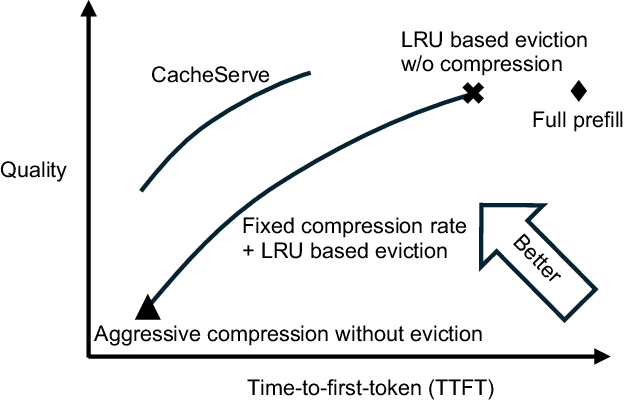
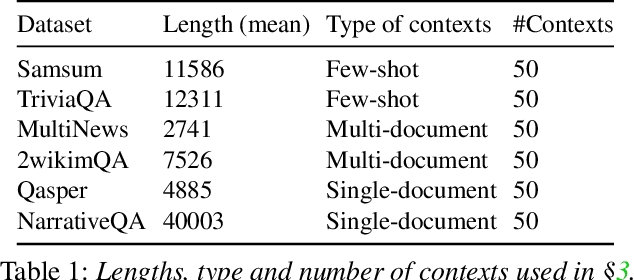
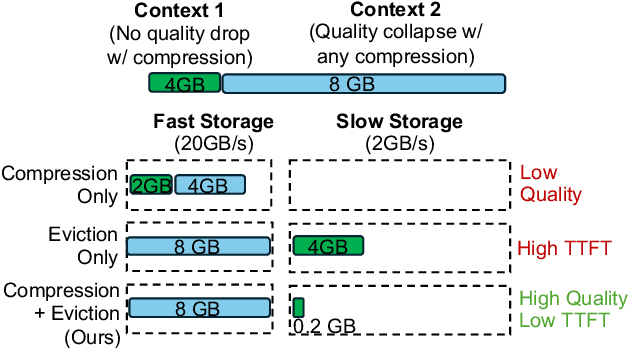
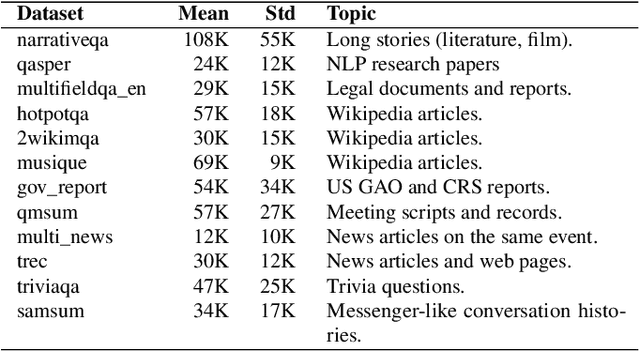
Reusing KV cache is essential for high efficiency of Large Language Model (LLM) inference systems. With more LLM users, the KV cache footprint can easily exceed GPU memory capacity, so prior work has proposed to either evict KV cache to lower-tier storage devices, or compress KV cache so that more KV cache can be fit in the fast memory. However, prior work misses an important opportunity: jointly optimizing the eviction and compression decisions across all KV caches to minimize average generation latency without hurting quality. We propose EVICPRESS, a KV-cache management system that applies lossy compression and adaptive eviction to KV cache across multiple storage tiers. Specifically, for each KV cache of a context, EVICPRESS considers the effect of compression and eviction of the KV cache on the average generation quality and delay across all contexts as a whole. To achieve this, EVICPRESS proposes a unified utility function that quantifies the effect of quality and delay of the lossy compression or eviction. To this end, EVICPRESS's profiling module periodically updates the utility function scores on all possible eviction-compression configurations for all contexts and places KV caches using a fast heuristic to rearrange KV caches on all storage tiers, with the goal of maximizing the utility function scores on each storage tier. Compared to the baselines that evict KV cache or compress KV cache, EVICPRESS achieves higher KV-cache hit rates on fast devices, i.e., lower delay, while preserving high generation quality by applying conservative compression to contexts that are sensitive to compression errors. Evaluation on 12 datasets and 5 models demonstrates that EVICPRESS achieves up to 2.19x faster time-to-first-token (TTFT) at equivalent generation quality.
3DGabSplat: 3D Gabor Splatting for Frequency-adaptive Radiance Field Rendering
Aug 07, 2025Recent prominence in 3D Gaussian Splatting (3DGS) has enabled real-time rendering while maintaining high-fidelity novel view synthesis. However, 3DGS resorts to the Gaussian function that is low-pass by nature and is restricted in representing high-frequency details in 3D scenes. Moreover, it causes redundant primitives with degraded training and rendering efficiency and excessive memory overhead. To overcome these limitations, we propose 3D Gabor Splatting (3DGabSplat) that leverages a novel 3D Gabor-based primitive with multiple directional 3D frequency responses for radiance field representation supervised by multi-view images. The proposed 3D Gabor-based primitive forms a filter bank incorporating multiple 3D Gabor kernels at different frequencies to enhance flexibility and efficiency in capturing fine 3D details. Furthermore, to achieve novel view rendering, an efficient CUDA-based rasterizer is developed to project the multiple directional 3D frequency components characterized by 3D Gabor-based primitives onto the 2D image plane, and a frequency-adaptive mechanism is presented for adaptive joint optimization of primitives. 3DGabSplat is scalable to be a plug-and-play kernel for seamless integration into existing 3DGS paradigms to enhance both efficiency and quality of novel view synthesis. Extensive experiments demonstrate that 3DGabSplat outperforms 3DGS and its variants using alternative primitives, and achieves state-of-the-art rendering quality across both real-world and synthetic scenes. Remarkably, we achieve up to 1.35 dB PSNR gain over 3DGS with simultaneously reduced number of primitives and memory consumption.
Alchemist: Towards the Design of Efficient Online Continual Learning System
Mar 03, 2025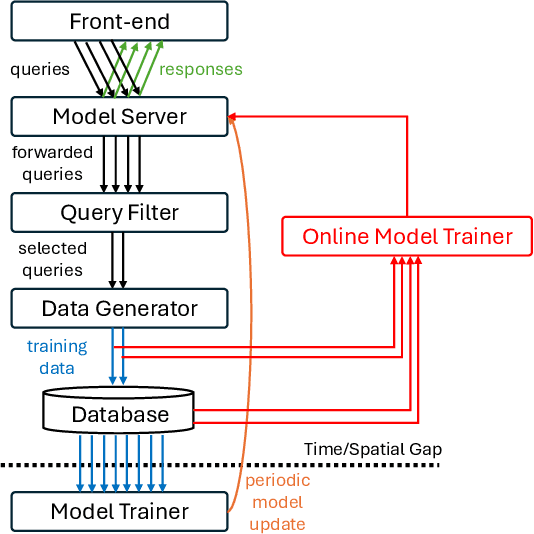
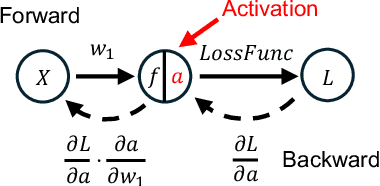
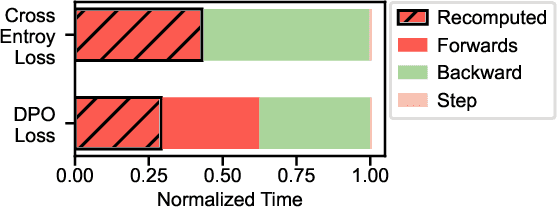
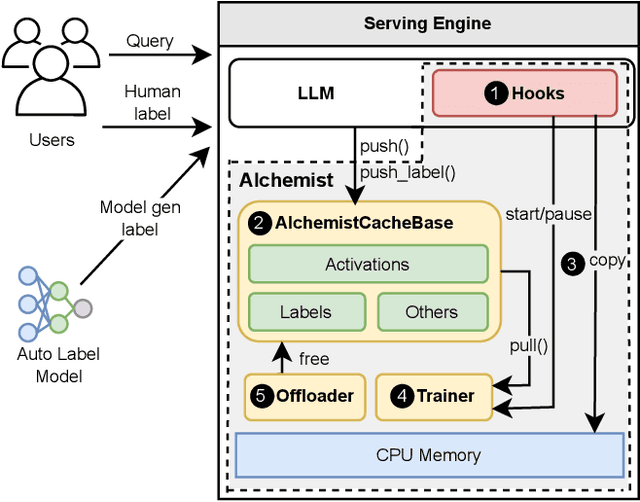
Continual learning has emerged as a promising solution to refine models incrementally by leveraging user feedback, thereby enhancing model performance in applications like code completion, personal assistants, and chat interfaces. In particular, online continual learning - iteratively training the model with small batches of user feedback - has demonstrated notable performance improvements. However, the existing practice of segregating training and serving processes forces the online trainer to recompute the intermediate results already done during serving. Such redundant computations can account for 30%-42% of total training time. In this paper, we propose Alchemist, to the best of our knowledge, the first online continual learning system that efficiently reuses intermediate results computed during serving to reduce redundant computation with minimal impact on the serving latency or capacity. Alchemist introduces two key techniques: (1) minimal activations recording and saving during serving, where activations are recorded and saved only during the prefill phase to minimize overhead; and (2) offloading of serving activations, which dynamically manages GPU memory by freeing activations in the forward order, while reloading them in the backward order during the backward pass. Evaluations with the ShareGPT dataset show that compared with a separate training cluster, Alchemist significantly increases training throughput by up to 1.72x, reduces up to 47% memory usage during training, and supports up to 2x more training tokens - all while maintaining negligible impact on serving latency.
BotEval: Facilitating Interactive Human Evaluation
Jul 25, 2024Following the rapid progress in natural language processing (NLP) models, language models are applied to increasingly more complex interactive tasks such as negotiations and conversation moderations. Having human evaluators directly interact with these NLP models is essential for adequately evaluating the performance on such interactive tasks. We develop BotEval, an easily customizable, open-source, evaluation toolkit that focuses on enabling human-bot interactions as part of the evaluation process, as opposed to human evaluators making judgements for a static input. BotEval balances flexibility for customization and user-friendliness by providing templates for common use cases that span various degrees of complexity and built-in compatibility with popular crowdsourcing platforms. We showcase the numerous useful features of BotEval through a study that evaluates the performance of various chatbots on their effectiveness for conversational moderation and discuss how BotEval differs from other annotation tools.
Data/moment-driven approaches for fast predictive control of collective dynamics
Feb 23, 2024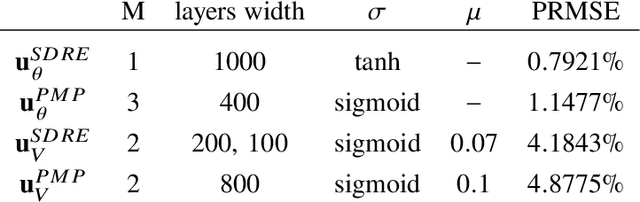
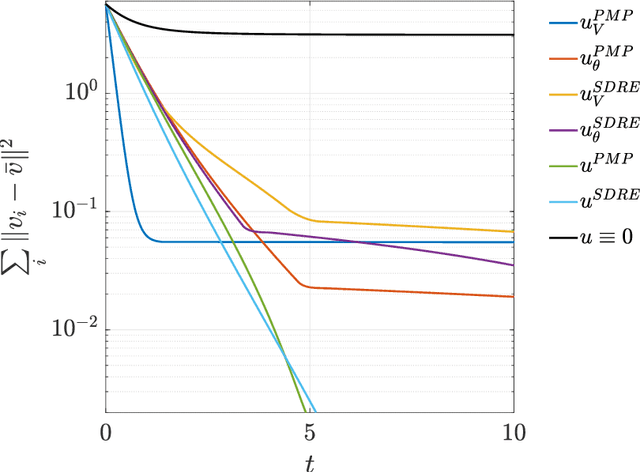

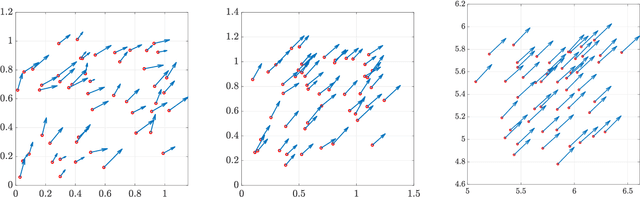
Feedback control synthesis for large-scale particle systems is reviewed in the framework of model predictive control (MPC). The high-dimensional character of collective dynamics hampers the performance of traditional MPC algorithms based on fast online dynamic optimization at every time step. Two alternatives to MPC are proposed. First, the use of supervised learning techniques for the offline approximation of optimal feedback laws is discussed. Then, a procedure based on sequential linearization of the dynamics based on macroscopic quantities of the particle ensemble is reviewed. Both approaches circumvent the online solution of optimal control problems enabling fast, real-time, feedback synthesis for large-scale particle systems. Numerical experiments assess the performance of the proposed algorithms.