 Add to Chrome
 Add to Firefox
 Add to Edge
DynaForcing: Overcoming Dynamic Collapse in Self-Forcing Distillation for Streaming Avatar Generation
Aug 18, 2026
Audio-driven avatar generation requires realistic lip-sync, expressive motion, and real-time streaming. Recent work achieves the latter via self-forcing with Distribution Matching Distillation (DMD), but this paradigm suffers from a critical failure that has not been systematically characterized: dynamic collapse, where the student model converges to a near-static optimum with high perceptual quality but severely suppressed temporal dynamics. We trace this to two causes: the reverse KL objective in DMD, which biases toward low-motion modes, and unanchored self-conditioning, which creates a feedback loop that amplifies collapse. This is especially harmful for avatars, where even subtle motion loss breaks lip-sync and expression. To address this, we propose DynaForcing, a training framework with three complementary strategies applied at different levels. Specifically, Hybrid Forcing anchors rollouts to ground-truth dynamics at the data level to break the feedback loop. Dynamics-Aware Reward Regularization introduces explicit motion rewards via the RL interpretation of DMD to counteract the reverse KL bias at the loss level. Reference Perturbation perturbs reference images to decouple identity from static details, forcing the model to rely on audio for motion at the conditioning level. We further introduce computation graph pruning and gradient replay, reducing the GPU footprint of self-forcing by over an order of magnitude. Experiments show that DynaForcing recovers dynamics to teacher-comparable levels (Dyn-Deg: 0.31 -> 0.73, Sync-C: 7.03 -> 7.68) while improving visual quality, resolving the quality-dynamics trade-off throughout training without early stopping.

Tango: Taming Visual Signals for Efficient Video Large Language Models
Apr 13, 2026Token pruning has emerged as a mainstream approach for developing efficient Video Large Language Models (Video LLMs). This work revisits and advances the two predominant token-pruning paradigms: attention-based selection and similarity-based clustering. Our study reveals two critical limitations in existing methods: (1) conventional top-k selection strategies fail to fully account for the attention distribution, which is often spatially multi-modal and long-tailed in magnitude; and (2) direct similarity-based clustering frequently generates fragmented clusters, resulting in distorted representations after pooling. To address these bottlenecks, we propose Tango, a novel framework designed to optimize the utilization of visual signals. Tango integrates a diversity-driven strategy to enhance attention-based token selection, and introduces Spatio-temporal Rotary Position Embedding (ST-RoPE) to preserve geometric structure via locality priors. Comprehensive experiments across various Video LLMs and video understanding benchmarks demonstrate the effectiveness and generalizability of our approach. Notably, when retaining only 10% of the video tokens, Tango preserves 98.9% of the original performance on LLaVA-OV while delivering a 1.88$\times$ inference speedup.
ActFER: Agentic Facial Expression Recognition via Active Tool-Augmented Visual Reasoning
Apr 10, 2026Recent advances in Multimodal Large Language Models (MLLMs) have created new opportunities for facial expression recognition (FER), moving it beyond pure label prediction toward reasoning-based affect understanding. However, existing MLLM-based FER methods still follow a passive paradigm: they rely on externally prepared facial inputs and perform single-pass reasoning over fixed visual evidence, without the capability for active facial perception. To address this limitation, we propose ActFER, an agentic framework that reformulates FER as active visual evidence acquisition followed by multimodal reasoning. Specifically, ActFER dynamically invokes tools for face detection and alignment, selectively zooms into informative local regions, and reasons over facial Action Units (AUs) and emotions through a visual Chain-of-Thought. To realize such behavior, we further develop Utility-Calibrated GRPO (UC-GRPO), a reinforcement learning algorithm tailored to agentic FER. UC-GRPO uses AU-grounded multi-level verifiable rewards to densify supervision, query-conditional contrastive utility estimation to enable sample-aware dynamic credit assignment for local inspection, and emotion-aware EMA calibration to reduce noisy utility estimates while capturing emotion-wise inspection tendencies. This algorithm enables ActFER to learn both when local inspection is beneficial and how to reason over the acquired evidence. Comprehensive experiments show that ActFER trained with UC-GRPO consistently outperforms passive MLLM-based FER baselines and substantially improves AU prediction accuracy.
SyncBreaker:Stage-Aware Multimodal Adversarial Attacks on Audio-Driven Talking Head Generation
Apr 09, 2026Diffusion-based audio-driven talking-head generation enables realistic portrait animation, but also introduces risks of misuse, such as fraud and misinformation. Existing protection methods are largely limited to a single modality, and neither image-only nor audio-only attacks can effectively suppress speech-driven facial dynamics. To address this gap, we propose SyncBreaker, a stage-aware multimodal protection framework that jointly perturbs portrait and audio inputs under modality-specific perceptual constraints. Our key contributions are twofold. First, for the image stream, we introduce nullifying supervision with Multi-Interval Sampling (MIS) across diffusion stages to steer the generation toward the static reference portrait by aggregating guidance from multiple denoising intervals. Second, for the audio stream, we propose Cross-Attention Fooling (CAF), which suppresses interval-specific audio-conditioned cross-attention responses. Both streams are optimized independently and combined at inference time to enable flexible deployment. We evaluate SyncBreaker in a white-box proactive protection setting. Extensive experiments demonstrate that SyncBreaker more effectively degrades lip synchronization and facial dynamics than strong single-modality baselines, while preserving input perceptual quality and remaining robust under purification. Code: https://github.com/kitty384/SyncBreaker.
Dual-Path Learning based on Frequency Structural Decoupling and Regional-Aware Fusion for Low-Light Image Super-Resolution
Mar 28, 2026Low-light image super-resolution (LLISR) is essential for restoring fine visual details and perceptual quality under insufficient illumination conditions with ubiquitous low-resolution devices. Although pioneer methods achieve high performance on single tasks, they solve both tasks in a serial manner, which inevitably leads to artifact amplification, texture suppression, and structural degradation. To address this, we propose Decoupling then Perceive (DTP), a novel frequency-aware framework that explicitly separates luminance and texture into semantically independent components, enabling specialized modeling and coherent reconstruction. Specifically, to adaptively separate the input into low-frequency luminance and high-frequency texture subspaces, we propose a Frequency-aware Structural Decoupling (FSD) mechanism, which lays a solid foundation for targeted representation learning and reconstruction. Based on the decoupled representation, a Semantics-specific Dual-path Representation (SDR) learning strategy that performs targeted enhancement and reconstruction for each frequency component is further designed, facilitating robust luminance adjustment and fine-grained texture recovery. To promote structural consistency and perceptual alignment in the reconstructed output, building upon this dual-path modeling, we further introduce a Cross-frequency Semantic Recomposition (CSR) module that selectively integrates the decoupled representations. Extensive experiments on the most widely used LLISR benchmarks demonstrate the superiority of our DTP framework, improving $+$1.6\% PSNR, $+$9.6\% SSIM, and $-$48\% LPIPS compared to the most state-of-the-art (SOTA) algorithm. Codes are released at https://github.com/JXVision/DTP.
ReMA: A Training-Free Plug-and-Play Mixing Augmentation for Video Behavior Recognition
Jan 01, 2026Video behavior recognition demands stable and discriminative representations under complex spatiotemporal variations. However, prevailing data augmentation strategies for videos remain largely perturbation-driven, often introducing uncontrolled variations that amplify non-discriminative factors, which finally weaken intra-class distributional structure and representation drift with inconsistent gains across temporal scales. To address these problems, we propose Representation-aware Mixing Augmentation (ReMA), a plug-and-play augmentation strategy that formulates mixing as a controlled replacement process to expand representations while preserving class-conditional stability. ReMA integrates two complementary mechanisms. Firstly, the Representation Alignment Mechanism (RAM) performs structured intra-class mixing under distributional alignment constraints, suppressing irrelevant intra-class drift while enhancing statistical reliability. Then, the Dynamic Selection Mechanism (DSM) generates motion-aware spatiotemporal masks to localize perturbations, guiding them away from discrimination-sensitive regions and promoting temporal coherence. By jointly controlling how and where mixing is applied, ReMA improves representation robustness without additional supervision or trainable parameters. Extensive experiments on diverse video behavior benchmarks demonstrate that ReMA consistently enhances generalization and robustness across different spatiotemporal granularities.
LIHE: Linguistic Instance-Split Hyperbolic-Euclidean Framework for Generalized Weakly-Supervised Referring Expression Comprehension
Nov 15, 2025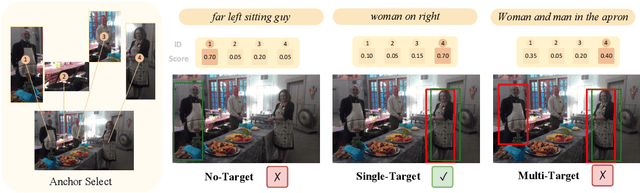
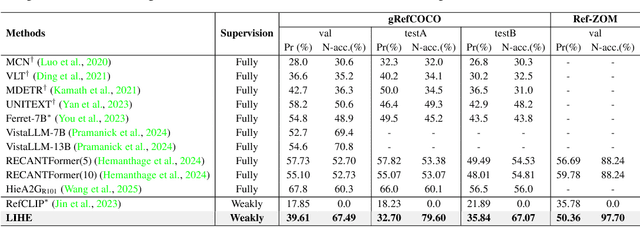
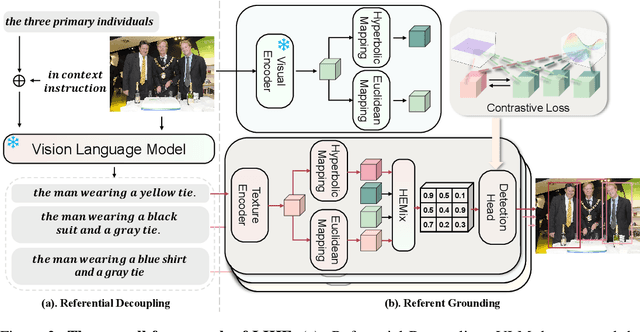
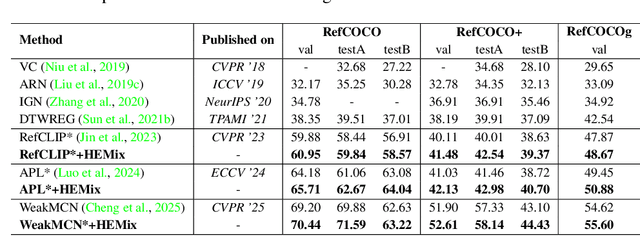
Existing Weakly-Supervised Referring Expression Comprehension (WREC) methods, while effective, are fundamentally limited by a one-to-one mapping assumption, hindering their ability to handle expressions corresponding to zero or multiple targets in realistic scenarios. To bridge this gap, we introduce the Weakly-Supervised Generalized Referring Expression Comprehension task (WGREC), a more practical paradigm that handles expressions with variable numbers of referents. However, extending WREC to WGREC presents two fundamental challenges: supervisory signal ambiguity, where weak image-level supervision is insufficient for training a model to infer the correct number and identity of referents, and semantic representation collapse, where standard Euclidean similarity forces hierarchically-related concepts into non-discriminative clusters, blurring categorical boundaries. To tackle these challenges, we propose a novel WGREC framework named Linguistic Instance-Split Hyperbolic-Euclidean (LIHE), which operates in two stages. The first stage, Referential Decoupling, predicts the number of target objects and decomposes the complex expression into simpler sub-expressions. The second stage, Referent Grounding, then localizes these sub-expressions using HEMix, our innovative hybrid similarity module that synergistically combines the precise alignment capabilities of Euclidean proximity with the hierarchical modeling strengths of hyperbolic geometry. This hybrid approach effectively prevents semantic collapse while preserving fine-grained distinctions between related concepts. Extensive experiments demonstrate LIHE establishes the first effective weakly supervised WGREC baseline on gRefCOCO and Ref-ZOM, while HEMix achieves consistent improvements on standard REC benchmarks, improving IoU@0.5 by up to 2.5\%. The code is available at https://anonymous.4open.science/r/LIHE.
Bind-Your-Avatar: Multi-Talking-Character Video Generation with Dynamic 3D-mask-based Embedding Router
Jun 24, 2025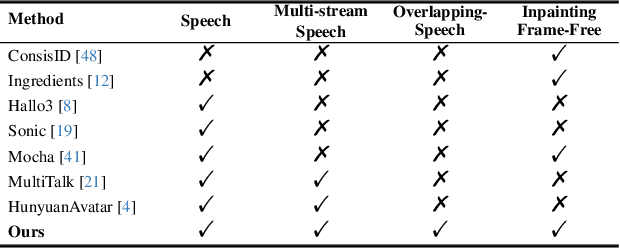
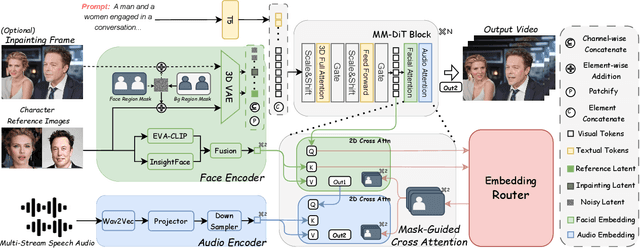
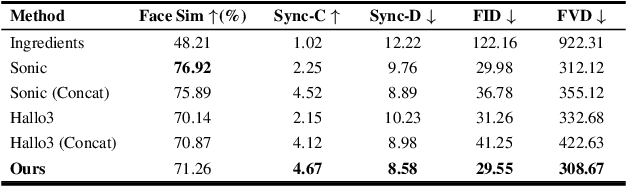
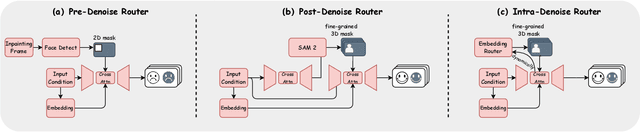
Recent years have witnessed remarkable advances in audio-driven talking head generation. However, existing approaches predominantly focus on single-character scenarios. While some methods can create separate conversation videos between two individuals, the critical challenge of generating unified conversation videos with multiple physically co-present characters sharing the same spatial environment remains largely unaddressed. This setting presents two key challenges: audio-to-character correspondence control and the lack of suitable datasets featuring multi-character talking videos within the same scene. To address these challenges, we introduce Bind-Your-Avatar, an MM-DiT-based model specifically designed for multi-talking-character video generation in the same scene. Specifically, we propose (1) A novel framework incorporating a fine-grained Embedding Router that binds `who' and `speak what' together to address the audio-to-character correspondence control. (2) Two methods for implementing a 3D-mask embedding router that enables frame-wise, fine-grained control of individual characters, with distinct loss functions based on observed geometric priors and a mask refinement strategy to enhance the accuracy and temporal smoothness of the predicted masks. (3) The first dataset, to the best of our knowledge, specifically constructed for multi-talking-character video generation, and accompanied by an open-source data processing pipeline, and (4) A benchmark for the dual-talking-characters video generation, with extensive experiments demonstrating superior performance over multiple state-of-the-art methods.
MELLM: Exploring LLM-Powered Micro-Expression Understanding Enhanced by Subtle Motion Perception
May 11, 2025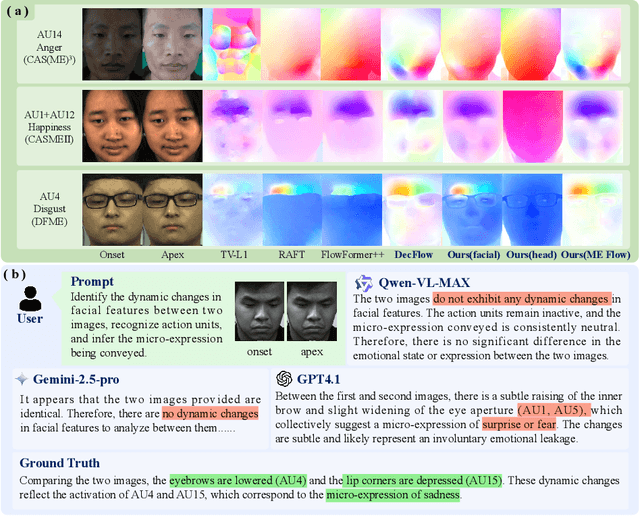
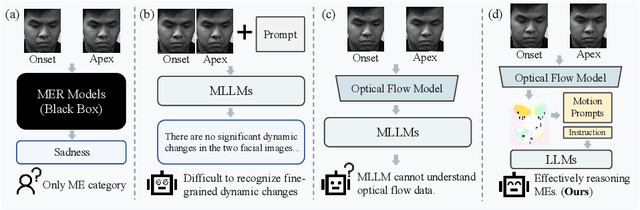
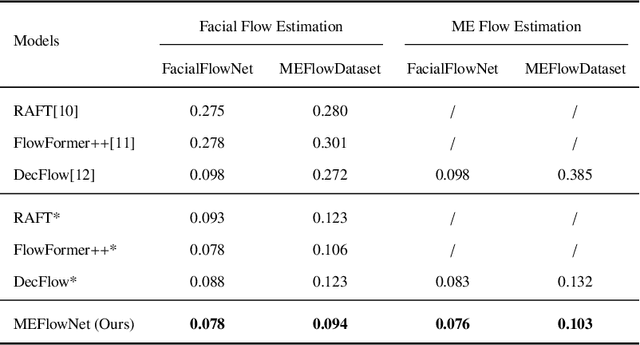
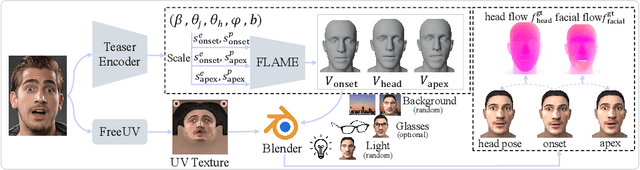
Micro-expressions (MEs) are crucial psychological responses with significant potential for affective computing. However, current automatic micro-expression recognition (MER) research primarily focuses on discrete emotion classification, neglecting a convincing analysis of the subtle dynamic movements and inherent emotional cues. The rapid progress in multimodal large language models (MLLMs), known for their strong multimodal comprehension and language generation abilities, offers new possibilities. MLLMs have shown success in various vision-language tasks, indicating their potential to understand MEs comprehensively, including both fine-grained motion patterns and underlying emotional semantics. Nevertheless, challenges remain due to the subtle intensity and short duration of MEs, as existing MLLMs are not designed to capture such delicate frame-level facial dynamics. In this paper, we propose a novel Micro-Expression Large Language Model (MELLM), which incorporates a subtle facial motion perception strategy with the strong inference capabilities of MLLMs, representing the first exploration of MLLMs in the domain of ME analysis. Specifically, to explicitly guide the MLLM toward motion-sensitive regions, we construct an interpretable motion-enhanced color map by fusing onset-apex optical flow dynamics with the corresponding grayscale onset frame as the model input. Additionally, specialized fine-tuning strategies are incorporated to further enhance the model's visual perception of MEs. Furthermore, we construct an instruction-description dataset based on Facial Action Coding System (FACS) annotations and emotion labels to train our MELLM. Comprehensive evaluations across multiple benchmark datasets demonstrate that our model exhibits superior robustness and generalization capabilities in ME understanding (MEU). Code is available at https://github.com/zyzhangUstc/MELLM.
T2Vid: Translating Long Text into Multi-Image is the Catalyst for Video-LLMs
Dec 02, 2024
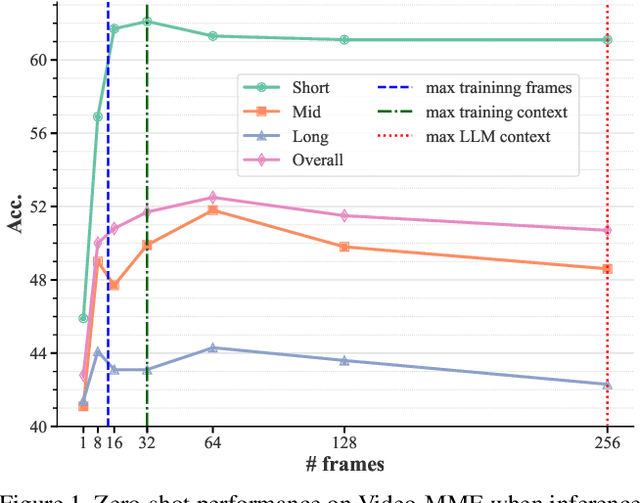
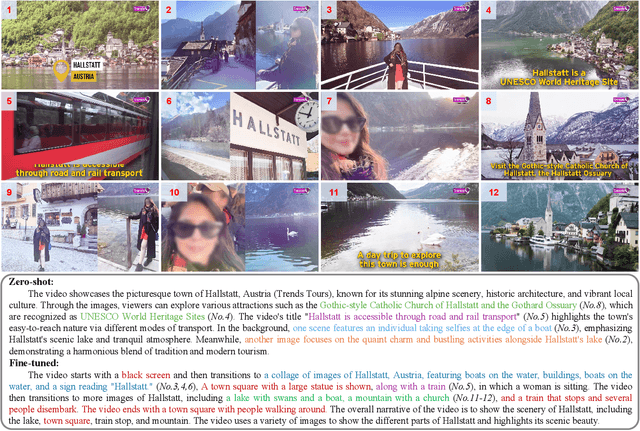
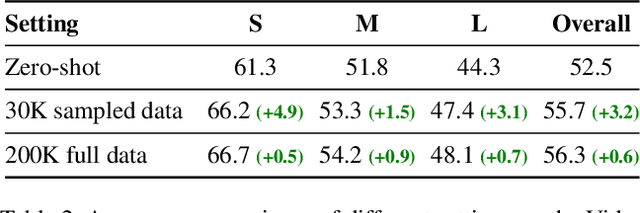
The success of Multimodal Large Language Models (MLLMs) in the image domain has garnered wide attention from the research community. Drawing on previous successful experiences, researchers have recently explored extending the success to the video understanding realms. Apart from training from scratch, an efficient way is to utilize the pre-trained image-LLMs, leading to two mainstream approaches, i.e. zero-shot inference and further fine-tuning with video data. In this work, our study of these approaches harvests an effective data augmentation method. We first make a deeper inspection of the zero-shot inference way and identify two limitations, i.e. limited generalization and lack of temporal understanding capabilities. Thus, we further investigate the fine-tuning approach and find a low learning efficiency when simply using all the video data samples, which can be attributed to a lack of instruction diversity. Aiming at this issue, we develop a method called T2Vid to synthesize video-like samples to enrich the instruction diversity in the training corpus. Integrating these data enables a simple and efficient training scheme, which achieves performance comparable to or even superior to using full video datasets by training with just 15% the sample size. Meanwhile, we find that the proposed scheme can boost the performance of long video understanding without training with long video samples. We hope our study will spark more thinking about using MLLMs for video understanding and curation of high-quality data. The code is released at https://github.com/xjtupanda/T2Vid.