 Add to Chrome
 Add to Firefox
 Add to Edge
AutoMS: Multi-Agent Evolutionary Search for Cross-Physics Inverse Microstructure Design
Mar 28, 2026
Designing microstructures that satisfy coupled cross-physics objectives is a fundamental challenge in material science. This inverse design problem involves a vast, discontinuous search space where traditional topology optimization is computationally prohibitive, and deep generative models often suffer from "physical hallucinations," lacking the capability to ensure rigorous validity. To address this limitation, we introduce AutoMS, a multi-agent neuro-symbolic framework that reformulates inverse design as an LLM-driven evolutionary search. Unlike methods that treat LLMs merely as interfaces, AutoMS integrates them as "semantic navigators" to initialize search spaces and break local optima, while our novel Simulation-Aware Evolutionary Search (SAES) addresses the "blindness" of traditional evolutionary strategies. Specifically, SAES utilizes simulation feedback to perform local gradient approximation and directed parameter updates, effectively guiding the search toward physically valid Pareto frontiers. Orchestrating specialized agents (Manager, Parser, Generator, and Simulator), AutoMS achieves a state-of-the-art 83.8\% success rate on 17 diverse cross-physics tasks, nearly doubling the performance of traditional NSGA-II (43.7\%) and significantly outperforming ReAct-based LLM baselines (53.3\%). Furthermore, our hierarchical architecture reduces total execution time by 23.3\%. AutoMS demonstrates that autonomous agent systems can effectively navigate complex physical landscapes, bridging the gap between semantic design intent and rigorous physical validity.

GFPack++: Improving 2D Irregular Packing by Learning Gradient Field with Attention
Jun 09, 20242D irregular packing is a classic combinatorial optimization problem with various applications, such as material utilization and texture atlas generation. This NP-hard problem requires efficient algorithms to optimize space utilization. Conventional numerical methods suffer from slow convergence and high computational cost. Existing learning-based methods, such as the score-based diffusion model, also have limitations, such as no rotation support, frequent collisions, and poor adaptability to arbitrary boundaries, and slow inferring. The difficulty of learning from teacher packing is to capture the complex geometric relationships among packing examples, which include the spatial (position, orientation) relationships of objects, their geometric features, and container boundary conditions. Representing these relationships in latent space is challenging. We propose GFPack++, an attention-based gradient field learning approach that addresses this challenge. It consists of two pivotal strategies: \emph{attention-based geometry encoding} for effective feature encoding and \emph{attention-based relation encoding} for learning complex relationships. We investigate the utilization distribution between the teacher and inference data and design a weighting function to prioritize tighter teacher data during training, enhancing learning effectiveness. Our diffusion model supports continuous rotation and outperforms existing methods on various datasets. We achieve higher space utilization over several widely used baselines, one-order faster than the previous diffusion-based method, and promising generalization for arbitrary boundaries. We plan to release our source code and datasets to support further research in this direction.
Learning Gradient Fields for Scalable and Generalizable Irregular Packing
Oct 18, 2023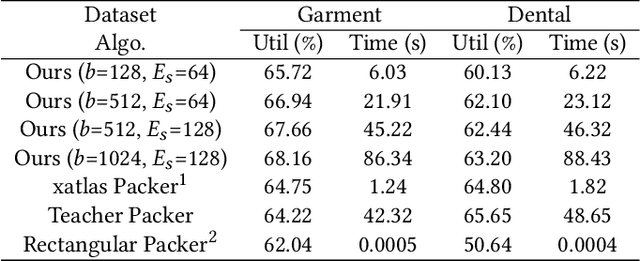
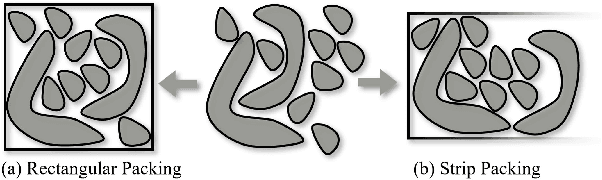
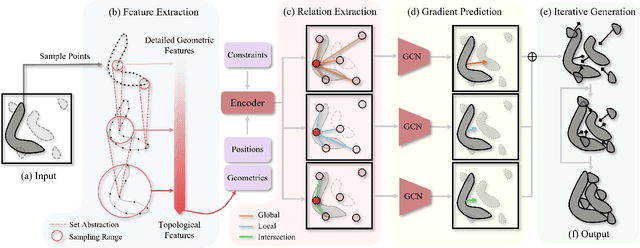
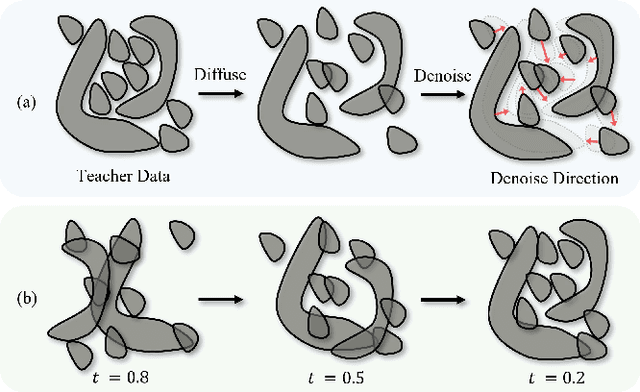
The packing problem, also known as cutting or nesting, has diverse applications in logistics, manufacturing, layout design, and atlas generation. It involves arranging irregularly shaped pieces to minimize waste while avoiding overlap. Recent advances in machine learning, particularly reinforcement learning, have shown promise in addressing the packing problem. In this work, we delve deeper into a novel machine learning-based approach that formulates the packing problem as conditional generative modeling. To tackle the challenges of irregular packing, including object validity constraints and collision avoidance, our method employs the score-based diffusion model to learn a series of gradient fields. These gradient fields encode the correlations between constraint satisfaction and the spatial relationships of polygons, learned from teacher examples. During the testing phase, packing solutions are generated using a coarse-to-fine refinement mechanism guided by the learned gradient fields. To enhance packing feasibility and optimality, we introduce two key architectural designs: multi-scale feature extraction and coarse-to-fine relation extraction. We conduct experiments on two typical industrial packing domains, considering translations only. Empirically, our approach demonstrates spatial utilization rates comparable to, or even surpassing, those achieved by the teacher algorithm responsible for training data generation. Additionally, it exhibits some level of generalization to shape variations. We are hopeful that this method could pave the way for new possibilities in solving the packing problem.