 Add to Chrome
 Add to Firefox
 Add to Edge
NTIRE 2025 Challenge on Day and Night Raindrop Removal for Dual-Focused Images: Methods and Results
Apr 19, 2025
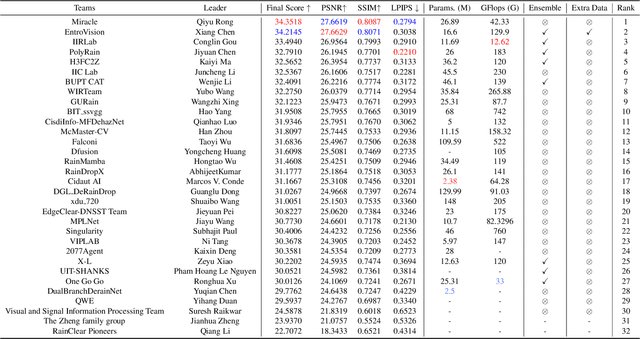
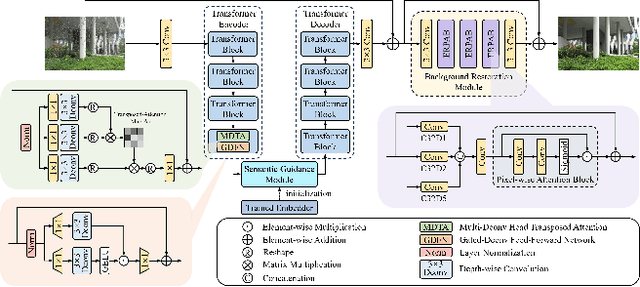
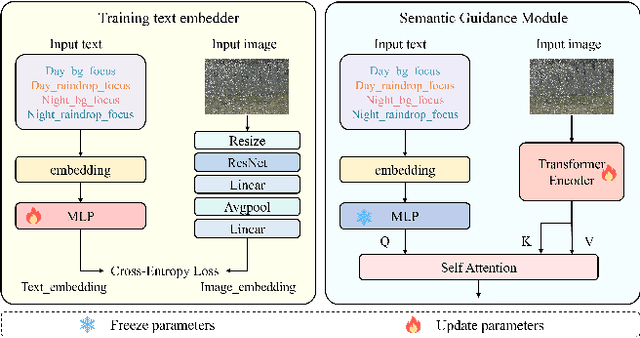
This paper reviews the NTIRE 2025 Challenge on Day and Night Raindrop Removal for Dual-Focused Images. This challenge received a wide range of impressive solutions, which are developed and evaluated using our collected real-world Raindrop Clarity dataset. Unlike existing deraining datasets, our Raindrop Clarity dataset is more diverse and challenging in degradation types and contents, which includes day raindrop-focused, day background-focused, night raindrop-focused, and night background-focused degradations. This dataset is divided into three subsets for competition: 14,139 images for training, 240 images for validation, and 731 images for testing. The primary objective of this challenge is to establish a new and powerful benchmark for the task of removing raindrops under varying lighting and focus conditions. There are a total of 361 participants in the competition, and 32 teams submitting valid solutions and fact sheets for the final testing phase. These submissions achieved state-of-the-art (SOTA) performance on the Raindrop Clarity dataset. The project can be found at https://lixinustc.github.io/CVPR-NTIRE2025-RainDrop-Competition.github.io/.

From Large to Super-Tiny: End-to-End Optimization for Cost-Efficient LLMs
Apr 18, 2025In recent years, Large Language Models (LLMs) have significantly advanced artificial intelligence by optimizing traditional Natural Language Processing (NLP) pipelines, improving performance and generalization. This has spurred their integration into various systems. Many NLP systems, including ours, employ a "one-stage" pipeline directly incorporating LLMs. While effective, this approach incurs substantial costs and latency due to the need for large model parameters to achieve satisfactory outcomes. This paper introduces a three-stage cost-efficient end-to-end LLM deployment pipeline-including prototyping, knowledge transfer, and model compression-to tackle the cost-performance dilemma in LLM-based frameworks. Our approach yields a super tiny model optimized for cost and performance in online systems, simplifying the system architecture. Initially, by transforming complex tasks into a function call-based LLM-driven pipeline, an optimal performance prototype system is constructed to produce high-quality data as a teacher model. The second stage combine techniques like rejection fine-tuning, reinforcement learning and knowledge distillation to transfer knowledge to a smaller 0.5B student model, delivering effective performance at minimal cost. The final stage applies quantization and pruning to extremely compress model to 0.4B, achieving ultra-low latency and cost. The framework's modular design and cross-domain capabilities suggest potential applicability in other NLP areas.
seeBias: A Comprehensive Tool for Assessing and Visualizing AI Fairness
Apr 11, 2025Fairness in artificial intelligence (AI) prediction models is increasingly emphasized to support responsible adoption in high-stakes domains such as health care and criminal justice. Guidelines and implementation frameworks highlight the importance of both predictive accuracy and equitable outcomes. However, current fairness toolkits often evaluate classification performance disparities in isolation, with limited attention to other critical aspects such as calibration. To address these gaps, we present seeBias, an R package for comprehensive evaluation of model fairness and predictive performance. seeBias offers an integrated evaluation across classification, calibration, and other performance domains, providing a more complete view of model behavior. It includes customizable visualizations to support transparent reporting and responsible AI implementation. Using public datasets from criminal justice and healthcare, we demonstrate how seeBias supports fairness evaluations, and uncovers disparities that conventional fairness metrics may overlook. The R package is available on GitHub, and a Python version is under development.
OmniCaptioner: One Captioner to Rule Them All
Apr 09, 2025We propose OmniCaptioner, a versatile visual captioning framework for generating fine-grained textual descriptions across a wide variety of visual domains. Unlike prior methods limited to specific image types (e.g., natural images or geometric visuals), our framework provides a unified solution for captioning natural images, visual text (e.g., posters, UIs, textbooks), and structured visuals (e.g., documents, tables, charts). By converting low-level pixel information into semantically rich textual representations, our framework bridges the gap between visual and textual modalities. Our results highlight three key advantages: (i) Enhanced Visual Reasoning with LLMs, where long-context captions of visual modalities empower LLMs, particularly the DeepSeek-R1 series, to reason effectively in multimodal scenarios; (ii) Improved Image Generation, where detailed captions improve tasks like text-to-image generation and image transformation; and (iii) Efficient Supervised Fine-Tuning (SFT), which enables faster convergence with less data. We believe the versatility and adaptability of OmniCaptioner can offer a new perspective for bridging the gap between language and visual modalities.
3R-GS: Best Practice in Optimizing Camera Poses Along with 3DGS
Apr 05, 20253D Gaussian Splatting (3DGS) has revolutionized neural rendering with its efficiency and quality, but like many novel view synthesis methods, it heavily depends on accurate camera poses from Structure-from-Motion (SfM) systems. Although recent SfM pipelines have made impressive progress, questions remain about how to further improve both their robust performance in challenging conditions (e.g., textureless scenes) and the precision of camera parameter estimation simultaneously. We present 3R-GS, a 3D Gaussian Splatting framework that bridges this gap by jointly optimizing 3D Gaussians and camera parameters from large reconstruction priors MASt3R-SfM. We note that naively performing joint 3D Gaussian and camera optimization faces two challenges: the sensitivity to the quality of SfM initialization, and its limited capacity for global optimization, leading to suboptimal reconstruction results. Our 3R-GS, overcomes these issues by incorporating optimized practices, enabling robust scene reconstruction even with imperfect camera registration. Extensive experiments demonstrate that 3R-GS delivers high-quality novel view synthesis and precise camera pose estimation while remaining computationally efficient. Project page: https://zsh523.github.io/3R-GS/
Q-Adapt: Adapting LMM for Visual Quality Assessment with Progressive Instruction Tuning
Apr 02, 2025The rapid advancement of Large Multi-modal Foundation Models (LMM) has paved the way for the possible Explainable Image Quality Assessment (EIQA) with instruction tuning from two perspectives: overall quality explanation, and attribute-wise perception answering. However, existing works usually overlooked the conflicts between these two types of perception explanations during joint instruction tuning, leading to insufficient perception understanding. To mitigate this, we propose a new paradigm for perception-oriented instruction tuning, i.e., Q-Adapt, which aims to eliminate the conflicts and achieve the synergy between these two EIQA tasks when adapting LMM, resulting in enhanced multi-faceted explanations of IQA. Particularly, we propose a progressive instruction tuning strategy by dividing the adaption process of LMM for EIQA into two stages, where the first stage empowers the LMM with universal perception knowledge tailored for two tasks using an efficient transfer learning strategy, i.e., LoRA, and the second stage introduces the instruction-adaptive visual prompt tuning to dynamically adapt visual features for the different instructions from two tasks. In this way, our proposed Q-Adapt can achieve a lightweight visual quality evaluator, demonstrating comparable performance and, in some instances, superior results across perceptual-related benchmarks and commonly-used IQA databases. The source code is publicly available at https://github.com/yeppp27/Q-Adapt.
Meta-Ori: monolithic meta-origami for nonlinear inflatable soft actuators
Mar 30, 2025The nonlinear mechanical response of soft materials and slender structures is purposefully harnessed to program functions by design in soft robotic actuators, such as sequencing, amplified response, fast energy release, etc. However, typical designs of nonlinear actuators - e.g. balloons, inverted membranes, springs - have limited design parameters space and complex fabrication processes, hindering the achievement of more elaborated functions. Mechanical metamaterials, on the other hand, have very large design parameter spaces, which allow fine-tuning of nonlinear behaviours. In this work, we present a novel approach to fabricate nonlinear inflatables based on metamaterials and origami (Meta-Ori) as monolithic parts that can be fully 3D printed via Fused Deposition Modeling (FDM) using thermoplastic polyurethane (TPU) commercial filaments. Our design consists of a metamaterial shell with cylindrical topology and nonlinear mechanical response combined with a Kresling origami inflatable acting as a pneumatic transmitter. We develop and release a design tool in the visual programming language Grasshopper to interactively design our Meta-Ori. We characterize the mechanical response of the metashell and the origami, and the nonlinear pressure-volume curve of the Meta-Ori inflatable and, lastly, we demonstrate the actuation sequencing of a bi-segment monolithic Meta-Ori soft actuator.
Embodied-Reasoner: Synergizing Visual Search, Reasoning, and Action for Embodied Interactive Tasks
Mar 27, 2025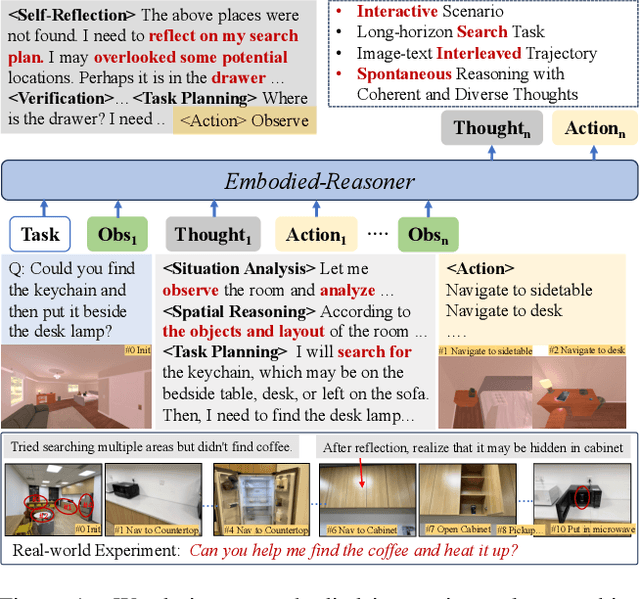
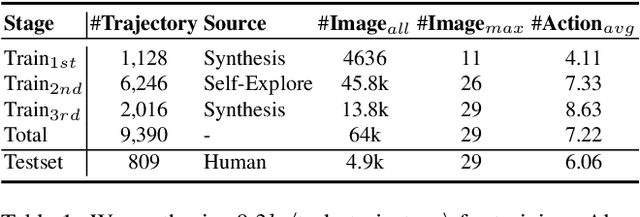
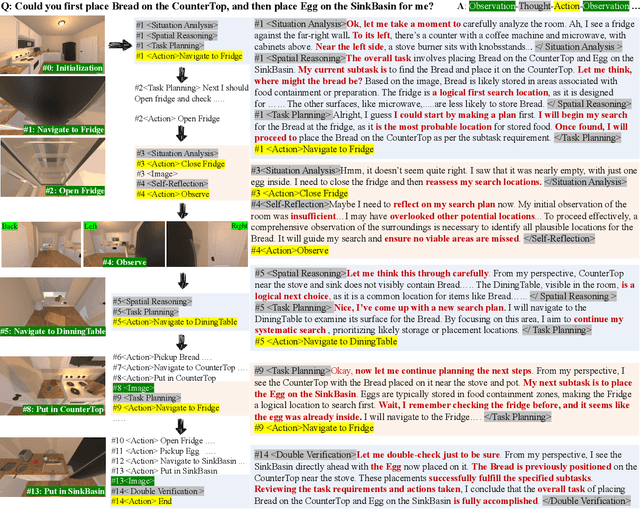
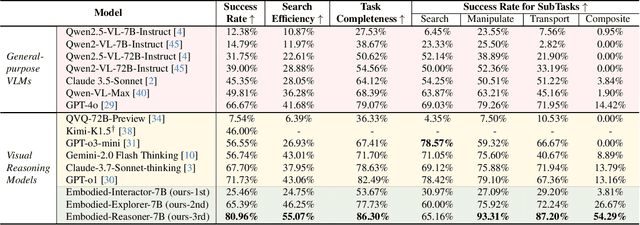
Recent advances in deep thinking models have demonstrated remarkable reasoning capabilities on mathematical and coding tasks. However, their effectiveness in embodied domains which require continuous interaction with environments through image action interleaved trajectories remains largely -unexplored. We present Embodied Reasoner, a model that extends o1 style reasoning to interactive embodied search tasks. Unlike mathematical reasoning that relies primarily on logical deduction, embodied scenarios demand spatial understanding, temporal reasoning, and ongoing self-reflection based on interaction history. To address these challenges, we synthesize 9.3k coherent Observation-Thought-Action trajectories containing 64k interactive images and 90k diverse thinking processes (analysis, spatial reasoning, reflection, planning, and verification). We develop a three-stage training pipeline that progressively enhances the model's capabilities through imitation learning, self-exploration via rejection sampling, and self-correction through reflection tuning. The evaluation shows that our model significantly outperforms those advanced visual reasoning models, e.g., it exceeds OpenAI o1, o3-mini, and Claude-3.7 by +9\%, 24\%, and +13\%. Analysis reveals our model exhibits fewer repeated searches and logical inconsistencies, with particular advantages in complex long-horizon tasks. Real-world environments also show our superiority while exhibiting fewer repeated searches and logical inconsistency cases.
HyperMAN: Hypergraph-enhanced Meta-learning Adaptive Network for Next POI Recommendation
Mar 27, 2025Next Point-of-Interest (POI) recommendation aims to predict users' next locations by leveraging historical check-in sequences. Although existing methods have shown promising results, they often struggle to capture complex high-order relationships and effectively adapt to diverse user behaviors, particularly when addressing the cold-start issue. To address these challenges, we propose Hypergraph-enhanced Meta-learning Adaptive Network (HyperMAN), a novel framework that integrates heterogeneous hypergraph modeling with a difficulty-aware meta-learning mechanism for next POI recommendation. Specifically, three types of heterogeneous hyperedges are designed to capture high-order relationships: user visit behaviors at specific times (Temporal behavioral hyperedge), spatial correlations among POIs (spatial functional hyperedge), and user long-term preferences (user preference hyperedge). Furthermore, a diversity-aware meta-learning mechanism is introduced to dynamically adjust learning strategies, considering users behavioral diversity. Extensive experiments on real-world datasets demonstrate that HyperMAN achieves superior performance, effectively addressing cold start challenges and significantly enhancing recommendation accuracy.
Prototype Perturbation for Relaxing Alignment Constraints in Backward-Compatible Learning
Mar 19, 2025The traditional paradigm to update retrieval models requires re-computing the embeddings of the gallery data, a time-consuming and computationally intensive process known as backfilling. To circumvent backfilling, Backward-Compatible Learning (BCL) has been widely explored, which aims to train a new model compatible with the old one. Many previous works focus on effectively aligning the embeddings of the new model with those of the old one to enhance the backward-compatibility. Nevertheless, such strong alignment constraints would compromise the discriminative ability of the new model, particularly when different classes are closely clustered and hard to distinguish in the old feature space. To address this issue, we propose to relax the constraints by introducing perturbations to the old feature prototypes. This allows us to align the new feature space with a pseudo-old feature space defined by these perturbed prototypes, thereby preserving the discriminative ability of the new model in backward-compatible learning. We have developed two approaches for calculating the perturbations: Neighbor-Driven Prototype Perturbation (NDPP) and Optimization-Driven Prototype Perturbation (ODPP). Particularly, they take into account the feature distributions of not only the old but also the new models to obtain proper perturbations along with new model updating. Extensive experiments on the landmark and commodity datasets demonstrate that our approaches perform favorably against state-of-the-art BCL algorithms.