 Add to Chrome
 Add to Firefox
 Add to Edge
Evo-Attacker: Memory-Augmented Reinforcement Learning for Long-Horizon Tool Attacks on LLM-MAS
May 25, 2026
While Large Language Model-based Multi-Agent Systems (LLM-MAS) demonstrate remarkable capabilities in solving complex tasks by orchestrating specialized agents and external tools, the implicit trust in tool outputs creates a critical attack surface. Existing tool attacks are limited by domain specificity or fixed and static templates. To address these challenges, we propose Evo-Attacker, which formulates the tool attack as a self-evolving, memory-augmented reinforcement learning process. Evo-Attacker constructs a dynamic attack memory and employs deliberative reasoning to retrieve adversarial patterns and strategize modifying interventions at critical moments. Furthermore, we introduce Attack-Flow GRPO to optimize intermediate reasoning steps via terminal outcomes, addressing the long-horizon credit assignment challenge. Comprehensive experiments demonstrate that Evo-Attacker consistently outperforms baselines, highlighting its generalization and evolutionary capabilities and the urgent need for defensive tool safeguards.

Disentangle-then-Refine: LLM-Guided Decoupling and Structure-Aware Refinement for Graph Contrastive Learning
Apr 16, 2026Conventional Graph Contrastive Learning (GCL) on Text-Attributed Graphs (TAGs) relies on blind stochastic augmentations, inadvertently entangling task-relevant signals with noise. We propose SDM-SCR, a robust framework anchored in Approximate Orthogonal Decomposition. First, the Semantic Decoupling Module (SDM) leverages the instruction-following capability of Large Language Models (LLMs) to actively parse raw attributes into asymmetric, task-oriented signal and noise views. This shifts the paradigm from random perturbation to semantic-aware disentanglement. Subsequently, Semantic Consistency Regularization (SCR) exploits the spectral observation that semantic signals are topologically smooth while residual noise is high-frequency. SCR functions as a selective spectral filter, enforcing consistency only on the signal subspace to eliminate LLM hallucinations without over-smoothing. This ``Disentangle-then-Refine'' mechanism ensures rigorous signal purification. Extensive experiments demonstrate that SDM-SCR achieves SOTA performance in accuracy and efficiency.
A Multimodal Foundation Model of Spatial Transcriptomics and Histology for Biological Discovery and Clinical Prediction
Apr 04, 2026Spatial transcriptomics (ST) enables gene expression mapping within anatomical context but remains costly and low-throughput. Hematoxylin and eosin (H\&E) staining offers rich morphology yet lacks molecular resolution. We present \textbf{\ours} (\textbf{S}patial \textbf{T}ranscriptomics and hist\textbf{O}logy \textbf{R}epresentation \textbf{M}odel), a foundation model trained on 1.2 million spatially resolved transcriptomic profiles with matched histology across 18 organs. Using a hierarchical architecture integrating morphological features, gene expression, and spatial context, STORM bridges imaging and omics through robust molecular--morphological representations. STORM enhances spatial domain discovery, producing biologically coherent tissue maps, and outperforms existing methods in predicting spatial gene expression from H\&E images across 11 tumor types. The model is platform-agnostic, performing consistently across Visium, Xenium, Visium HD, and CosMx. Applied to 23 independent cohorts comprising 7,245 patients, STORM significantly improves immunotherapy response prediction and prognostication over established biomarkers, providing a scalable framework for spatially informed discovery and clinical precision medicine.
BloClaw: An Omniscient, Multi-Modal Agentic Workspace for Next-Generation Scientific Discovery
Apr 01, 2026The integration of Large Language Models (LLMs) into life sciences has catalyzed the development of "AI Scientists." However, translating these theoretical capabilities into deployment-ready research environments exposes profound infrastructural vulnerabilities. Current frameworks are bottlenecked by fragile JSON-based tool-calling protocols, easily disrupted execution sandboxes that lose graphical outputs, and rigid conversational interfaces inherently ill-suited for high-dimensional scientific data.We introduce BloClaw, a unified, multi-modal operating system designed for Artificial Intelligence for Science (AI4S). BloClaw reconstructs the Agent-Computer Interaction (ACI) paradigm through three architectural innovations: (1) An XML-Regex Dual-Track Routing Protocol that statistically eliminates serialization failures (0.2% error rate vs. 17.6% in JSON); (2) A Runtime State Interception Sandbox that utilizes Python monkey-patching to autonomously capture and compile dynamic data visualizations (Plotly/Matplotlib), circumventing browser CORS policies; and (3) A State-Driven Dynamic Viewport UI that morphs seamlessly between a minimalist command deck and an interactive spatial rendering engine. We comprehensively benchmark BloClaw across cheminformatics (RDKit), de novo 3D protein folding via ESMFold, molecular docking, and autonomous Retrieval-Augmented Generation (RAG), establishing a highly robust, self-evolving paradigm for computational research assistants. The open-source repository is available at https://github.com/qinheming/BloClaw.
Non-Contrast CT Esophageal Varices Grading through Clinical Prior-Enhanced Multi-Organ Analysis
Dec 22, 2025Esophageal varices (EV) represent a critical complication of portal hypertension, affecting approximately 60% of cirrhosis patients with a significant bleeding risk of ~30%. While traditionally diagnosed through invasive endoscopy, non-contrast computed tomography (NCCT) presents a potential non-invasive alternative that has yet to be fully utilized in clinical practice. We present Multi-Organ-COhesion Network++ (MOON++), a novel multimodal framework that enhances EV assessment through comprehensive analysis of NCCT scans. Inspired by clinical evidence correlating organ volumetric relationships with liver disease severity, MOON++ synthesizes imaging characteristics of the esophagus, liver, and spleen through multimodal learning. We evaluated our approach using 1,631 patients, those with endoscopically confirmed EV were classified into four severity grades. Validation in 239 patient cases and independent testing in 289 cases demonstrate superior performance compared to conventional single organ methods, achieving an AUC of 0.894 versus 0.803 for the severe grade EV classification (G3 versus <G3) and 0.921 versus 0.793 for the differentiation of moderate to severe grades (>=G2 versus <G2). We conducted a reader study involving experienced radiologists to further validate the performance of MOON++. To our knowledge, MOON++ represents the first comprehensive multi-organ NCCT analysis framework incorporating clinical knowledge priors for EV assessment, potentially offering a promising non-invasive diagnostic alternative.
MergeDNA: Context-aware Genome Modeling with Dynamic Tokenization through Token Merging
Nov 17, 2025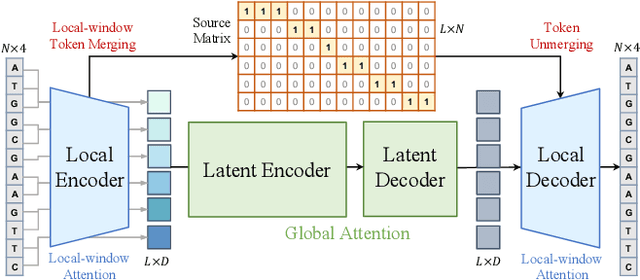

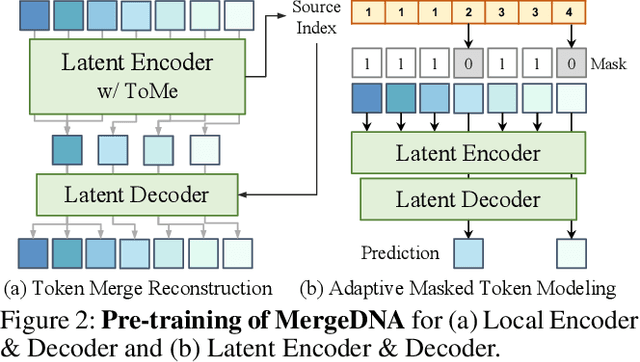
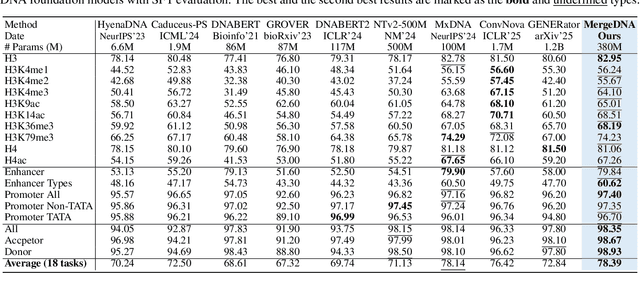
Modeling genomic sequences faces two unsolved challenges: the information density varies widely across different regions, while there is no clearly defined minimum vocabulary unit. Relying on either four primitive bases or independently designed DNA tokenizers, existing approaches with naive masked language modeling pre-training often fail to adapt to the varying complexities of genomic sequences. Leveraging Token Merging techniques, this paper introduces a hierarchical architecture that jointly optimizes a dynamic genomic tokenizer and latent Transformers with context-aware pre-training tasks. As for network structures, the tokenization module automatically chunks adjacent bases into words by stacking multiple layers of the differentiable token merging blocks with local-window constraints, then a Latent Encoder captures the global context of these merged words by full-attention blocks. Symmetrically employing a Latent Decoder and a Local Decoder, MergeDNA learns with two pre-training tasks: Merged Token Reconstruction simultaneously trains the dynamic tokenization module and adaptively filters important tokens, while Adaptive Masked Token Modeling learns to predict these filtered tokens to capture informative contents. Extensive experiments show that MergeDNA achieves superior performance on three popular DNA benchmarks and several multi-omics tasks with fine-tuning or zero-shot evaluation, outperforming typical tokenization methods and large-scale DNA foundation models.
An Energy-Efficient Edge Coprocessor for Neural Rendering with Explicit Data Reuse Strategies
Oct 09, 2025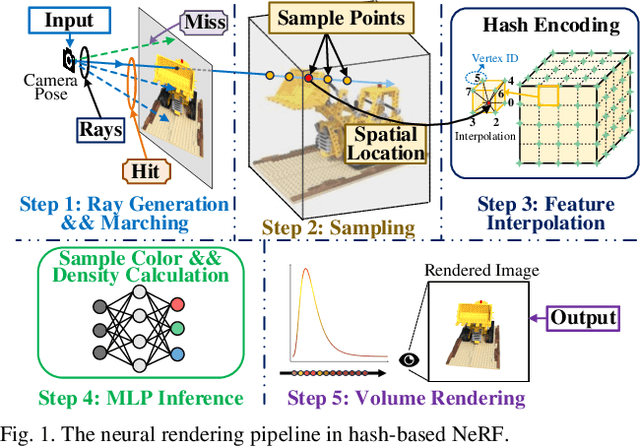
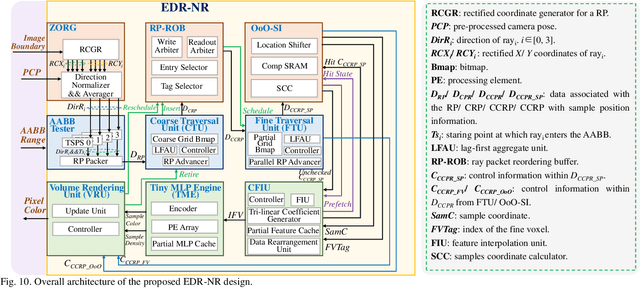
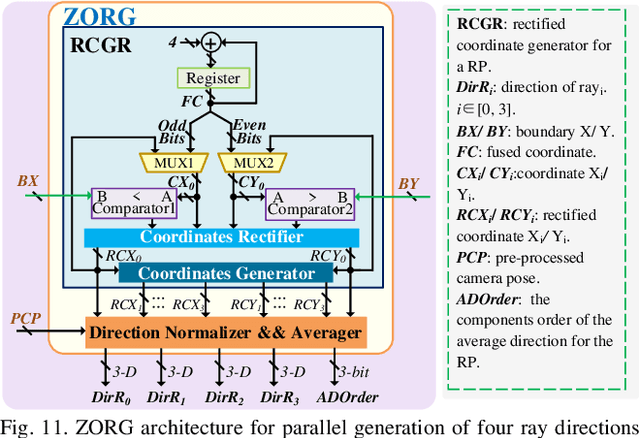
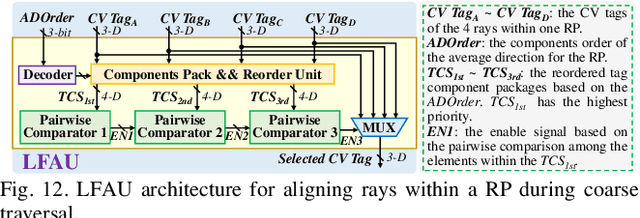
Neural radiance fields (NeRF) have transformed 3D reconstruction and rendering, facilitating photorealistic image synthesis from sparse viewpoints. This work introduces an explicit data reuse neural rendering (EDR-NR) architecture, which reduces frequent external memory accesses (EMAs) and cache misses by exploiting the spatial locality from three phases, including rays, ray packets (RPs), and samples. The EDR-NR architecture features a four-stage scheduler that clusters rays on the basis of Z-order, prioritize lagging rays when ray divergence happens, reorders RPs based on spatial proximity, and issues samples out-of-orderly (OoO) according to the availability of on-chip feature data. In addition, a four-tier hierarchical RP marching (HRM) technique is integrated with an axis-aligned bounding box (AABB) to facilitate spatial skipping (SS), reducing redundant computations and improving throughput. Moreover, a balanced allocation strategy for feature storage is proposed to mitigate SRAM bank conflicts. Fabricated using a 40 nm process with a die area of 10.5 mmX, the EDR-NR chip demonstrates a 2.41X enhancement in normalized energy efficiency, a 1.21X improvement in normalized area efficiency, a 1.20X increase in normalized throughput, and a 53.42% reduction in on-chip SRAM consumption compared to state-of-the-art accelerators.
Lifelong Evolution: Collaborative Learning between Large and Small Language Models for Continuous Emergent Fake News Detection
Jun 05, 2025The widespread dissemination of fake news on social media has significantly impacted society, resulting in serious consequences. Conventional deep learning methodologies employing small language models (SLMs) suffer from extensive supervised training requirements and difficulties adapting to evolving news environments due to data scarcity and distribution shifts. Large language models (LLMs), despite robust zero-shot capabilities, fall short in accurately detecting fake news owing to outdated knowledge and the absence of suitable demonstrations. In this paper, we propose a novel Continuous Collaborative Emergent Fake News Detection (C$^2$EFND) framework to address these challenges. The C$^2$EFND framework strategically leverages both LLMs' generalization power and SLMs' classification expertise via a multi-round collaborative learning framework. We further introduce a lifelong knowledge editing module based on a Mixture-of-Experts architecture to incrementally update LLMs and a replay-based continue learning method to ensure SLMs retain prior knowledge without retraining entirely. Extensive experiments on Pheme and Twitter16 datasets demonstrate that C$^2$EFND significantly outperforms existed methods, effectively improving detection accuracy and adaptability in continuous emergent fake news scenarios.
Refining Interactions: Enhancing Anisotropy in Graph Neural Networks with Language Semantics
Apr 02, 2025The integration of Large Language Models (LLMs) with Graph Neural Networks (GNNs) has recently been explored to enhance the capabilities of Text Attribute Graphs (TAGs). Most existing methods feed textual descriptions of the graph structure or neighbouring nodes' text directly into LLMs. However, these approaches often cause LLMs to treat structural information simply as general contextual text, thus limiting their effectiveness in graph-related tasks. In this paper, we introduce LanSAGNN (Language Semantic Anisotropic Graph Neural Network), a framework that extends the concept of anisotropic GNNs to the natural language level. This model leverages LLMs to extract tailor-made semantic information for node pairs, effectively capturing the unique interactions within node relationships. In addition, we propose an efficient dual-layer LLMs finetuning architecture to better align LLMs' outputs with graph tasks. Experimental results demonstrate that LanSAGNN significantly enhances existing LLM-based methods without increasing complexity while also exhibiting strong robustness against interference.
Collaborative Evolution: Multi-Round Learning Between Large and Small Language Models for Emergent Fake News Detection
Mar 27, 2025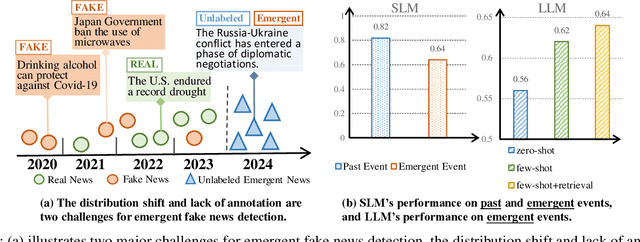
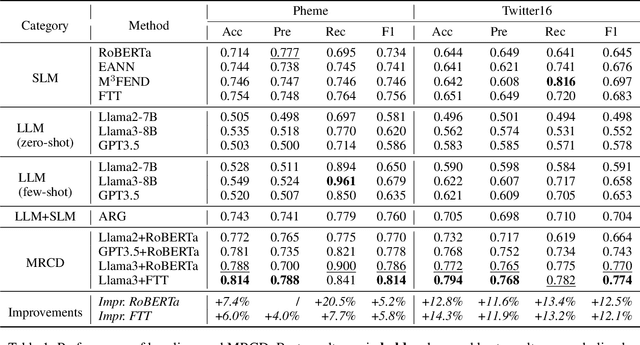
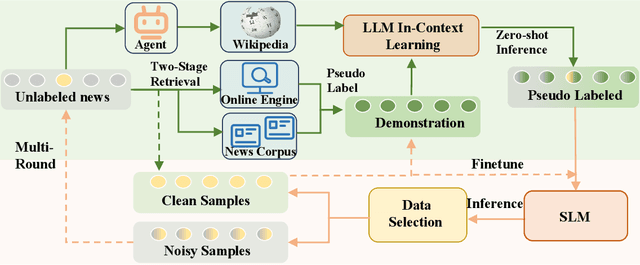
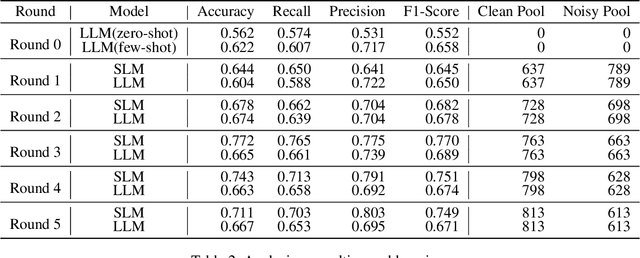
The proliferation of fake news on social media platforms has exerted a substantial influence on society, leading to discernible impacts and deleterious consequences. Conventional deep learning methodologies employing small language models (SLMs) suffer from the necessity for extensive supervised training and the challenge of adapting to rapidly evolving circumstances. Large language models (LLMs), despite their robust zero-shot capabilities, have fallen short in effectively identifying fake news due to a lack of pertinent demonstrations and the dynamic nature of knowledge. In this paper, a novel framework Multi-Round Collaboration Detection (MRCD) is proposed to address these aforementioned limitations. The MRCD framework is capable of enjoying the merits from both LLMs and SLMs by integrating their generalization abilities and specialized functionalities, respectively. Our approach features a two-stage retrieval module that selects relevant and up-to-date demonstrations and knowledge, enhancing in-context learning for better detection of emerging news events. We further design a multi-round learning framework to ensure more reliable detection results. Our framework MRCD achieves SOTA results on two real-world datasets Pheme and Twitter16, with accuracy improvements of 7.4\% and 12.8\% compared to using only SLMs, which effectively addresses the limitations of current models and improves the detection of emergent fake news.