 Add to Chrome
 Add to Firefox
 Add to Edge
From Noisy Historical Maps to Time-Series Oil Palm Mapping Without Annotation in Malaysia and Indonesia (2020-2024)
Apr 26, 2026
Accurate monitoring of oil palm plantations is critical for balancing economic development with environmental conservation in Southeast Asia. However, existing plantation maps often suffer from low spatial resolution and a lack of recent temporal coverage, impeding effective surveillance of rapid land-use changes. In this study, we propose a deep learning framework to generate 10-meter resolution oil palm plantation maps for Indonesia and Malaysia from 2020 to 2024, utilizing Sentinel-2 imagery without requiring new manual annotations. To address the resolution mismatch between coarse 100-meter historical labels and 10-meter imagery, we employ a U-Net architecture optimized with Determinant-based Mutual Information (DMI). This approach effectively mitigates the influence of label noise. We validated our method against 2,058 manually verified points, achieving overall accuracies of 70.64%, 63.53%, and 60.06% for the years 2020, 2022, and 2024, respectively. Our comprehensive analysis reveals that oil palm coverage in the region peaked in 2022 before experiencing a decline in 2024. Furthermore, land cover transition analysis highlights a concerning trajectory of plantation expansion into flooded vegetation areas, despite a general stabilization in rotations with other crop types. These high-resolution maps provide essential data for monitoring sustainability commitments and deforestation dynamics in the region, and the generated datasets are made publicly available at https://doi.org/10.5281/zenodo.17768444.

Collaborative Evolution: Multi-Round Learning Between Large and Small Language Models for Emergent Fake News Detection
Mar 27, 2025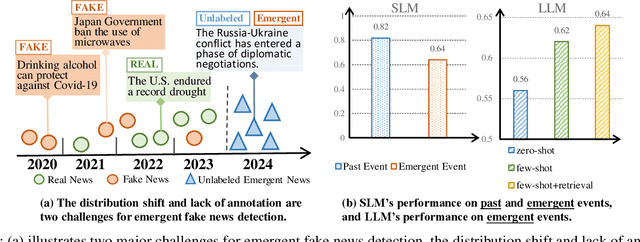
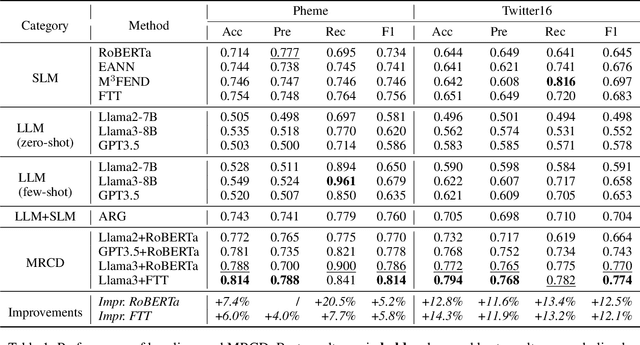
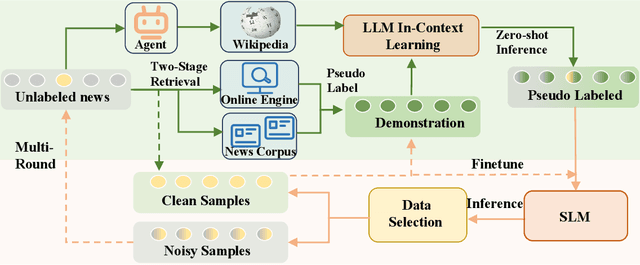
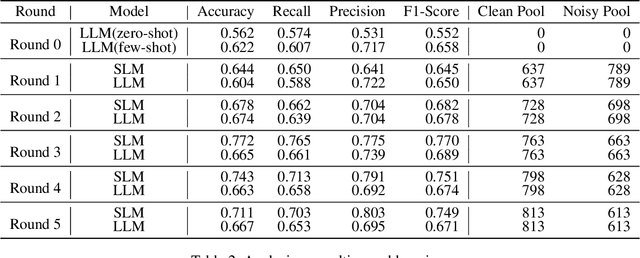
The proliferation of fake news on social media platforms has exerted a substantial influence on society, leading to discernible impacts and deleterious consequences. Conventional deep learning methodologies employing small language models (SLMs) suffer from the necessity for extensive supervised training and the challenge of adapting to rapidly evolving circumstances. Large language models (LLMs), despite their robust zero-shot capabilities, have fallen short in effectively identifying fake news due to a lack of pertinent demonstrations and the dynamic nature of knowledge. In this paper, a novel framework Multi-Round Collaboration Detection (MRCD) is proposed to address these aforementioned limitations. The MRCD framework is capable of enjoying the merits from both LLMs and SLMs by integrating their generalization abilities and specialized functionalities, respectively. Our approach features a two-stage retrieval module that selects relevant and up-to-date demonstrations and knowledge, enhancing in-context learning for better detection of emerging news events. We further design a multi-round learning framework to ensure more reliable detection results. Our framework MRCD achieves SOTA results on two real-world datasets Pheme and Twitter16, with accuracy improvements of 7.4\% and 12.8\% compared to using only SLMs, which effectively addresses the limitations of current models and improves the detection of emergent fake news.