 Add to Chrome
 Add to Firefox
 Add to Edge
Non-Contrast CT Esophageal Varices Grading through Clinical Prior-Enhanced Multi-Organ Analysis
Dec 22, 2025
Esophageal varices (EV) represent a critical complication of portal hypertension, affecting approximately 60% of cirrhosis patients with a significant bleeding risk of ~30%. While traditionally diagnosed through invasive endoscopy, non-contrast computed tomography (NCCT) presents a potential non-invasive alternative that has yet to be fully utilized in clinical practice. We present Multi-Organ-COhesion Network++ (MOON++), a novel multimodal framework that enhances EV assessment through comprehensive analysis of NCCT scans. Inspired by clinical evidence correlating organ volumetric relationships with liver disease severity, MOON++ synthesizes imaging characteristics of the esophagus, liver, and spleen through multimodal learning. We evaluated our approach using 1,631 patients, those with endoscopically confirmed EV were classified into four severity grades. Validation in 239 patient cases and independent testing in 289 cases demonstrate superior performance compared to conventional single organ methods, achieving an AUC of 0.894 versus 0.803 for the severe grade EV classification (G3 versus <G3) and 0.921 versus 0.793 for the differentiation of moderate to severe grades (>=G2 versus <G2). We conducted a reader study involving experienced radiologists to further validate the performance of MOON++. To our knowledge, MOON++ represents the first comprehensive multi-organ NCCT analysis framework incorporating clinical knowledge priors for EV assessment, potentially offering a promising non-invasive diagnostic alternative.

FECT: Classification of Breast Cancer Pathological Images Based on Fusion Features
Jan 17, 2025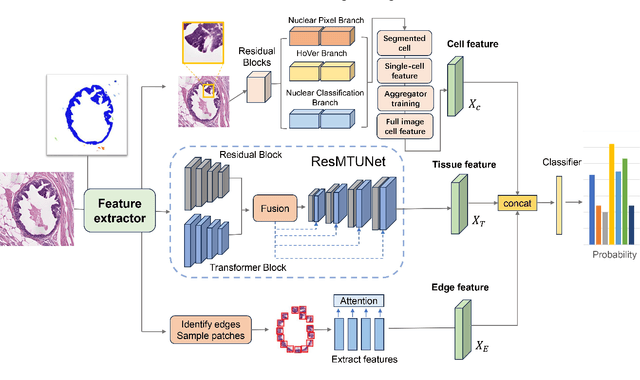
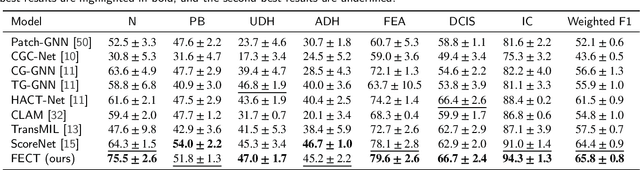
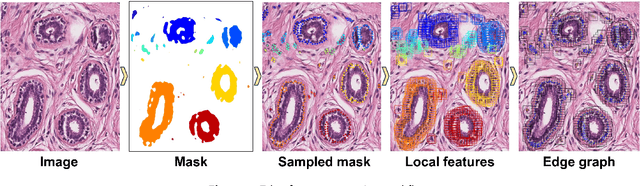
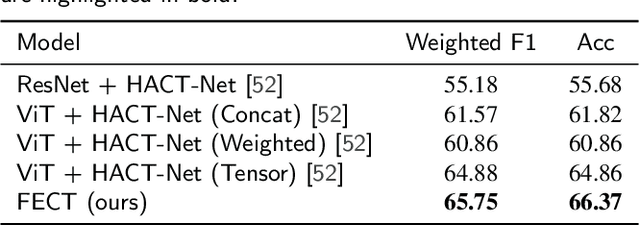
Breast cancer is one of the most common cancers among women globally, with early diagnosis and precise classification being crucial. With the advancement of deep learning and computer vision, the automatic classification of breast tissue pathological images has emerged as a research focus. Existing methods typically rely on singular cell or tissue features and lack design considerations for morphological characteristics of challenging-to-classify categories, resulting in suboptimal classification performance. To address these problems, we proposes a novel breast cancer tissue classification model that Fused features of Edges, Cells, and Tissues (FECT), employing the ResMTUNet and an attention-based aggregator to extract and aggregate these features. Extensive testing on the BRACS dataset demonstrates that our model surpasses current advanced methods in terms of classification accuracy and F1 scores. Moreover, due to its feature fusion that aligns with the diagnostic approach of pathologists, our model exhibits interpretability and holds promise for significant roles in future clinical applications.