 Add to Chrome
 Add to Firefox
 Add to Edge
AREX: Towards a Recursively Self-Improving Agent for Deep Research
Jul 24, 2026
Deep research requires agents to find answers that jointly satisfy multiple constraints. Discovering such answers is costly, whereas verifying a candidate can often be decomposed into tractable constraint-wise checks. This discovery--verification asymmetry suggests that a research agent should do more than simply search longer: it should recursively improve its current answer by verifying intermediate results and using the partially verified state to guide subsequent refinement. We introduce AREX, a family of Recursively Self-Improving (RSI) deep research agents. AREX alternates between an inner research loop that gathers evidence and constructs a provisional answer, and an outer self-improvement loop that audits the answer constraint-wise, identifies unresolved claims, and launches targeted follow-up research. To sustain RSI over long horizons, AREX learns an autonomous context-update tool that compresses growing interaction history into a compact improvement state preserving verified evidence and unresolved constraints, without relying on an external model. We train AREX on verified synthetic tasks and high-quality trajectories through agentic mid-training and long-horizon reinforcement learning. To mitigate sparse final rewards during long horizon learning, we emphasize key steps where decisive evidence is acquired or erroneous research directions are corrected. We instantiate a dense 4B model and a 122B-A10B Mixture-of-Experts model. Across BrowseComp, WideSearch, DeepSearchQA, Humanity's Last Exam (HLE), and other reasoning and tool-use benchmarks, AREX substantially outperforms comparable-scale baselines and remains competitive with models using substantially more activated parameters.

Evo-Attacker: Memory-Augmented Reinforcement Learning for Long-Horizon Tool Attacks on LLM-MAS
May 25, 2026While Large Language Model-based Multi-Agent Systems (LLM-MAS) demonstrate remarkable capabilities in solving complex tasks by orchestrating specialized agents and external tools, the implicit trust in tool outputs creates a critical attack surface. Existing tool attacks are limited by domain specificity or fixed and static templates. To address these challenges, we propose Evo-Attacker, which formulates the tool attack as a self-evolving, memory-augmented reinforcement learning process. Evo-Attacker constructs a dynamic attack memory and employs deliberative reasoning to retrieve adversarial patterns and strategize modifying interventions at critical moments. Furthermore, we introduce Attack-Flow GRPO to optimize intermediate reasoning steps via terminal outcomes, addressing the long-horizon credit assignment challenge. Comprehensive experiments demonstrate that Evo-Attacker consistently outperforms baselines, highlighting its generalization and evolutionary capabilities and the urgent need for defensive tool safeguards.
Model-Agnostic Lifelong LLM Safety via Externalized Attack-Defense Co-Evolution
May 13, 2026Large language models remain vulnerable to adversarial prompts that elicit harmful outputs. Existing safety paradigms typically couple red-teaming and post-training in a closed, policy-centric loop, causing attack discovery to suffer from rapid saturation and limiting the exposure of novel failure modes, while leaving defenses inefficient, rigid, and difficult to transfer across victim models. To this end, we propose EvoSafety, an LLM safety framework built around persistent, inspectable, and reusable external structures. For red teaming, EvoSafety equips the attack policy with an adversarial skill library, enabling continued vulnerability probing through simple library expansion after saturation, while supporting the evolution of adversarial vectors. For defense learning, EvoSafety replaces model-specific safety fine-tuning with a lightweight auxiliary defense model augmented with memory retrieval. This enables efficient, transferable, and model-agnostic safety improvements, while allowing robustness to be enhanced solely through memory updates. With a single training procedure, the defense policy can operate in both Steer and Guard modes: the former activates the victim model's intrinsic defense mechanisms, while the latter directly filters harmful inputs. Extensive experiments demonstrate the superiority of EvoSafety: in Guard mode, it achieves a 99.61% defense success rate, outperforming Qwen3Guard-8B by 14.13% with only 37.5% of its parameters, while preserving reasoning performance on benign queries. Warning: This paper contains potentially harmful text.
Beyond Self-Talk: A Communication-Centric Survey of LLM-Based Multi-Agent Systems
Feb 20, 2025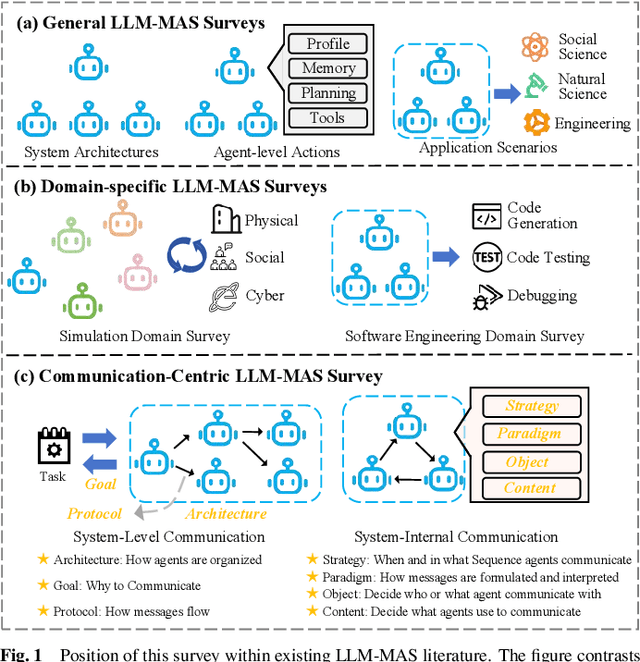
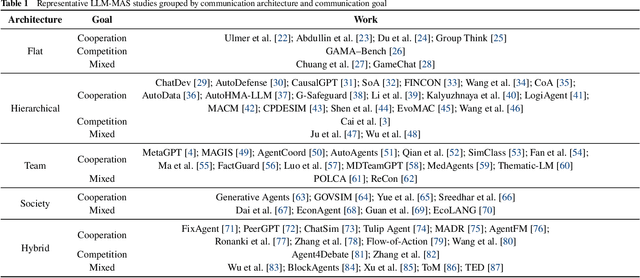
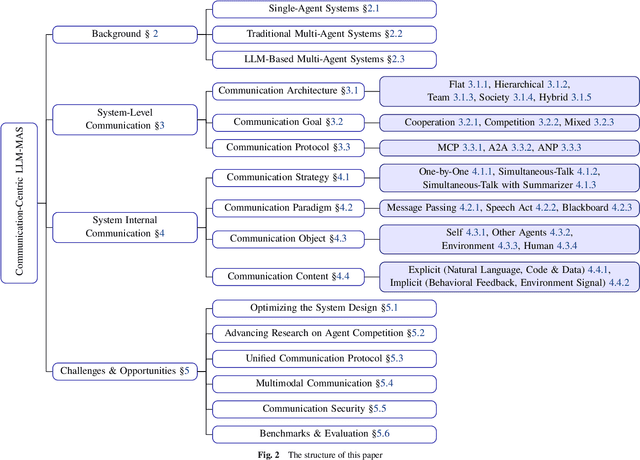
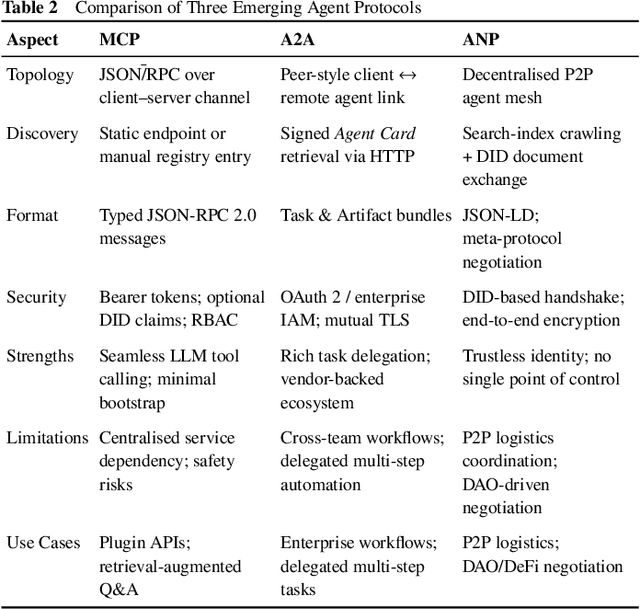
Large Language Models (LLMs) have recently demonstrated remarkable capabilities in reasoning, planning, and decision-making. Building upon these strengths, researchers have begun incorporating LLMs into multi-agent systems (MAS), where agents collaborate or compete through natural language interactions to tackle tasks beyond the scope of single-agent setups. In this survey, we present a communication-centric perspective on LLM-based multi-agent systems, examining key system-level features such as architecture design and communication goals, as well as internal mechanisms like communication strategies, paradigms, objects and content. We illustrate how these communication elements interplay to enable collective intelligence and flexible collaboration. Furthermore, we discuss prominent challenges, including scalability, security, and multimodal integration, and propose directions for future work to advance research in this emerging domain. Ultimately, this survey serves as a catalyst for further innovation, fostering more robust, scalable, and intelligent multi-agent systems across diverse application domains.