 Add to Chrome
 Add to Firefox
 Add to Edge
User-Feedback-Driven Continual Adaptation for Vision-and-Language Navigation
Dec 11, 2025
Vision-and-Language Navigation (VLN) requires agents to navigate complex environments by following natural-language instructions. General Scene Adaptation for VLN (GSA-VLN) shifts the focus from zero-shot generalization to continual, environment-specific adaptation, narrowing the gap between static benchmarks and real-world deployment. However, current GSA-VLN frameworks exclude user feedback, relying solely on unsupervised adaptation from repeated environmental exposure. In practice, user feedback offers natural and valuable supervision that can significantly enhance adaptation quality. We introduce a user-feedback-driven adaptation framework that extends GSA-VLN by systematically integrating human interactions into continual learning. Our approach converts user feedback-navigation instructions and corrective signals-into high-quality, environment-aligned training data, enabling efficient and realistic adaptation. A memory-bank warm-start mechanism further reuses previously acquired environmental knowledge, mitigating cold-start degradation and ensuring stable redeployment. Experiments on the GSA-R2R benchmark show that our method consistently surpasses strong baselines such as GR-DUET, improving navigation success and path efficiency. The memory-bank warm start stabilizes early navigation and reduces performance drops after updates. Results under both continual and hybrid adaptation settings confirm the robustness and generality of our framework, demonstrating sustained improvement across diverse deployment conditions.

GLaD: Geometric Latent Distillation for Vision-Language-Action Models
Dec 10, 2025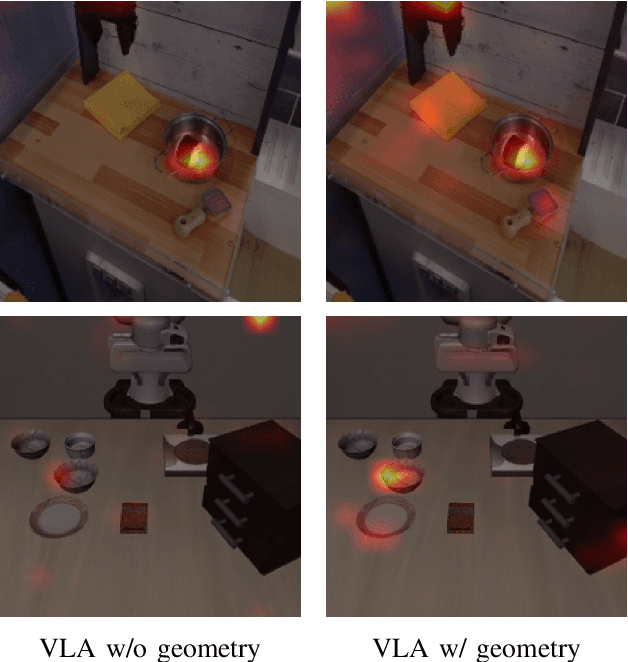
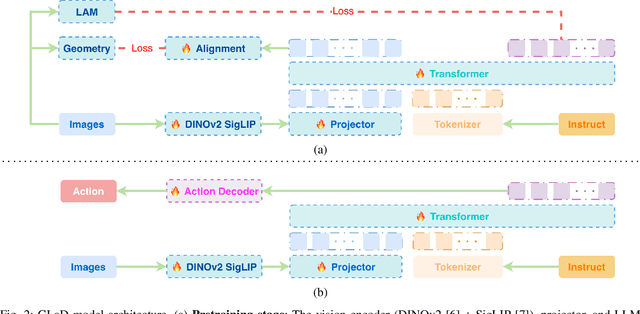
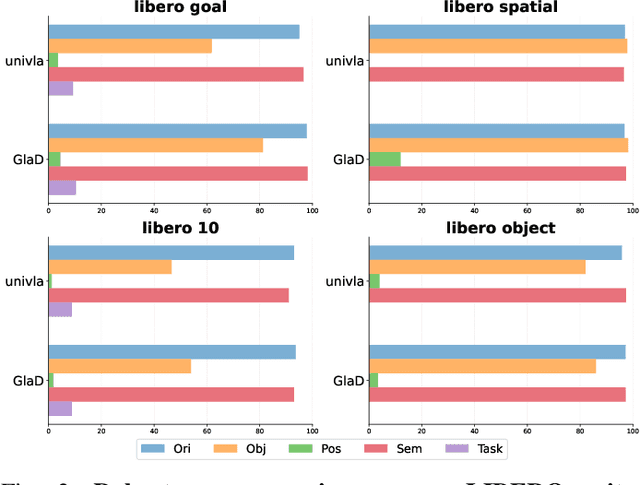
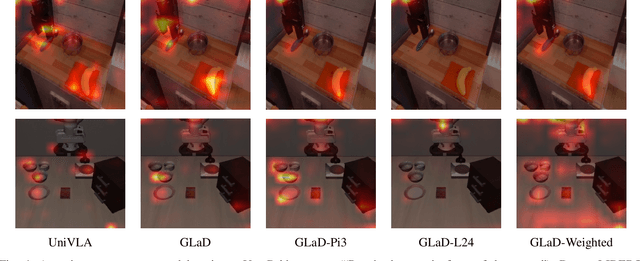
Most existing Vision-Language-Action (VLA) models rely primarily on RGB information, while ignoring geometric cues crucial for spatial reasoning and manipulation. In this work, we introduce GLaD, a geometry-aware VLA framework that incorporates 3D geometric priors during pretraining through knowledge distillation. Rather than distilling geometric features solely into the vision encoder, we align the LLM's hidden states corresponding to visual tokens with features from a frozen geometry-aware vision transformer (VGGT), ensuring that geometric understanding is deeply integrated into the multimodal representations that drive action prediction. Pretrained on the Bridge dataset with this geometry distillation mechanism, GLaD achieves 94.1% average success rate across four LIBERO task suites, outperforming UniVLA (92.5%) which uses identical pretraining data. These results validate that geometry-aware pretraining enhances spatial reasoning and policy generalization without requiring explicit depth sensors or 3D annotations.
FusionFM: All-in-One Multi-Modal Image Fusion with Flow Matching
Nov 17, 2025Current multi-modal image fusion methods typically rely on task-specific models, leading to high training costs and limited scalability. While generative methods provide a unified modeling perspective, they often suffer from slow inference due to the complex sampling trajectories from noise to image. To address this, we formulate image fusion as a direct probabilistic transport from source modalities to the fused image distribution, leveraging the flow matching paradigm to improve sampling efficiency and structural consistency. To mitigate the lack of high-quality fused images for supervision, we collect fusion results from multiple state-of-the-art models as priors, and employ a task-aware selection function to select the most reliable pseudo-labels for each task. We further introduce a Fusion Refiner module that employs a divide-and-conquer strategy to systematically identify, decompose, and enhance degraded components in selected pseudo-labels. For multi-task scenarios, we integrate elastic weight consolidation and experience replay mechanisms to preserve cross-task performance and enhance continual learning ability from both parameter stability and memory retention perspectives. Our approach achieves competitive performance across diverse fusion tasks, while significantly improving sampling efficiency and maintaining a lightweight model design. The code will be available at: https://github.com/Ist-Zhy/FusionFM.
EmoVerse: A MLLMs-Driven Emotion Representation Dataset for Interpretable Visual Emotion Analysis
Nov 16, 2025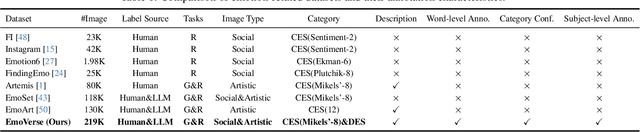
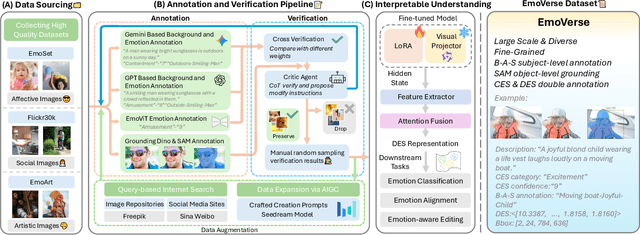
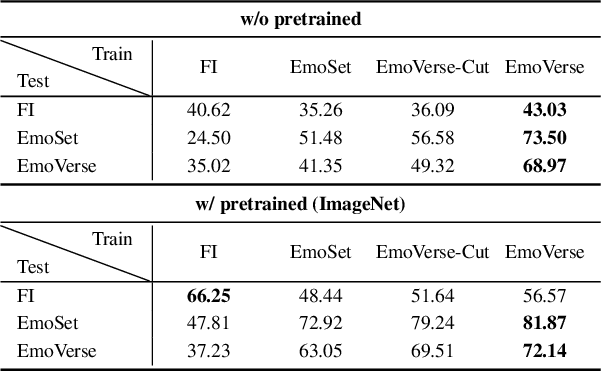
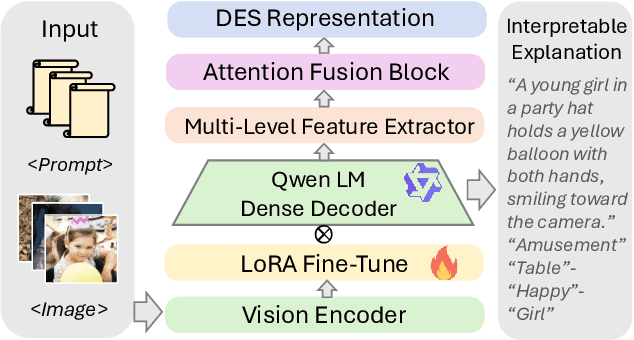
Visual Emotion Analysis (VEA) aims to bridge the affective gap between visual content and human emotional responses. Despite its promise, progress in this field remains limited by the lack of open-source and interpretable datasets. Most existing studies assign a single discrete emotion label to an entire image, offering limited insight into how visual elements contribute to emotion. In this work, we introduce EmoVerse, a large-scale open-source dataset that enables interpretable visual emotion analysis through multi-layered, knowledge-graph-inspired annotations. By decomposing emotions into Background-Attribute-Subject (B-A-S) triplets and grounding each element to visual regions, EmoVerse provides word-level and subject-level emotional reasoning. With over 219k images, the dataset further includes dual annotations in Categorical Emotion States (CES) and Dimensional Emotion Space (DES), facilitating unified discrete and continuous emotion representation. A novel multi-stage pipeline ensures high annotation reliability with minimal human effort. Finally, we introduce an interpretable model that maps visual cues into DES representations and provides detailed attribution explanations. Together, the dataset, pipeline, and model form a comprehensive foundation for advancing explainable high-level emotion understanding.
Towards Efficient General Feature Prediction in Masked Skeleton Modeling
Sep 03, 2025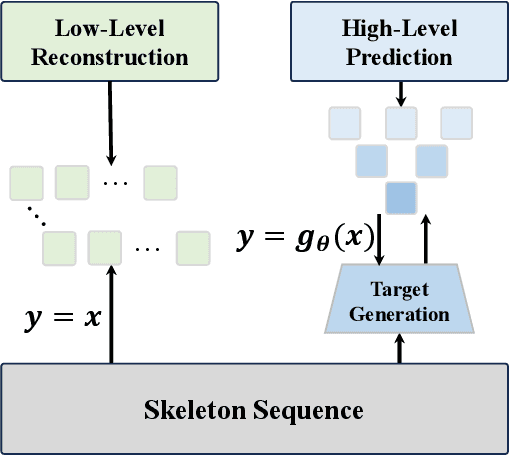
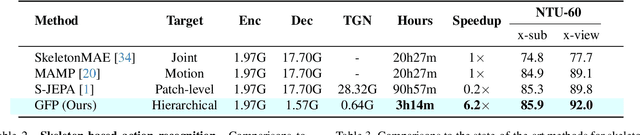
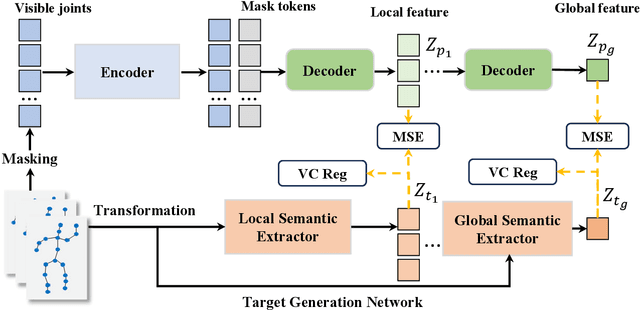
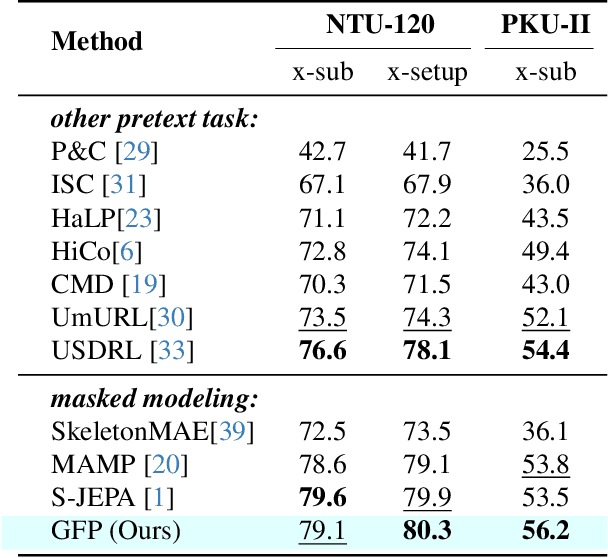
Recent advances in the masked autoencoder (MAE) paradigm have significantly propelled self-supervised skeleton-based action recognition. However, most existing approaches limit reconstruction targets to raw joint coordinates or their simple variants, resulting in computational redundancy and limited semantic representation. To address this, we propose a novel General Feature Prediction framework (GFP) for efficient mask skeleton modeling. Our key innovation is replacing conventional low-level reconstruction with high-level feature prediction that spans from local motion patterns to global semantic representations. Specifically, we introduce a collaborative learning framework where a lightweight target generation network dynamically produces diversified supervision signals across spatial-temporal hierarchies, avoiding reliance on pre-computed offline features. The framework incorporates constrained optimization to ensure feature diversity while preventing model collapse. Experiments on NTU RGB+D 60, NTU RGB+D 120 and PKU-MMD demonstrate the benefits of our approach: Computational efficiency (with 6.2$\times$ faster training than standard masked skeleton modeling methods) and superior representation quality, achieving state-of-the-art performance in various downstream tasks.
MDK12-Bench: A Comprehensive Evaluation of Multimodal Large Language Models on Multidisciplinary Exams
Aug 09, 2025Multimodal large language models (MLLMs), which integrate language and visual cues for problem-solving, are crucial for advancing artificial general intelligence (AGI). However, current benchmarks for measuring the intelligence of MLLMs suffer from limited scale, narrow coverage, and unstructured knowledge, offering only static and undifferentiated evaluations. To bridge this gap, we introduce MDK12-Bench, a large-scale multidisciplinary benchmark built from real-world K-12 exams spanning six disciplines with 141K instances and 6,225 knowledge points organized in a six-layer taxonomy. Covering five question formats with difficulty and year annotations, it enables comprehensive evaluation to capture the extent to which MLLMs perform over four dimensions: 1) difficulty levels, 2) temporal (cross-year) shifts, 3) contextual shifts, and 4) knowledge-driven reasoning. We propose a novel dynamic evaluation framework that introduces unfamiliar visual, textual, and question form shifts to challenge model generalization while improving benchmark objectivity and longevity by mitigating data contamination. We further evaluate knowledge-point reference-augmented generation (KP-RAG) to examine the role of knowledge in problem-solving. Key findings reveal limitations in current MLLMs in multiple aspects and provide guidance for enhancing model robustness, interpretability, and AI-assisted education.
Ground-R1: Incentivizing Grounded Visual Reasoning via Reinforcement Learning
May 26, 2025Large Vision-Language Models (LVLMs) have demonstrated impressive general capabilities across a wide range of multi-modal tasks. However, the reasoning processes of LVLMs often suffer from unreliable outputs and limited interpretability. To address this, grounded visual reasoning has emerged as a promising paradigm that enforces responses anchored on salient visual evidence regions. However, existing approaches typically rely on costly supervision such as bounding box annotations, chain-of-thought rationale or external tool calls, limiting their scalability. In this work, we propose Ground-R1, a reinforcement learning framework that enables grounded visual reasoning without requiring explicit evidence or rationale annotations. Ground-R1 consists of a grounding phase that generates evidence region rollouts based on format constraints, and an answering phase that produces responses guided by both answer correctness and format adherence rewards. Extensive experiments across multiple visual reasoning benchmarks manifest that Ground-R1 achieves superior performance and exhibits emergent cognitive behaviors such as uncertainty awareness, spatial perception, and iterative refinement, offering a scalable and interpretable alternative to existing approaches.
Semantic-enhanced Co-attention Prompt Learning for Non-overlapping Cross-Domain Recommendation
May 25, 2025Non-overlapping Cross-domain Sequential Recommendation (NCSR) is the task that focuses on domain knowledge transfer without overlapping entities. Compared with traditional Cross-domain Sequential Recommendation (CSR), NCSR poses several challenges: 1) NCSR methods often rely on explicit item IDs, overlooking semantic information among entities. 2) Existing CSR mainly relies on domain alignment for knowledge transfer, risking semantic loss during alignment. 3) Most previous studies do not consider the many-to-one characteristic, which is challenging because of the utilization of multiple source domains. Given the above challenges, we introduce the prompt learning technique for Many-to-one Non-overlapping Cross-domain Sequential Recommendation (MNCSR) and propose a Text-enhanced Co-attention Prompt Learning Paradigm (TCPLP). Specifically, we capture semantic meanings by representing items through text rather than IDs, leveraging natural language universality to facilitate cross-domain knowledge transfer. Unlike prior works that need to conduct domain alignment, we directly learn transferable domain information, where two types of prompts, i.e., domain-shared and domain-specific prompts, are devised, with a co-attention-based network for prompt encoding. Then, we develop a two-stage learning strategy, i.e., pre-train & prompt-tuning paradigm, for domain knowledge pre-learning and transferring, respectively. We conduct extensive experiments on three datasets and the experimental results demonstrate the superiority of our TCPLP. Our source codes have been publicly released.
CoNav: Collaborative Cross-Modal Reasoning for Embodied Navigation
May 22, 2025Embodied navigation demands comprehensive scene understanding and precise spatial reasoning. While image-text models excel at interpreting pixel-level color and lighting cues, 3D-text models capture volumetric structure and spatial relationships. However, unified fusion approaches that jointly fuse 2D images, 3D point clouds, and textual instructions face challenges in limited availability of triple-modality data and difficulty resolving conflicting beliefs among modalities. In this work, we introduce CoNav, a collaborative cross-modal reasoning framework where a pretrained 3D-text model explicitly guides an image-text navigation agent by providing structured spatial-semantic knowledge to resolve ambiguities during navigation. Specifically, we introduce Cross-Modal Belief Alignment, which operationalizes this cross-modal guidance by simply sharing textual hypotheses from the 3D-text model to the navigation agent. Through lightweight fine-tuning on a small 2D-3D-text corpus, the navigation agent learns to integrate visual cues with spatial-semantic knowledge derived from the 3D-text model, enabling effective reasoning in embodied navigation. CoNav achieves significant improvements on four standard embodied navigation benchmarks (R2R, CVDN, REVERIE, SOON) and two spatial reasoning benchmarks (ScanQA, SQA3D). Moreover, under close navigation Success Rate, CoNav often generates shorter paths compared to other methods (as measured by SPL), showcasing the potential and challenges of fusing data from different modalities in embodied navigation. Project Page: https://oceanhao.github.io/CoNav/
Token-Level Prompt Mixture with Parameter-Free Routing for Federated Domain Generalization
Apr 29, 2025Federated domain generalization (FedDG) aims to learn a globally generalizable model from decentralized clients with heterogeneous data while preserving privacy. Recent studies have introduced prompt learning to adapt vision-language models (VLMs) in FedDG by learning a single global prompt. However, such a one-prompt-fits-all learning paradigm typically leads to performance degradation on personalized samples. Although the mixture of experts (MoE) offers a promising solution for specialization, existing MoE-based methods suffer from coarse image-level expert assignment and high communication costs from parameterized routers. To address these limitations, we propose TRIP, a Token-level prompt mixture with parameter-free routing framework for FedDG, which treats multiple prompts as distinct experts. Unlike existing image-level routing designs, TRIP assigns different tokens within an image to specific experts. To ensure communication efficiency, TRIP incorporates a parameter-free routing mechanism based on token clustering and optimal transport. The instance-specific prompt is then synthesized by aggregating experts, weighted by the number of tokens assigned to each. Additionally, TRIP develops an unbiased learning strategy for prompt experts, leveraging the VLM's zero-shot generalization capability. Extensive experiments across four benchmarks demonstrate that TRIP achieves optimal generalization results, with communication of only 1K parameters per round. Our code is available at https://github.com/GongShuai8210/TRIP.