 Add to Chrome
 Add to Firefox
 Add to Edge
Consistent Instance Field for Dynamic Scene Understanding
Dec 16, 2025
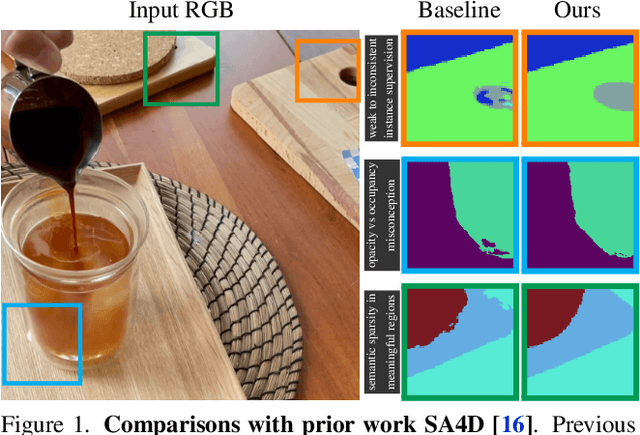
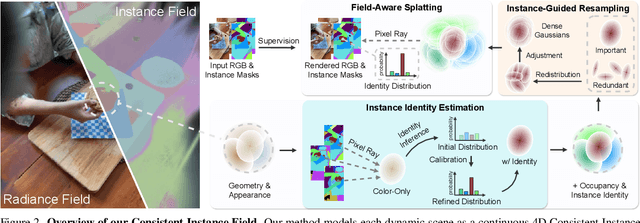
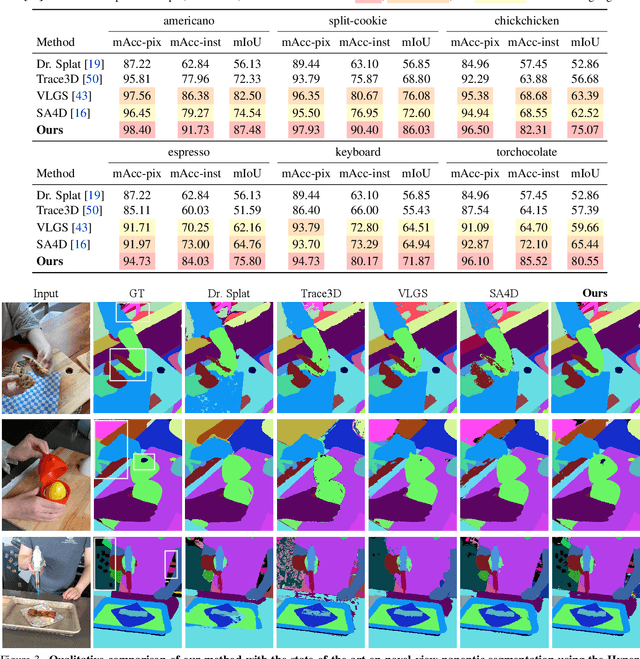
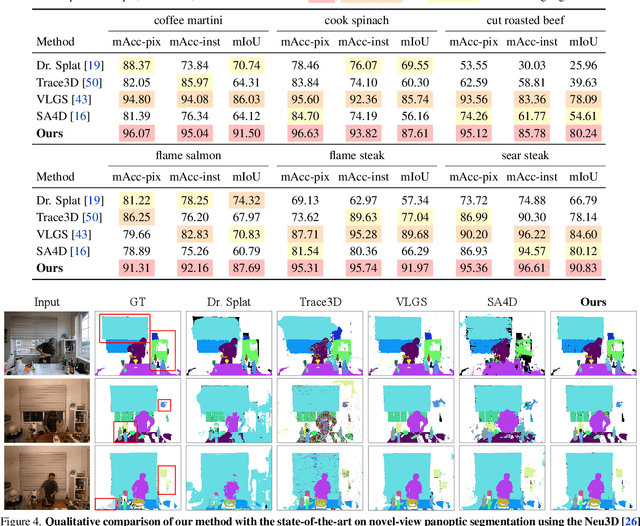
We introduce Consistent Instance Field, a continuous and probabilistic spatio-temporal representation for dynamic scene understanding. Unlike prior methods that rely on discrete tracking or view-dependent features, our approach disentangles visibility from persistent object identity by modeling each space-time point with an occupancy probability and a conditional instance distribution. To realize this, we introduce a novel instance-embedded representation based on deformable 3D Gaussians, which jointly encode radiance and semantic information and are learned directly from input RGB images and instance masks through differentiable rasterization. Furthermore, we introduce new mechanisms to calibrate per-Gaussian identities and resample Gaussians toward semantically active regions, ensuring consistent instance representations across space and time. Experiments on HyperNeRF and Neu3D datasets demonstrate that our method significantly outperforms state-of-the-art methods on novel-view panoptic segmentation and open-vocabulary 4D querying tasks.

From Particles to Fields: Reframing Photon Mapping with Continuous Gaussian Photon Fields
Dec 13, 2025Accurately modeling light transport is essential for realistic image synthesis. Photon mapping provides physically grounded estimates of complex global illumination effects such as caustics and specular-diffuse interactions, yet its per-view radiance estimation remains computationally inefficient when rendering multiple views of the same scene. The inefficiency arises from independent photon tracing and stochastic kernel estimation at each viewpoint, leading to inevitable redundant computation. To accelerate multi-view rendering, we reformulate photon mapping as a continuous and reusable radiance function. Specifically, we introduce the Gaussian Photon Field (GPF), a learnable representation that encodes photon distributions as anisotropic 3D Gaussian primitives parameterized by position, rotation, scale, and spectrum. GPF is initialized from physically traced photons in the first SPPM iteration and optimized using multi-view supervision of final radiance, distilling photon-based light transport into a continuous field. Once trained, the field enables differentiable radiance evaluation along camera rays without repeated photon tracing or iterative refinement. Extensive experiments on scenes with complex light transport, such as caustics and specular-diffuse interactions, demonstrate that GPF attains photon-level accuracy while reducing computation by orders of magnitude, unifying the physical rigor of photon-based rendering with the efficiency of neural scene representations.
TraceFlow: Dynamic 3D Reconstruction of Specular Scenes Driven by Ray Tracing
Dec 10, 2025We present TraceFlow, a novel framework for high-fidelity rendering of dynamic specular scenes by addressing two key challenges: precise reflection direction estimation and physically accurate reflection modeling. To achieve this, we propose a Residual Material-Augmented 2D Gaussian Splatting representation that models dynamic geometry and material properties, allowing accurate reflection ray computation. Furthermore, we introduce a Dynamic Environment Gaussian and a hybrid rendering pipeline that decomposes rendering into diffuse and specular components, enabling physically grounded specular synthesis via rasterization and ray tracing. Finally, we devise a coarse-to-fine training strategy to improve optimization stability and promote physically meaningful decomposition. Extensive experiments on dynamic scene benchmarks demonstrate that TraceFlow outperforms prior methods both quantitatively and qualitatively, producing sharper and more realistic specular reflections in complex dynamic environments.
GLaD: Geometric Latent Distillation for Vision-Language-Action Models
Dec 10, 2025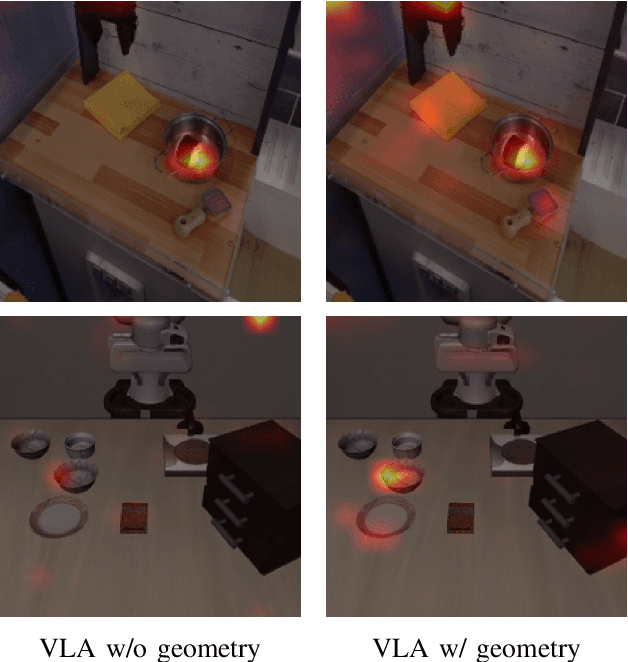
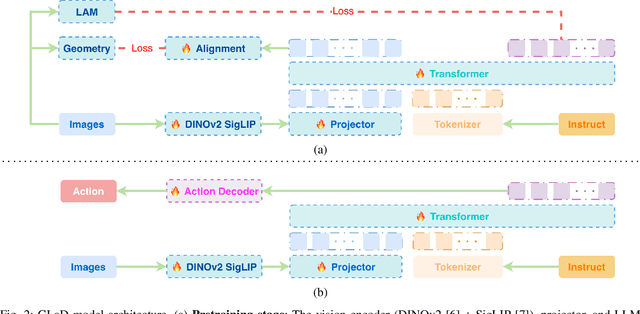
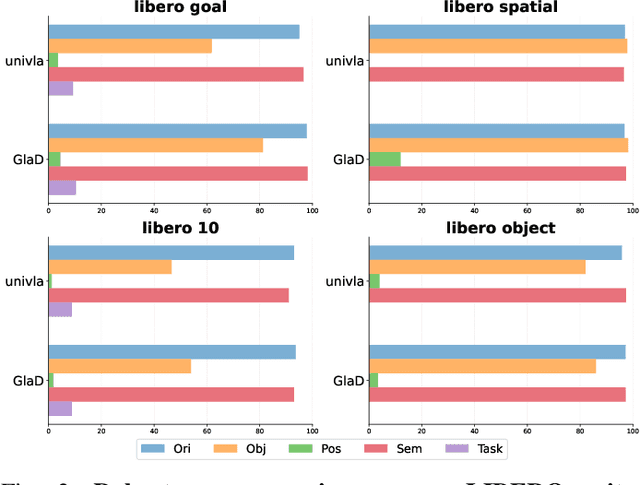
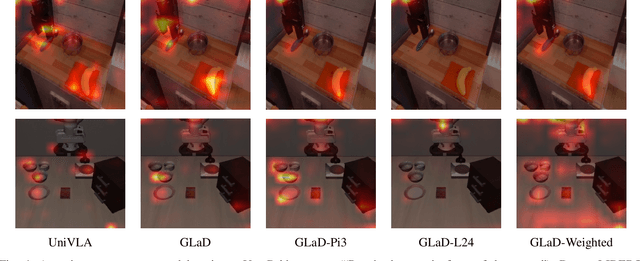
Most existing Vision-Language-Action (VLA) models rely primarily on RGB information, while ignoring geometric cues crucial for spatial reasoning and manipulation. In this work, we introduce GLaD, a geometry-aware VLA framework that incorporates 3D geometric priors during pretraining through knowledge distillation. Rather than distilling geometric features solely into the vision encoder, we align the LLM's hidden states corresponding to visual tokens with features from a frozen geometry-aware vision transformer (VGGT), ensuring that geometric understanding is deeply integrated into the multimodal representations that drive action prediction. Pretrained on the Bridge dataset with this geometry distillation mechanism, GLaD achieves 94.1% average success rate across four LIBERO task suites, outperforming UniVLA (92.5%) which uses identical pretraining data. These results validate that geometry-aware pretraining enhances spatial reasoning and policy generalization without requiring explicit depth sensors or 3D annotations.
X-Field: A Physically Grounded Representation for 3D X-ray Reconstruction
Mar 11, 2025X-ray imaging is indispensable in medical diagnostics, yet its use is tightly regulated due to potential health risks. To mitigate radiation exposure, recent research focuses on generating novel views from sparse inputs and reconstructing Computed Tomography (CT) volumes, borrowing representations from the 3D reconstruction area. However, these representations originally target visible light imaging that emphasizes reflection and scattering effects, while neglecting penetration and attenuation properties of X-ray imaging. In this paper, we introduce X-Field, the first 3D representation specifically designed for X-ray imaging, rooted in the energy absorption rates across different materials. To accurately model diverse materials within internal structures, we employ 3D ellipsoids with distinct attenuation coefficients. To estimate each material's energy absorption of X-rays, we devise an efficient path partitioning algorithm accounting for complex ellipsoid intersections. We further propose hybrid progressive initialization to refine the geometric accuracy of X-Filed and incorporate material-based optimization to enhance model fitting along material boundaries. Experiments show that X-Field achieves superior visual fidelity on both real-world human organ and synthetic object datasets, outperforming state-of-the-art methods in X-ray Novel View Synthesis and CT Reconstruction.
Human101: Training 100+FPS Human Gaussians in 100s from 1 View
Dec 23, 2023Reconstructing the human body from single-view videos plays a pivotal role in the virtual reality domain. One prevalent application scenario necessitates the rapid reconstruction of high-fidelity 3D digital humans while simultaneously ensuring real-time rendering and interaction. Existing methods often struggle to fulfill both requirements. In this paper, we introduce Human101, a novel framework adept at producing high-fidelity dynamic 3D human reconstructions from 1-view videos by training 3D Gaussians in 100 seconds and rendering in 100+ FPS. Our method leverages the strengths of 3D Gaussian Splatting, which provides an explicit and efficient representation of 3D humans. Standing apart from prior NeRF-based pipelines, Human101 ingeniously applies a Human-centric Forward Gaussian Animation method to deform the parameters of 3D Gaussians, thereby enhancing rendering speed (i.e., rendering 1024-resolution images at an impressive 60+ FPS and rendering 512-resolution images at 100+ FPS). Experimental results indicate that our approach substantially eclipses current methods, clocking up to a 10 times surge in frames per second and delivering comparable or superior rendering quality. Code and demos will be released at https://github.com/longxiang-ai/Human101.