 Add to Chrome
 Add to Firefox
 Add to Edge
Looped World Models
Jun 16, 2026
Current world models face a fundamental tension: faithful long-horizon simulation demands deep computation, but deeper models are expensive to deploy and prone to compounding errors. We resolve this by introducing Looped World Models (LoopWM), which are the first looped architectures for world modelling. Our method iteratively refines latent environment states through a parameter-shared transformer block. This yield up to 100x parameter efficiency over conventional approaches with adaptive computation that automatically scales depth to match the complexity of each prediction step. Orthogonal to scaling model size and training data, LoopWM establishes iterative latent depth as a new scaling axis for world simulation, which might significantly push the community forward.

Exploring Adaptive Masked Reconstruction for Self-Supervised Skeleton-Based Action Recognition
Jun 09, 2026Recently, masked skeleton reconstruction models have emerged as strong action representation learners, driving significant progress in self-supervised skeleton-based action recognition. However, existing state-of-the-art methods must predict an exceedingly large number of spatiotemporal patches, significantly prolonging training time. Besides, by treating all spatiotemporal regions equally during reconstruction, these models are distracted from learning the critical motion patterns that underlie action semantics. To address these challenges, we propose Adaptive Masked Reconstruction (AMR), a faster and stronger pre-training framework. We first decouple the decoder from the encoder, enabling flexible prediction of larger spatiotemporal patches and dramatically reducing reconstruction complexity. Given that larger patches contain more complex information, which is challenging to predict and consequently degrades performance, we accordingly introduce an adaptive guidance module. This module identifies regions of high motion informativeness, guiding the model to focus on the most discriminative parts of each patch and alleviating reconstruction difficulty. Experiments on NTU RGB+D 60, NTU RGB+D 120, and PKU-MMD datasets demonstrate that AMR not only accelerates pre-training substantially but also improves downstream recognition accuracy, surpassing current state-of-the-art approaches.
Periodic Steady-State Control of a Handkerchief-Spinning Task Using a Parallel Anti-Parallelogram Tendon-driven Wrist
Apr 20, 2026Spinning flexible objects, exemplified by traditional Chinese handkerchief performances, demands periodic steady-state motions under nonlinear dynamics with frictional contacts and boundary constraints. To address these challenges, we first design an intuitive dexterous wrist based on a parallel anti-parallelogram tendon-driven structure, which achieves 90 degrees omnidirectional rotation with low inertia and decoupled roll-pitch sensing, and implement a high-low level hierarchical control scheme. We then develop a particle-spring model of the handkerchief for control-oriented abstraction and strategy evaluation. Hardware experiments validate this framework, achieving an unfolding ratio of approximately 99% and fingertip tracking error of RMSE = 2.88 mm in high-dynamic spinning. These results demonstrate that integrating control-oriented modeling with a task-tailored dexterous wrist enables robust rest-to-steady-state transitions and precise periodic manipulation of highly flexible objects. More visualizations: https://slowly1113.github.io/icra2026-handkerchief/
Adam's Law: Textual Frequency Law on Large Language Models
Apr 02, 2026While textual frequency has been validated as relevant to human cognition in reading speed, its relatedness to Large Language Models (LLMs) is seldom studied. We propose a novel research direction in terms of textual data frequency, which is an understudied topic, to the best of our knowledge. Our framework is composed of three units. First, this paper proposes Textual Frequency Law (TFL), which indicates that frequent textual data should be preferred for LLMs for both prompting and fine-tuning. Since many LLMs are closed-source in their training data, we propose using online resources to estimate the sentence-level frequency. We then utilize an input paraphraser to paraphrase the input into a more frequent textual expression. Next, we propose Textual Frequency Distillation (TFD) by querying LLMs to conduct story completion by further extending the sentences in the datasets, and the resulting corpora are used to adjust the initial estimation. Finally, we propose Curriculum Textual Frequency Training (CTFT) that fine-tunes LLMs in an increasing order of sentence-level frequency. Experiments are conducted on our curated dataset Textual Frequency Paired Dataset (TFPD) on math reasoning, machine translation, commonsense reasoning and agentic tool calling. Results show the effectiveness of our framework.
Multi-Stage Patient Role-Playing Framework for Realistic Clinical Interactions
Jan 16, 2026The simulation of realistic clinical interactions plays a pivotal role in advancing clinical Large Language Models (LLMs) and supporting medical diagnostic education. Existing approaches and benchmarks rely on generic or LLM-generated dialogue data, which limits the authenticity and diversity of doctor-patient interactions. In this work, we propose the first Chinese patient simulation dataset (Ch-PatientSim), constructed from realistic clinical interaction scenarios to comprehensively evaluate the performance of models in emulating patient behavior. Patients are simulated based on a five-dimensional persona structure. To address issues of the persona class imbalance, a portion of the dataset is augmented using few-shot generation, followed by manual verification. We evaluate various state-of-the-art LLMs and find that most produce overly formal responses that lack individual personality. To address this limitation, we propose a training-free Multi-Stage Patient Role-Playing (MSPRP) framework, which decomposes interactions into three stages to ensure both personalization and realism in model responses. Experimental results demonstrate that our approach significantly improves model performance across multiple dimensions of patient simulation.
VERHallu: Evaluating and Mitigating Event Relation Hallucination in Video Large Language Models
Jan 15, 2026Video Large Language Models (VideoLLMs) exhibit various types of hallucinations. Existing research has primarily focused on hallucinations involving the presence of events, objects, and scenes in videos, while largely neglecting event relation hallucination. In this paper, we introduce a novel benchmark for evaluating the Video Event Relation Hallucination, named VERHallu. This benchmark focuses on causal, temporal, and subevent relations between events, encompassing three types of tasks: relation classification, question answering, and counterfactual question answering, for a comprehensive evaluation of event relation hallucination. Additionally, it features counterintuitive video scenarios that deviate from typical pretraining distributions, with each sample accompanied by human-annotated candidates covering both vision-language and pure language biases. Our analysis reveals that current state-of-the-art VideoLLMs struggle with dense-event relation reasoning, often relying on prior knowledge due to insufficient use of frame-level cues. Although these models demonstrate strong grounding capabilities for key events, they often overlook the surrounding subevents, leading to an incomplete and inaccurate understanding of event relations. To tackle this, we propose a Key-Frame Propagating (KFP) strategy, which reallocates frame-level attention within intermediate layers to enhance multi-event understanding. Experiments show it effectively mitigates the event relation hallucination without affecting inference speed.
Towards Efficient General Feature Prediction in Masked Skeleton Modeling
Sep 03, 2025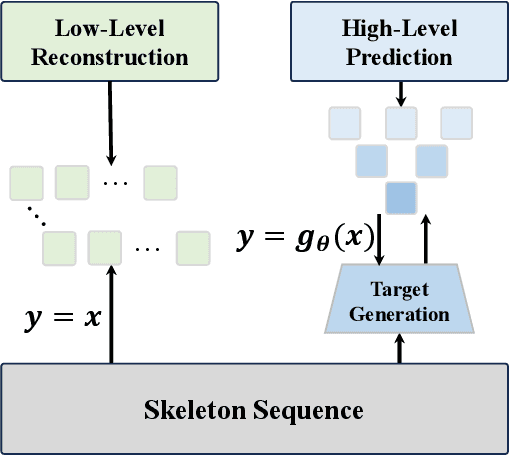
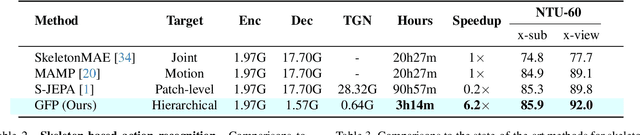
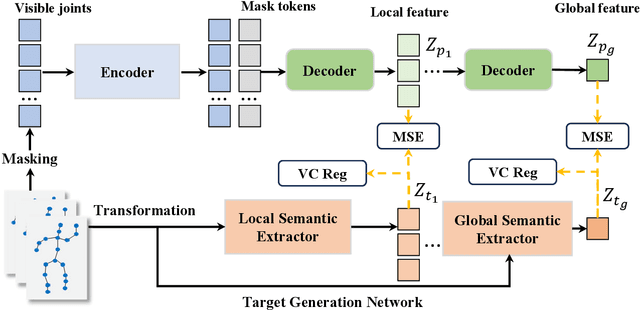
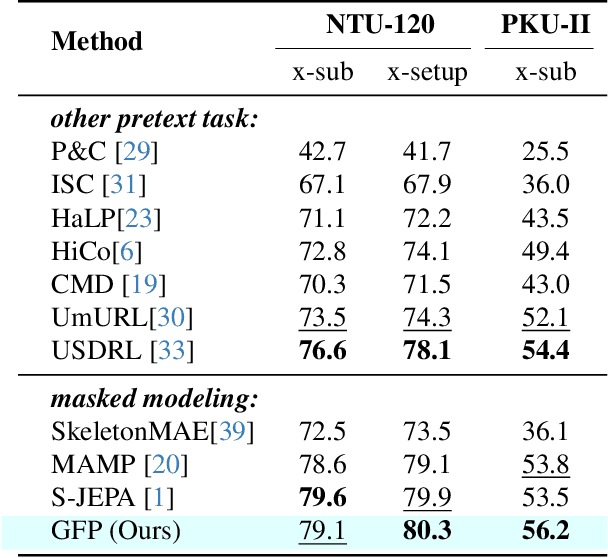
Recent advances in the masked autoencoder (MAE) paradigm have significantly propelled self-supervised skeleton-based action recognition. However, most existing approaches limit reconstruction targets to raw joint coordinates or their simple variants, resulting in computational redundancy and limited semantic representation. To address this, we propose a novel General Feature Prediction framework (GFP) for efficient mask skeleton modeling. Our key innovation is replacing conventional low-level reconstruction with high-level feature prediction that spans from local motion patterns to global semantic representations. Specifically, we introduce a collaborative learning framework where a lightweight target generation network dynamically produces diversified supervision signals across spatial-temporal hierarchies, avoiding reliance on pre-computed offline features. The framework incorporates constrained optimization to ensure feature diversity while preventing model collapse. Experiments on NTU RGB+D 60, NTU RGB+D 120 and PKU-MMD demonstrate the benefits of our approach: Computational efficiency (with 6.2$\times$ faster training than standard masked skeleton modeling methods) and superior representation quality, achieving state-of-the-art performance in various downstream tasks.