 Add to Chrome
 Add to Firefox
 Add to Edge
CaRiNG: Learning Temporal Causal Representation under Non-Invertible Generation Process
Jan 25, 2024
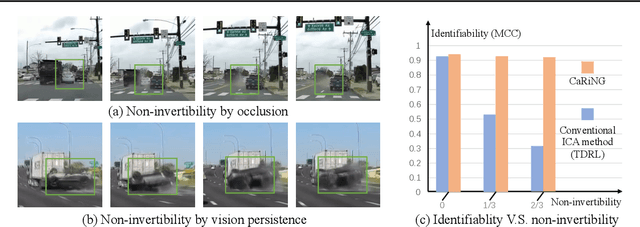

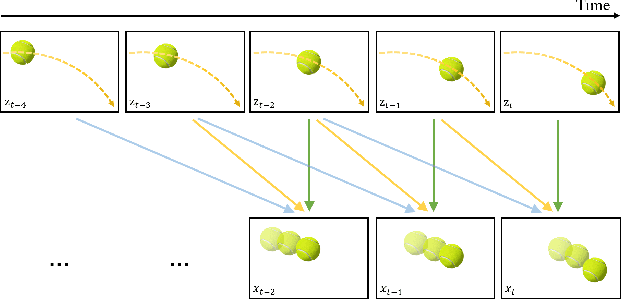
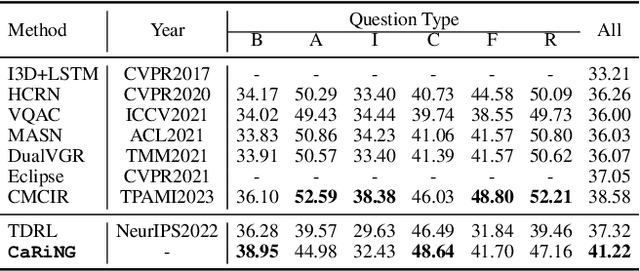
Identifying the underlying time-delayed latent causal processes in sequential data is vital for grasping temporal dynamics and making downstream reasoning. While some recent methods can robustly identify these latent causal variables, they rely on strict assumptions about the invertible generation process from latent variables to observed data. However, these assumptions are often hard to satisfy in real-world applications containing information loss. For instance, the visual perception process translates a 3D space into 2D images, or the phenomenon of persistence of vision incorporates historical data into current perceptions. To address this challenge, we establish an identifiability theory that allows for the recovery of independent latent components even when they come from a nonlinear and non-invertible mix. Using this theory as a foundation, we propose a principled approach, CaRiNG, to learn the CAusal RepresentatIon of Non-invertible Generative temporal data with identifiability guarantees. Specifically, we utilize temporal context to recover lost latent information and apply the conditions in our theory to guide the training process. Through experiments conducted on synthetic datasets, we validate that our CaRiNG method reliably identifies the causal process, even when the generation process is non-invertible. Moreover, we demonstrate that our approach considerably improves temporal understanding and reasoning in practical applications.

BET: Explaining Deep Reinforcement Learning through The Error-Prone Decisions
Jan 14, 2024Despite the impressive capabilities of Deep Reinforcement Learning (DRL) agents in many challenging scenarios, their black-box decision-making process significantly limits their deployment in safety-sensitive domains. Several previous self-interpretable works focus on revealing the critical states of the agent's decision. However, they cannot pinpoint the error-prone states. To address this issue, we propose a novel self-interpretable structure, named Backbone Extract Tree (BET), to better explain the agent's behavior by identify the error-prone states. At a high level, BET hypothesizes that states in which the agent consistently executes uniform decisions exhibit a reduced propensity for errors. To effectively model this phenomenon, BET expresses these states within neighborhoods, each defined by a curated set of representative states. Therefore, states positioned at a greater distance from these representative benchmarks are more prone to error. We evaluate BET in various popular RL environments and show its superiority over existing self-interpretable models in terms of explanation fidelity. Furthermore, we demonstrate a use case for providing explanations for the agents in StarCraft II, a sophisticated multi-agent cooperative game. To the best of our knowledge, we are the first to explain such a complex scenarios using a fully transparent structure.
CASA: Causality-driven Argument Sufficiency Assessment
Jan 10, 2024The argument sufficiency assessment task aims to determine if the premises of a given argument support its conclusion. To tackle this task, existing works often train a classifier on data annotated by humans. However, annotating data is laborious, and annotations are often inconsistent due to subjective criteria. Motivated by the probability of sufficiency (PS) definition in the causal literature, we propose CASA, a zero-shot causality-driven argument sufficiency assessment framework. PS measures how likely introducing the premise event would lead to the conclusion, when both the premise and conclusion events are absent. To estimate this probability, we propose to use large language models (LLMs) to generate contexts that are inconsistent with the premise and conclusion, and revise them by injecting the premise event. Experiments on two logical fallacy detection datasets demonstrate that CASA accurately identifies insufficient arguments. We further deploy CASA in a writing assistance application, and find that suggestions generated by CASA enhance the sufficiency of student-written arguments. Code and data are available at https://github.com/xxxiaol/CASA.
Robust Image Watermarking using Stable Diffusion
Jan 08, 2024Watermarking images is critical for tracking image provenance and claiming ownership. With the advent of generative models, such as stable diffusion, able to create fake but realistic images, watermarking has become particularly important, e.g., to make generated images reliably identifiable. Unfortunately, the very same stable diffusion technology can remove watermarks injected using existing methods. To address this problem, we present a ZoDiac, which uses a pre-trained stable diffusion model to inject a watermark into the trainable latent space, resulting in watermarks that can be reliably detected in the latent vector, even when attacked. We evaluate ZoDiac on three benchmarks, MS-COCO, DiffusionDB, and WikiArt, and find that ZoDiac is robust against state-of-the-art watermark attacks, with a watermark detection rate over 98% and a false positive rate below 6.4%, outperforming state-of-the-art watermarking methods. Our research demonstrates that stable diffusion is a promising approach to robust watermarking, able to withstand even stable-diffusion-based attacks.
AlignBench: Benchmarking Chinese Alignment of Large Language Models
Dec 05, 2023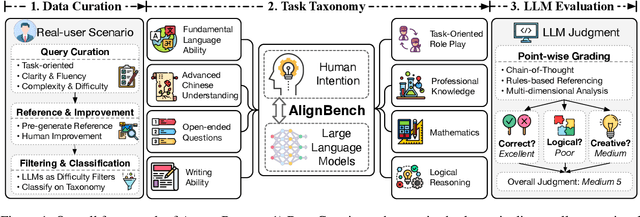
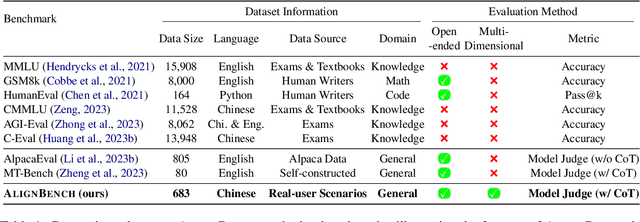
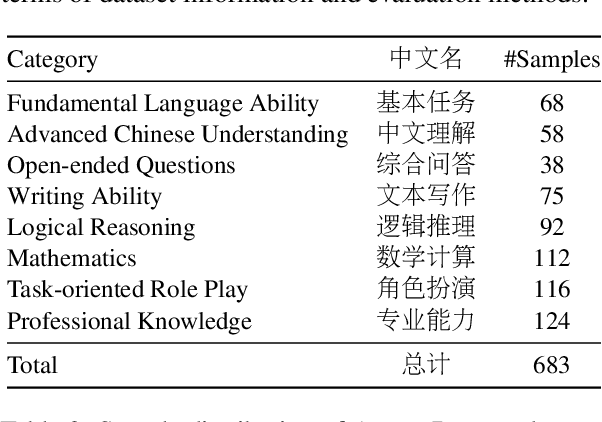
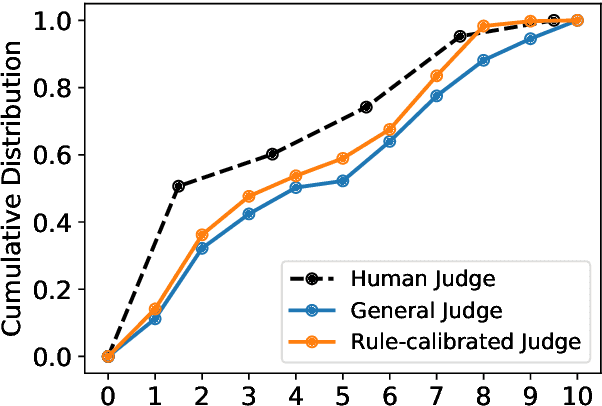
Alignment has become a critical step for instruction-tuned Large Language Models (LLMs) to become helpful assistants. However, effective evaluation of alignment for emerging Chinese LLMs is still significantly lacking, calling for real-scenario grounded, open-ended, challenging and automatic evaluations tailored for alignment. To fill in this gap, we introduce AlignBench, a comprehensive multi-dimensional benchmark for evaluating LLMs' alignment in Chinese. Equipped with a human-in-the-loop data curation pipeline, our benchmark employs a rule-calibrated multi-dimensional LLM-as-Judge with Chain-of-Thought to generate explanations and final ratings as evaluations, ensuring high reliability and interpretability. Furthermore, we report AlignBench evaluated by CritiqueLLM, a dedicated Chinese evaluator LLM that recovers 95% of GPT-4's evaluation ability. We will provide public APIs for evaluating AlignBench with CritiqueLLM to facilitate the evaluation of LLMs' Chinese alignment. All evaluation codes, data, and LLM generations are available at \url{https://github.com/THUDM/AlignBench}.
Competition-Level Problems are Effective LLM Evaluators
Dec 05, 2023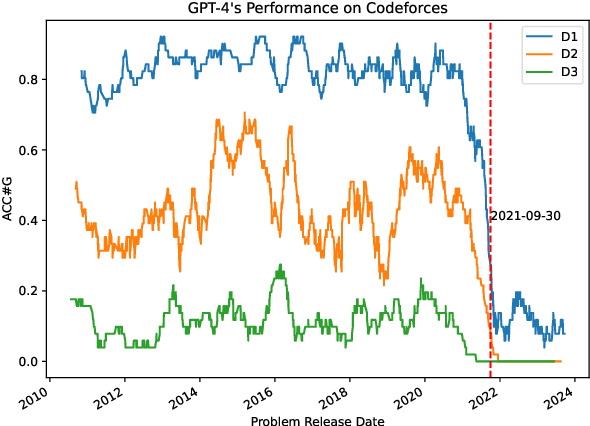
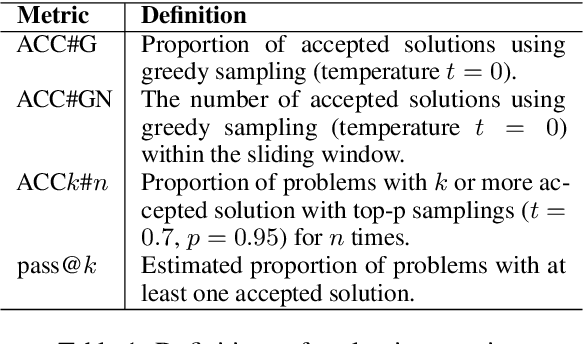
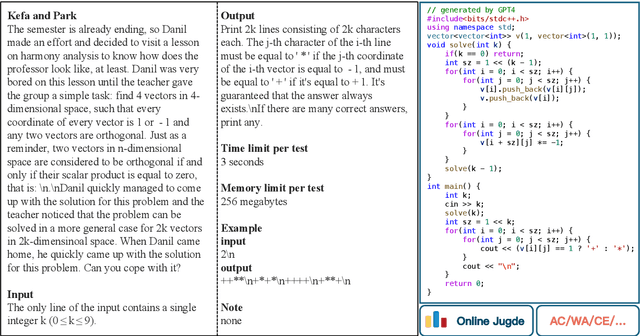
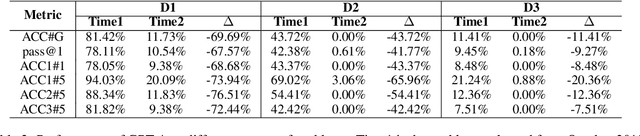
Large language models (LLMs) have demonstrated impressive reasoning capabilities, yet there is ongoing debate about these abilities and the potential data contamination problem recently. This paper aims to evaluate the reasoning capacities of LLMs, specifically in solving recent competition-level programming problems in Codeforces, which are expert-crafted and unique, requiring deep understanding and robust reasoning skills. We first provide a comprehensive evaluation of GPT-4's peiceived zero-shot performance on this task, considering various aspects such as problems' release time, difficulties, and types of errors encountered. Surprisingly, the peiceived performance of GPT-4 has experienced a cliff like decline in problems after September 2021 consistently across all the difficulties and types of problems, which shows the potential data contamination, as well as the challenges for any existing LLM to solve unseen complex reasoning problems. We further explore various approaches such as fine-tuning, Chain-of-Thought prompting and problem description simplification, unfortunately none of them is able to consistently mitigate the challenges. Through our work, we emphasis the importance of this excellent data source for assessing the genuine reasoning capabilities of LLMs, and foster the development of LLMs with stronger reasoning abilities and better generalization in the future.
CritiqueLLM: Scaling LLM-as-Critic for Effective and Explainable Evaluation of Large Language Model Generation
Nov 30, 2023Since the natural language processing (NLP) community started to make large language models (LLMs), such as GPT-4, act as a critic to evaluate the quality of generated texts, most of them only train a critique generation model of a specific scale on specific datasets. We argue that a comprehensive investigation on the key factor of LLM-based evaluation models, such as scaling properties, is lacking, so that it is still inconclusive whether these models have potential to replace GPT-4's evaluation in practical scenarios. In this paper, we propose a new critique generation model called CritiqueLLM, which includes a dialogue-based prompting method for high-quality referenced / reference-free evaluation data. Experimental results show that our model can achieve comparable evaluation performance to GPT-4 especially in system-level correlations, and even outperform GPT-4 in 3 out of 8 tasks in a challenging reference-free setting. We conduct detailed analysis to show promising scaling properties of our model in the quality of generated critiques. We also demonstrate that our generated critiques can act as scalable feedback to directly improve the generation quality of LLMs.
Beyond Text: Unveiling Multimodal Proficiency of Large Language Models with MultiAPI Benchmark
Nov 21, 2023The proliferation of Large Language Models like ChatGPT has significantly advanced language understanding and generation, impacting a broad spectrum of applications. However, these models predominantly excel in text-based tasks, overlooking the complexity of real-world multimodal information. This study introduces MultiAPI, a pioneering comprehensive large-scale API benchmark dataset aimed at expanding LLMs' proficiency in multimodal contexts. Developed collaboratively through ChatGPT, MultiAPI consists of 235 diverse API calls and 2,038 contextual prompts, offering a unique platform evaluation of tool-augmented LLMs handling multimodal tasks. Through comprehensive experiments, our findings reveal that while LLMs demonstrate proficiency in API call decision-making, they face challenges in domain identification, function selection, and argument generation. What's more, we surprisingly notice that auxiliary context can actually impair the performance. An in-depth error analysis paves the way for a new paradigm to address these challenges, suggesting a potential direction for future LLM research.
Multimodal Learning of Soft Robot Dynamics using Differentiable Filters
Nov 12, 2023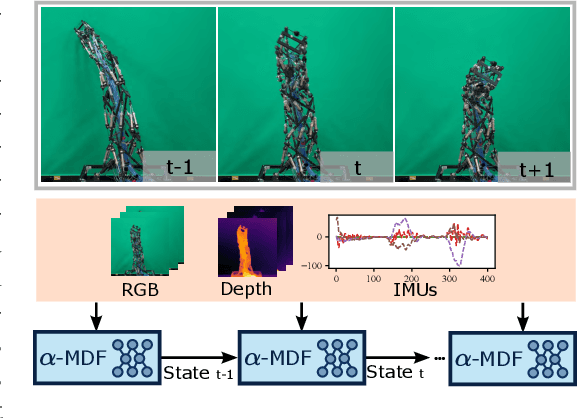
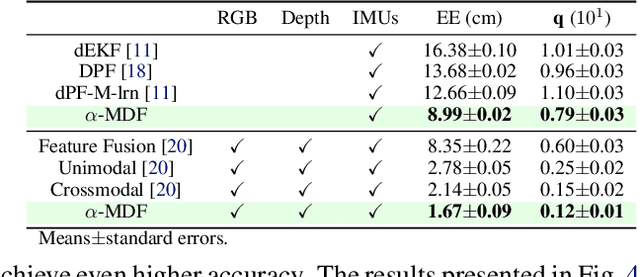
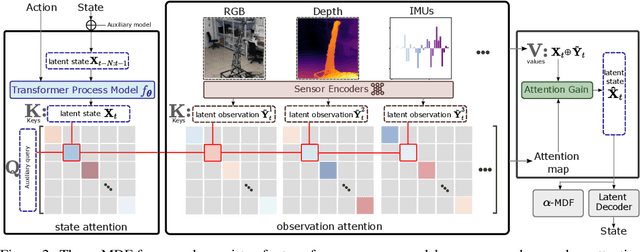
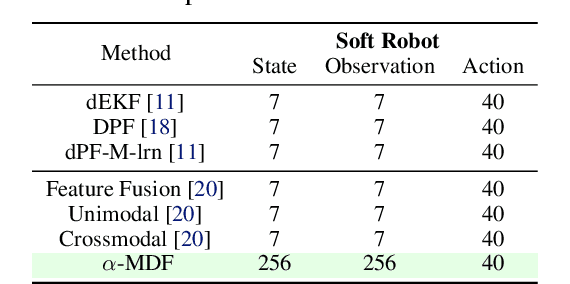
Differentiable Filters, as recursive Bayesian estimators, possess the ability to learn complex dynamics by deriving state transition and measurement models exclusively from data. This data-driven approach eliminates the reliance on explicit analytical models while maintaining the essential algorithmic components of the filtering process. However, the gain mechanism remains non-differentiable, limiting its adaptability to specific task requirements and contextual variations. To address this limitation, this paper introduces an innovative approach called {\alpha}-MDF (Attention-based Multimodal Differentiable Filter). {\alpha}-MDF leverages modern attention mechanisms to learn multimodal latent representations for accurate state estimation in soft robots. By incorporating attention mechanisms, {\alpha}-MDF offers the flexibility to tailor the gain mechanism to the unique nature of the task and context. The effectiveness of {\alpha}-MDF is validated through real-world state estimation tasks on soft robots. Our experimental results demonstrate significant reductions in state estimation errors, consistently surpassing differentiable filter baselines by up to 45% in the domain of soft robotics.
Black-Box Prompt Optimization: Aligning Large Language Models without Model Training
Nov 08, 2023Large language models (LLMs) have shown impressive success in various applications. However, these models are often not well aligned with human intents, which calls for additional treatments on them, that is, the alignment problem. To make LLMs better follow user instructions, existing alignment methods mostly focus on further training them. However, the extra training of LLMs are usually expensive in terms of GPU compute; worse still, LLMs of interest are oftentimes not accessible for user-demanded training, such as GPTs. In this work, we take a different perspective -- Black-Box Prompt Optimization (BPO) -- to perform alignments. The idea is to optimize user prompts to suit LLMs' input understanding, so as to best realize users' intents without updating LLMs' parameters. BPO is model-agnostic and the empirical results demonstrate that the BPO-aligned ChatGPT yields a 22% increase in the win rate against its original version, and 10% for GPT-4. Importantly, the BPO-aligned LLMs can outperform the same models aligned by PPO and DPO, and it also brings additional performance gains when combining BPO with PPO or DPO. Code and datasets are released at https://github.com/thu-coai/BPO.