 Add to Chrome
 Add to Firefox
 Add to Edge
HalluTracer: Hallucination Detection via Depth-Averaging Truth Signals
Aug 17, 2026
Even well-aligned large language models confidently generate factually incorrect text, making hallucination a persistent reliability risk in high-stakes deployments. These models nonetheless carry linearly separable truthfulness signals in their internal representations. Existing white-box detectors, however, collapse this evidence to isolated components or a single depth, discarding discriminative information distributed across the full forward pass. We introduce HalluTracer, a detection framework that reads and aggregates truthfulness evidence across every layer of the forward pass before the model emits any answer token. A geometric analysis reveals that the per-layer signals are weakly correlated, so that simple depth averaging suppresses layer-specific noise and captures nearly all linearly accessible information. Across six open-source language models and five hallucination benchmarks, HalluTracer consistently outperforms matched white-box baselines, with gains ranging from one to fourteen points. Collectively, our work recasts hallucination detection from a layer-selection problem into a depth-aggregation problem governed by the geometric sparsity of the truthfulness signal.

DeltaFlow: Noise-Adaptive Bidirectional Gated Delta Networks for Embedded Language Flows
Aug 02, 2026Embedded Language Flows (ELF) rely primarily on full non-causal attention for iterative denoising, repeatedly incurring quadratic sequence-mixing cost at each sampling step. Gated Delta Networks (GDNs) provide an efficient recurrent alternative, but their standard causal formulation cannot directly capture the bidirectional context required by ELF. We introduce DeltaFlow, a noise-adaptive bidirectional GDN backbone for continuous language denoising. We study two variants: DeltaFlow-A, which alternates scan directions across layers, and DeltaFlow-P, which performs parallel forward and backward scans within each layer. We further introduce noise-adaptive memory control and scheduled Temporal State Consistency (TSC) to stabilize hidden representations across nearby noise levels. On OpenWebText, using a 32-step stochastic differential equation sampler, DeltaFlow-P reduces generated perplexity from 24.218 for the full-attention ELF baseline to 21.228 while maintaining comparable unigram entropy, with 36B training-token exposure compared with 45B for the baseline. In a denoiser-only benchmark, DeltaFlow-P achieves a 2.72x throughput speedup over the full-attention baseline at a sequence length of 16k. These results show that DeltaFlow is a promising alternative to dense attention for efficient continuous language denoising.
Cura 1T: Specialized Model for Agentic Healthcare
Jul 15, 2026Healthcare spans high-stakes communication, expert reasoning, and workflow execution, yet specialized LLMs that cover these use cases together remain limited. A healthcare model must handle patient consultation, clinical reasoning over text and images, interactive diagnosis, and electronic health record (EHR) tool use. These capabilities fail in different ways, and a narrow update for one task can degrade another. We present Cura 1T, a healthcare-specialized LLM trained through a human-gated self-evolution loop. In each evolution round, a training agent plans a target capability, trains the model, evaluates benchmark trajectories, and refines the data mixture from observed failures. This data-centered loop improves the model through targeted synthetic and curated examples rather than a single generic medical-data update. Across the healthcare evaluation suite, Cura 1T ranks at or near the top among frontier baselines, while remaining competitive on out-of-domain reasoning and agentic benchmarks.
LoCoBench-Agent: An Interactive Benchmark for LLM Agents in Long-Context Software Engineering
Nov 17, 2025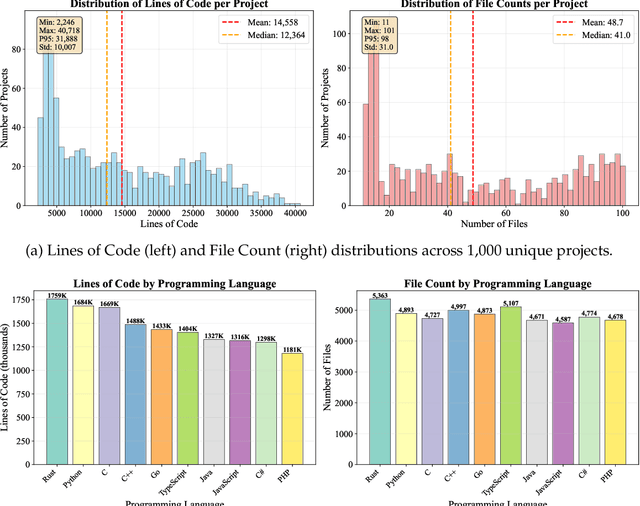
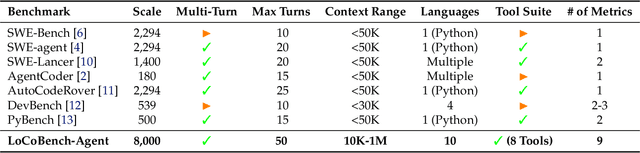
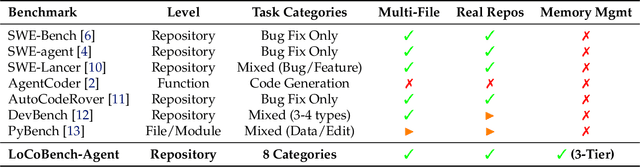
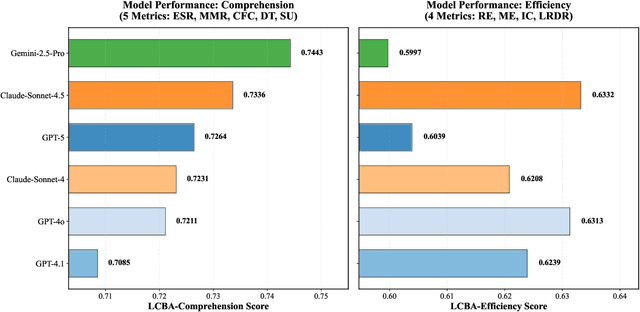
As large language models (LLMs) evolve into sophisticated autonomous agents capable of complex software development tasks, evaluating their real-world capabilities becomes critical. While existing benchmarks like LoCoBench~\cite{qiu2025locobench} assess long-context code understanding, they focus on single-turn evaluation and cannot capture the multi-turn interactive nature, tool usage patterns, and adaptive reasoning required by real-world coding agents. We introduce \textbf{LoCoBench-Agent}, a comprehensive evaluation framework specifically designed to assess LLM agents in realistic, long-context software engineering workflows. Our framework extends LoCoBench's 8,000 scenarios into interactive agent environments, enabling systematic evaluation of multi-turn conversations, tool usage efficiency, error recovery, and architectural consistency across extended development sessions. We also introduce an evaluation methodology with 9 metrics across comprehension and efficiency dimensions. Our framework provides agents with 8 specialized tools (file operations, search, code analysis) and evaluates them across context lengths ranging from 10K to 1M tokens, enabling precise assessment of long-context performance. Through systematic evaluation of state-of-the-art models, we reveal several key findings: (1) agents exhibit remarkable long-context robustness; (2) comprehension-efficiency trade-off exists with negative correlation, where thorough exploration increases comprehension but reduces efficiency; and (3) conversation efficiency varies dramatically across models, with strategic tool usage patterns differentiating high-performing agents. As the first long-context LLM agent benchmark for software engineering, LoCoBench-Agent establishes a rigorous foundation for measuring agent capabilities, identifying performance gaps, and advancing autonomous software development at scale.
GeoGNN: Quantifying and Mitigating Semantic Drift in Text-Attributed Graphs
Nov 12, 2025Graph neural networks (GNNs) on text--attributed graphs (TAGs) typically encode node texts using pretrained language models (PLMs) and propagate these embeddings through linear neighborhood aggregation. However, the representation spaces of modern PLMs are highly non--linear and geometrically structured, where textual embeddings reside on curved semantic manifolds rather than flat Euclidean spaces. Linear aggregation on such manifolds inevitably distorts geometry and causes semantic drift--a phenomenon where aggregated representations deviate from the intrinsic manifold, losing semantic fidelity and expressive power. To quantitatively investigate this problem, this work introduces a local PCA--based metric that measures the degree of semantic drift and provides the first quantitative framework to analyze how different aggregation mechanisms affect manifold structure. Building upon these insights, we propose Geodesic Aggregation, a manifold--aware mechanism that aggregates neighbor information along geodesics via log--exp mappings on the unit sphere, ensuring that representations remain faithful to the semantic manifold during message passing. We further develop GeoGNN, a practical instantiation that integrates spherical attention with manifold interpolation. Extensive experiments across four benchmark datasets and multiple text encoders show that GeoGNN substantially mitigates semantic drift and consistently outperforms strong baselines, establishing the importance of manifold--aware aggregation in text--attributed graph learning.
LoCoBench: A Benchmark for Long-Context Large Language Models in Complex Software Engineering
Sep 11, 2025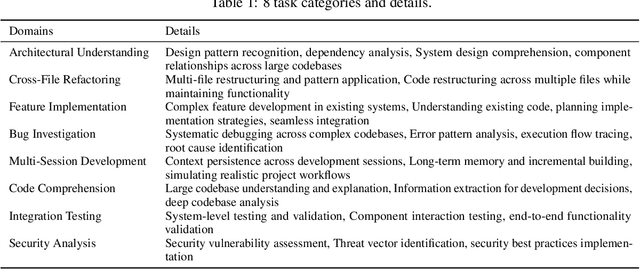
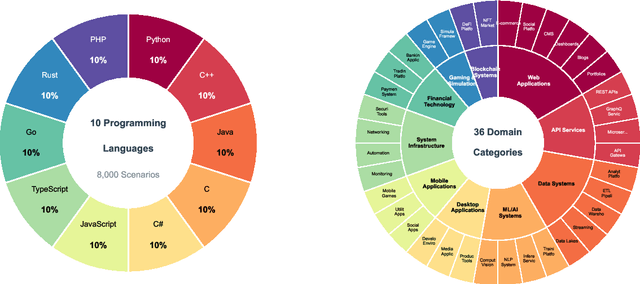
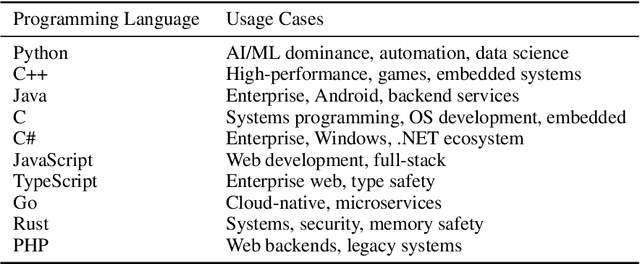
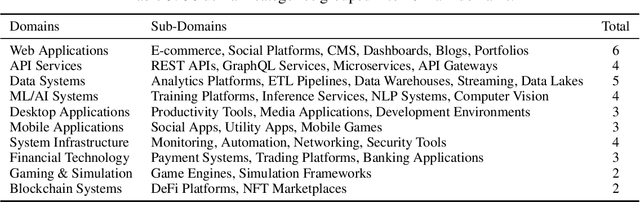
The emergence of long-context language models with context windows extending to millions of tokens has created new opportunities for sophisticated code understanding and software development evaluation. We propose LoCoBench, a comprehensive benchmark specifically designed to evaluate long-context LLMs in realistic, complex software development scenarios. Unlike existing code evaluation benchmarks that focus on single-function completion or short-context tasks, LoCoBench addresses the critical evaluation gap for long-context capabilities that require understanding entire codebases, reasoning across multiple files, and maintaining architectural consistency across large-scale software systems. Our benchmark provides 8,000 evaluation scenarios systematically generated across 10 programming languages, with context lengths spanning 10K to 1M tokens, a 100x variation that enables precise assessment of long-context performance degradation in realistic software development settings. LoCoBench introduces 8 task categories that capture essential long-context capabilities: architectural understanding, cross-file refactoring, multi-session development, bug investigation, feature implementation, code comprehension, integration testing, and security analysis. Through a 5-phase pipeline, we create diverse, high-quality scenarios that challenge LLMs to reason about complex codebases at unprecedented scale. We introduce a comprehensive evaluation framework with 17 metrics across 4 dimensions, including 8 new evaluation metrics, combined in a LoCoBench Score (LCBS). Our evaluation of state-of-the-art long-context models reveals substantial performance gaps, demonstrating that long-context understanding in complex software development represents a significant unsolved challenge that demands more attention. LoCoBench is released at: https://github.com/SalesforceAIResearch/LoCoBench.
UserBench: An Interactive Gym Environment for User-Centric Agents
Jul 29, 2025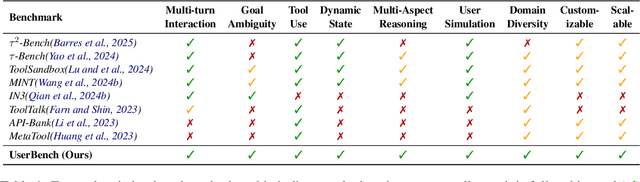
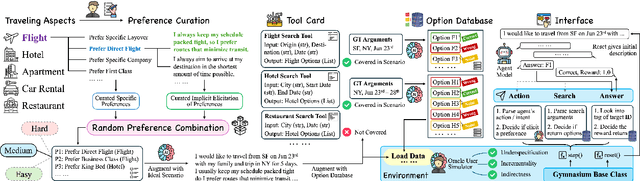

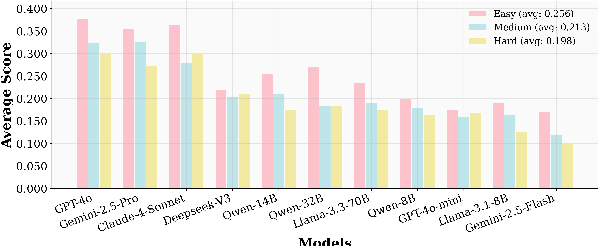
Large Language Models (LLMs)-based agents have made impressive progress in reasoning and tool use, enabling them to solve complex tasks. However, their ability to proactively collaborate with users, especially when goals are vague, evolving, or indirectly expressed, remains underexplored. To address this gap, we introduce UserBench, a user-centric benchmark designed to evaluate agents in multi-turn, preference-driven interactions. UserBench features simulated users who start with underspecified goals and reveal preferences incrementally, requiring agents to proactively clarify intent and make grounded decisions with tools. Our evaluation of leading open- and closed-source LLMs reveals a significant disconnect between task completion and user alignment. For instance, models provide answers that fully align with all user intents only 20% of the time on average, and even the most advanced models uncover fewer than 30% of all user preferences through active interaction. These results highlight the challenges of building agents that are not just capable task executors, but true collaborative partners. UserBench offers an interactive environment to measure and advance this critical capability.
APIGen-MT: Agentic Pipeline for Multi-Turn Data Generation via Simulated Agent-Human Interplay
Apr 08, 2025Training effective AI agents for multi-turn interactions requires high-quality data that captures realistic human-agent dynamics, yet such data is scarce and expensive to collect manually. We introduce APIGen-MT, a two-phase framework that generates verifiable and diverse multi-turn agent data. In the first phase, our agentic pipeline produces detailed task blueprints with ground-truth actions, leveraging a committee of LLM reviewers and iterative feedback loops. These blueprints are then transformed into complete interaction trajectories through simulated human-agent interplay. We train a family of models -- the xLAM-2-fc-r series with sizes ranging from 1B to 70B parameters. Our models outperform frontier models such as GPT-4o and Claude 3.5 on $\tau$-bench and BFCL benchmarks, with the smaller models surpassing their larger counterparts, particularly in multi-turn settings, while maintaining superior consistency across multiple trials. Comprehensive experiments demonstrate that our verified blueprint-to-details approach yields high-quality training data, enabling the development of more reliable, efficient, and capable agents. We open-source both the synthetic data collected and the trained xLAM-2-fc-r models to advance research in AI agents. Models are available on HuggingFace at https://huggingface.co/collections/Salesforce/xlam-2-67ef5be12949d8dcdae354c4 and project website is https://apigen-mt.github.io
ActionStudio: A Lightweight Framework for Data and Training of Large Action Models
Mar 31, 2025Action models are essential for enabling autonomous agents to perform complex tasks. However, training large action models remains challenging due to the diversity of agent environments and the complexity of agentic data. Despite growing interest, existing infrastructure provides limited support for scalable, agent-specific fine-tuning. We present ActionStudio, a lightweight and extensible data and training framework designed for large action models. ActionStudio unifies heterogeneous agent trajectories through a standardized format, supports diverse training paradigms including LoRA, full fine-tuning, and distributed setups, and integrates robust preprocessing and verification tools. We validate its effectiveness across both public and realistic industry benchmarks, demonstrating strong performance and practical scalability. We open-sourced code and data at https://github.com/SalesforceAIResearch/xLAM to facilitate research in the community.
PersonaBench: Evaluating AI Models on Understanding Personal Information through Accessing (Synthetic) Private User Data
Feb 28, 2025Personalization is critical in AI assistants, particularly in the context of private AI models that work with individual users. A key scenario in this domain involves enabling AI models to access and interpret a user's private data (e.g., conversation history, user-AI interactions, app usage) to understand personal details such as biographical information, preferences, and social connections. However, due to the sensitive nature of such data, there are no publicly available datasets that allow us to assess an AI model's ability to understand users through direct access to personal information. To address this gap, we introduce a synthetic data generation pipeline that creates diverse, realistic user profiles and private documents simulating human activities. Leveraging this synthetic data, we present PersonaBench, a benchmark designed to evaluate AI models' performance in understanding personal information derived from simulated private user data. We evaluate Retrieval-Augmented Generation (RAG) pipelines using questions directly related to a user's personal information, supported by the relevant private documents provided to the models. Our results reveal that current retrieval-augmented AI models struggle to answer private questions by extracting personal information from user documents, highlighting the need for improved methodologies to enhance personalization capabilities in AI.