 Add to Chrome
 Add to Firefox
 Add to Edge
IF-RewardBench: Benchmarking Judge Models for Instruction-Following Evaluation
Mar 05, 2026
Instruction-following is a foundational capability of large language models (LLMs), with its improvement hinging on scalable and accurate feedback from judge models. However, the reliability of current judge models in instruction-following remains underexplored due to several deficiencies of existing meta-evaluation benchmarks, such as their insufficient data coverage and oversimplified pairwise evaluation paradigms that misalign with model optimization scenarios. To this end, we propose IF-RewardBench, a comprehensive meta-evaluation benchmark for instruction-following that covers diverse instruction and constraint types. For each instruction, we construct a preference graph containing all pairwise preferences among multiple responses based on instruction-following quality. This design enables a listwise evaluation paradigm that assesses the capabilities of judge models to rank multiple responses, which is essential in guiding model alignment. Extensive experiments on IF-RewardBench reveal significant deficiencies in current judge models and demonstrate that our benchmark achieves a stronger positive correlation with downstream task performance compared to existing benchmarks. Our codes and data are available at https://github.com/thu-coai/IF-RewardBench.

RLAR: An Agentic Reward System for Multi-task Reinforcement Learning on Large Language Models
Feb 28, 2026Large language model alignment via reinforcement learning depends critically on reward function quality. However, static, domain-specific reward models are often costly to train and exhibit poor generalization in out-of-distribution scenarios encountered during RL iterations. We present RLAR (Reinforcement Learning from Agent Rewards), an agent-driven framework that dynamically assigns tailored reward functions to individual queries. Specifically, RLAR transforms reward acquisition into a dynamic tool synthesis and invocation task. It leverages LLM agents to autonomously retrieve optimal reward models from the Internet and synthesize programmatic verifiers through code generation. This allows the reward system to self-evolve with the shifting data distributions during training. Experimental results demonstrate that RLAR yields consistent performance gains ranging from 10 to 60 across mathematics, coding, translation, and dialogue tasks. On RewardBench-V2, RLAR significantly outperforms static baselines and approaches the performance upper bound, demonstrating superior generalization through dynamic reward orchestration. The data and code are available on this link: https://github.com/ZhuoerFeng/RLAR.
RAVEL: Reasoning Agents for Validating and Evaluating LLM Text Synthesis
Feb 28, 2026Large Language Models have evolved from single-round generators into long-horizon agents, capable of complex text synthesis scenarios. However, current evaluation frameworks lack the ability to assess the actual synthesis operations, such as outlining, drafting, and editing. Consequently, they fail to evaluate the actual and detailed capabilities of LLMs. To bridge this gap, we introduce RAVEL, an agentic framework that enables the LLM testers to autonomously plan and execute typical synthesis operations, including outlining, drafting, reviewing, and refining. Complementing this framework, we present C3EBench, a comprehensive benchmark comprising 1,258 samples derived from professional human writings. We utilize a "reverse-engineering" pipeline to isolate specific capabilities across four tasks: Cloze, Edit, Expand, and End-to-End. Through our analysis of 14 LLMs, we uncover that most LLMs struggle with tasks that demand contextual understanding under limited or under-specified instructions. By augmenting RAVEL with SOTA LLMs as operators, we find that such agentic text synthesis is dominated by the LLM's reasoning capability rather than raw generative capacity. Furthermore, we find that a strong reasoner can guide a weaker generator to yield higher-quality results, whereas the inverse does not hold. Our code and data are available at this link: https://github.com/ZhuoerFeng/RAVEL-Reasoning-Agents-Text-Eval.
TraceSIR: A Multi-Agent Framework for Structured Analysis and Reporting of Agentic Execution Traces
Feb 28, 2026Agentic systems augment large language models with external tools and iterative decision making, enabling complex tasks such as deep research, function calling, and coding. However, their long and intricate execution traces make failure diagnosis and root cause analysis extremely challenging. Manual inspection does not scale, while directly applying LLMs to raw traces is hindered by input length limits and unreliable reasoning. Focusing solely on final task outcomes further discards critical behavioral information required for accurate issue localization. To address these issues, we propose TraceSIR, a multi-agent framework for structured analysis and reporting of agentic execution traces. TraceSIR coordinates three specialized agents: (1) StructureAgent, which introduces a novel abstraction format, TraceFormat, to compress execution traces while preserving essential behavioral information; (2) InsightAgent, which performs fine-grained diagnosis including issue localization, root cause analysis, and optimization suggestions; (3) ReportAgent, which aggregates insights across task instances and generates comprehensive analysis reports. To evaluate TraceSIR, we construct TraceBench, covering three real-world agentic scenarios, and introduce ReportEval, an evaluation protocol for assessing the quality and usability of analysis reports aligned with industry needs. Experiments show that TraceSIR consistently produces coherent, informative, and actionable reports, significantly outperforming existing approaches across all evaluation dimensions. Our project and video are publicly available at https://github.com/SHU-XUN/TraceSIR.
GLM-5: from Vibe Coding to Agentic Engineering
Feb 17, 2026We present GLM-5, a next-generation foundation model designed to transition the paradigm of vibe coding to agentic engineering. Building upon the agentic, reasoning, and coding (ARC) capabilities of its predecessor, GLM-5 adopts DSA to significantly reduce training and inference costs while maintaining long-context fidelity. To advance model alignment and autonomy, we implement a new asynchronous reinforcement learning infrastructure that drastically improves post-training efficiency by decoupling generation from training. Furthermore, we propose novel asynchronous agent RL algorithms that further improve RL quality, enabling the model to learn from complex, long-horizon interactions more effectively. Through these innovations, GLM-5 achieves state-of-the-art performance on major open benchmarks. Most critically, GLM-5 demonstrates unprecedented capability in real-world coding tasks, surpassing previous baselines in handling end-to-end software engineering challenges. Code, models, and more information are available at https://github.com/zai-org/GLM-5.
RLMR: Reinforcement Learning with Mixed Rewards for Creative Writing
Aug 28, 2025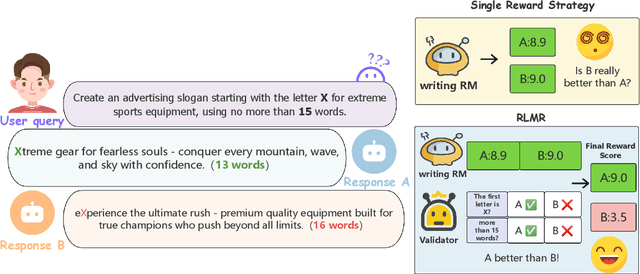
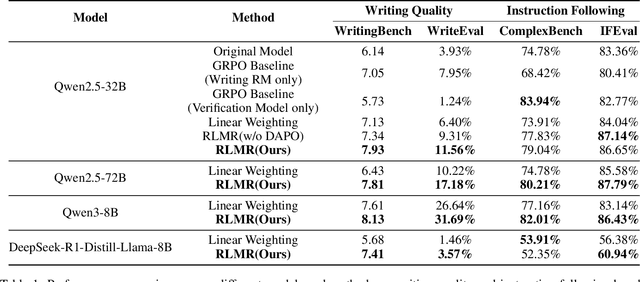
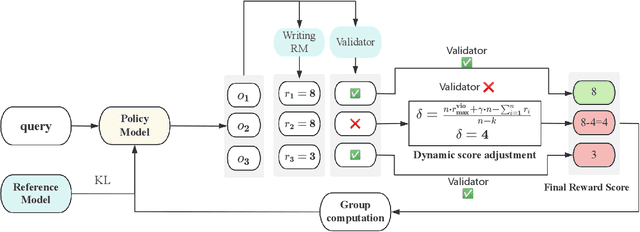
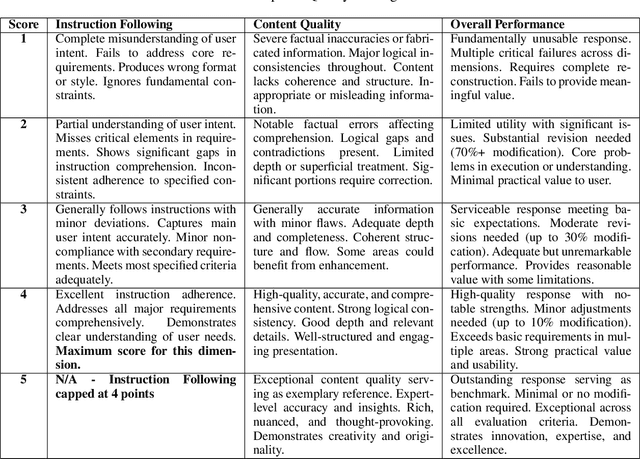
Large language models are extensively utilized in creative writing applications. Creative writing requires a balance between subjective writing quality (e.g., literariness and emotional expression) and objective constraint following (e.g., format requirements and word limits). Existing methods find it difficult to balance these two aspects: single reward strategies fail to improve both abilities simultaneously, while fixed-weight mixed-reward methods lack the ability to adapt to different writing scenarios. To address this problem, we propose Reinforcement Learning with Mixed Rewards (RLMR), utilizing a dynamically mixed reward system from a writing reward model evaluating subjective writing quality and a constraint verification model assessing objective constraint following. The constraint following reward weight is adjusted dynamically according to the writing quality within sampled groups, ensuring that samples violating constraints get negative advantage in GRPO and thus penalized during training, which is the key innovation of this proposed method. We conduct automated and manual evaluations across diverse model families from 8B to 72B parameters. Additionally, we construct a real-world writing benchmark named WriteEval for comprehensive evaluation. Results illustrate that our method achieves consistent improvements in both instruction following (IFEval from 83.36% to 86.65%) and writing quality (72.75% win rate in manual expert pairwise evaluations on WriteEval). To the best of our knowledge, RLMR is the first work to combine subjective preferences with objective verification in online RL training, providing an effective solution for multi-dimensional creative writing optimization.
GLM-4.5: Agentic, Reasoning, and Coding (ARC) Foundation Models
Aug 08, 2025We present GLM-4.5, an open-source Mixture-of-Experts (MoE) large language model with 355B total parameters and 32B activated parameters, featuring a hybrid reasoning method that supports both thinking and direct response modes. Through multi-stage training on 23T tokens and comprehensive post-training with expert model iteration and reinforcement learning, GLM-4.5 achieves strong performance across agentic, reasoning, and coding (ARC) tasks, scoring 70.1% on TAU-Bench, 91.0% on AIME 24, and 64.2% on SWE-bench Verified. With much fewer parameters than several competitors, GLM-4.5 ranks 3rd overall among all evaluated models and 2nd on agentic benchmarks. We release both GLM-4.5 (355B parameters) and a compact version, GLM-4.5-Air (106B parameters), to advance research in reasoning and agentic AI systems. Code, models, and more information are available at https://github.com/zai-org/GLM-4.5.
HPSS: Heuristic Prompting Strategy Search for LLM Evaluators
Feb 18, 2025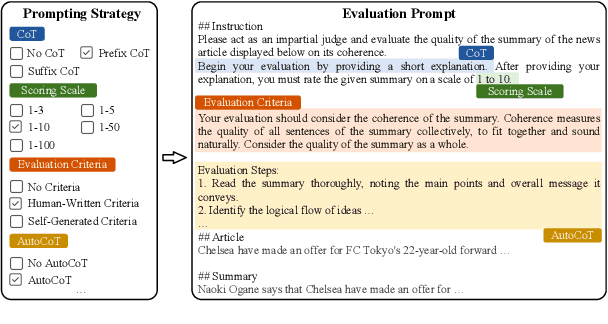
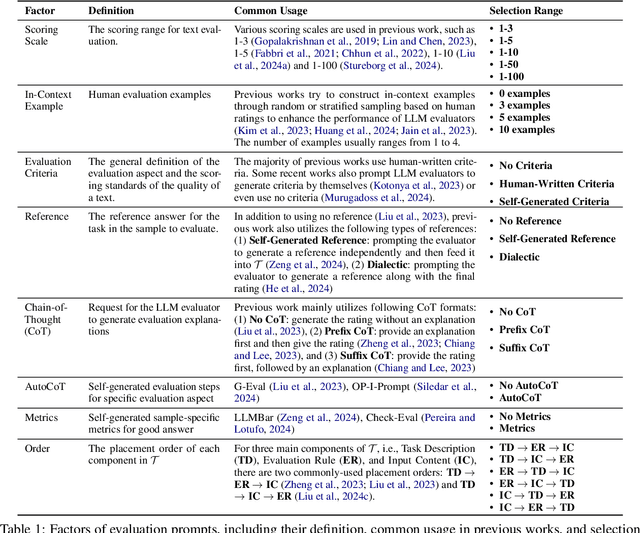
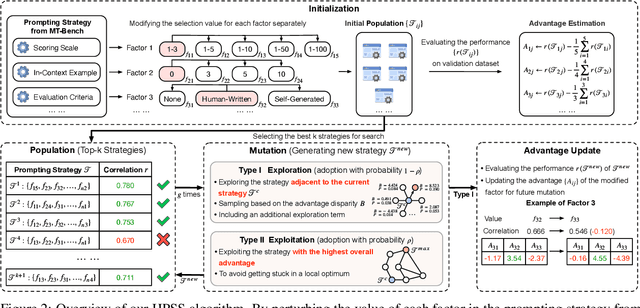
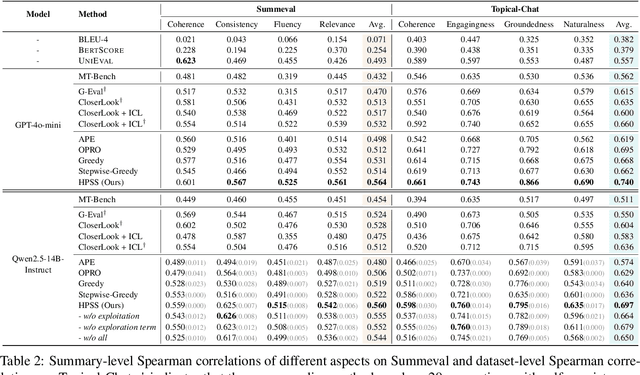
Since the adoption of large language models (LLMs) for text evaluation has become increasingly prevalent in the field of natural language processing (NLP), a series of existing works attempt to optimize the prompts for LLM evaluators to improve their alignment with human judgment. However, their efforts are limited to optimizing individual factors of evaluation prompts, such as evaluation criteria or output formats, neglecting the combinatorial impact of multiple factors, which leads to insufficient optimization of the evaluation pipeline. Nevertheless, identifying well-behaved prompting strategies for adjusting multiple factors requires extensive enumeration. To this end, we comprehensively integrate 8 key factors for evaluation prompts and propose a novel automatic prompting strategy optimization method called Heuristic Prompting Strategy Search (HPSS). Inspired by the genetic algorithm, HPSS conducts an iterative search to find well-behaved prompting strategies for LLM evaluators. A heuristic function is employed to guide the search process, enhancing the performance of our algorithm. Extensive experiments across four evaluation tasks demonstrate the effectiveness of HPSS, consistently outperforming both human-designed evaluation prompts and existing automatic prompt optimization methods.
CharacterBench: Benchmarking Character Customization of Large Language Models
Dec 16, 2024

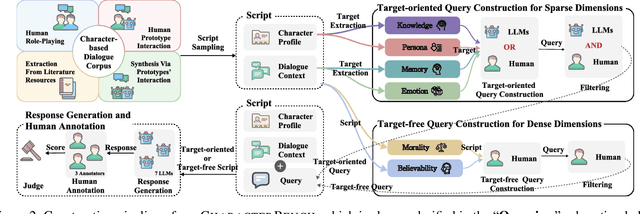

Character-based dialogue (aka role-playing) enables users to freely customize characters for interaction, which often relies on LLMs, raising the need to evaluate LLMs' character customization capability. However, existing benchmarks fail to ensure a robust evaluation as they often only involve a single character category or evaluate limited dimensions. Moreover, the sparsity of character features in responses makes feature-focused generative evaluation both ineffective and inefficient. To address these issues, we propose CharacterBench, the largest bilingual generative benchmark, with 22,859 human-annotated samples covering 3,956 characters from 25 detailed character categories. We define 11 dimensions of 6 aspects, classified as sparse and dense dimensions based on whether character features evaluated by specific dimensions manifest in each response. We enable effective and efficient evaluation by crafting tailored queries for each dimension to induce characters' responses related to specific dimensions. Further, we develop CharacterJudge model for cost-effective and stable evaluations. Experiments show its superiority over SOTA automatic judges (e.g., GPT-4) and our benchmark's potential to optimize LLMs' character customization. Our repository is at https://github.com/thu-coai/CharacterBench.
Benchmarking Complex Instruction-Following with Multiple Constraints Composition
Jul 04, 2024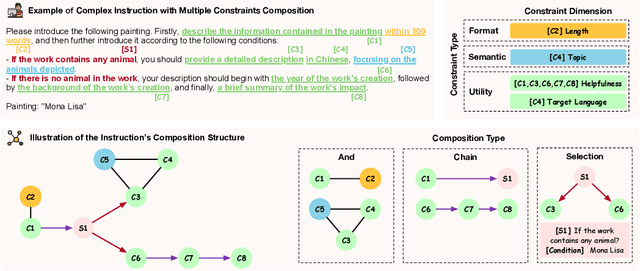
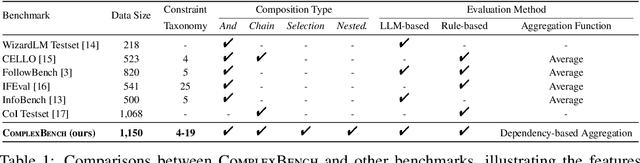
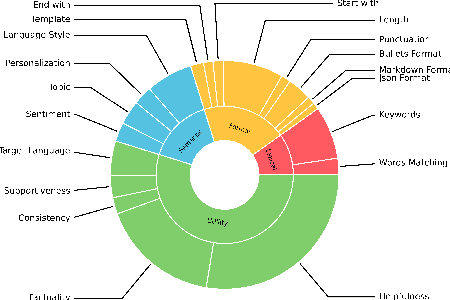
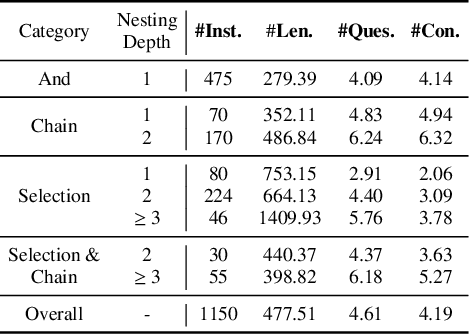
Instruction following is one of the fundamental capabilities of large language models (LLMs). As the ability of LLMs is constantly improving, they have been increasingly applied to deal with complex human instructions in real-world scenarios. Therefore, how to evaluate the ability of complex instruction-following of LLMs has become a critical research problem. Existing benchmarks mainly focus on modeling different types of constraints in human instructions while neglecting the composition of different constraints, which is an indispensable constituent in complex instructions. To this end, we propose ComplexBench, a benchmark for comprehensively evaluating the ability of LLMs to follow complex instructions composed of multiple constraints. We propose a hierarchical taxonomy for complex instructions, including 4 constraint types, 19 constraint dimensions, and 4 composition types, and manually collect a high-quality dataset accordingly. To make the evaluation reliable, we augment LLM-based evaluators with rules to effectively verify whether generated texts can satisfy each constraint and composition. Furthermore, we obtain the final evaluation score based on the dependency structure determined by different composition types. ComplexBench identifies significant deficiencies in existing LLMs when dealing with complex instructions with multiple constraints composition.