 Add to Chrome
 Add to Firefox
 Add to Edge
Debiasing Watermarks for Large Language Models via Maximal Coupling
Nov 17, 2024
Watermarking language models is essential for distinguishing between human and machine-generated text and thus maintaining the integrity and trustworthiness of digital communication. We present a novel green/red list watermarking approach that partitions the token set into ``green'' and ``red'' lists, subtly increasing the generation probability for green tokens. To correct token distribution bias, our method employs maximal coupling, using a uniform coin flip to decide whether to apply bias correction, with the result embedded as a pseudorandom watermark signal. Theoretical analysis confirms this approach's unbiased nature and robust detection capabilities. Experimental results show that it outperforms prior techniques by preserving text quality while maintaining high detectability, and it demonstrates resilience to targeted modifications aimed at improving text quality. This research provides a promising watermarking solution for language models, balancing effective detection with minimal impact on text quality.

GeoGround: A Unified Large Vision-Language Model. for Remote Sensing Visual Grounding
Nov 16, 2024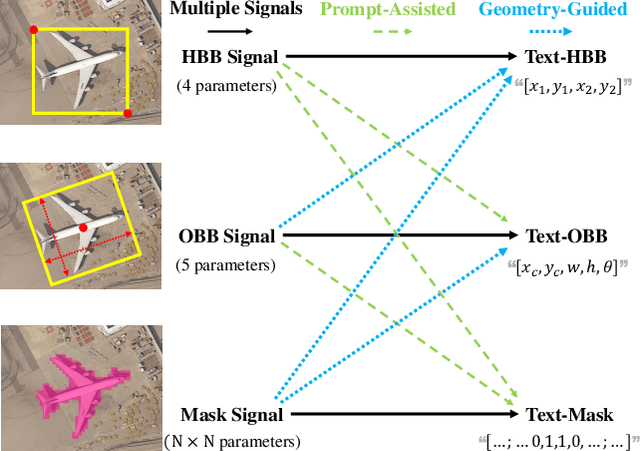
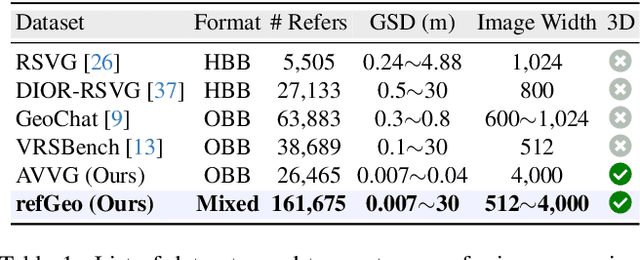
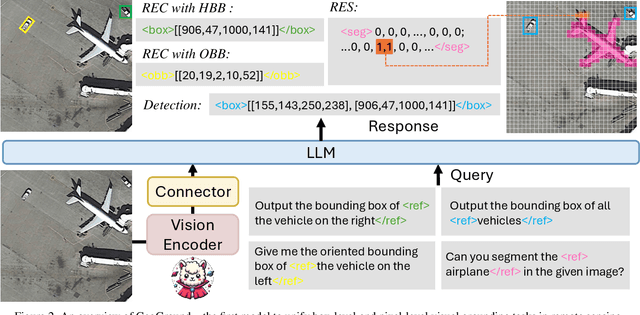
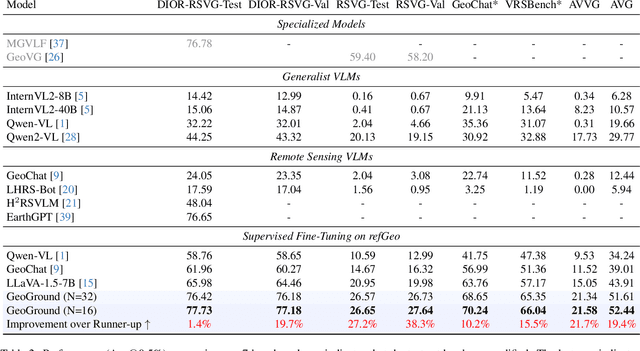
Remote sensing (RS) visual grounding aims to use natural language expression to locate specific objects (in the form of the bounding box or segmentation mask) in RS images, enhancing human interaction with intelligent RS interpretation systems. Early research in this area was primarily based on horizontal bounding boxes (HBBs), but as more diverse RS datasets have become available, tasks involving oriented bounding boxes (OBBs) and segmentation masks have emerged. In practical applications, different targets require different grounding types: HBB can localize an object's position, OBB provides its orientation, and mask depicts its shape. However, existing specialized methods are typically tailored to a single type of RS visual grounding task and are hard to generalize across tasks. In contrast, large vision-language models (VLMs) exhibit powerful multi-task learning capabilities but struggle to handle dense prediction tasks like segmentation. This paper proposes GeoGround, a novel framework that unifies support for HBB, OBB, and mask RS visual grounding tasks, allowing flexible output selection. Rather than customizing the architecture of VLM, our work aims to elegantly support pixel-level visual grounding output through the Text-Mask technique. We define prompt-assisted and geometry-guided learning to enhance consistency across different signals. To support model training, we present refGeo, a large-scale RS visual instruction-following dataset containing 161k image-text pairs. Experimental results show that GeoGround demonstrates strong performance across four RS visual grounding tasks, matching or surpassing the performance of specialized methods on multiple benchmarks. Code available at https://github.com/zytx121/GeoGround
Towards Next-Generation Medical Agent: How o1 is Reshaping Decision-Making in Medical Scenarios
Nov 16, 2024

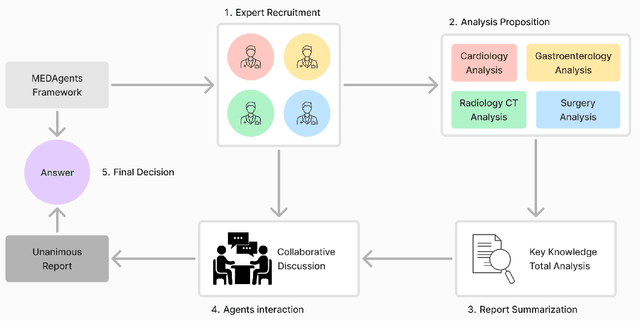

Artificial Intelligence (AI) has become essential in modern healthcare, with large language models (LLMs) offering promising advances in clinical decision-making. Traditional model-based approaches, including those leveraging in-context demonstrations and those with specialized medical fine-tuning, have demonstrated strong performance in medical language processing but struggle with real-time adaptability, multi-step reasoning, and handling complex medical tasks. Agent-based AI systems address these limitations by incorporating reasoning traces, tool selection based on context, knowledge retrieval, and both short- and long-term memory. These additional features enable the medical AI agent to handle complex medical scenarios where decision-making should be built on real-time interaction with the environment. Therefore, unlike conventional model-based approaches that treat medical queries as isolated questions, medical AI agents approach them as complex tasks and behave more like human doctors. In this paper, we study the choice of the backbone LLM for medical AI agents, which is the foundation for the agent's overall reasoning and action generation. In particular, we consider the emergent o1 model and examine its impact on agents' reasoning, tool-use adaptability, and real-time information retrieval across diverse clinical scenarios, including high-stakes settings such as intensive care units (ICUs). Our findings demonstrate o1's ability to enhance diagnostic accuracy and consistency, paving the way for smarter, more responsive AI tools that support better patient outcomes and decision-making efficacy in clinical practice.
HELENE: Hessian Layer-wise Clipping and Gradient Annealing for Accelerating Fine-tuning LLM with Zeroth-order Optimization
Nov 16, 2024


Fine-tuning large language models (LLMs) poses significant memory challenges, as the back-propagation process demands extensive resources, especially with growing model sizes. Recent work, MeZO, addresses this issue using a zeroth-order (ZO) optimization method, which reduces memory consumption by matching the usage to the inference phase. However, MeZO experiences slow convergence due to varying curvatures across model parameters. To overcome this limitation, we introduce HELENE, a novel scalable and memory-efficient optimizer that integrates annealed A-GNB gradients with a diagonal Hessian estimation and layer-wise clipping, serving as a second-order pre-conditioner. This combination allows for faster and more stable convergence. Our theoretical analysis demonstrates that HELENE improves convergence rates, particularly for models with heterogeneous layer dimensions, by reducing the dependency on the total parameter space dimension. Instead, the method scales with the largest layer dimension, making it highly suitable for modern LLM architectures. Experimental results on RoBERTa-large and OPT-1.3B across multiple tasks show that HELENE achieves up to a 20x speedup compared to MeZO, with average accuracy improvements of 1.5%. Furthermore, HELENE remains compatible with both full parameter tuning and parameter-efficient fine-tuning (PEFT), outperforming several state-of-the-art optimizers. The codes will be released after reviewing.
Rethinking Structure Learning For Graph Neural Networks
Nov 12, 2024

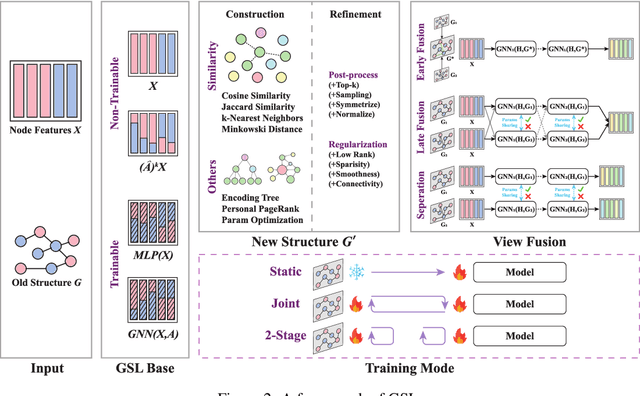
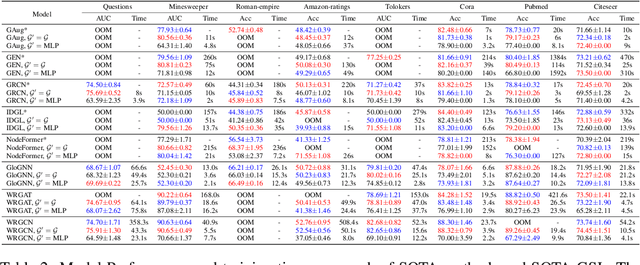
To improve the performance of Graph Neural Networks (GNNs), Graph Structure Learning (GSL) has been extensively applied to reconstruct or refine original graph structures, effectively addressing issues like heterophily, over-squashing, and noisy structures. While GSL is generally thought to improve GNN performance, it often leads to longer training times and more hyperparameter tuning. Besides, the distinctions among current GSL methods remain ambiguous from the perspective of GNN training, and there is a lack of theoretical analysis to quantify their effectiveness. Recent studies further suggest that, under fair comparisons with the same hyperparameter tuning, GSL does not consistently outperform baseline GNNs. This motivates us to ask a critical question: is GSL really useful for GNNs? To address this question, this paper makes two key contributions. First, we propose a new GSL framework, which includes three steps: GSL base (the representation used for GSL) construction, new structure construction, and view fusion, to better understand the effectiveness of GSL in GNNs. Second, after graph convolution, we analyze the differences in mutual information (MI) between node representations derived from the original topology and those from the newly constructed topology. Surprisingly, our empirical observations and theoretical analysis show that no matter which type of graph structure construction methods are used, after feeding the same GSL bases to the newly constructed graph, there is no MI gain compared to the original GSL bases. To fairly reassess the effectiveness of GSL, we conduct ablation experiments and find that it is the pretrained GSL bases that enhance GNN performance, and in most cases, GSL cannot improve GNN performance. This finding encourages us to rethink the essential components in GNNs, such as self-training and structural encoding, in GNN design rather than GSL.
Is Graph Convolution Always Beneficial For Every Feature?
Nov 12, 2024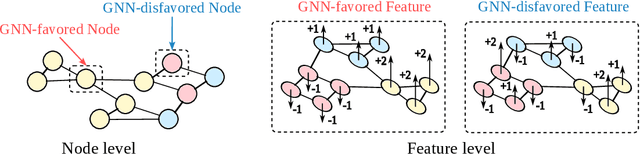
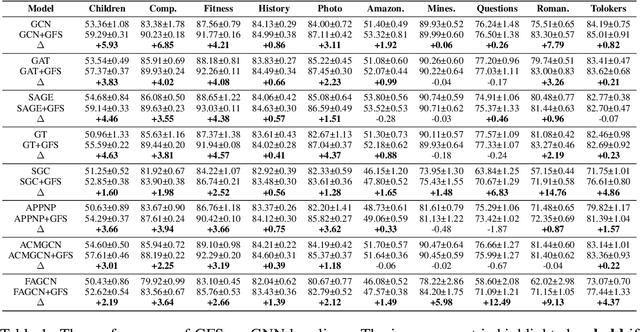
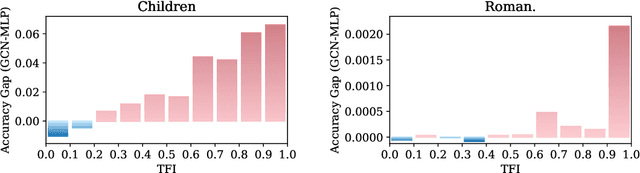
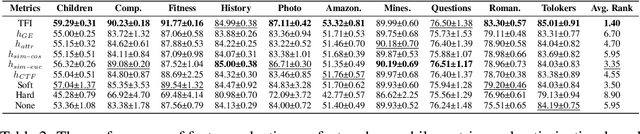
Graph Neural Networks (GNNs) have demonstrated strong capabilities in processing structured data. While traditional GNNs typically treat each feature dimension equally during graph convolution, we raise an important question: Is the graph convolution operation equally beneficial for each feature? If not, the convolution operation on certain feature dimensions can possibly lead to harmful effects, even worse than the convolution-free models. In prior studies, to assess the impacts of graph convolution on features, people proposed metrics based on feature homophily to measure feature consistency with the graph topology. However, these metrics have shown unsatisfactory alignment with GNN performance and have not been effectively employed to guide feature selection in GNNs. To address these limitations, we introduce a novel metric, Topological Feature Informativeness (TFI), to distinguish between GNN-favored and GNN-disfavored features, where its effectiveness is validated through both theoretical analysis and empirical observations. Based on TFI, we propose a simple yet effective Graph Feature Selection (GFS) method, which processes GNN-favored and GNN-disfavored features separately, using GNNs and non-GNN models. Compared to original GNNs, GFS significantly improves the extraction of useful topological information from each feature with comparable computational costs. Extensive experiments show that after applying GFS to 8 baseline and state-of-the-art (SOTA) GNN architectures across 10 datasets, 83.75% of the GFS-augmented cases show significant performance boosts. Furthermore, our proposed TFI metric outperforms other feature selection methods. These results validate the effectiveness of both GFS and TFI. Additionally, we demonstrate that GFS's improvements are robust to hyperparameter tuning, highlighting its potential as a universal method for enhancing various GNN architectures.
PhoneLM:an Efficient and Capable Small Language Model Family through Principled Pre-training
Nov 07, 2024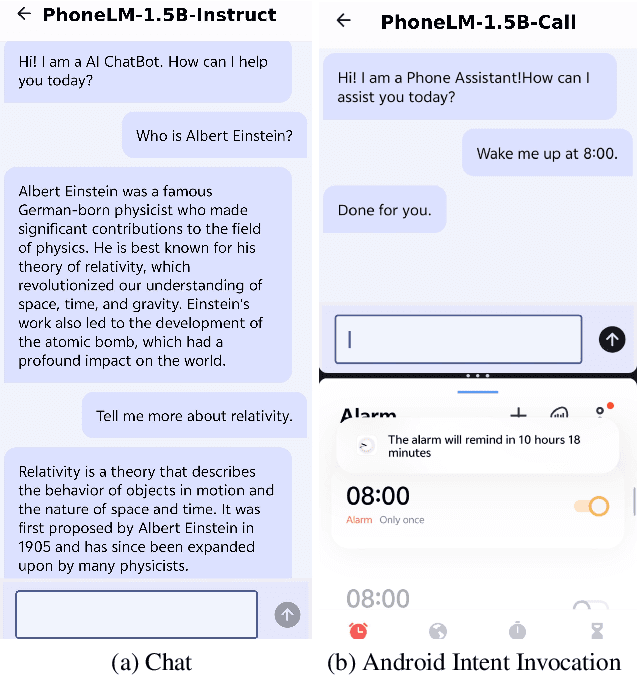


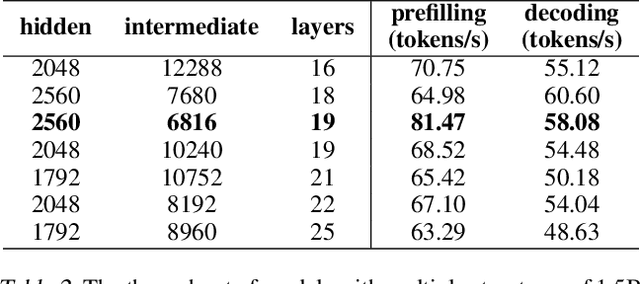
The interest in developing small language models (SLM) for on-device deployment is fast growing. However, the existing SLM design hardly considers the device hardware characteristics. Instead, this work presents a simple yet effective principle for SLM design: architecture searching for (near-)optimal runtime efficiency before pre-training. Guided by this principle, we develop PhoneLM SLM family (currently with 0.5B and 1.5B versions), that acheive the state-of-the-art capability-efficiency tradeoff among those with similar parameter size. We fully open-source the code, weights, and training datasets of PhoneLM for reproducibility and transparency, including both base and instructed versions. We also release a finetuned version of PhoneLM capable of accurate Android Intent invocation, and an end-to-end Android demo. All materials are available at https://github.com/UbiquitousLearning/PhoneLM.
TransUNext: towards a more advanced U-shaped framework for automatic vessel segmentation in the fundus image
Nov 05, 2024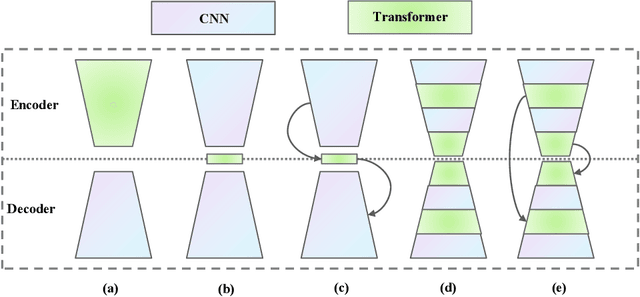


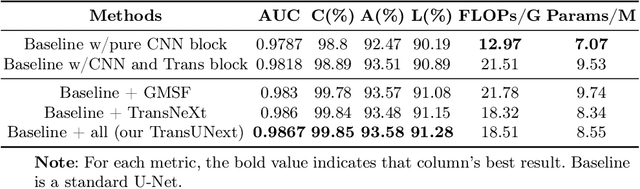
Purpose: Automatic and accurate segmentation of fundus vessel images has become an essential prerequisite for computer-aided diagnosis of ophthalmic diseases such as diabetes mellitus. The task of high-precision retinal vessel segmentation still faces difficulties due to the low contrast between the branch ends of retinal vessels and the background, the long and thin vessel span, and the variable morphology of the optic disc and optic cup in fundus vessel images. Methods: We propose a more advanced U-shaped architecture for a hybrid Transformer and CNN: TransUNext, which integrates an Efficient Self-attention Mechanism into the encoder and decoder of U-Net to capture both local features and global dependencies with minimal computational overhead. Meanwhile, the Global Multi-Scale Fusion (GMSF) module is further introduced to upgrade skip-connections, fuse high-level semantic and low-level detailed information, and eliminate high- and low-level semantic differences. Inspired by ConvNeXt, TransNeXt Block is designed to optimize the computational complexity of each base block in U-Net and avoid the information loss caused by the compressed dimension when the information is converted between the feature spaces of different dimensions. Results: We evaluated the proposed method on four public datasets DRIVE, STARE, CHASE-DB1, and HRF. In the experimental results, the AUC (area under the ROC curve) values were 0.9867, 0.9869, 0.9910, and 0.9887, which exceeded the other state-of-the-art.
Hunyuan-Large: An Open-Source MoE Model with 52 Billion Activated Parameters by Tencent
Nov 05, 2024


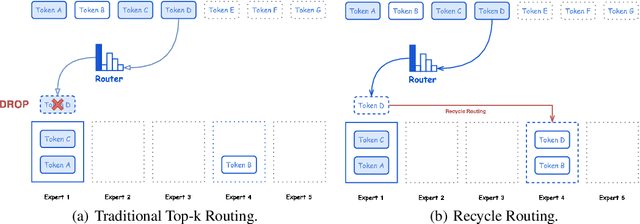
In this paper, we introduce Hunyuan-Large, which is currently the largest open-source Transformer-based mixture of experts model, with a total of 389 billion parameters and 52 billion activation parameters, capable of handling up to 256K tokens. We conduct a thorough evaluation of Hunyuan-Large's superior performance across various benchmarks including language understanding and generation, logical reasoning, mathematical problem-solving, coding, long-context, and aggregated tasks, where it outperforms LLama3.1-70B and exhibits comparable performance when compared to the significantly larger LLama3.1-405B model. Key practice of Hunyuan-Large include large-scale synthetic data that is orders larger than in previous literature, a mixed expert routing strategy, a key-value cache compression technique, and an expert-specific learning rate strategy. Additionally, we also investigate the scaling laws and learning rate schedule of mixture of experts models, providing valuable insights and guidances for future model development and optimization. The code and checkpoints of Hunyuan-Large are released to facilitate future innovations and applications. Codes: https://github.com/Tencent/Hunyuan-Large Models: https://huggingface.co/tencent/Tencent-Hunyuan-Large
TableGPT2: A Large Multimodal Model with Tabular Data Integration
Nov 04, 2024The emergence of models like GPTs, Claude, LLaMA, and Qwen has reshaped AI applications, presenting vast new opportunities across industries. Yet, the integration of tabular data remains notably underdeveloped, despite its foundational role in numerous real-world domains. This gap is critical for three main reasons. First, database or data warehouse data integration is essential for advanced applications; second, the vast and largely untapped resource of tabular data offers immense potential for analysis; and third, the business intelligence domain specifically demands adaptable, precise solutions that many current LLMs may struggle to provide. In response, we introduce TableGPT2, a model rigorously pre-trained and fine-tuned with over 593.8K tables and 2.36M high-quality query-table-output tuples, a scale of table-related data unprecedented in prior research. This extensive training enables TableGPT2 to excel in table-centric tasks while maintaining strong general language and coding abilities. One of TableGPT2's key innovations is its novel table encoder, specifically designed to capture schema-level and cell-level information. This encoder strengthens the model's ability to handle ambiguous queries, missing column names, and irregular tables commonly encountered in real-world applications. Similar to visual language models, this pioneering approach integrates with the decoder to form a robust large multimodal model. We believe the results are compelling: over 23 benchmarking metrics, TableGPT2 achieves an average performance improvement of 35.20% in the 7B model and 49.32% in the 72B model over prior benchmark-neutral LLMs, with robust general-purpose capabilities intact.