 Add to Chrome
 Add to Firefox
 Add to Edge
Fictional Worldbuilding: Multi-Agent LLM Collaboration with Hierarchical Context Compression and Iterative Review
Jul 10, 2026
Worldbuilding, the construction of coherent fictional worlds, is a foundational task in game design and literary creation. Large Language Models (LLMs) offer new possibilities for automated content generation, but their application to worldbuilding faces three challenges: context explosion that grows linearly with the building process, the tension between creative diversity and content consistency, and the absence of automated quality assurance. This paper presents AutoWorldBuilder, a multi-agent collaborative system that addresses these challenges through five integrated components: a structured concept network with conflict detection; a DAG-based hybrid batch scheduler that groups tasks by semantic locality; a four-layer context compression mechanism achieving approximately 90% token reduction; an iterative review system with specialized Auditor agents that improves proposal pass rates from 42% to over 85%; and a skill-driven agent architecture supporting zero-code extension with differentiated temperature configuration. Two experiments across 20 diverse worldbuilding tasks, using GPT-OSS 120B and DeepSeek v3.2 as LLM backends, demonstrate a 95.0% success rate. The system generated 56-103 self-consistent concepts per world in 18-31 minutes with zero-conflict delivery. The architectural patterns validated here, including layer-as-budget compression, semantic-locality scheduling, and separation of generation and review, transfer to the broader class of knowledge-intensive, multi-agent LLM applications.

PhoneLM:an Efficient and Capable Small Language Model Family through Principled Pre-training
Nov 07, 2024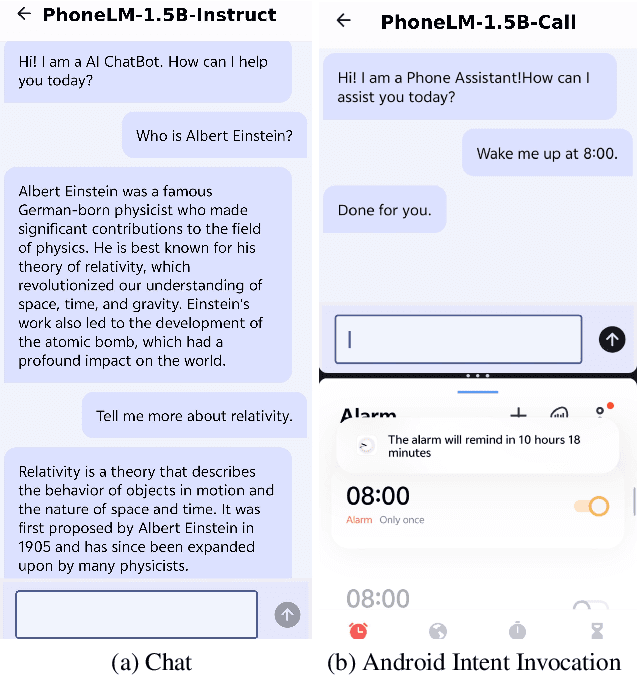


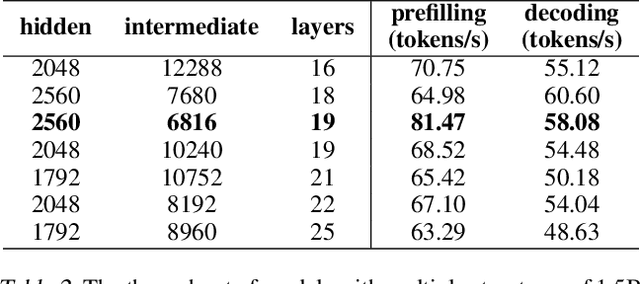
The interest in developing small language models (SLM) for on-device deployment is fast growing. However, the existing SLM design hardly considers the device hardware characteristics. Instead, this work presents a simple yet effective principle for SLM design: architecture searching for (near-)optimal runtime efficiency before pre-training. Guided by this principle, we develop PhoneLM SLM family (currently with 0.5B and 1.5B versions), that acheive the state-of-the-art capability-efficiency tradeoff among those with similar parameter size. We fully open-source the code, weights, and training datasets of PhoneLM for reproducibility and transparency, including both base and instructed versions. We also release a finetuned version of PhoneLM capable of accurate Android Intent invocation, and an end-to-end Android demo. All materials are available at https://github.com/UbiquitousLearning/PhoneLM.
Small Language Models: Survey, Measurements, and Insights
Sep 24, 2024


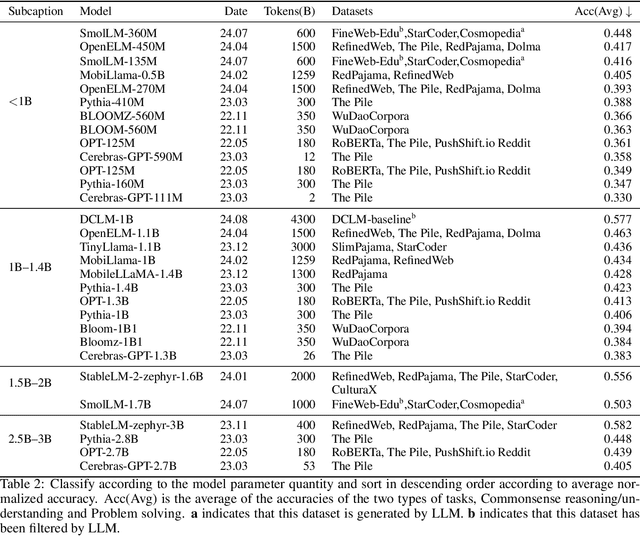
Small language models (SLMs), despite their widespread adoption in modern smart devices, have received significantly less academic attention compared to their large language model (LLM) counterparts, which are predominantly deployed in data centers and cloud environments. While researchers continue to improve the capabilities of LLMs in the pursuit of artificial general intelligence, SLM research aims to make machine intelligence more accessible, affordable, and efficient for everyday tasks. Focusing on transformer-based, decoder-only language models with 100M-5B parameters, we survey 59 state-of-the-art open-source SLMs, analyzing their technical innovations across three axes: architectures, training datasets, and training algorithms. In addition, we evaluate their capabilities in various domains, including commonsense reasoning, in-context learning, mathematics, and coding. To gain further insight into their on-device runtime costs, we benchmark their inference latency and memory footprints. Through in-depth analysis of our benchmarking data, we offer valuable insights to advance research in this field.
A Survey of Resource-efficient LLM and Multimodal Foundation Models
Jan 16, 2024

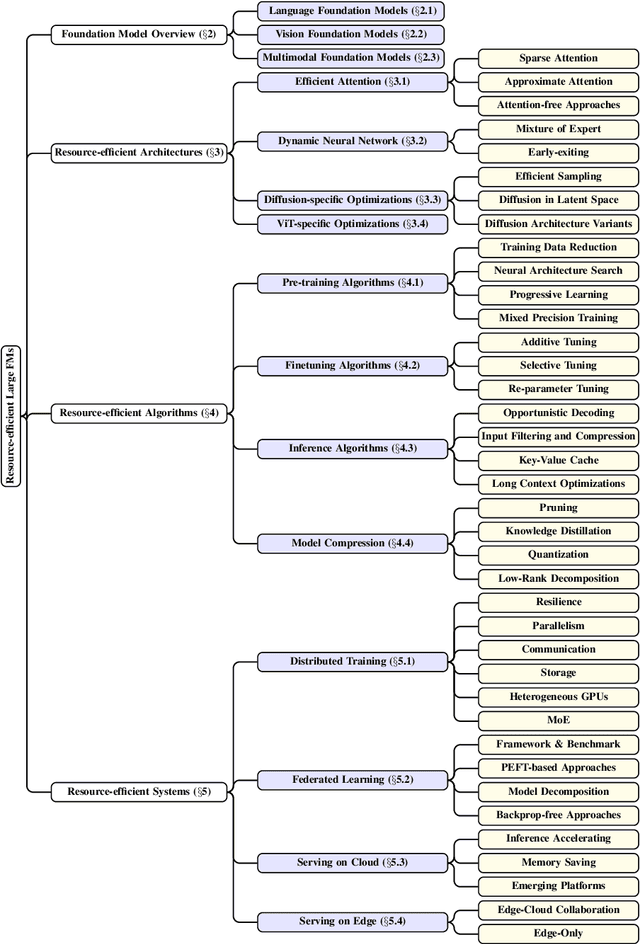

Large foundation models, including large language models (LLMs), vision transformers (ViTs), diffusion, and LLM-based multimodal models, are revolutionizing the entire machine learning lifecycle, from training to deployment. However, the substantial advancements in versatility and performance these models offer come at a significant cost in terms of hardware resources. To support the growth of these large models in a scalable and environmentally sustainable way, there has been a considerable focus on developing resource-efficient strategies. This survey delves into the critical importance of such research, examining both algorithmic and systemic aspects. It offers a comprehensive analysis and valuable insights gleaned from existing literature, encompassing a broad array of topics from cutting-edge model architectures and training/serving algorithms to practical system designs and implementations. The goal of this survey is to provide an overarching understanding of how current approaches are tackling the resource challenges posed by large foundation models and to potentially inspire future breakthroughs in this field.