 Add to Chrome
 Add to Firefox
 Add to Edge
PhyAI: Real-Time Physical AI at the Edge, Scalable Rollouts in the Cloud
Aug 05, 2026
Physical AI policies require inference throughout their lifecycle, including model evaluation, cloud reinforcement learning rollout, edge GPU serving, and onboard deployment. Although these settings share the same checkpoint and action semantics, they often rely on separate inference programs. To unify them, we build PhyAI, a Physical AI inference engine with a single runtime that keeps architecture-specific conditioning, solver, cache, and output logic in model adapters while sharing graph execution, kernels, memory management, and parallel services. The same codebase runs vision-language-action (VLA) models and world-action models (WAMs) on single or multiple GPUs across onboard, edge, and cloud deployments. We used the adapter interface to add MiniCPM-Robot on the day of its release. PhyAI achieves 1.40x-4.65x speedups over the official implementations of pi0, pi0.5, GR00T N1.7, and MiniCPM-Robot. On Cosmos3-Nano-Policy-DROID it reduces latency from 2.46 to 1.18 s on eight H20 GPUs (CFG=2, TP=4), a 2.08x speedup. Specialized runtimes remain faster in several configurations, so our goal is one runtime with competitive latency rather than the fastest result in every case. Detailed profiles reveal why different models need different execution policies: on a Hopper-series GPU at batch size one, the pi0.5 action expert accounts for 8.8% of FLOPs but 57.2% of latency; at batch size 32 its share drops to 13.5% and throughput reaches about 100 samples/s. Cosmos3 remains generation-dominated and gains only 14.3% throughput as batch size increases from 1 to 16. We further introduce the control-time Roofline, which distinguishes inference-bound from environment-bound control; the measured pi0.5 points on four LIBERO suites are environment-bound while Cosmos3 stays inference-bound. Code and benchmarks: https://github.com/mingti-org/phyai.

DroidCall: A Dataset for LLM-powered Android Intent Invocation
Nov 30, 2024
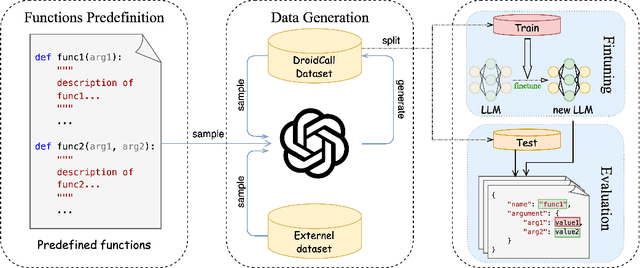
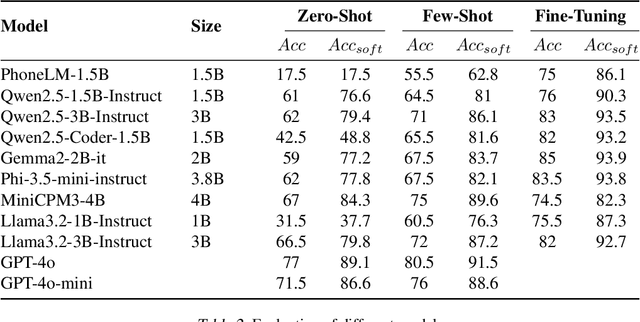
The growing capabilities of large language models in natural language understanding significantly strengthen existing agentic systems. To power performant on-device mobile agents for better data privacy, we introduce DroidCall, the first training and testing dataset for accurate Android intent invocation. With a highly flexible and reusable data generation pipeline, we constructed 10k samples in DroidCall. Given a task instruction in natural language, small language models such as Qwen2.5-3B and Gemma2-2B fine-tuned with DroidCall can approach or even surpass the capabilities of GPT-4o for accurate Android intent invocation. We also provide an end-to-end Android app equipped with these fine-tuned models to demonstrate the Android intent invocation process. The code and dataset are available at https://github.com/UbiquitousLearning/DroidCall.
PhoneLM:an Efficient and Capable Small Language Model Family through Principled Pre-training
Nov 07, 2024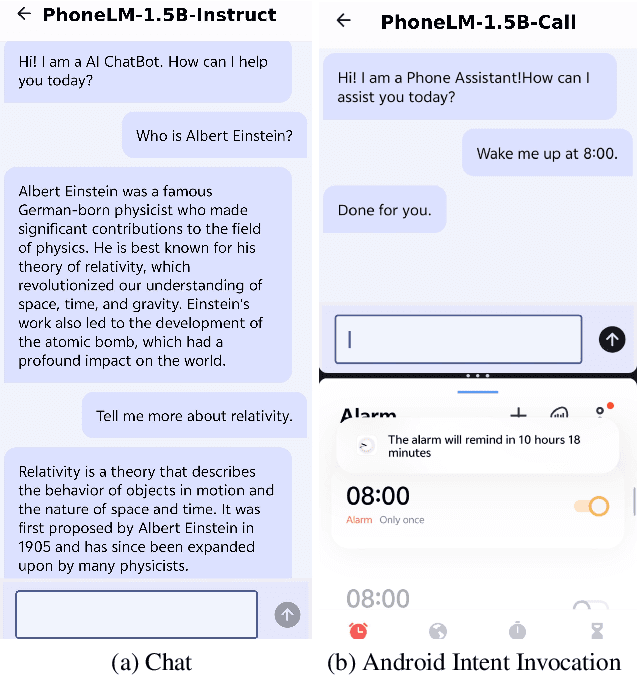


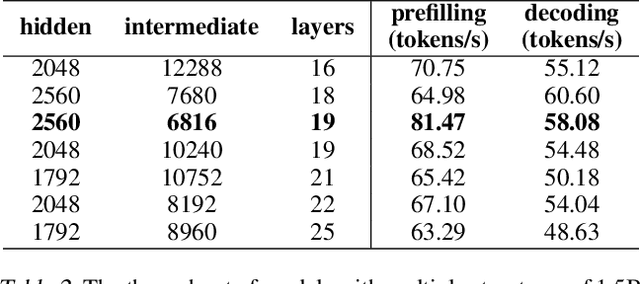
The interest in developing small language models (SLM) for on-device deployment is fast growing. However, the existing SLM design hardly considers the device hardware characteristics. Instead, this work presents a simple yet effective principle for SLM design: architecture searching for (near-)optimal runtime efficiency before pre-training. Guided by this principle, we develop PhoneLM SLM family (currently with 0.5B and 1.5B versions), that acheive the state-of-the-art capability-efficiency tradeoff among those with similar parameter size. We fully open-source the code, weights, and training datasets of PhoneLM for reproducibility and transparency, including both base and instructed versions. We also release a finetuned version of PhoneLM capable of accurate Android Intent invocation, and an end-to-end Android demo. All materials are available at https://github.com/UbiquitousLearning/PhoneLM.
Small Language Models: Survey, Measurements, and Insights
Sep 24, 2024


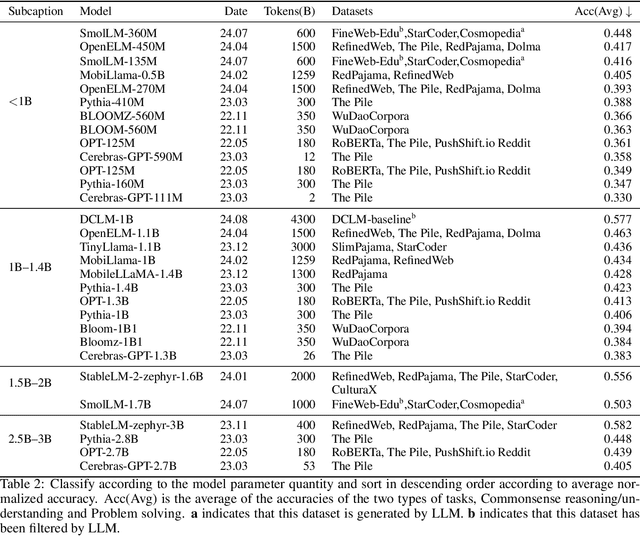
Small language models (SLMs), despite their widespread adoption in modern smart devices, have received significantly less academic attention compared to their large language model (LLM) counterparts, which are predominantly deployed in data centers and cloud environments. While researchers continue to improve the capabilities of LLMs in the pursuit of artificial general intelligence, SLM research aims to make machine intelligence more accessible, affordable, and efficient for everyday tasks. Focusing on transformer-based, decoder-only language models with 100M-5B parameters, we survey 59 state-of-the-art open-source SLMs, analyzing their technical innovations across three axes: architectures, training datasets, and training algorithms. In addition, we evaluate their capabilities in various domains, including commonsense reasoning, in-context learning, mathematics, and coding. To gain further insight into their on-device runtime costs, we benchmark their inference latency and memory footprints. Through in-depth analysis of our benchmarking data, we offer valuable insights to advance research in this field.
A Survey of Resource-efficient LLM and Multimodal Foundation Models
Jan 16, 2024

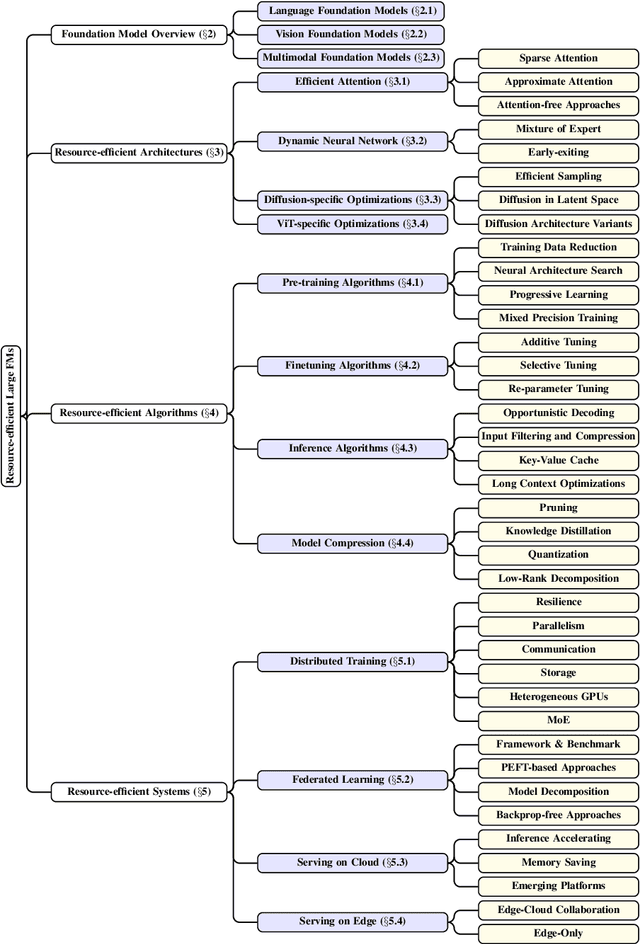

Large foundation models, including large language models (LLMs), vision transformers (ViTs), diffusion, and LLM-based multimodal models, are revolutionizing the entire machine learning lifecycle, from training to deployment. However, the substantial advancements in versatility and performance these models offer come at a significant cost in terms of hardware resources. To support the growth of these large models in a scalable and environmentally sustainable way, there has been a considerable focus on developing resource-efficient strategies. This survey delves into the critical importance of such research, examining both algorithmic and systemic aspects. It offers a comprehensive analysis and valuable insights gleaned from existing literature, encompassing a broad array of topics from cutting-edge model architectures and training/serving algorithms to practical system designs and implementations. The goal of this survey is to provide an overarching understanding of how current approaches are tackling the resource challenges posed by large foundation models and to potentially inspire future breakthroughs in this field.
EdgeMoE: Fast On-Device Inference of MoE-based Large Language Models
Aug 28, 2023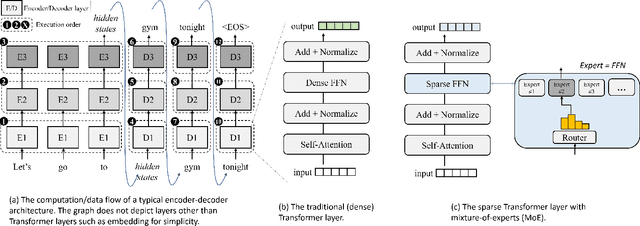
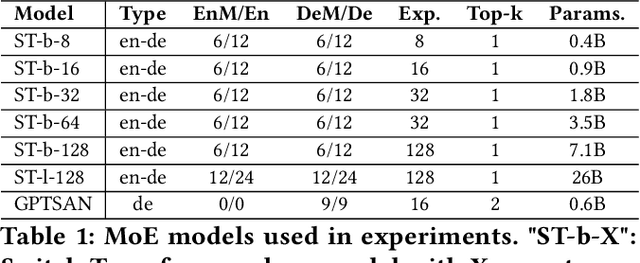
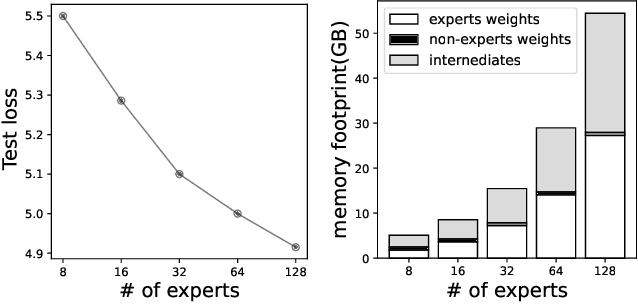
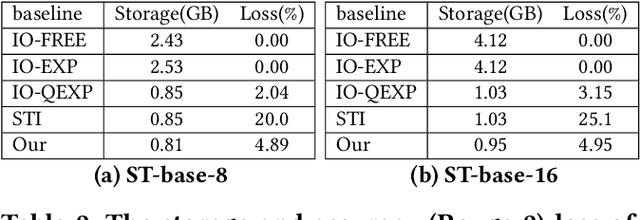
Large Language Models (LLMs) such as GPTs and LLaMa have ushered in a revolution in machine intelligence, owing to their exceptional capabilities in a wide range of machine learning tasks. However, the transition of LLMs from data centers to edge devices presents a set of challenges and opportunities. While this shift can enhance privacy and availability, it is hampered by the enormous parameter sizes of these models, leading to impractical runtime costs. In light of these considerations, we introduce EdgeMoE, the first on-device inference engine tailored for mixture-of-expert (MoE) LLMs, a popular variant of sparse LLMs that exhibit nearly constant computational complexity as their parameter size scales. EdgeMoE achieves both memory and computational efficiency by strategically partitioning the model across the storage hierarchy. Specifically, non-expert weights are stored in the device's memory, while expert weights are kept in external storage and are fetched into memory only when they are activated. This design is underpinned by a crucial insight that expert weights, though voluminous, are infrequently accessed due to sparse activation patterns. To further mitigate the overhead associated with expert I/O swapping, EdgeMoE incorporates two innovative techniques: (1) Expert-wise bitwidth adaptation: This method reduces the size of expert weights with an acceptable level of accuracy loss. (2) Expert management: It predicts the experts that will be activated in advance and preloads them into the compute-I/O pipeline, thus further optimizing the process. In empirical evaluations conducted on well-established MoE LLMs and various edge devices, EdgeMoE demonstrates substantial memory savings and performance improvements when compared to competitive baseline solutions.
Understanding and Optimizing Deep Learning Cold-Start Latency on Edge Devices
Jun 15, 2022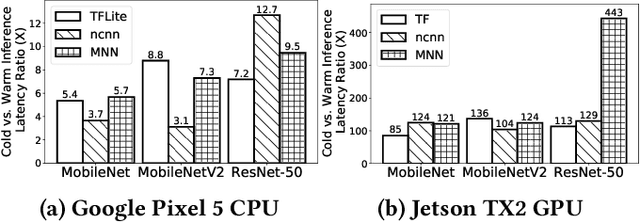
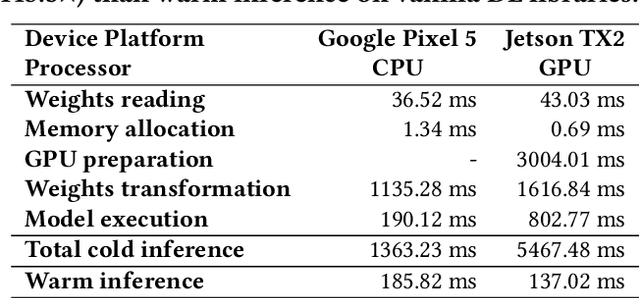
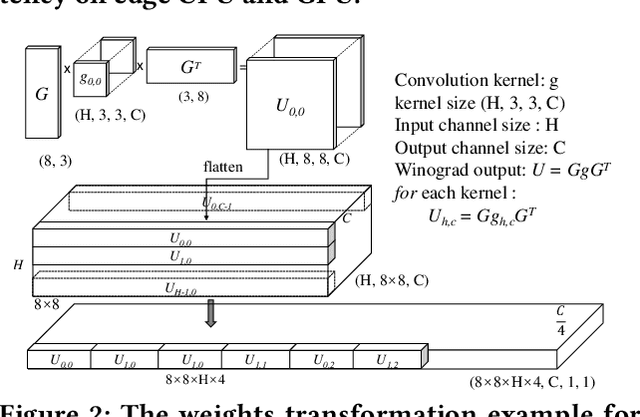
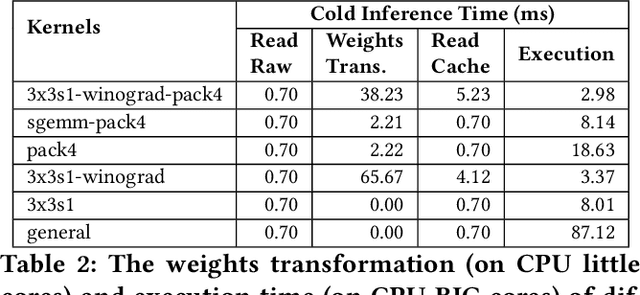
DNNs are ubiquitous on edge devices nowadays. With its increasing importance and use cases, it's not likely to pack all DNNs into device memory and expect that each inference has been warmed up. Therefore, cold inference, the process to read, initialize, and execute a DNN model, is becoming commonplace and its performance is urgently demanded to be optimized. To this end, we present NNV12, the first on-device inference engine that optimizes for cold inference NNV12 is built atop 3 novel optimization knobs: selecting a proper kernel (implementation) for each DNN operator, bypassing the weights transformation process by caching the post-transformed weights on disk, and pipelined execution of many kernels on asymmetric processors. To tackle with the huge search space, NNV12 employs a heuristic-based scheme to obtain a near-optimal kernel scheduling plan. We fully implement a prototype of NNV12 and evaluate its performance across extensive experiments. It shows that NNV12 achieves up to 15.2x and 401.5x compared to the state-of-the-art DNN engines on edge CPUs and GPUs, respectively.