 Add to Chrome
 Add to Firefox
 Add to Edge
OPRD: On-Policy Representation Distillation
Jun 04, 2026
On-policy distillation (OPD) supervises the student only in output space by matching next-token probabilities. This output-only paradigm has two limits: (1) sampling variance from Monte Carlo KL estimates over large vocabularies (e.g., Qwen's ~150k tokens) persists throughout training, and (2) it treats the teacher as a black-box, discarding all intermediate hidden states after the LM head. We propose On-Policy Representation Distillation (OPRD), which lifts distillation into hidden-state space by aligning student and teacher representations across selected layers on the same rollouts, bypassing the LM head entirely. Theoretically, OPRD eliminates sampling variance and provides richer per-layer structural information. Empirically, OPRD closes the student-teacher gap on AIME 2024/2025 and AIMO, while output-space OPD baselines plateau below the teacher. OPRD also trains 1.44x faster and uses 54% less memory than top-k OPD. Code: https://github.com/ShenzhiYang2000/OPRD.

Smart Picks in the Dark: Towards Efficient RLVR for Reasoning via Tracing Metacognitive Pivots
Jun 03, 2026Reinforcement learning with verifiable rewards (RLVR) has greatly advanced large reasoning models (LRMs), but it requires timely training on a huge fully-annotated dataset. To this end, data-efficient RLVR methods have been widely studied from two perspectives: (i) data selection methods identify a small subset of "golden" samples that yield near-full-data performance, but they rely on a pre-existing pool of labeled data. (ii) unsupervised RLVR methods train the model using its own internal supervision signals on large-scale unlabeled data, yet they exhibit suboptimal performance. Accordingly, we investigate the "pick in the dark" setup for RLVR, which aims to select, without prior supervision, unlabeled samples that are most beneficial for training and worthy of annotation. Through systematic analysis, we demonstrate that smart picks hinge on a well-calibrated uncertainty estimator to enable strategic partitioning of data for adaptive training regimes. Building on this insight, we propose PivotTrace, a three-way data triage framework that leverages attention dynamics to trace metacognitive pivots during reasoning. By precisely quantifying uncertainty through pivot density, PivotTrace achieves automated data routing to synergistically maximize both annotation and training efficiency. Empirically, PivotTrace surpasses the fully supervised LRM with only 29.3% annotated samples and 2.75 faster convergence.
GeoMin: Data-Efficient Semi-Supervised RLVR via Geometric Distribution Modeling
Jun 03, 2026Reinforcement learning with verifiable rewards (RLVR) significantly advances LLM reasoning, yet it faces a dilemma: standard supervised scaling is throttled by high annotation costs, while unsupervised alternatives suffer from severe model collapse. Recent semi-supervised RLVR methods address this by using a small labeled set to guide unlabeled data, achieving a promising trade-off between training efficacy and annotation cost. However, they suffer from a severe data-efficiency bottleneck due to the reliance on coarse performance heuristics, leaving a vast majority of valuable instances underutilized. To this end, we propose GeoMin, which models global feature distributions on labeled data to decode the structural discrepancy between correct and incorrect rollouts, thereby establishing a robust prior to assess the reliability of self-reward signals and fully unleash the potential of unlabeled data. Empirically, GeoMin outperforms the strongest baselines by +4.1% and even surpasses fully supervised models with only 10% of the annotations, demonstrating remarkable data efficiency.
Can LLMs Learn to Reason Robustly under Noisy Supervision?
Apr 05, 2026Reinforcement Learning with Verifiable Rewards (RLVR) effectively trains reasoning models that rely on abundant perfect labels, but its vulnerability to unavoidable noisy labels due to expert scarcity remains critically underexplored. In this work, we take the first step toward a systematic analysis of noisy label mechanisms in RLVR. In contrast to supervised classification, most RLVR algorithms incorporate a rollout-based condition: a label's influence on training is contingent on whether the current policy can generate rollouts that realize it, a property that naturally extends to noisy labels. Based on this observation, we distinguish two types of noise: inactive noisy labels, which reduce data efficiency, and active noisy labels, which are reinforced and risk skewing the model toward incorrect distributions. From experiments on training with noisy samples, we identify an Early Correctness Coherence phenomenon: although noisy samples begin to lag behind in later stages, accuracy on both clean and noisy samples increases similarly in early training. Motivated by this dynamic, we propose Online Label Refinement (OLR), which progressively corrects potentially noisy labels with majority-voted answers when two conditions hold: a positive slope in the majority answer's rollout pass rate and stable historical consistency across updates, enabling gradual self-correction as the policy improves. We evaluate OLR on six in-distribution mathematical reasoning benchmarks (AIME24/25, AMC, MATH-500, Minerva, and Olympiad) and three out-of-distribution tasks (ARC-c, GPQA-diamond, and MMLU-pro). Across noise ratios from 0.1 to 0.9, OLR consistently improves robustness under both inactive and active noisy-label settings, achieving average gains of 3.6% to 3.9% on in-distribution benchmarks and 3.3% to 4.6% on out-of-distribution evaluations.
TraPO: A Semi-Supervised Reinforcement Learning Framework for Boosting LLM Reasoning
Dec 15, 2025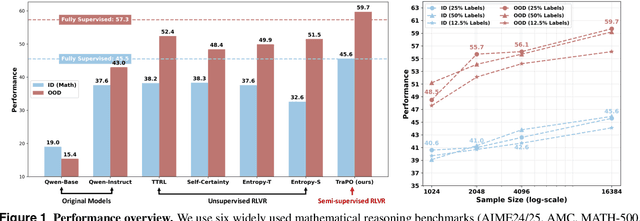
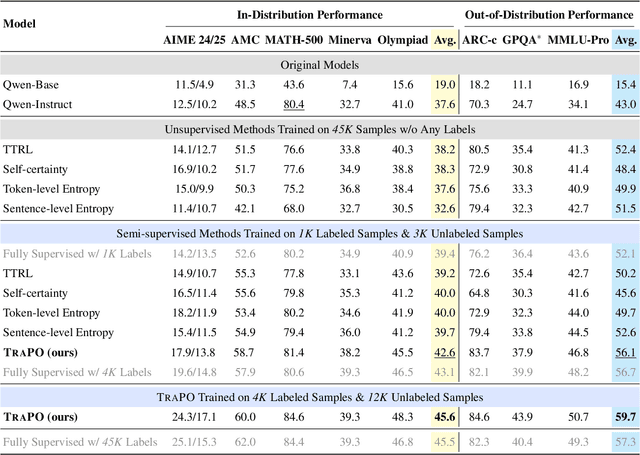
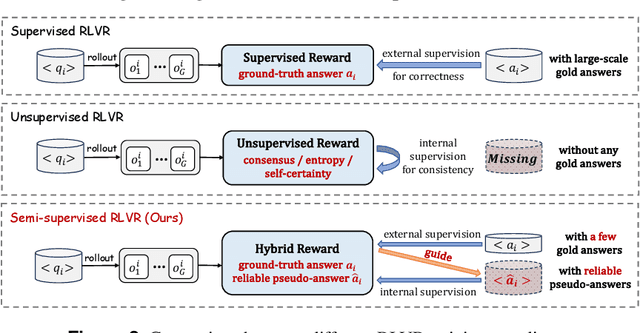
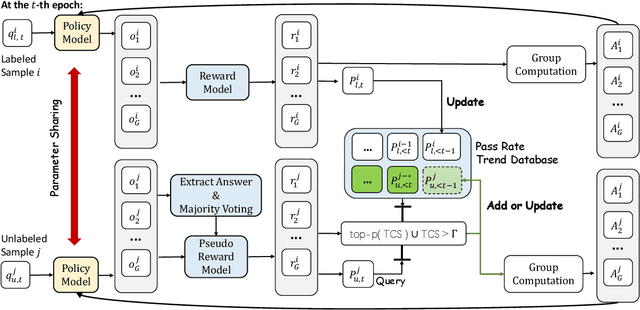
Reinforcement learning with verifiable rewards (RLVR) has proven effective in training large reasoning models (LRMs) by leveraging answer-verifiable signals to guide policy optimization, which, however, suffers from high annotation costs. To alleviate this problem, recent work has explored unsupervised RLVR methods that derive rewards solely from the model's internal consistency, such as through entropy and majority voting. While seemingly promising, these methods often suffer from model collapse in the later stages of training, which may arise from the reinforcement of incorrect reasoning patterns in the absence of external supervision. In this work, we investigate a novel semi-supervised RLVR paradigm that utilizes a small labeled set to guide RLVR training on unlabeled samples. Our key insight is that supervised rewards are essential for stabilizing consistency-based training on unlabeled samples, ensuring that only reasoning patterns verified on labeled instances are incorporated into RL training. Technically, we propose an effective policy optimization algorithm, TraPO, that identifies reliable unlabeled samples by matching their learning trajectory similarity to labeled ones. Building on this, TraPO achieves remarkable data efficiency and strong generalization on six widely used mathematical reasoning benchmarks (AIME24/25, AMC, MATH-500, Minerva, and Olympiad) and three out-of-distribution tasks (ARC-c, GPQA-diamond, and MMLU-pro). With only 1K labeled and 3K unlabeled samples, TraPO reaches 42.6% average accuracy, surpassing the best unsupervised method trained on 45K unlabeled samples (38.3%). Notably, when using 4K labeled and 12K unlabeled samples, TraPO even outperforms the fully supervised model trained on the full 45K labeled samples on all benchmarks, while using only 10% of the labeled data. The code is available via https://github.com/ShenzhiYang2000/TRAPO.
RealHiTBench: A Comprehensive Realistic Hierarchical Table Benchmark for Evaluating LLM-Based Table Analysis
Jun 16, 2025With the rapid advancement of Large Language Models (LLMs), there is an increasing need for challenging benchmarks to evaluate their capabilities in handling complex tabular data. However, existing benchmarks are either based on outdated data setups or focus solely on simple, flat table structures. In this paper, we introduce RealHiTBench, a comprehensive benchmark designed to evaluate the performance of both LLMs and Multimodal LLMs (MLLMs) across a variety of input formats for complex tabular data, including LaTeX, HTML, and PNG. RealHiTBench also includes a diverse collection of tables with intricate structures, spanning a wide range of task types. Our experimental results, using 25 state-of-the-art LLMs, demonstrate that RealHiTBench is indeed a challenging benchmark. Moreover, we also develop TreeThinker, a tree-based pipeline that organizes hierarchical headers into a tree structure for enhanced tabular reasoning, validating the importance of improving LLMs' perception of table hierarchies. We hope that our work will inspire further research on tabular data reasoning and the development of more robust models. The code and data are available at https://github.com/cspzyy/RealHiTBench.
TableGPT2: A Large Multimodal Model with Tabular Data Integration
Nov 04, 2024The emergence of models like GPTs, Claude, LLaMA, and Qwen has reshaped AI applications, presenting vast new opportunities across industries. Yet, the integration of tabular data remains notably underdeveloped, despite its foundational role in numerous real-world domains. This gap is critical for three main reasons. First, database or data warehouse data integration is essential for advanced applications; second, the vast and largely untapped resource of tabular data offers immense potential for analysis; and third, the business intelligence domain specifically demands adaptable, precise solutions that many current LLMs may struggle to provide. In response, we introduce TableGPT2, a model rigorously pre-trained and fine-tuned with over 593.8K tables and 2.36M high-quality query-table-output tuples, a scale of table-related data unprecedented in prior research. This extensive training enables TableGPT2 to excel in table-centric tasks while maintaining strong general language and coding abilities. One of TableGPT2's key innovations is its novel table encoder, specifically designed to capture schema-level and cell-level information. This encoder strengthens the model's ability to handle ambiguous queries, missing column names, and irregular tables commonly encountered in real-world applications. Similar to visual language models, this pioneering approach integrates with the decoder to form a robust large multimodal model. We believe the results are compelling: over 23 benchmarking metrics, TableGPT2 achieves an average performance improvement of 35.20% in the 7B model and 49.32% in the 72B model over prior benchmark-neutral LLMs, with robust general-purpose capabilities intact.