 Add to Chrome
 Add to Firefox
 Add to Edge
EgoMe: Follow Me via Egocentric View in Real World
Jan 31, 2025
When interacting with the real world, human often take the egocentric (first-person) view as a benchmark, naturally transferring behaviors observed from a exocentric (third-person) view to their own. This cognitive theory provides a foundation for researching how robots can more effectively imitate human behavior. However, current research either employs multiple cameras with different views focusing on the same individual's behavior simultaneously or encounters unpair ego-exo view scenarios, there is no effort to fully exploit human cognitive behavior in the real world. To fill this gap, in this paper, we introduce a novel large-scale egocentric dataset, called EgoMe, which towards following the process of human imitation learning via egocentric view in the real world. Our dataset includes 7902 pairs of videos (15804 videos) for diverse daily behaviors in real-world scenarios. For a pair of videos, one video captures a exocentric view of the imitator observing the demonstrator's actions, while the other captures a egocentric view of the imitator subsequently following those actions. Notably, our dataset also contain exo-ego eye gaze, angular velocity, acceleration, magnetic strength and other sensor multi-modal data for assisting in establishing correlations between observing and following process. In addition, we also propose eight challenging benchmark tasks for fully leveraging this data resource and promoting the research of robot imitation learning ability. Extensive statistical analysis demonstrates significant advantages compared to existing datasets. The proposed EgoMe dataset and benchmark will be released soon.

Value Function Decomposition in Markov Recommendation Process
Jan 29, 2025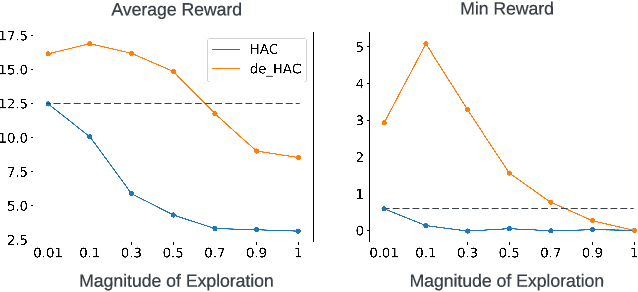
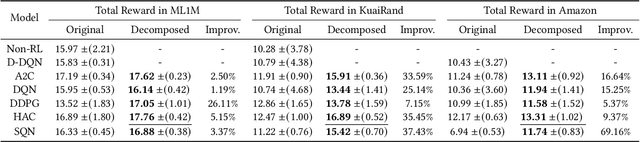
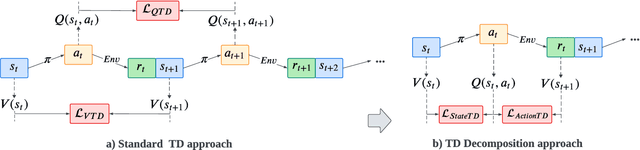
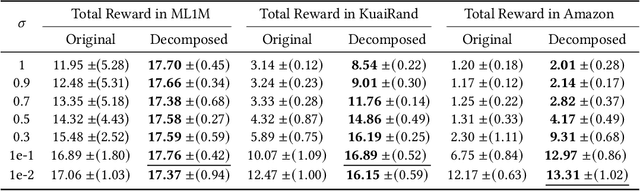
Recent advances in recommender systems have shown that user-system interaction essentially formulates long-term optimization problems, and online reinforcement learning can be adopted to improve recommendation performance. The general solution framework incorporates a value function that estimates the user's expected cumulative rewards in the future and guides the training of the recommendation policy. To avoid local maxima, the policy may explore potential high-quality actions during inference to increase the chance of finding better future rewards. To accommodate the stepwise recommendation process, one widely adopted approach to learning the value function is learning from the difference between the values of two consecutive states of a user. However, we argue that this paradigm involves an incorrect approximation in the stochastic process. Specifically, between the current state and the next state in each training sample, there exist two separate random factors from the stochastic policy and the uncertain user environment. Original temporal difference (TD) learning under these mixed random factors may result in a suboptimal estimation of the long-term rewards. As a solution, we show that these two factors can be separately approximated by decomposing the original temporal difference loss. The disentangled learning framework can achieve a more accurate estimation with faster learning and improved robustness against action exploration. As empirical verification of our proposed method, we conduct offline experiments with online simulated environments built based on public datasets.
Distinguished Quantized Guidance for Diffusion-based Sequence Recommendation
Jan 29, 2025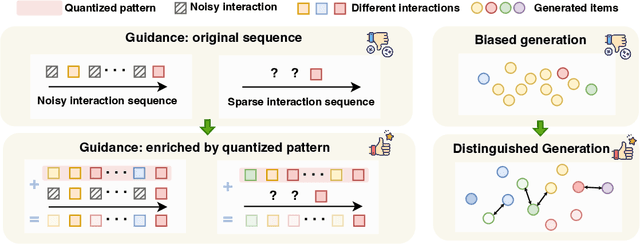
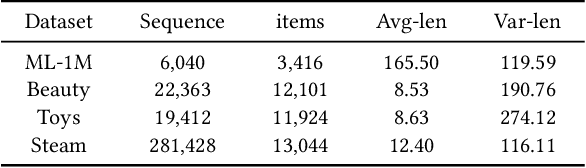
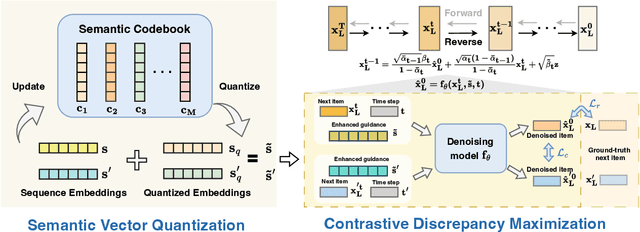
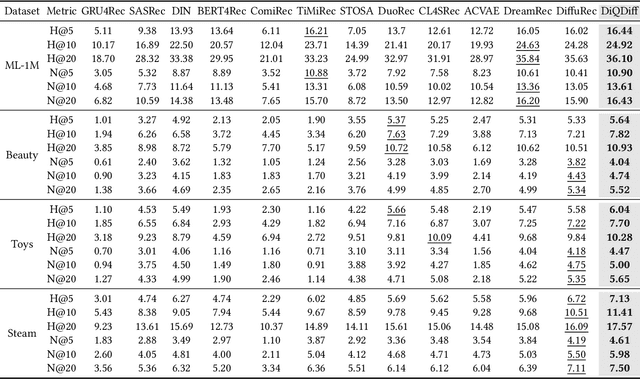
Diffusion models (DMs) have emerged as promising approaches for sequential recommendation due to their strong ability to model data distributions and generate high-quality items. Existing work typically adds noise to the next item and progressively denoises it guided by the user's interaction sequence, generating items that closely align with user interests. However, we identify two key issues in this paradigm. First, the sequences are often heterogeneous in length and content, exhibiting noise due to stochastic user behaviors. Using such sequences as guidance may hinder DMs from accurately understanding user interests. Second, DMs are prone to data bias and tend to generate only the popular items that dominate the training dataset, thus failing to meet the personalized needs of different users. To address these issues, we propose Distinguished Quantized Guidance for Diffusion-based Sequence Recommendation (DiQDiff), which aims to extract robust guidance to understand user interests and generate distinguished items for personalized user interests within DMs. To extract robust guidance, DiQDiff introduces Semantic Vector Quantization (SVQ) to quantize sequences into semantic vectors (e.g., collaborative signals and category interests) using a codebook, which can enrich the guidance to better understand user interests. To generate distinguished items, DiQDiff personalizes the generation through Contrastive Discrepancy Maximization (CDM), which maximizes the distance between denoising trajectories using contrastive loss to prevent biased generation for different users. Extensive experiments are conducted to compare DiQDiff with multiple baseline models across four widely-used datasets. The superior recommendation performance of DiQDiff against leading approaches demonstrates its effectiveness in sequential recommendation tasks.
Fine-Tuning Open-Source Large Language Models to Improve Their Performance on Radiation Oncology Tasks: A Feasibility Study to Investigate Their Potential Clinical Applications in Radiation Oncology
Jan 28, 2025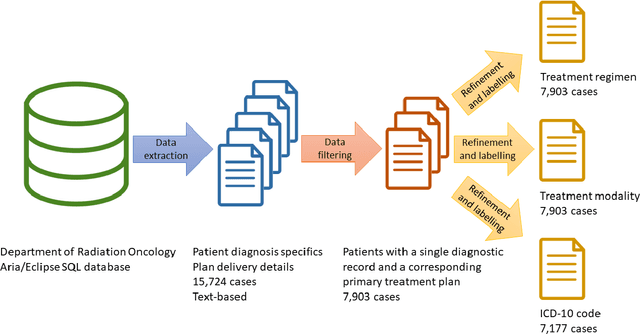

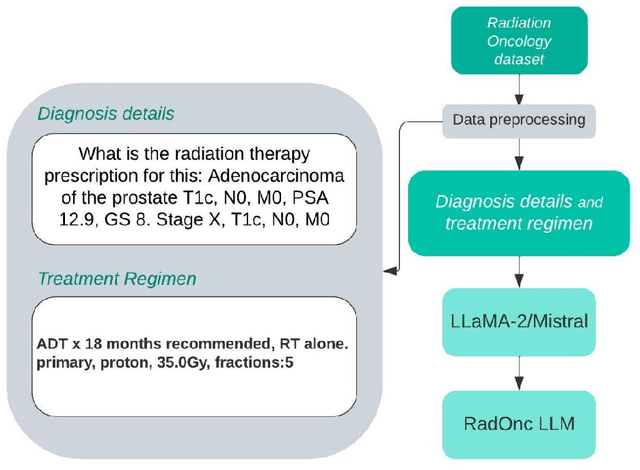
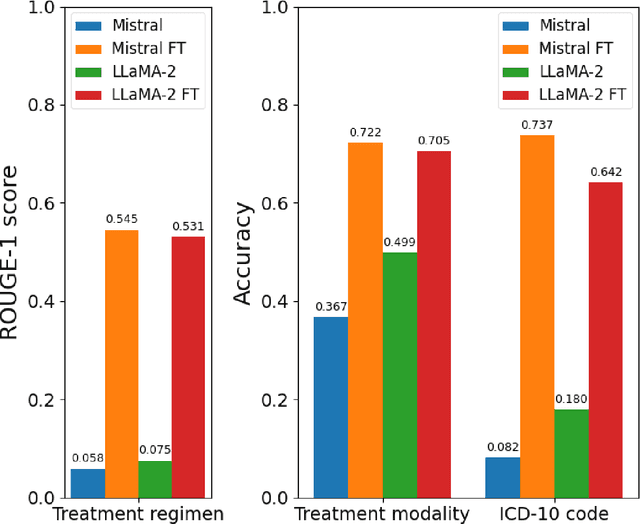
Background: The radiation oncology clinical practice involves many steps relying on the dynamic interplay of abundant text data. Large language models have displayed remarkable capabilities in processing complex text information. But their direct applications in specific fields like radiation oncology remain underexplored. Purpose: This study aims to investigate whether fine-tuning LLMs with domain knowledge can improve the performance on Task (1) treatment regimen generation, Task (2) treatment modality selection (photon, proton, electron, or brachytherapy), and Task (3) ICD-10 code prediction in radiation oncology. Methods: Data for 15,724 patient cases were extracted. Cases where patients had a single diagnostic record, and a clearly identifiable primary treatment plan were selected for preprocessing and manual annotation to have 7,903 cases of the patient diagnosis, treatment plan, treatment modality, and ICD-10 code. Each case was used to construct a pair consisting of patient diagnostics details and an answer (treatment regimen, treatment modality, or ICD-10 code respectively) for the supervised fine-tuning of these three tasks. Open source LLaMA2-7B and Mistral-7B models were utilized for the fine-tuning with the Low-Rank Approximations method. Accuracy and ROUGE-1 score were reported for the fine-tuned models and original models. Clinical evaluation was performed on Task (1) by radiation oncologists, while precision, recall, and F-1 score were evaluated for Task (2) and (3). One-sided Wilcoxon signed-rank tests were used to statistically analyze the results. Results: Fine-tuned LLMs outperformed original LLMs across all tasks with p-value <= 0.001. Clinical evaluation demonstrated that over 60% of the fine-tuned LLMs-generated treatment regimens were clinically acceptable. Precision, recall, and F1-score showed improved performance of fine-tuned LLMs.
Scalable Benchmarking and Robust Learning for Noise-Free Ego-Motion and 3D Reconstruction from Noisy Video
Jan 24, 2025We aim to redefine robust ego-motion estimation and photorealistic 3D reconstruction by addressing a critical limitation: the reliance on noise-free data in existing models. While such sanitized conditions simplify evaluation, they fail to capture the unpredictable, noisy complexities of real-world environments. Dynamic motion, sensor imperfections, and synchronization perturbations lead to sharp performance declines when these models are deployed in practice, revealing an urgent need for frameworks that embrace and excel under real-world noise. To bridge this gap, we tackle three core challenges: scalable data generation, comprehensive benchmarking, and model robustness enhancement. First, we introduce a scalable noisy data synthesis pipeline that generates diverse datasets simulating complex motion, sensor imperfections, and synchronization errors. Second, we leverage this pipeline to create Robust-Ego3D, a benchmark rigorously designed to expose noise-induced performance degradation, highlighting the limitations of current learning-based methods in ego-motion accuracy and 3D reconstruction quality. Third, we propose Correspondence-guided Gaussian Splatting (CorrGS), a novel test-time adaptation method that progressively refines an internal clean 3D representation by aligning noisy observations with rendered RGB-D frames from clean 3D map, enhancing geometric alignment and appearance restoration through visual correspondence. Extensive experiments on synthetic and real-world data demonstrate that CorrGS consistently outperforms prior state-of-the-art methods, particularly in scenarios involving rapid motion and dynamic illumination.
PointOBB-v3: Expanding Performance Boundaries of Single Point-Supervised Oriented Object Detection
Jan 23, 2025

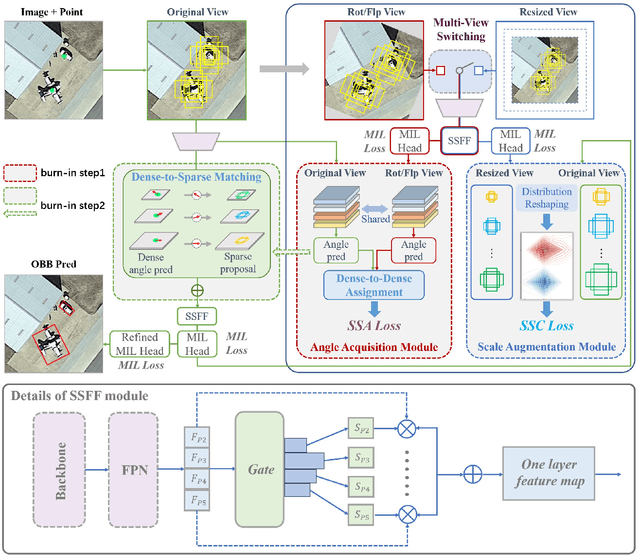

With the growing demand for oriented object detection (OOD), recent studies on point-supervised OOD have attracted significant interest. In this paper, we propose PointOBB-v3, a stronger single point-supervised OOD framework. Compared to existing methods, it generates pseudo rotated boxes without additional priors and incorporates support for the end-to-end paradigm. PointOBB-v3 functions by integrating three unique image views: the original view, a resized view, and a rotated/flipped (rot/flp) view. Based on the views, a scale augmentation module and an angle acquisition module are constructed. In the first module, a Scale-Sensitive Consistency (SSC) loss and a Scale-Sensitive Feature Fusion (SSFF) module are introduced to improve the model's ability to estimate object scale. To achieve precise angle predictions, the second module employs symmetry-based self-supervised learning. Additionally, we introduce an end-to-end version that eliminates the pseudo-label generation process by integrating a detector branch and introduces an Instance-Aware Weighting (IAW) strategy to focus on high-quality predictions. We conducted extensive experiments on the DIOR-R, DOTA-v1.0/v1.5/v2.0, FAIR1M, STAR, and RSAR datasets. Across all these datasets, our method achieves an average improvement in accuracy of 3.56% in comparison to previous state-of-the-art methods. The code will be available at https://github.com/ZpyWHU/PointOBB-v3.
3DCoMPaT200: Language-Grounded Compositional Understanding of Parts and Materials of 3D Shapes
Jan 12, 2025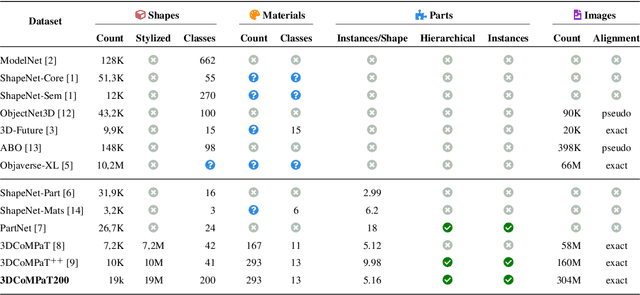

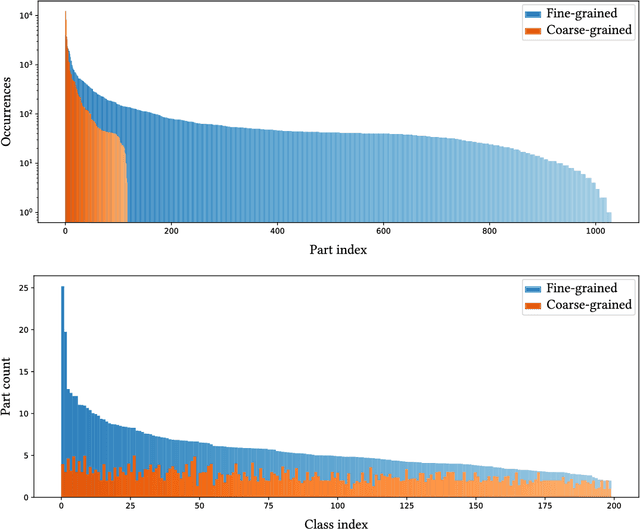
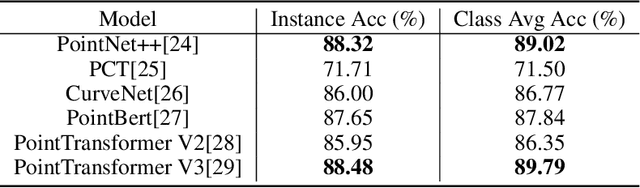
Understanding objects in 3D at the part level is essential for humans and robots to navigate and interact with the environment. Current datasets for part-level 3D object understanding encompass a limited range of categories. For instance, the ShapeNet-Part and PartNet datasets only include 16, and 24 object categories respectively. The 3DCoMPaT dataset, specifically designed for compositional understanding of parts and materials, contains only 42 object categories. To foster richer and fine-grained part-level 3D understanding, we introduce 3DCoMPaT200, a large-scale dataset tailored for compositional understanding of object parts and materials, with 200 object categories with $\approx$5 times larger object vocabulary compared to 3DCoMPaT and $\approx$ 4 times larger part categories. Concretely, 3DCoMPaT200 significantly expands upon 3DCoMPaT, featuring 1,031 fine-grained part categories and 293 distinct material classes for compositional application to 3D object parts. Additionally, to address the complexities of compositional 3D modeling, we propose a novel task of Compositional Part Shape Retrieval using ULIP to provide a strong 3D foundational model for 3D Compositional Understanding. This method evaluates the model shape retrieval performance given one, three, or six parts described in text format. These results show that the model's performance improves with an increasing number of style compositions, highlighting the critical role of the compositional dataset. Such results underscore the dataset's effectiveness in enhancing models' capability to understand complex 3D shapes from a compositional perspective. Code and Data can be found at http://github.com/3DCoMPaT200/3DCoMPaT200
Large Language Models for Bioinformatics
Jan 10, 2025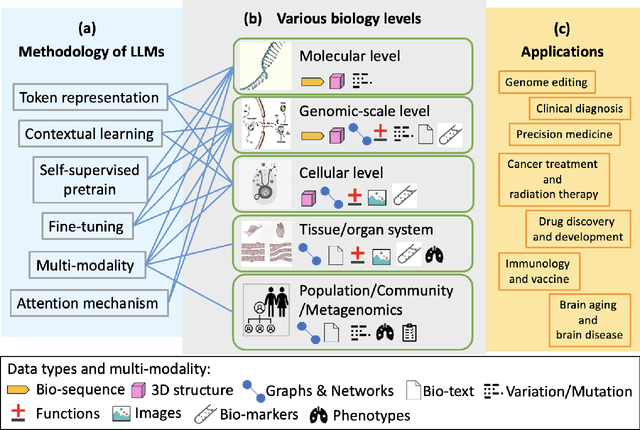
With the rapid advancements in large language model (LLM) technology and the emergence of bioinformatics-specific language models (BioLMs), there is a growing need for a comprehensive analysis of the current landscape, computational characteristics, and diverse applications. This survey aims to address this need by providing a thorough review of BioLMs, focusing on their evolution, classification, and distinguishing features, alongside a detailed examination of training methodologies, datasets, and evaluation frameworks. We explore the wide-ranging applications of BioLMs in critical areas such as disease diagnosis, drug discovery, and vaccine development, highlighting their impact and transformative potential in bioinformatics. We identify key challenges and limitations inherent in BioLMs, including data privacy and security concerns, interpretability issues, biases in training data and model outputs, and domain adaptation complexities. Finally, we highlight emerging trends and future directions, offering valuable insights to guide researchers and clinicians toward advancing BioLMs for increasingly sophisticated biological and clinical applications.
Strip R-CNN: Large Strip Convolution for Remote Sensing Object Detection
Jan 08, 2025While witnessed with rapid development, remote sensing object detection remains challenging for detecting high aspect ratio objects. This paper shows that large strip convolutions are good feature representation learners for remote sensing object detection and can detect objects of various aspect ratios well. Based on large strip convolutions, we build a new network architecture called Strip R-CNN, which is simple, efficient, and powerful. Unlike recent remote sensing object detectors that leverage large-kernel convolutions with square shapes, our Strip R-CNN takes advantage of sequential orthogonal large strip convolutions to capture spatial information. In addition, we enhance the localization capability of remote-sensing object detectors by decoupling the detection heads and equipping the localization head with strip convolutions to better localize the target objects. Extensive experiments on several benchmarks, e.g., DOTA, FAIR1M, HRSC2016, and DIOR, show that our Strip R-CNN can largely improve previous works. Notably, our 30M model achieves 82.75% mAP on DOTA-v1.0, setting a new state-of-the-art record.Code is available at https://github.com/YXB-NKU/Strip-R-CNN.
RSAR: Restricted State Angle Resolver and Rotated SAR Benchmark
Jan 08, 2025


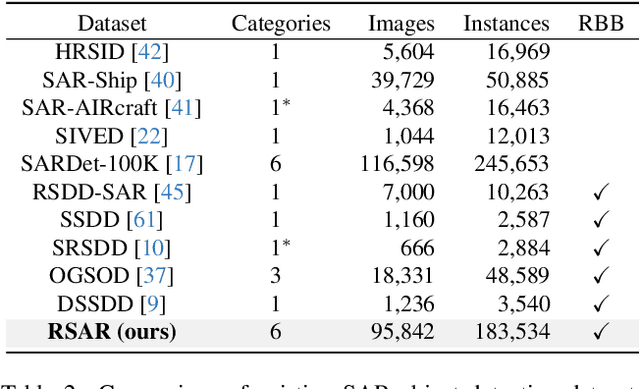
Rotated object detection has made significant progress in the optical remote sensing. However, advancements in the Synthetic Aperture Radar (SAR) field are laggard behind, primarily due to the absence of a large-scale dataset. Annotating such a dataset is inefficient and costly. A promising solution is to employ a weakly supervised model (e.g., trained with available horizontal boxes only) to generate pseudo-rotated boxes for reference before manual calibration. Unfortunately, the existing weakly supervised models exhibit limited accuracy in predicting the object's angle. Previous works attempt to enhance angle prediction by using angle resolvers that decouple angles into cosine and sine encodings. In this work, we first reevaluate these resolvers from a unified perspective of dimension mapping and expose that they share the same shortcomings: these methods overlook the unit cycle constraint inherent in these encodings, easily leading to prediction biases. To address this issue, we propose the Unit Cycle Resolver, which incorporates a unit circle constraint loss to improve angle prediction accuracy. Our approach can effectively improve the performance of existing state-of-the-art weakly supervised methods and even surpasses fully supervised models on existing optical benchmarks (i.e., DOTA-v1.0 dataset). With the aid of UCR, we further annotate and introduce RSAR, the largest multi-class rotated SAR object detection dataset to date. Extensive experiments on both RSAR and optical datasets demonstrate that our UCR enhances angle prediction accuracy. Our dataset and code can be found at: https://github.com/zhasion/RSAR.