 Add to Chrome
 Add to Firefox
 Add to Edge
HoliDubber: Holistic Video Dubbing for Complex Acoustic Scenes via Text-Guided Audio Synthesis
Jun 08, 2026
Video dubbing is a cornerstone of multimedia content creation, aiming to synthesize synchronized acoustic sequences for visual streams. While Text-to-Speech (TTS) and Text-to-Audio (TTA) generation have each achieved remarkable progress, existing dubbing systems remain confined to isolated speech synthesis without incorporating sound effects and ambient audio, forcing practitioners to rely on fragmented workflows and laborious manual post-mixing. To address this limitation, we present HoliDubber, a holistic video dubbing framework that moves beyond speech-only generation by enabling the joint synthesis of speech and sound effects from a single text prompt. Specifically, HoliDubber adopts a patch-based autoregressive diffusion transformer architecture, where a causal language model autoregressively models aggregated patch embeddings to capture global temporal structure, and a Diffusion Transformer decoder generates high-fidelity continuous tokens within each patch, following a divide-and-conquer strategy. To achieve cross-modal alignment, visual features are encoded into patch-level representations and fused with audio patches via cross-attention, enabling the model to ground speech generation in the speaker's visual articulation dynamics. In addition, we introduce HoliDub-Bench, a benchmark curated from established datasets with synchronized video-text-audio triplets designed for holistic dubbing evaluation. Extensive experiments demonstrate that HoliDubber significantly outperforms existing methods across multiple benchmarks in speech quality, synchronization, and speaker similarity. Furthermore, results on HoliDub-Bench validate the effectiveness of joint speech-and-sound generation, establishing a new paradigm for holistic video dubbing in complex acoustic scenes. \footnote{The demo page of the project is https://holidubber.github.io}

MMAE: A Massive Multitask Audio Editing Benchmark
Jun 05, 2026We introduce MMAE, a Massive Multitask Audio Editing benchmark, serving as the first comprehensive evaluation testbed designed for general-purpose instruction-based audio editing. Spurred by the shift toward intelligent creation, interactive editing has rapidly expanded from visual domains, pioneered by models like Nano-banana 2 for images and Gemini-Omni for video, into audio. However, the current evaluation infrastructure lags severely, remaining highly fragmented and restricted to specific subdomains or basic operations. Unlike existing benchmarks that are limited in scope, MMAE extends to a broad spectrum of real-world scenarios, encompassing 7 distinct audio modalities, including sound, speech, music, and their mixtures. Furthermore, we establish a comprehensive taxonomy spanning 6 levels of task complexity, from basic modifications to multi-hop reasoning and multi-round editing, 2 levels of granularity, and 8 distinct operation types. Meticulously curated through human-agent collaboration, MMAE comprises 2,000 high-fidelity samples paired with a pioneering rubric-based evaluation framework. By decomposing free-form tasks into 17,741 verifiable criteria, this robust rubric-based paradigm enables a precise, multi-dimensional assessment of both instruction following and context consistency. Our extensive evaluation of leading models reveals that current systems remain far from achieving reliable edits. Strikingly, the Exact Match Rate (EMR) consistently falls below 5% and plummets to an absolute 0% in complex, mixed-modality tasks, exposing critical bottlenecks in precise execution and structural robustness. We hope MMAE will serve as a catalyst for future advances in the intelligent creation community, providing a clear diagnostic roadmap and establishing a standardized, long-lasting evaluation paradigm for next-generation audio editing systems.
MOVA: Towards Scalable and Synchronized Video-Audio Generation
Feb 09, 2026Audio is indispensable for real-world video, yet generation models have largely overlooked audio components. Current approaches to producing audio-visual content often rely on cascaded pipelines, which increase cost, accumulate errors, and degrade overall quality. While systems such as Veo 3 and Sora 2 emphasize the value of simultaneous generation, joint multimodal modeling introduces unique challenges in architecture, data, and training. Moreover, the closed-source nature of existing systems limits progress in the field. In this work, we introduce MOVA (MOSS Video and Audio), an open-source model capable of generating high-quality, synchronized audio-visual content, including realistic lip-synced speech, environment-aware sound effects, and content-aligned music. MOVA employs a Mixture-of-Experts (MoE) architecture, with a total of 32B parameters, of which 18B are active during inference. It supports IT2VA (Image-Text to Video-Audio) generation task. By releasing the model weights and code, we aim to advance research and foster a vibrant community of creators. The released codebase features comprehensive support for efficient inference, LoRA fine-tuning, and prompt enhancement.
MeanAudio: Fast and Faithful Text-to-Audio Generation with Mean Flows
Aug 08, 2025Recent developments in diffusion- and flow- based models have significantly advanced Text-to-Audio Generation (TTA). While achieving great synthesis quality and controllability, current TTA systems still suffer from slow inference speed, which significantly limits their practical applicability. This paper presents MeanAudio, a novel MeanFlow-based model tailored for fast and faithful text-to-audio generation. Built on a Flux-style latent transformer, MeanAudio regresses the average velocity field during training, enabling fast generation by mapping directly from the start to the endpoint of the flow trajectory. By incorporating classifier-free guidance (CFG) into the training target, MeanAudio incurs no additional cost in the guided sampling process. To further stabilize training, we propose an instantaneous-to-mean curriculum with flow field mix-up, which encourages the model to first learn the foundational instantaneous dynamics, and then gradually adapt to mean flows. This strategy proves critical for enhancing training efficiency and generation quality. Experimental results demonstrate that MeanAudio achieves state-of-the-art performance in single-step audio generation. Specifically, it achieves a real time factor (RTF) of 0.013 on a single NVIDIA RTX 3090, yielding a 100x speedup over SOTA diffusion-based TTA systems. Moreover, MeanAudio also demonstrates strong performance in multi-step generation, enabling smooth and coherent transitions across successive synthesis steps.
Prompt-enhanced Network for Hateful Meme Classification
Nov 12, 2024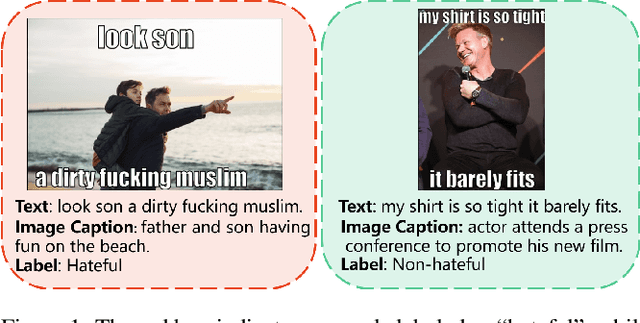
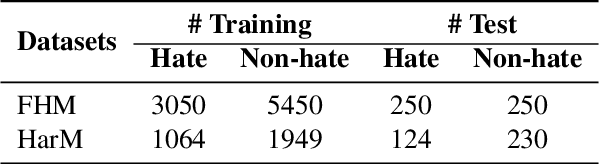
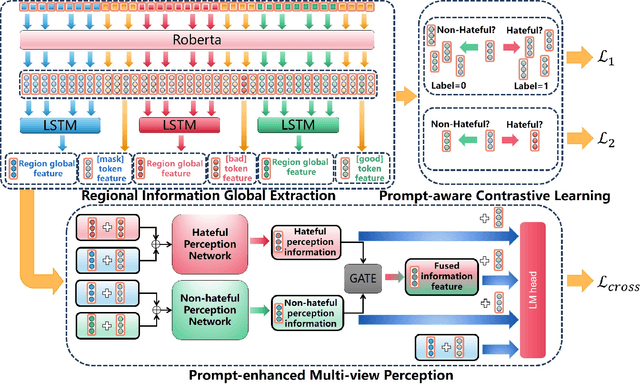
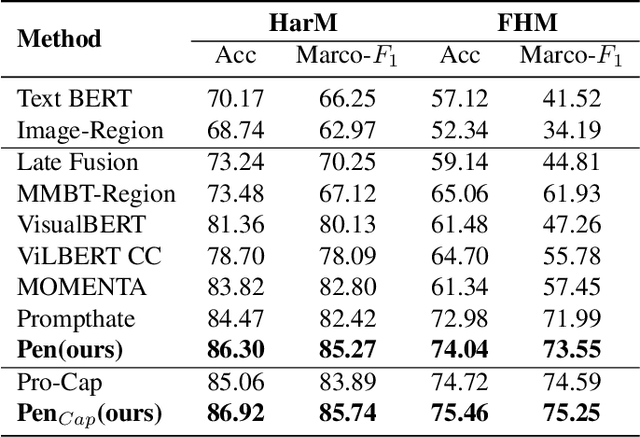
The dynamic expansion of social media has led to an inundation of hateful memes on media platforms, accentuating the growing need for efficient identification and removal. Acknowledging the constraints of conventional multimodal hateful meme classification, which heavily depends on external knowledge and poses the risk of including irrelevant or redundant content, we developed Pen -- a prompt-enhanced network framework based on the prompt learning approach. Specifically, after constructing the sequence through the prompt method and encoding it with a language model, we performed region information global extraction on the encoded sequence for multi-view perception. By capturing global information about inference instances and demonstrations, Pen facilitates category selection by fully leveraging sequence information. This approach significantly improves model classification accuracy. Additionally, to bolster the model's reasoning capabilities in the feature space, we introduced prompt-aware contrastive learning into the framework to improve the quality of sample feature distributions. Through extensive ablation experiments on two public datasets, we evaluate the effectiveness of the Pen framework, concurrently comparing it with state-of-the-art model baselines. Our research findings highlight that Pen surpasses manual prompt methods, showcasing superior generalization and classification accuracy in hateful meme classification tasks. Our code is available at https://github.com/juszzi/Pen.
Golden Touchstone: A Comprehensive Bilingual Benchmark for Evaluating Financial Large Language Models
Nov 09, 2024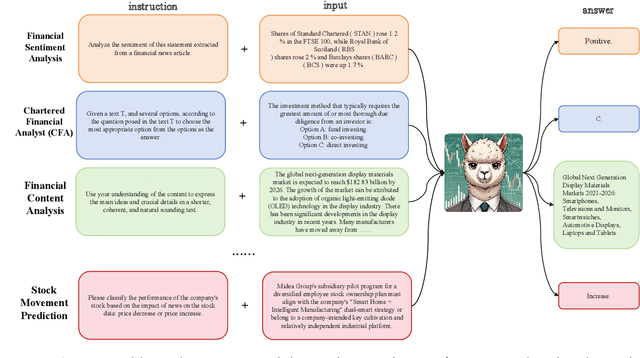

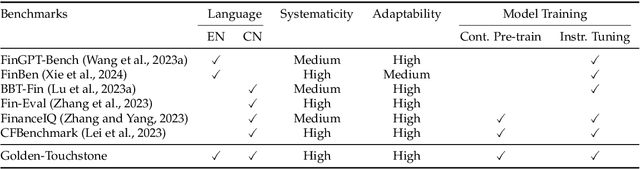
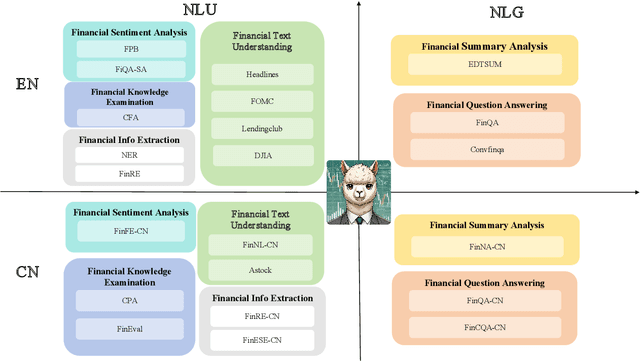
As large language models become increasingly prevalent in the financial sector, there is a pressing need for a standardized method to comprehensively assess their performance. However, existing finance benchmarks often suffer from limited language and task coverage, as well as challenges such as low-quality datasets and inadequate adaptability for LLM evaluation. To address these limitations, we propose "Golden Touchstone", the first comprehensive bilingual benchmark for financial LLMs, which incorporates representative datasets from both Chinese and English across eight core financial NLP tasks. Developed from extensive open source data collection and industry-specific demands, this benchmark includes a variety of financial tasks aimed at thoroughly assessing models' language understanding and generation capabilities. Through comparative analysis of major models on the benchmark, such as GPT-4o Llama3, FinGPT and FinMA, we reveal their strengths and limitations in processing complex financial information. Additionally, we open-sourced Touchstone-GPT, a financial LLM trained through continual pre-training and financial instruction tuning, which demonstrates strong performance on the bilingual benchmark but still has limitations in specific tasks.This research not only provides the financial large language models with a practical evaluation tool but also guides the development and optimization of future research. The source code for Golden Touchstone and model weight of Touchstone-GPT have been made publicly available at \url{https://github.com/IDEA-FinAI/Golden-Touchstone}, contributing to the ongoing evolution of FinLLMs and fostering further research in this critical area.