 Add to Chrome
 Add to Firefox
 Add to Edge
Key-Frame Reasoning with SAM3: Third Place Solution for the MeViS-Text Track of the 8th LSVOS Challenge
Aug 18, 2026
This report presents a two-stage, training-free solution for the MeViS-Text track of the 8th LSVOS Challenge. The task requires a model to localize and segment the object specified by a natural-language expression throughout a video. Such expressions often depend on temporal cues, including actions, interactions, directions, and relative positions. Our first stage uses Gemini-3.1 Pro via API to decompose a video-level event into instance-level targets, select a key frame for each target, and generate a discriminative description aligned with that frame. In the second stage, SAM3-agent produces a pixel-level seed mask on the selected frame, and the SAM3 video tracker propagates the mask bidirectionally through the video. Valid instances are grounded and propagated independently before their frame-wise masks are merged. All local SAM3 processing runs on a single NVIDIA GeForce RTX 4090 without task-specific training or model ensembling. Our method ranked third on the challenge test set, obtaining J&F, J, F, N-acc., T-acc., and Final scores of 0.761, 0.7367, 0.7852, 0.8333, 0.9755, and 0.856593, respectively.

VOS-Agent: The 1st Place Solution for the 8th LSVOS Challenge (MOSEv2 Track)
Aug 13, 2026Complex video object segmentation requires robust target propagation under severe occlusion, disappearance and reappearance. Although SAM3 provides strong promptable mask propagation, a uniform inference path remains unreliable for tiny targets with insufficient visual evidence and semantic-dominated targets whose identities depend on explicit attributes. To this end, we present VOS-Agent, a collaborative framework that retains SAM3 as the shared dense segmentation module and conditionally activates specialized agents according to target characteristics. A Target Perception and Routing Agent assigns each sequence to a regular, tiny, or semantic-dominated route. Tiny targets are supported by a Visual Tracking Agent through confidence-aware box prompts, while semantic-dominated targets are handled by an MLLM-based Semantic Agent through description-guided localization and candidate verification. On the MOSEv2 test set, VOS-Agent achieves 69.82% on the official $\mathcal{J}\&\dot{\mathcal{F}}$ metric and ranks first in the MOSEv2 Track of the 8th LSVOS Challenge at ECCV 2026.
AirForesight: Current-to-Future Spatial Map Imagination with Cross-Space Planning Consistency for UAV-VLN
Aug 13, 2026Unmanned Aerial Vehicle Vision-Language Navigation (UAV-VLN) requires agents to follow language instructions, infer spatial structure from sparse multi-view observations, and execute feasible 3D motion in complex outdoor environments. Despite recent progress with large language models, most existing methods still map vision-language inputs directly to actions, providing limited explicit scene grounding and future-aware spatial reasoning. We propose AirForesight, a current-to-future spatial map imagination framework for UAV-VLN. AirForesight first learns a structured current-map representation from multi-view observations. This representation is jointly supervised by current-map reconstruction and future-trajectory prediction, encouraging it to encode both present scene structure and future motion intent. Under structured causal attention, the current spatial knowledge is propagated to future-map reasoning, and the resulting current and future representations are aggregated to predict the next 3D waypoint. To make spatial imagination more relevant to navigation, we introduce a cross-space planning consistency loss that encourages directional agreement between the predicted map-space trajectory and the expert action direction derived from the ground-truth waypoint displacement. Experiments on OpenUAV and AerialVLN-S, together with extensive ablations, demonstrate strong performance and support the effectiveness and stability of the proposed framework.
Learning New Tasks via Reusable Skills: Skill-Compositional Experts for Embodied Continual Learning
Jun 14, 2026Embodied Continual Learning (ECL) aims to enable robots to continually acquire new manipulation tasks while retaining previously learned behaviors under closed-loop control. Compared with conventional continual learning, ECL suffers from more severe catastrophic forgetting. Feature drift accumulated under closed-loop control progressively propagates through sequential decision-making, leading to degradation of previously learned behaviors. A key challenge in ECL lies in structured skill reuse across continually evolving tasks, since existing methods primarily focus on skill learning without explicitly organizing them for coherent task execution. To address this issue, we propose SCE, a Skill-Compositional Experts framework for ECL. SCE builds a skill base via Compositional Skill Grounding (CSG), which decomposes task demonstrations into reusable skills. Based on this, Dual Execution-and-Transition Experts (DETE) enable new task learning through skill composition, where one branch ensures skill execution and the other supports transitions between skills for coherent behavior. Experiments on LIBERO benchmarks and real-world manipulation tasks demonstrate that SCE consistently improves retention and overall task performance. Further feature drift analyses and ablation studies verify the effectiveness of our method. Project website: https://eqcy.github.io/sce/.
Advancing Complex Video Object Segmentation via Tracking-Enhanced Prompt: The 1st Winner for 5th PVUW MOSE Challenge
Apr 01, 2026In the Complex Video Object Segmentation task, researchers are required to track and segment specific targets within cluttered environments, which rigorously tests a method's capability for target comprehension and environmental adaptability. Although SAM3, the current state-of-the-art solution, exhibits unparalleled segmentation performance and robustness on conventional targets, it underperforms on tiny and semantic-dominated objects. The root cause of this limitation lies in SAM3's insufficient comprehension of these specific target types. To address this issue, we propose TEP: Advancing Complex Video Object Segmentation via Tracking-Enhanced Prompts. As a training-free approach, TEP leverages external tracking models and Multimodal Large Language Models to introduce tracking-enhanced prompts, thereby alleviating the difficulty SAM3 faces in understanding these challenging targets. Our method achieved first place (56.91%) on the test set of the PVUW Challenge 2026: Complex Video Object Segmentation Track.
The 1st Winner for 5th PVUW MeViS-Text Challenge: Strong MLLMs Meet SAM3 for Referring Video Object Segmentation
Apr 01, 2026This report presents our winning solution to the 5th PVUW MeViS-Text Challenge. The track studies referring video object segmentation under motion-centric language expressions, where the model must jointly understand appearance, temporal behavior, and object interactions. To address this problem, we build a fully training-free pipeline that combines strong multimodal large language models with SAM3. Our method contains three stages. First, Gemini-3.1 Pro decomposes each target event into instance-level grounding targets, selects the frame where the target is most clearly visible, and generates a discriminative description. Second, SAM3-agent produces a precise seed mask on the selected frame, and the official SAM3 tracker propagates the mask through the whole video. Third, a refinement stage uses Qwen3.5-Plus and behavior-level verification to correct ambiguous or semantically inconsistent predictions. Without task-specific fine-tuning, our method ranks first on the PVUW 2026 MeViS-Text test set, achieving a Final score of 0.909064 and a J&F score of 0.7897. The code is available at https://github.com/Moujuruo/MeViSv2_Track_Solution_2026.
StructAlign: Structured Cross-Modal Alignment for Continual Text-to-Video Retrieval
Jan 28, 2026Continual Text-to-Video Retrieval (CTVR) is a challenging multimodal continual learning setting, where models must incrementally learn new semantic categories while maintaining accurate text-video alignment for previously learned ones, thus making it particularly prone to catastrophic forgetting. A key challenge in CTVR is feature drift, which manifests in two forms: intra-modal feature drift caused by continual learning within each modality, and non-cooperative feature drift across modalities that leads to modality misalignment. To mitigate these issues, we propose StructAlign, a structured cross-modal alignment method for CTVR. First, StructAlign introduces a simplex Equiangular Tight Frame (ETF) geometry as a unified geometric prior to mitigate modality misalignment. Building upon this geometric prior, we design a cross-modal ETF alignment loss that aligns text and video features with category-level ETF prototypes, encouraging the learned representations to form an approximate simplex ETF geometry. In addition, to suppress intra-modal feature drift, we design a Cross-modal Relation Preserving loss, which leverages complementary modalities to preserve cross-modal similarity relations, providing stable relational supervision for feature updates. By jointly addressing non-cooperative feature drift across modalities and intra-modal feature drift, StructAlign effectively alleviates catastrophic forgetting in CTVR. Extensive experiments on benchmark datasets demonstrate that our method consistently outperforms state-of-the-art continual retrieval approaches.
AdaReTaKe: Adaptive Redundancy Reduction to Perceive Longer for Video-language Understanding
Mar 16, 2025Multimodal Large Language Models (MLLMs) have revolutionized video understanding, yet are still limited by context length when processing long videos. Recent methods compress videos by leveraging visual redundancy uniformly, yielding promising results. Nevertheless, our quantitative analysis shows that redundancy varies significantly across time and model layers, necessitating a more flexible compression strategy. We propose AdaReTaKe, a training-free method that flexibly reduces visual redundancy by allocating compression ratios among time and layers with theoretical guarantees. Integrated into state-of-the-art MLLMs, AdaReTaKe improves processing capacity from 256 to 2048 frames while preserving critical information. Experiments on VideoMME, MLVU, LongVideoBench, and LVBench datasets demonstrate that AdaReTaKe outperforms existing methods by 2.3% and 2.8% for 7B and 72B models, respectively, with even greater improvements of 5.9% and 6.0% on the longest LVBench. Our code is available at https://github.com/SCZwangxiao/video-FlexReduc.git.
MegaSR: Mining Customized Semantics and Expressive Guidance for Image Super-Resolution
Mar 11, 2025Pioneering text-to-image (T2I) diffusion models have ushered in a new era of real-world image super-resolution (Real-ISR), significantly enhancing the visual perception of reconstructed images. However, existing methods typically integrate uniform abstract textual semantics across all blocks, overlooking the distinct semantic requirements at different depths and the fine-grained, concrete semantics inherently present in the images themselves. Moreover, relying solely on a single type of guidance further disrupts the consistency of reconstruction. To address these issues, we propose MegaSR, a novel framework that mines customized block-wise semantics and expressive guidance for diffusion-based ISR. Compared to uniform textual semantics, MegaSR enables flexible adaptation to multi-granularity semantic awareness by dynamically incorporating image attributes at each block. Furthermore, we experimentally identify HED edge maps, depth maps, and segmentation maps as the most expressive guidance, and propose a multi-stage aggregation strategy to modulate them into the T2I models. Extensive experiments demonstrate the superiority of MegaSR in terms of semantic richness and structural consistency.
HAIC: Improving Human Action Understanding and Generation with Better Captions for Multi-modal Large Language Models
Feb 28, 2025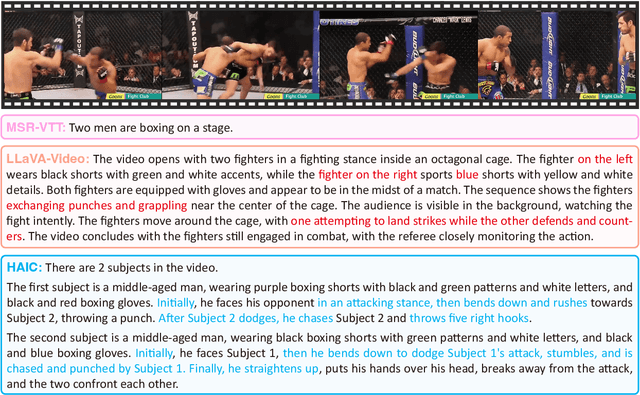
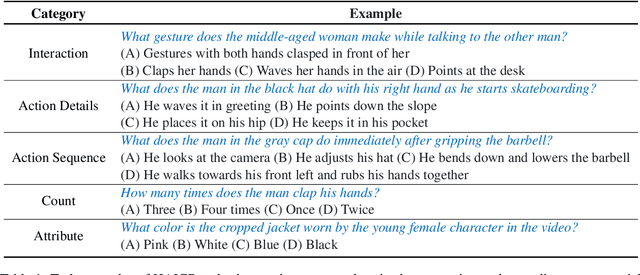
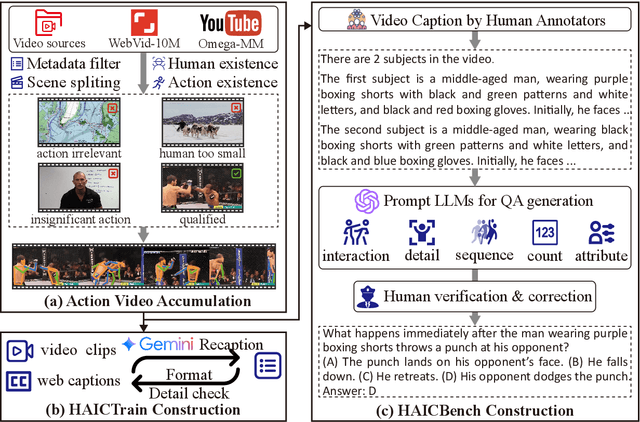
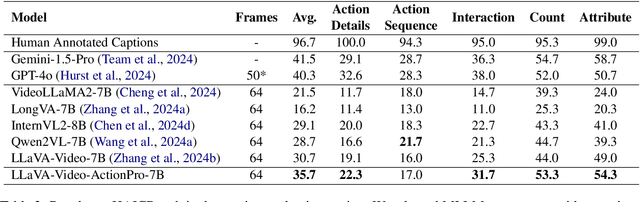
Recent Multi-modal Large Language Models (MLLMs) have made great progress in video understanding. However, their performance on videos involving human actions is still limited by the lack of high-quality data. To address this, we introduce a two-stage data annotation pipeline. First, we design strategies to accumulate videos featuring clear human actions from the Internet. Second, videos are annotated in a standardized caption format that uses human attributes to distinguish individuals and chronologically details their actions and interactions. Through this pipeline, we curate two datasets, namely HAICTrain and HAICBench. \textbf{HAICTrain} comprises 126K video-caption pairs generated by Gemini-Pro and verified for training purposes. Meanwhile, \textbf{HAICBench} includes 500 manually annotated video-caption pairs and 1,400 QA pairs, for a comprehensive evaluation of human action understanding. Experimental results demonstrate that training with HAICTrain not only significantly enhances human understanding abilities across 4 benchmarks, but can also improve text-to-video generation results. Both the HAICTrain and HAICBench are released at https://huggingface.co/datasets/KuaishouHAIC/HAIC.