 Add to Chrome
 Add to Firefox
 Add to Edge
RefCaptioner: Multi-Reference Image-Grounded Video Captioning
Jul 30, 2026
Existing video captioning models generate natural descriptions of video content but cannot explicitly ground local visual elements to multiple reference images. We introduce multi-reference image-grounded video captioning, a new task requiring factual video descriptions with phrase-level reference grounding, and propose RefCaptioner, a two-stage post-training framework for this task. RefCaptioner combines mixed-data SFT with Hierarchical Coverage-Discounted GRPO to jointly improve reference selection, phrase-level binding, distractor rejection, and cross-reference consistency while preserving general video-captioning ability. To support training, we construct a corpus containing $20,000$ videos and 171,354 reference images. We further introduce MRVBench, a benchmark for evaluating caption factuality and multi-reference grounding on both real-world and AI-generated videos. Experiments show that RefCaptioner achieves the best overall performance among the open-source models while remaining competitive on standard video captioning benchmarks. Human evaluation further confirms that its captions are preferred by annotators and enable more source-faithful video reconstruction with both open-source and proprietary video generators.

MultiRef-Compass: Towards Comprehensive Evaluation of Multi-Reference-to-Audio-Video Generation
Jul 15, 2026Multi-reference-to-audio-video (MR2AV) generation aims to generate coherent audio-video content conditioned on multiple references and textual instructions. Existing benchmarks mainly focus on text-driven generation, single-reference subject preservation, or isolated audio-video alignment, leaving the emerging MR2AV setting largely unexplored. Compared with these settings, MR2AV requires models to jointly reason over multiple references while generating synchronized visual and audio content. Models must not only preserve each reference faithfully but also correctly bind and compose multiple referenced entities into coherent audio-visual events. To address this gap, we introduce MultiRef-Compass, a unified benchmark for MR2AV generation. It comprises $350$ carefully curated samples constructed through a scalable and controllable asset-composition pipeline, covering multi-view subject preservation, multi-entity binding, and human-object-scene composition. To provide interpretable assessment, MultiRef-Compass defines an evaluation protocol with four dimensions: Basic Quality, Reference Consistency, Audio-Visual Consistency, and Instruction Following, using 14 sub-metrics. MultiRef-Compass integrates automatic metrics with a rejudging-enhanced MLLM-as-a-Judge framework, enabling scalable and auditable evaluation of both perceptual fidelity and reference-conditioned composition. Extensive experiments on eight representative MR2AV systems reveal substantial room for improvement across multiple evaluation dimensions, underscoring the need for a comprehensive benchmark and positioning MultiRef-Compass as a foundation for future MR2AV research.
KeyFrame-Compass: Towards Comprehensive Evaluation of Keyframe-Conditioned Video Generation
Jul 15, 2026Video generation increasingly relies on keyframe-based workflows, where creators specify a sequence of reference images to guide generation. Although recent models support multi-keyframe conditioning, it remains unclear whether they can faithfully reproduce the prescribed keyframes while maintaining overall video quality. We present KeyFrame-Compass, the first comprehensive benchmark for evaluating keyframe-conditioned video generation. The benchmark contains 386 carefully curated samples spanning three application domains, two video structures, two prompt granularities, two conditioning formats, and four keyframe densities, enabling controlled analysis under diverse generation settings. We further introduce an automated evaluation framework that jointly measures keyframe execution and overall video quality. Specifically, we decompose keyframe execution into six complementary metrics covering presence, fidelity, temporal ordering, localization, persistence, and uniqueness, while assessing overall video quality through evidence-grounded MLLM judgments augmented with specialized perception models. Experiments on nine representative video generation systems reveal several fundamental limitations. Current models exhibit a clear trade-off between faithful keyframe execution and natural video synthesis. Their performance further degrades as keyframe constraints become denser and most open-source models also fail to interpret storyboard-grid inputs as temporally ordered keyframe sequences.
CoVEBench: Can Video Editing Models Handle Complex Instructions?
Jun 07, 2026While recent text-guided video editing models excel at elementary tasks (e.g., style transfer, object insertion), real-world user requests are highly compositional. A single prompt often demands multiple coupled edits, such as modifying subjects, actions, and camera views, while strictly preserving unrelated spatiotemporal content. Existing benchmarks, heavily constrained by isolated edits and coarse global metrics, fail to diagnose how models handle such complex workflows. To address this gap, we introduce CoVEBench, a compositional video editing benchmark comprising 416 curated source videos, 626 multi-point editing instructions, and 9,990 fine-grained checklist items. Covering diverse editing dimensions, CoVEBench evaluates models via MLLM-judged instruction compliance and video fidelity, alongside automated metrics for video quality. Extensive experiments reveal that compositional editing remains a profound challenge: current models frequently omit edits, violate preservation constraints, or introduce artifacts when handling multiple operations simultaneously. CoVEBench provides a challenging, diagnostic testbed to advance video editing toward realistic user workflows.
LongAV-Compass: Towards Unified Evaluation of Minute-Scale Audio-Visual Generation Across T2AV, I2AV, and V2AV
May 25, 2026Audio-visual generation is rapidly advancing from short clips to minute-long content, while existing evaluation protocols remain largely confined to short-form settings. Existing benchmarks primarily focus on 5--10 second text-conditioned generation and rarely support unified evaluation across text, image, and video conditioning modalities. Moreover, they provide limited insight into how identity consistency, narrative coherence, and audio-visual alignment degrade over extended temporal horizons. To bridge this gap, we introduce LongAV-Compass, a systematic benchmark for minute-long audio-visual generation. LongAV-Compass contains 284 curated test cases spanning text-to-audio-video (T2AV), image-to-audio-video (I2AV), and video-to-audio-video (V2AV), organized by application scenario and generation complexity. The benchmark combines taxonomy-guided benchmark construction with a unified evaluation framework that integrates MLLM-assisted assessment with complementary perceptual and multimodal metrics, including DINO-v2, ArcFace, CLIP, and ImageBind. The framework evaluates more than 20 fine-grained dimensions covering within-segment quality, cross-segment consistency, global narrative coherence, semantic alignment, and audio-visual synchronization. Through experiments on 11 representative models together with human-alignment validation, LongAV-Compass provides a diagnostic testbed for analyzing the limitations of current systems in sustaining coherent, semantically aligned, and temporally consistent minute-scale audio-visual generation across diverse input modalities.
Kling-MotionControl Technical Report
Mar 03, 2026Character animation aims to generate lifelike videos by transferring motion dynamics from a driving video to a reference image. Recent strides in generative models have paved the way for high-fidelity character animation. In this work, we present Kling-MotionControl, a unified DiT-based framework engineered specifically for robust, precise, and expressive holistic character animation. Leveraging a divide-and-conquer strategy within a cohesive system, the model orchestrates heterogeneous motion representations tailored to the distinct characteristics of body, face, and hands, effectively reconciling large-scale structural stability with fine-grained articulatory expressiveness. To ensure robust cross-identity generalization, we incorporate adaptive identity-agnostic learning, facilitating natural motion retargeting for diverse characters ranging from realistic humans to stylized cartoons. Simultaneously, we guarantee faithful appearance preservation through meticulous identity injection and fusion designs, further supported by a subject library mechanism that leverages comprehensive reference contexts. To ensure practical utility, we implement an advanced acceleration framework utilizing multi-stage distillation, boosting inference speed by over 10x. Kling-MotionControl distinguishes itself through intelligent semantic motion understanding and precise text responsiveness, allowing for flexible control beyond visual inputs. Human preference evaluations demonstrate that Kling-MotionControl delivers superior performance compared to leading commercial and open-source solutions, achieving exceptional fidelity in holistic motion control, open domain generalization, and visual quality and coherence. These results establish Kling-MotionControl as a robust solution for high-quality, controllable, and lifelike character animation.
T2AV-Compass: Towards Unified Evaluation for Text-to-Audio-Video Generation
Dec 24, 2025Text-to-Audio-Video (T2AV) generation aims to synthesize temporally coherent video and semantically synchronized audio from natural language, yet its evaluation remains fragmented, often relying on unimodal metrics or narrowly scoped benchmarks that fail to capture cross-modal alignment, instruction following, and perceptual realism under complex prompts. To address this limitation, we present T2AV-Compass, a unified benchmark for comprehensive evaluation of T2AV systems, consisting of 500 diverse and complex prompts constructed via a taxonomy-driven pipeline to ensure semantic richness and physical plausibility. Besides, T2AV-Compass introduces a dual-level evaluation framework that integrates objective signal-level metrics for video quality, audio quality, and cross-modal alignment with a subjective MLLM-as-a-Judge protocol for instruction following and realism assessment. Extensive evaluation of 11 representative T2AVsystems reveals that even the strongest models fall substantially short of human-level realism and cross-modal consistency, with persistent failures in audio realism, fine-grained synchronization, instruction following, etc. These results indicate significant improvement room for future models and highlight the value of T2AV-Compass as a challenging and diagnostic testbed for advancing text-to-audio-video generation.
Kling-Omni Technical Report
Dec 18, 2025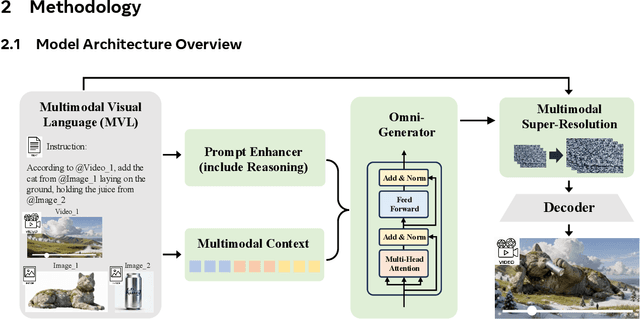
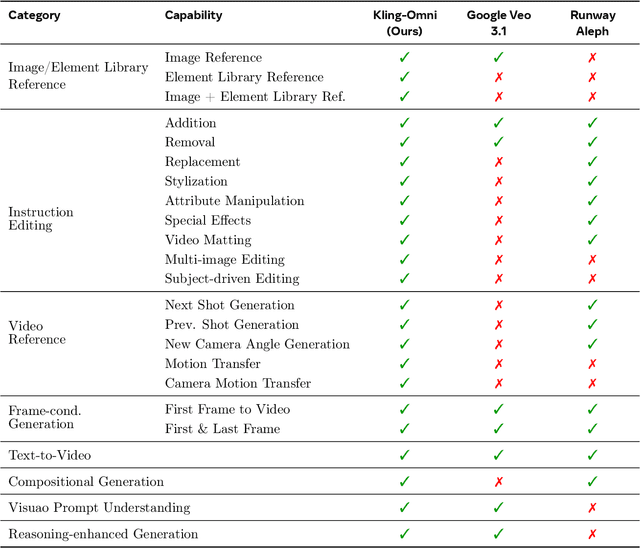
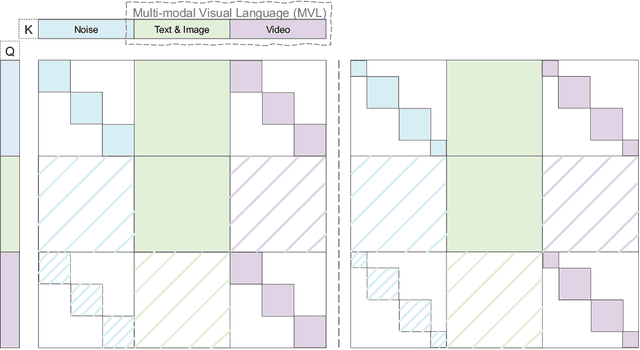
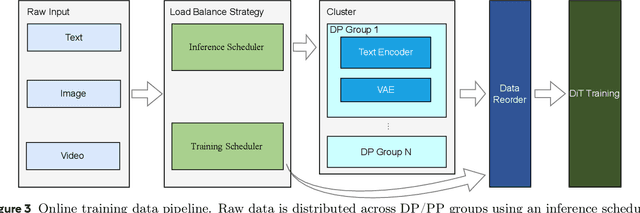
We present Kling-Omni, a generalist generative framework designed to synthesize high-fidelity videos directly from multimodal visual language inputs. Adopting an end-to-end perspective, Kling-Omni bridges the functional separation among diverse video generation, editing, and intelligent reasoning tasks, integrating them into a holistic system. Unlike disjointed pipeline approaches, Kling-Omni supports a diverse range of user inputs, including text instructions, reference images, and video contexts, processing them into a unified multimodal representation to deliver cinematic-quality and highly-intelligent video content creation. To support these capabilities, we constructed a comprehensive data system that serves as the foundation for multimodal video creation. The framework is further empowered by efficient large-scale pre-training strategies and infrastructure optimizations for inference. Comprehensive evaluations reveal that Kling-Omni demonstrates exceptional capabilities in in-context generation, reasoning-based editing, and multimodal instruction following. Moving beyond a content creation tool, we believe Kling-Omni is a pivotal advancement toward multimodal world simulators capable of perceiving, reasoning, generating and interacting with the dynamic and complex worlds.
KlingAvatar 2.0 Technical Report
Dec 15, 2025Avatar video generation models have achieved remarkable progress in recent years. However, prior work exhibits limited efficiency in generating long-duration high-resolution videos, suffering from temporal drifting, quality degradation, and weak prompt following as video length increases. To address these challenges, we propose KlingAvatar 2.0, a spatio-temporal cascade framework that performs upscaling in both spatial resolution and temporal dimension. The framework first generates low-resolution blueprint video keyframes that capture global semantics and motion, and then refines them into high-resolution, temporally coherent sub-clips using a first-last frame strategy, while retaining smooth temporal transitions in long-form videos. To enhance cross-modal instruction fusion and alignment in extended videos, we introduce a Co-Reasoning Director composed of three modality-specific large language model (LLM) experts. These experts reason about modality priorities and infer underlying user intent, converting inputs into detailed storylines through multi-turn dialogue. A Negative Director further refines negative prompts to improve instruction alignment. Building on these components, we extend the framework to support ID-specific multi-character control. Extensive experiments demonstrate that our model effectively addresses the challenges of efficient, multimodally aligned long-form high-resolution video generation, delivering enhanced visual clarity, realistic lip-teeth rendering with accurate lip synchronization, strong identity preservation, and coherent multimodal instruction following.