 Add to Chrome
 Add to Firefox
 Add to Edge
ArborMem: Navigating Interaction States with Memory Forests
Aug 18, 2026
Large language models increasingly serve as persistent conversational assistants, requiring memory that preserves relevant experience and maintains continuity across interactions. Existing methods improve access to conversational history through long-context processing, selective retrieval, and structured memory organization. However, most systems treat memory access as retrieving relevant past information without first determining which prior interaction state the current turn resumes. This limitation becomes particularly important when conversations interleave multiple tasks, people, and plans that may be interrupted and later revisited. We introduce ArborMem, an online memory framework that represents a long-running conversation as a navigable forest of interaction states. Each branch preserves a locally coherent trajectory, while the forest maintains multiple trajectories that may later be resumed. For each new input, ArborMem localizes the relevant state, restores its branch-local context, and augments it with reusable evidence retrieved across branches, preserving interaction continuity without conflating semantically related but structurally distinct trajectories. Existing long-term memory benchmarks cover diverse memory and reasoning capabilities but do not explicitly isolate branch-structured challenges. We therefore introduce BranchMemEval, a controlled diagnostic benchmark for interleaved and resumable interaction trajectories. Experiments on LongMemEval, LoCoMo, BEAM 100K, and BranchMemEval show that ArborMem outperforms the strongest baselines by 3.36 to 10.31 percentage points on the three established benchmarks and by 5.0 points on BranchMemEval. Its advantage grows under constrained read budgets, while complete memory queries remain below half a second.

ReQuant: Fixed-Grid Discrete Refinement for Post-Training Quantization
Aug 07, 2026Post-training quantization (PTQ) is widely used to reduce the memory and computational cost of large language models. Existing PTQ methods typically obtain an initial quantized model through heuristic rules or greedy optimization, and once quantization is completed the resulting integer assignments are usually treated as final. This observation motivates a complementary optimization stage within PTQ that keeps quantized weights improvable after an executable quantized model has been produced, while preserving the quantized format. We introduce ReQuant, a backpropagation-free fixed-grid refinement procedure for this stage. Agnostic to the PTQ initializer, ReQuant takes an existing quantized model as a feasible starting point and iteratively revisits its discrete weight assignments on the fixed quantization grid. Accepted updates strictly reduce the mean squared reconstruction error and remain on the original grid. In this way, ReQuant turns the initially fixed PTQ output into an iteratively optimizable discrete solution and serves as a plug-and-play post-processing stage for existing PTQ pipelines. Experiments across diverse model families, bit-widths, and downstream tasks show that ReQuant consistently improves quantized models from heterogeneous PTQ initializers, with especially large gains on simple initializers and lower bit-widths. Notably, ReQuant can refine a simple round-to-nearest initialization across multiple sweeps until it approaches or surpasses GPTAQ under the same quantization format. These results establish ReQuant as a practical complementary stage for further improving existing PTQ pipelines.
Hy-MultiTurn: A Six-Dimensional Benchmark for Deep Multi-Turn Dialogue Understanding
Jul 31, 2026Long-running multi-turn interactions with chatbots and agents are now common, and a correct response often depends on remembering earlier details, tracking later revisions, identifying intended objects or referents, and withholding action when required conditions are unmet. Existing multi-turn benchmarks typically cover short exchanges and do not fully evaluate these capabilities in long multi-turn interactions, particularly in Chinese, while offering limited insight into how and why models fail. To address these limitations, we analyze real chatbot failures to identify six recurring mechanisms and use them to define six controlled evaluation modes in Hy-MultiTurn, a Chinese benchmark for deep multi-turn dialogue understanding. The six modes evaluate constraint memory, precise execution, constraint synthesis, object localization, action suppression, and reference resolution. Across the six modes, we construct 209 controlled tasks spanning 12-76 turns, with dialogue length, irrelevant-topic distraction, and colloquial phrasing adding further difficulty. Evaluation of 22 frontier model configurations shows that Hy-MultiTurn is broadly challenging, as even GPT-5.5, the strongest overall configuration, satisfies all requirements in only 41.1 percent of responses and no model performs best in all six modes.
Beyond Rephrasing: Book-Level Organization Improves Synthetic Textbook Data for Mid-Training
Jul 30, 2026Synthetic textbook data has improved language model pre-training, but prior work largely treats the benefit as a property of generated content or local rewriting style. We study a different factor: whether related content is organized into coherent book-level documents. We contribute both a scalable synthesis pipeline and controlled evidence that this organization matters. The pipeline retrieves source material from a pre-training corpus, clusters it into topical units, plans hierarchical tables of contents, and assembles source-grounded sections into complete books (our Full setting), yielding 686K textbooks (32B tokens) across 15,000+ disciplines. Replacing natural books in a mid-training mix with this corpus improves downstream performance by +1.09 on average. Controlled comparisons then disentangle the relevant design factors. A content-matched Split condition holds generated text and tokens fixed but treats each section as an independent document; Full's +1.02 mean gain isolates document packaging. A length-matched RandomConcat control that joins sections from different books remains below Full, ruling out document length alone. A retrieval-pool-matched Rephrase condition independently rewrites individual retrieved documents under the same audience-by-style scheme, without clustering, TOC planning, or book assembly; Full's +1.17 gain demonstrates the value of structured synthesis. On Llama3-8B, Full likewise outperforms both RandomConcat and Natural Books, supporting book-level organization as a useful axis for synthetic pre-training data design.
RealClawBench: Live OpenClaw Benchmarks from Real Developer-Agent Sessions
Jun 02, 2026Agent benchmarks should reflect what users actually ask deployed agents to do, yet existing benchmarks often miss key realism properties of real developer-agent sessions. We introduce RealClawBench, a live benchmark framework built from real OpenClaw sessions to capture the distribution, diversity, and real-world difficulty of deployed agent use. Real user requests are challenging to benchmark because they often depend on local execution environments, involve implicit or underspecified intent, and require nontrivial verification. RealClawBench addresses these challenges with two core mechanisms: reconstructed execution environments and deterministic verifiable scorers, which together convert real sessions into reproducible, automatically scored tasks. The resulting release contains 281 executable tasks sampled from a much larger real-session pool while preserving the source distribution, with maximum final-vs-source Jensen-Shannon divergence of 0.0448. Evaluating 14 contemporary models shows that the best system solves only 65.8% of tasks, revealing substantial headroom on realistic developer-agent workloads. By turning real deployed sessions into controlled evaluation instances, RealClawBench provides a practical path toward benchmarks that better measure agent capability in actual use. Code is available at:https://anonymous.4open.science/r/real-claw-bench-582B.
A Primer in Post-Training Reasoning Data: What We Know About How It Works
Jun 01, 2026Post-training has become a primary driver of recent progress in large reasoning models, and reasoning data are often the key variable determining whether this stage succeeds. Work on post-training reasoning data has grown rapidly, yet this literature remains scattered across dataset papers, reinforcement-learning recipes, reward-model studies, benchmarks, and frontier system reports. This paper is the first primer to synthesize over 150 key public studies and system reports on post-training reasoning data. We organize the field around four questions: what data objects exist, what makes them useful, how they are constructed, and how they scale. Together, this organization provides an attribution framework for future reasoning-data releases and post-training recipes.
ConMoE: Expert-Pool Consolidation via Prototype Reassignment for MoE Compression
May 28, 2026Mixture-of-Experts (MoE) language models reduce per-token computation but still require storing and serving all experts, making deployment memory-intensive. Existing post-training compression methods mainly shrink this cost by pruning experts or merging their weights. We formulate post-training MoE compression as expert-pool consolidation: retaining a smaller set of pretrained experts as reusable prototypes and deterministically remapping each original expert reference to one selected prototype. This view separates the reduced expert pool from the reuse structure that represents the original expert slots, and allows prototype sharing within local layer scopes while preserving the original router interface. We propose ConMoE, a train-free prototype remapping framework that selects retained experts using calibration-based contribution and replaceability signals, then redirects original expert calls to the selected prototypes without weight updates or post-compression fine-tuning. Experiments on three pretrained MoE language models show that ConMoE matches or outperforms strong pruning and merging baselines in several settings, achieving the best average score on deepseek-moe-16b-base at both 25% and 50% routed-expert reduction, while remaining competitive on Qwen3-30B-A3B and OLMoE-1B-7B-0125. Ablations indicate that deterministic reassignment is the most stable component, whereas broader cross-layer sharing and post-hoc weight fusion are model-dependent.
SAHG: Sector-Anisotropic Hyperbolic Graph Model for Social Bot Detection
May 28, 2026LLM-driven social bots can generate fluent, human-like text, reducing the discriminative advantage of content-based detection alone. However, coordinated campaigns still leave relational patterns -- interactions, behavioral similarity, shared neighborhoods, community positions, and coordinated activity -- that graph-based methods can exploit. Existing graph detectors face two challenges when exploiting such evidence. First, Euclidean GNNs distort hierarchical and scale-free social graphs; while hyperbolic geometry addresses this volume-growth mismatch, fixed-curvature models still assign uniform geometric resolution to structural directions with different densities and separation needs. Second, relational evidence is not always reliable: sophisticated bots forge heterophilic connections with genuine users, causing neighborhood aggregation to mix bot and human signals and dilute account-level evidence. We propose \textsc{SAHG} (Sector-Anisotropic Hyperbolic Graph), addressing both challenges. \textsc{SAHG} learns a direction-dependent curvature field $γ(u)$ that adapts geometric resolution across structural directions, and uses sector prototypes to convert angular concentration and alignment into classifier-readable features. To prevent contaminated aggregation from overwhelming account-level evidence, \textsc{SAHG} encodes per-account features and graph-neighborhood representations in two independent SAH channels, fusing them only at the classifier. Experiments on Fox8-23, BotSim-24, and MGTAB show that \textsc{SAHG} achieves the highest accuracy and F1 on all three benchmarks, outperforming feature-based, graph-based, LLM-based, and isotropic hyperbolic baselines. Ablation and geometric analyses confirm the effectiveness of the anisotropic geometry and dual-channel design.
Harness-Bench: Measuring Harness Effects across Models in Realistic Agent Workflows
May 27, 2026LLM agents are increasingly deployed as executable systems that use tools, modify workspaces, and produce concrete artifacts. In such workflows, performance depends not only on the base model, but also on the harness: the system layer that manages context, tools, state, constraints, permissions, tracing, and recovery. However, existing benchmarks typically abstract away execution, compare complete agent systems, or hold the harness fixed, making execution-layer variation difficult to study. We introduce Harness-Bench, a diagnostic benchmark for evaluating configuration-level harness effects in realistic agent workflows. Harness-Bench evaluates representative harness configurations across multiple model backends under shared task environments, budgets, and evaluation protocols, while preserving each harness's native execution behavior. The benchmark contains 106 sandboxed offline tasks constructed from practical agent-use patterns and manually reviewed for realism, solvability, oracle-checkability, and integrity. Each run records final artifacts, execution traces, usage statistics, and validator outputs, enabling analysis beyond final completion. Across 5,194 execution trajectories, we observe substantial variation in completion, process quality, efficiency, and failure behavior across model-harness pairings. These results suggest that agent capability should be reported at the model-harness configuration level rather than attributed to the base model alone. Our analysis further identifies recurring execution-alignment failures, where plausible reasoning becomes decoupled from tool feedback, workspace state, evidence, or verifiable output contracts. Harness-Bench provides a reproducible foundation for diagnosing and improving reliable, efficient, and auditable agent execution stacks.
ReFocus: Reinforcing Mid-Frequency and Key-Frequency Modeling for Multivariate Time Series Forecasting
Feb 24, 2025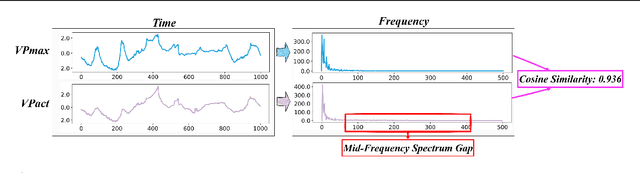
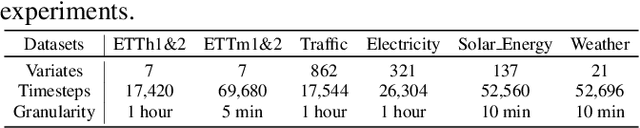
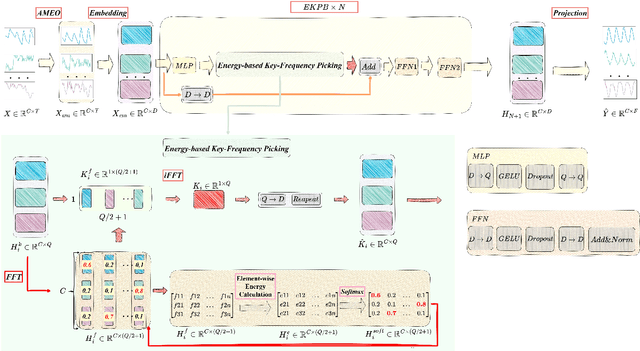
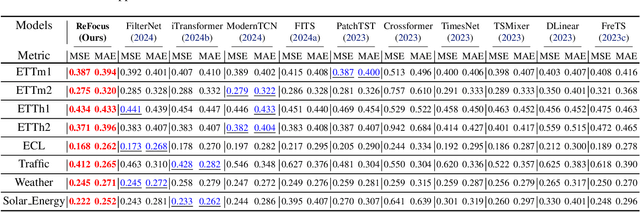
Recent advancements have progressively incorporated frequency-based techniques into deep learning models, leading to notable improvements in accuracy and efficiency for time series analysis tasks. However, the Mid-Frequency Spectrum Gap in the real-world time series, where the energy is concentrated at the low-frequency region while the middle-frequency band is negligible, hinders the ability of existing deep learning models to extract the crucial frequency information. Additionally, the shared Key-Frequency in multivariate time series, where different time series share indistinguishable frequency patterns, is rarely exploited by existing literature. This work introduces a novel module, Adaptive Mid-Frequency Energy Optimizer, based on convolution and residual learning, to emphasize the significance of mid-frequency bands. We also propose an Energy-based Key-Frequency Picking Block to capture shared Key-Frequency, which achieves superior inter-series modeling performance with fewer parameters. A novel Key-Frequency Enhanced Training strategy is employed to further enhance Key-Frequency modeling, where spectral information from other channels is randomly introduced into each channel. Our approach advanced multivariate time series forecasting on the challenging Traffic, ECL, and Solar benchmarks, reducing MSE by 4%, 6%, and 5% compared to the previous SOTA iTransformer. Code is available at this GitHub Repository: https://github.com/Levi-Ackman/ReFocus.