 Add to Chrome
 Add to Firefox
 Add to Edge
LongAV-Compass: Towards Unified Evaluation of Minute-Scale Audio-Visual Generation Across T2AV, I2AV, and V2AV
May 25, 2026
Audio-visual generation is rapidly advancing from short clips to minute-long content, while existing evaluation protocols remain largely confined to short-form settings. Existing benchmarks primarily focus on 5--10 second text-conditioned generation and rarely support unified evaluation across text, image, and video conditioning modalities. Moreover, they provide limited insight into how identity consistency, narrative coherence, and audio-visual alignment degrade over extended temporal horizons. To bridge this gap, we introduce LongAV-Compass, a systematic benchmark for minute-long audio-visual generation. LongAV-Compass contains 284 curated test cases spanning text-to-audio-video (T2AV), image-to-audio-video (I2AV), and video-to-audio-video (V2AV), organized by application scenario and generation complexity. The benchmark combines taxonomy-guided benchmark construction with a unified evaluation framework that integrates MLLM-assisted assessment with complementary perceptual and multimodal metrics, including DINO-v2, ArcFace, CLIP, and ImageBind. The framework evaluates more than 20 fine-grained dimensions covering within-segment quality, cross-segment consistency, global narrative coherence, semantic alignment, and audio-visual synchronization. Through experiments on 11 representative models together with human-alignment validation, LongAV-Compass provides a diagnostic testbed for analyzing the limitations of current systems in sustaining coherent, semantically aligned, and temporally consistent minute-scale audio-visual generation across diverse input modalities.

LatentOmni: Rethinking Omni-Modal Understanding via Unified Audio-Visual Latent Reasoning
May 21, 2026Joint audio-visual reasoning is essential for omnimodal understanding, yet current multimodal large language models (MLLMs) still struggle when reasoning requires fine-grained evidence from both modalities. A central limitation is that explicit text-based chain-of-thought (CoT) compresses continuous audio-visual signals into discrete tokens, weakening temporal grounding and shifting intermediate reasoning toward language priors. We argue that a unified latent space is a better medium for such reasoning because it preserves dense sensory information while remaining compatible with autoregressive generation. Based on this insight, we propose \textbf{LatentOmni}, a cross-modal reasoning framework that interleaves textual reasoning with audio-visual latent states. LatentOmni introduces feature-level supervision to align latent reasoning states with task-relevant sensory features and uses Omni-Sync Position Embedding (OSPE) to maintain temporal consistency between latent audio and visual states. We further construct \textbf{LatentOmni-Instruct-35K}, a dataset of audio-visual interleaved reasoning trajectories for supervising latent-space reasoning. Comprehensive evaluation across multiple audio-visual reasoning benchmarks demonstrates that LatentOmni achieves the best performance among the evaluated open-source models and consistently outperforms the Explicit Text CoT baseline, supporting latent-space joint reasoning as a promising path toward stronger omnimodal understanding.
Artifact-Bench: Evaluating MLLMs on Detecting and Assessing the Artifacts of AI-Generated Videos
May 18, 2026Recent video generative models have greatly improved the realism of AI-generated videos, yet their outputs still exhibit artifacts such as temporal inconsistencies, structural distortions, and semantic incoherence. While Multimodal Large Language Models (MLLMs) show strong visual understanding capabilities, their ability to perceive and reason about such artifacts remains unclear. Existing benchmarks often lack systematic evaluation of artifact-aware perception and fine-grained diagnostic reasoning, especially across diverse AI-generated video domains beyond photorealistic content. To address this gap, we introduce Artifact-Bench, a comprehensive benchmark for evaluating MLLMs on AI-generated video artifact detection and analysis. We first establish a three-level hierarchical taxonomy of realism artifacts, covering photorealistic, animated, and CG-style videos. Based on this taxonomy, Artifact-Bench defines three complementary tasks: real vs. AI-generated video classification, pairwise realism comparison, and fine-grained artifact identification. Experiments on 19 leading MLLMs reveal substantial limitations in artifact perception and reasoning, with many models approaching random or even below-random performance in challenging settings. We further observe significant misalignment between MLLM judgments and human perceptual preferences, highlighting their limited reliability as general evaluators for AI-generated video realism.
OpenWorldLib: A Unified Codebase and Definition of Advanced World Models
Apr 06, 2026World models have garnered significant attention as a promising research direction in artificial intelligence, yet a clear and unified definition remains lacking. In this paper, we introduce OpenWorldLib, a comprehensive and standardized inference framework for Advanced World Models. Drawing on the evolution of world models, we propose a clear definition: a world model is a model or framework centered on perception, equipped with interaction and long-term memory capabilities, for understanding and predicting the complex world. We further systematically categorize the essential capabilities of world models. Based on this definition, OpenWorldLib integrates models across different tasks within a unified framework, enabling efficient reuse and collaborative inference. Finally, we present additional reflections and analyses on potential future directions for world model research. Code link: https://github.com/OpenDCAI/OpenWorldLib
OmniSIFT: Modality-Asymmetric Token Compression for Efficient Omni-modal Large Language Models
Feb 04, 2026Omni-modal Large Language Models (Omni-LLMs) have demonstrated strong capabilities in audio-video understanding tasks. However, their reliance on long multimodal token sequences leads to substantial computational overhead. Despite this challenge, token compression methods designed for Omni-LLMs remain limited. To bridge this gap, we propose OmniSIFT (Omni-modal Spatio-temporal Informed Fine-grained Token compression), a modality-asymmetric token compression framework tailored for Omni-LLMs. Specifically, OmniSIFT adopts a two-stage compression strategy: (i) a spatio-temporal video pruning module that removes video redundancy arising from both intra-frame structure and inter-frame overlap, and (ii) a vision-guided audio selection module that filters audio tokens. The entire framework is optimized end-to-end via a differentiable straight-through estimator. Extensive experiments on five representative benchmarks demonstrate the efficacy and robustness of OmniSIFT. Notably, for Qwen2.5-Omni-7B, OmniSIFT introduces only 4.85M parameters while maintaining lower latency than training-free baselines such as OmniZip. With merely 25% of the original token context, OmniSIFT consistently outperforms all compression baselines and even surpasses the performance of the full-token model on several tasks.
Semantic Routing: Exploring Multi-Layer LLM Feature Weighting for Diffusion Transformers
Feb 03, 2026Recent DiT-based text-to-image models increasingly adopt LLMs as text encoders, yet text conditioning remains largely static and often utilizes only a single LLM layer, despite pronounced semantic hierarchy across LLM layers and non-stationary denoising dynamics over both diffusion time and network depth. To better match the dynamic process of DiT generation and thereby enhance the diffusion model's generative capability, we introduce a unified normalized convex fusion framework equipped with lightweight gates to systematically organize multi-layer LLM hidden states via time-wise, depth-wise, and joint fusion. Experiments establish Depth-wise Semantic Routing as the superior conditioning strategy, consistently improving text-image alignment and compositional generation (e.g., +9.97 on the GenAI-Bench Counting task). Conversely, we find that purely time-wise fusion can paradoxically degrade visual generation fidelity. We attribute this to a train-inference trajectory mismatch: under classifier-free guidance, nominal timesteps fail to track the effective SNR, causing semantically mistimed feature injection during inference. Overall, our results position depth-wise routing as a strong and effective baseline and highlight the critical need for trajectory-aware signals to enable robust time-dependent conditioning.
Research on World Models Is Not Merely Injecting World Knowledge into Specific Tasks
Feb 02, 2026World models have emerged as a critical frontier in AI research, aiming to enhance large models by infusing them with physical dynamics and world knowledge. The core objective is to enable agents to understand, predict, and interact with complex environments. However, current research landscape remains fragmented, with approaches predominantly focused on injecting world knowledge into isolated tasks, such as visual prediction, 3D estimation, or symbol grounding, rather than establishing a unified definition or framework. While these task-specific integrations yield performance gains, they often lack the systematic coherence required for holistic world understanding. In this paper, we analyze the limitations of such fragmented approaches and propose a unified design specification for world models. We suggest that a robust world model should not be a loose collection of capabilities but a normative framework that integrally incorporates interaction, perception, symbolic reasoning, and spatial representation. This work aims to provide a structured perspective to guide future research toward more general, robust, and principled models of the world.
DiaDem: Advancing Dialogue Descriptions in Audiovisual Video Captioning for Multimodal Large Language Models
Jan 27, 2026Accurate dialogue description in audiovisual video captioning is crucial for downstream understanding and generation tasks. However, existing models generally struggle to produce faithful dialogue descriptions within audiovisual captions. To mitigate this limitation, we propose DiaDem, a powerful audiovisual video captioning model capable of generating captions with more precise dialogue descriptions while maintaining strong overall performance. We first synthesize a high-quality dataset for SFT, then employ a difficulty-partitioned two-stage GRPO strategy to further enhance dialogue descriptions. To enable systematic evaluation of dialogue description capabilities, we introduce DiaDemBench, a comprehensive benchmark designed to evaluate models across diverse dialogue scenarios, emphasizing both speaker attribution accuracy and utterance transcription fidelity in audiovisual captions. Extensive experiments on DiaDemBench reveal even commercial models still exhibit substantial room for improvement in dialogue-aware captioning. Notably, DiaDem not only outperforms the Gemini series in dialogue description accuracy but also achieves competitive performance on general audiovisual captioning benchmarks, demonstrating its overall effectiveness.
GRAN-TED: Generating Robust, Aligned, and Nuanced Text Embedding for Diffusion Models
Dec 17, 2025The text encoder is a critical component of text-to-image and text-to-video diffusion models, fundamentally determining the semantic fidelity of the generated content. However, its development has been hindered by two major challenges: the lack of an efficient evaluation framework that reliably predicts downstream generation performance, and the difficulty of effectively adapting pretrained language models for visual synthesis. To address these issues, we introduce GRAN-TED, a paradigm to Generate Robust, Aligned, and Nuanced Text Embeddings for Diffusion models. Our contribution is twofold. First, we propose TED-6K, a novel text-only benchmark that enables efficient and robust assessment of an encoder's representational quality without requiring costly end-to-end model training. We demonstrate that performance on TED-6K, standardized via a lightweight, unified adapter, strongly correlates with an encoder's effectiveness in downstream generation tasks. Second, guided by this validated framework, we develop a superior text encoder using a novel two-stage training paradigm. This process involves an initial fine-tuning stage on a Multimodal Large Language Model for better visual representation, followed by a layer-wise weighting method to extract more nuanced and potent text features. Our experiments show that the resulting GRAN-TED encoder not only achieves state-of-the-art performance on TED-6K but also leads to demonstrable performance gains in text-to-image and text-to-video generation. Our code is available at the following link: https://anonymous.4open.science/r/GRAN-TED-4FCC/.
The Unseen Bias: How Norm Discrepancy in Pre-Norm MLLMs Leads to Visual Information Loss
Dec 09, 2025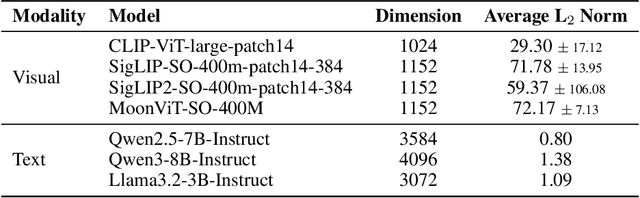

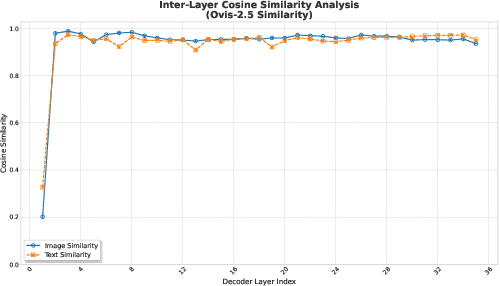
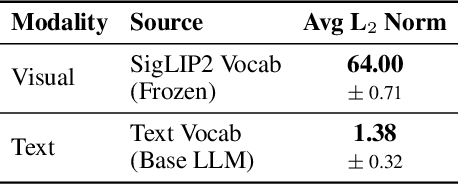
Multimodal Large Language Models (MLLMs), which couple pre-trained vision encoders and language models, have shown remarkable capabilities. However, their reliance on the ubiquitous Pre-Norm architecture introduces a subtle yet critical flaw: a severe norm disparity between the high-norm visual tokens and the low-norm text tokens. In this work, we present a formal theoretical analysis demonstrating that this imbalance is not a static issue. Instead, it induces an ``asymmetric update dynamic,'' where high-norm visual tokens exhibit a ``representational inertia,'' causing them to transform semantically much slower than their textual counterparts. This fundamentally impairs effective cross-modal feature fusion. Our empirical validation across a range of mainstream MLLMs confirms that this theoretical dynamic -- the persistence of norm disparity and the resulting asymmetric update rates -- is a prevalent phenomenon. Based on this insight, we propose a remarkably simple yet effective solution: inserting a single, carefully initialized LayerNorm layer after the visual projector to enforce norm alignment. Experiments conducted on the LLaVA-1.5 architecture show that this intervention yields significant performance gains not only on a wide suite of multimodal benchmarks but also, notably, on text-only evaluations such as MMLU, suggesting that resolving the architectural imbalance leads to a more holistically capable model.