 Add to Chrome
 Add to Firefox
 Add to Edge
Kling-MotionControl Technical Report
Mar 03, 2026
Character animation aims to generate lifelike videos by transferring motion dynamics from a driving video to a reference image. Recent strides in generative models have paved the way for high-fidelity character animation. In this work, we present Kling-MotionControl, a unified DiT-based framework engineered specifically for robust, precise, and expressive holistic character animation. Leveraging a divide-and-conquer strategy within a cohesive system, the model orchestrates heterogeneous motion representations tailored to the distinct characteristics of body, face, and hands, effectively reconciling large-scale structural stability with fine-grained articulatory expressiveness. To ensure robust cross-identity generalization, we incorporate adaptive identity-agnostic learning, facilitating natural motion retargeting for diverse characters ranging from realistic humans to stylized cartoons. Simultaneously, we guarantee faithful appearance preservation through meticulous identity injection and fusion designs, further supported by a subject library mechanism that leverages comprehensive reference contexts. To ensure practical utility, we implement an advanced acceleration framework utilizing multi-stage distillation, boosting inference speed by over 10x. Kling-MotionControl distinguishes itself through intelligent semantic motion understanding and precise text responsiveness, allowing for flexible control beyond visual inputs. Human preference evaluations demonstrate that Kling-MotionControl delivers superior performance compared to leading commercial and open-source solutions, achieving exceptional fidelity in holistic motion control, open domain generalization, and visual quality and coherence. These results establish Kling-MotionControl as a robust solution for high-quality, controllable, and lifelike character animation.

Kling-Omni Technical Report
Dec 18, 2025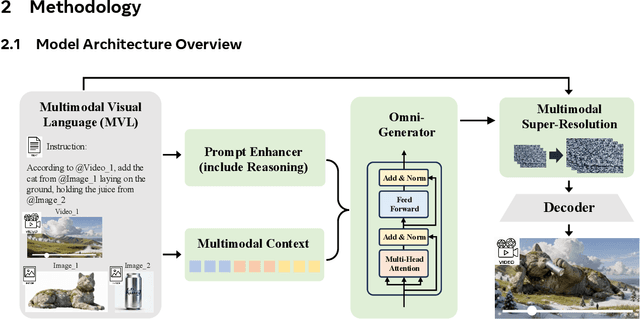
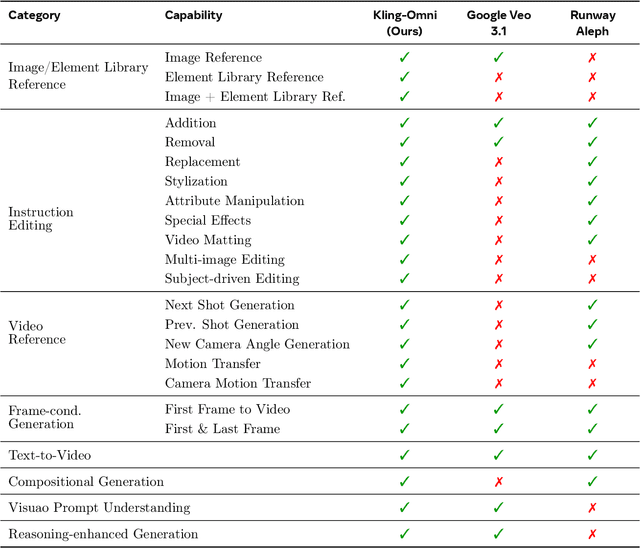
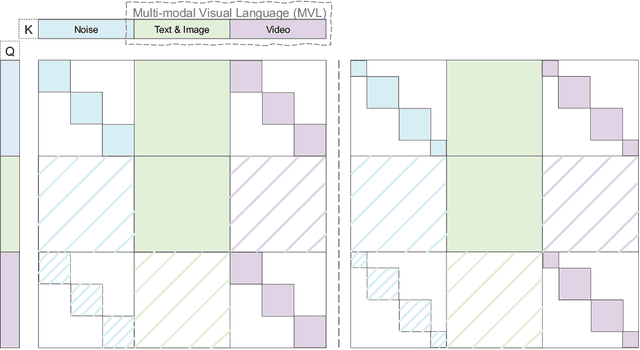
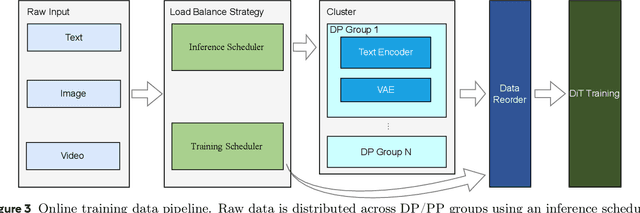
We present Kling-Omni, a generalist generative framework designed to synthesize high-fidelity videos directly from multimodal visual language inputs. Adopting an end-to-end perspective, Kling-Omni bridges the functional separation among diverse video generation, editing, and intelligent reasoning tasks, integrating them into a holistic system. Unlike disjointed pipeline approaches, Kling-Omni supports a diverse range of user inputs, including text instructions, reference images, and video contexts, processing them into a unified multimodal representation to deliver cinematic-quality and highly-intelligent video content creation. To support these capabilities, we constructed a comprehensive data system that serves as the foundation for multimodal video creation. The framework is further empowered by efficient large-scale pre-training strategies and infrastructure optimizations for inference. Comprehensive evaluations reveal that Kling-Omni demonstrates exceptional capabilities in in-context generation, reasoning-based editing, and multimodal instruction following. Moving beyond a content creation tool, we believe Kling-Omni is a pivotal advancement toward multimodal world simulators capable of perceiving, reasoning, generating and interacting with the dynamic and complex worlds.
KlingAvatar 2.0 Technical Report
Dec 15, 2025Avatar video generation models have achieved remarkable progress in recent years. However, prior work exhibits limited efficiency in generating long-duration high-resolution videos, suffering from temporal drifting, quality degradation, and weak prompt following as video length increases. To address these challenges, we propose KlingAvatar 2.0, a spatio-temporal cascade framework that performs upscaling in both spatial resolution and temporal dimension. The framework first generates low-resolution blueprint video keyframes that capture global semantics and motion, and then refines them into high-resolution, temporally coherent sub-clips using a first-last frame strategy, while retaining smooth temporal transitions in long-form videos. To enhance cross-modal instruction fusion and alignment in extended videos, we introduce a Co-Reasoning Director composed of three modality-specific large language model (LLM) experts. These experts reason about modality priorities and infer underlying user intent, converting inputs into detailed storylines through multi-turn dialogue. A Negative Director further refines negative prompts to improve instruction alignment. Building on these components, we extend the framework to support ID-specific multi-character control. Extensive experiments demonstrate that our model effectively addresses the challenges of efficient, multimodally aligned long-form high-resolution video generation, delivering enhanced visual clarity, realistic lip-teeth rendering with accurate lip synchronization, strong identity preservation, and coherent multimodal instruction following.