 Add to Chrome
 Add to Firefox
 Add to Edge
MMGT: Motion Mask Guided Two-Stage Network for Co-Speech Gesture Video Generation
May 29, 2025
Co-Speech Gesture Video Generation aims to generate vivid speech videos from audio-driven still images, which is challenging due to the diversity of different parts of the body in terms of amplitude of motion, audio relevance, and detailed features. Relying solely on audio as the control signal often fails to capture large gesture movements in video, leading to more pronounced artifacts and distortions. Existing approaches typically address this issue by introducing additional a priori information, but this can limit the practical application of the task. Specifically, we propose a Motion Mask-Guided Two-Stage Network (MMGT) that uses audio, as well as motion masks and motion features generated from the audio signal to jointly drive the generation of synchronized speech gesture videos. In the first stage, the Spatial Mask-Guided Audio Pose Generation (SMGA) Network generates high-quality pose videos and motion masks from audio, effectively capturing large movements in key regions such as the face and gestures. In the second stage, we integrate the Motion Masked Hierarchical Audio Attention (MM-HAA) into the Stabilized Diffusion Video Generation model, overcoming limitations in fine-grained motion generation and region-specific detail control found in traditional methods. This guarantees high-quality, detailed upper-body video generation with accurate texture and motion details. Evaluations show improved video quality, lip-sync, and gesture. The model and code are available at https://github.com/SIA-IDE/MMGT.

Interspeech 2025 URGENT Speech Enhancement Challenge
May 29, 2025There has been a growing effort to develop universal speech enhancement (SE) to handle inputs with various speech distortions and recording conditions. The URGENT Challenge series aims to foster such universal SE by embracing a broad range of distortion types, increasing data diversity, and incorporating extensive evaluation metrics. This work introduces the Interspeech 2025 URGENT Challenge, the second edition of the series, to explore several aspects that have received limited attention so far: language dependency, universality for more distortion types, data scalability, and the effectiveness of using noisy training data. We received 32 submissions, where the best system uses a discriminative model, while most other competitive ones are hybrid methods. Analysis reveals some key findings: (i) some generative or hybrid approaches are preferred in subjective evaluations over the top discriminative model, and (ii) purely generative SE models can exhibit language dependency.
DvD: Unleashing a Generative Paradigm for Document Dewarping via Coordinates-based Diffusion Model
May 28, 2025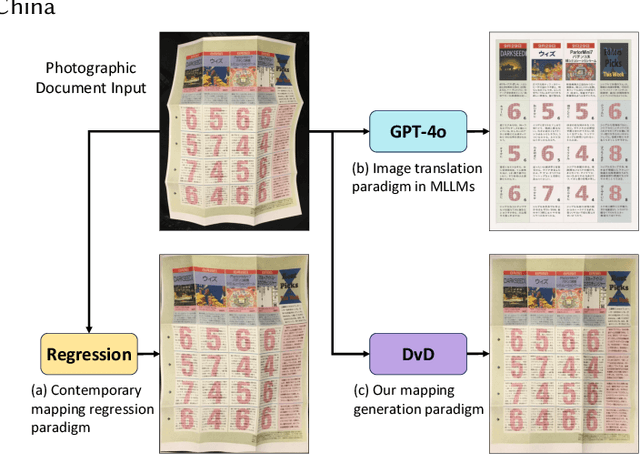
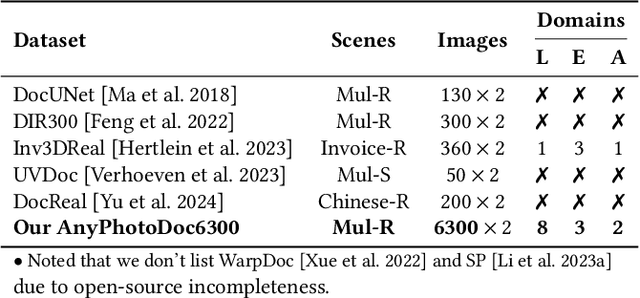
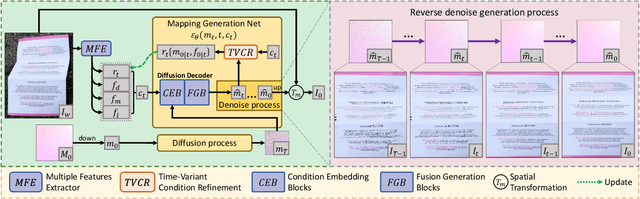
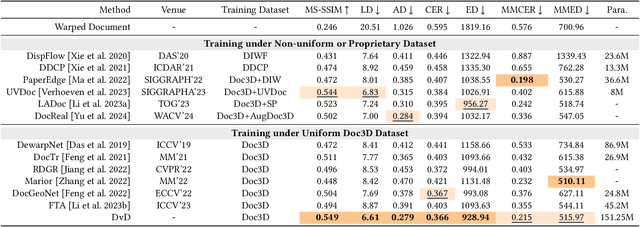
Document dewarping aims to rectify deformations in photographic document images, thus improving text readability, which has attracted much attention and made great progress, but it is still challenging to preserve document structures. Given recent advances in diffusion models, it is natural for us to consider their potential applicability to document dewarping. However, it is far from straightforward to adopt diffusion models in document dewarping due to their unfaithful control on highly complex document images (e.g., 2000$\times$3000 resolution). In this paper, we propose DvD, the first generative model to tackle document \textbf{D}ewarping \textbf{v}ia a \textbf{D}iffusion framework. To be specific, DvD introduces a coordinate-level denoising instead of typical pixel-level denoising, generating a mapping for deformation rectification. In addition, we further propose a time-variant condition refinement mechanism to enhance the preservation of document structures. In experiments, we find that current document dewarping benchmarks can not evaluate dewarping models comprehensively. To this end, we present AnyPhotoDoc6300, a rigorously designed large-scale document dewarping benchmark comprising 6,300 real image pairs across three distinct domains, enabling fine-grained evaluation of dewarping models. Comprehensive experiments demonstrate that our proposed DvD can achieve state-of-the-art performance with acceptable computational efficiency on multiple metrics across various benchmarks including DocUNet, DIR300, and AnyPhotoDoc6300. The new benchmark and code will be publicly available.
InstGenIE: Generative Image Editing Made Efficient with Mask-aware Caching and Scheduling
May 27, 2025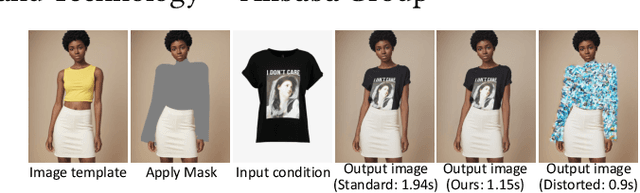


Generative image editing using diffusion models has become a prevalent application in today's AI cloud services. In production environments, image editing typically involves a mask that specifies the regions of an image template to be edited. The use of masks provides direct control over the editing process and introduces sparsity in the model inference. In this paper, we present InstGenIE, a system that efficiently serves image editing requests. The key insight behind InstGenIE is that image editing only modifies the masked regions of image templates while preserving the original content in the unmasked areas. Driven by this insight, InstGenIE judiciously skips redundant computations associated with the unmasked areas by reusing cached intermediate activations from previous inferences. To mitigate the high cache loading overhead, InstGenIE employs a bubble-free pipeline scheme that overlaps computation with cache loading. Additionally, to reduce queuing latency in online serving while improving the GPU utilization, InstGenIE proposes a novel continuous batching strategy for diffusion model serving, allowing newly arrived requests to join the running batch in just one step of denoising computation, without waiting for the entire batch to complete. As heterogeneous masks induce imbalanced loads, InstGenIE also develops a load balancing strategy that takes into account the loads of both computation and cache loading. Collectively, InstGenIE outperforms state-of-the-art diffusion serving systems for image editing, achieving up to 3x higher throughput and reducing average request latency by up to 14.7x while ensuring image quality.
PathBench: A comprehensive comparison benchmark for pathology foundation models towards precision oncology
May 26, 2025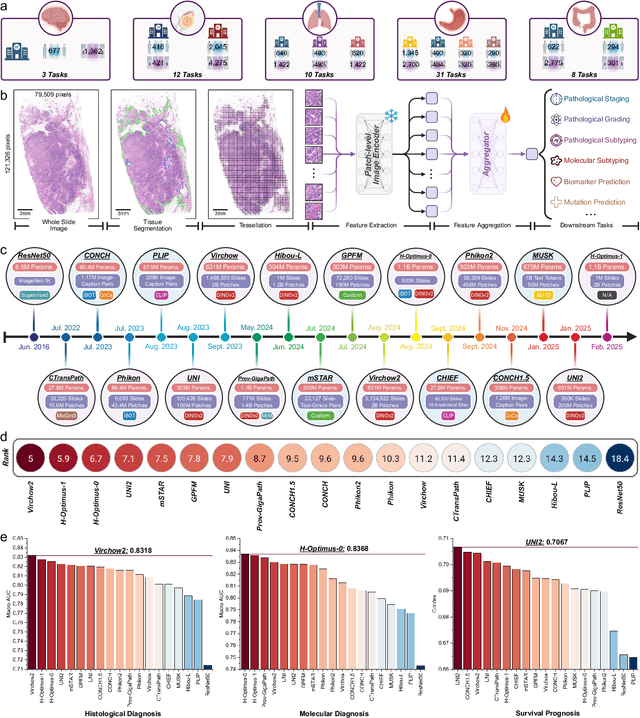
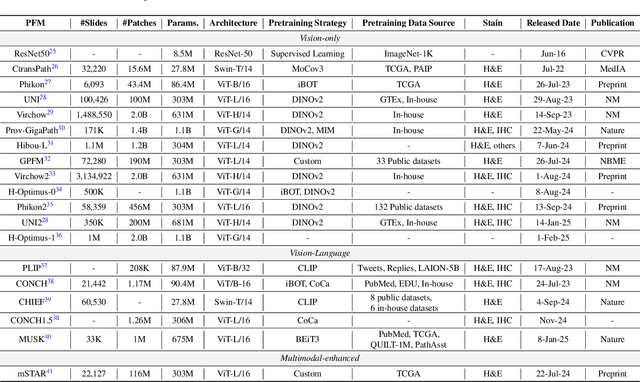
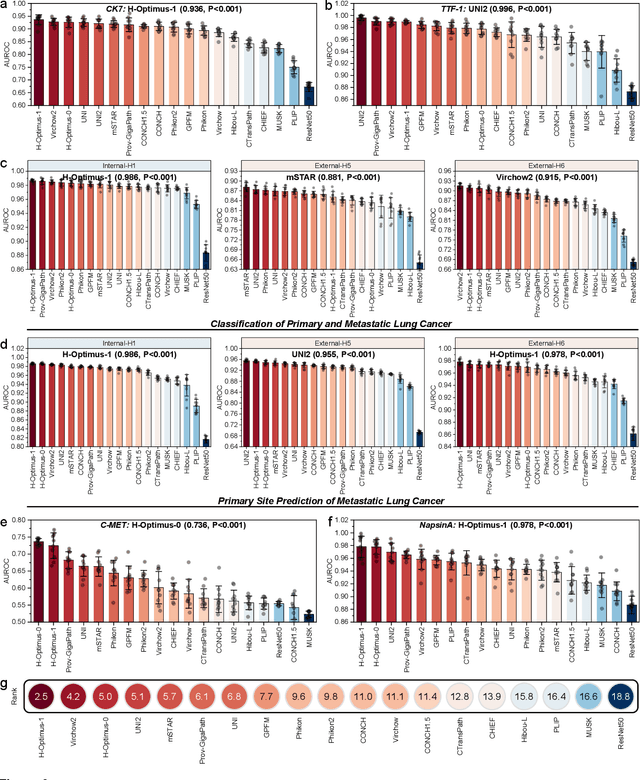
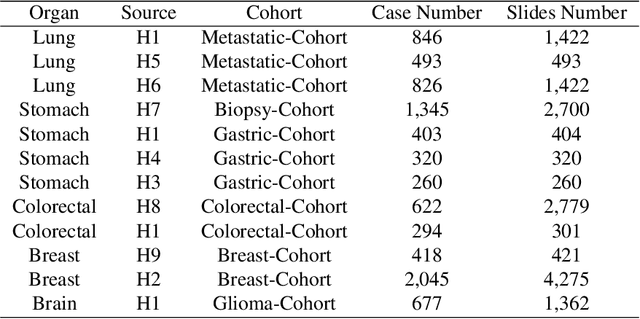
The emergence of pathology foundation models has revolutionized computational histopathology, enabling highly accurate, generalized whole-slide image analysis for improved cancer diagnosis, and prognosis assessment. While these models show remarkable potential across cancer diagnostics and prognostics, their clinical translation faces critical challenges including variability in optimal model across cancer types, potential data leakage in evaluation, and lack of standardized benchmarks. Without rigorous, unbiased evaluation, even the most advanced PFMs risk remaining confined to research settings, delaying their life-saving applications. Existing benchmarking efforts remain limited by narrow cancer-type focus, potential pretraining data overlaps, or incomplete task coverage. We present PathBench, the first comprehensive benchmark addressing these gaps through: multi-center in-hourse datasets spanning common cancers with rigorous leakage prevention, evaluation across the full clinical spectrum from diagnosis to prognosis, and an automated leaderboard system for continuous model assessment. Our framework incorporates large-scale data, enabling objective comparison of PFMs while reflecting real-world clinical complexity. All evaluation data comes from private medical providers, with strict exclusion of any pretraining usage to avoid data leakage risks. We have collected 15,888 WSIs from 8,549 patients across 10 hospitals, encompassing over 64 diagnosis and prognosis tasks. Currently, our evaluation of 19 PFMs shows that Virchow2 and H-Optimus-1 are the most effective models overall. This work provides researchers with a robust platform for model development and offers clinicians actionable insights into PFM performance across diverse clinical scenarios, ultimately accelerating the translation of these transformative technologies into routine pathology practice.
Vad-R1: Towards Video Anomaly Reasoning via Perception-to-Cognition Chain-of-Thought
May 26, 2025Recent advancements in reasoning capability of Multimodal Large Language Models (MLLMs) demonstrate its effectiveness in tackling complex visual tasks. However, existing MLLM-based Video Anomaly Detection (VAD) methods remain limited to shallow anomaly descriptions without deep reasoning. In this paper, we propose a new task named Video Anomaly Reasoning (VAR), which aims to enable deep analysis and understanding of anomalies in the video by requiring MLLMs to think explicitly before answering. To this end, we propose Vad-R1, an end-to-end MLLM-based framework for VAR. Specifically, we design a Perception-to-Cognition Chain-of-Thought (P2C-CoT) that simulates the human process of recognizing anomalies, guiding the MLLM to reason anomaly step-by-step. Based on the structured P2C-CoT, we construct Vad-Reasoning, a dedicated dataset for VAR. Furthermore, we propose an improved reinforcement learning algorithm AVA-GRPO, which explicitly incentivizes the anomaly reasoning capability of MLLMs through a self-verification mechanism with limited annotations. Experimental results demonstrate that Vad-R1 achieves superior performance, outperforming both open-source and proprietary models on VAD and VAR tasks. Codes and datasets will be released at https://github.com/wbfwonderful/Vad-R1.
FD-Bench: A Modular and Fair Benchmark for Data-driven Fluid Simulation
May 25, 2025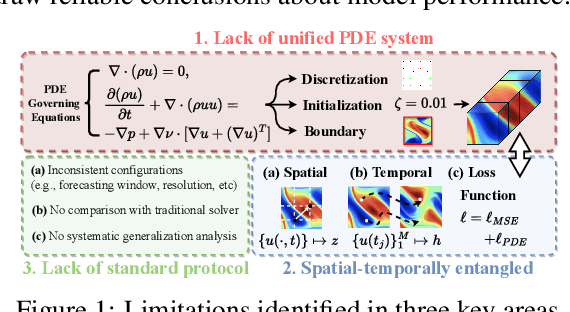
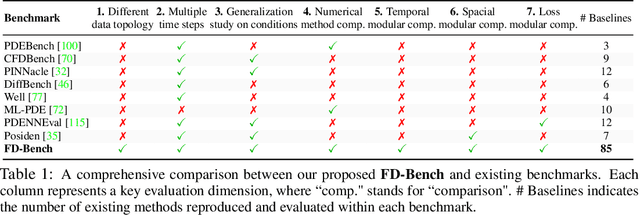
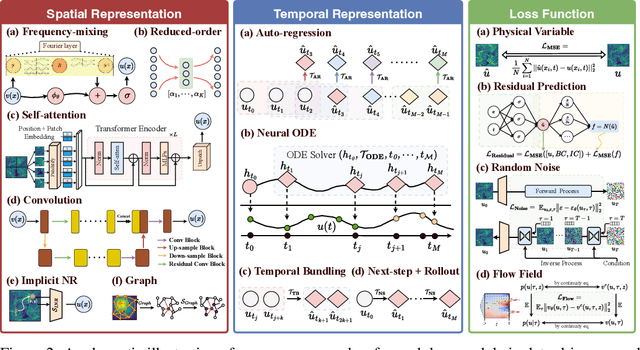
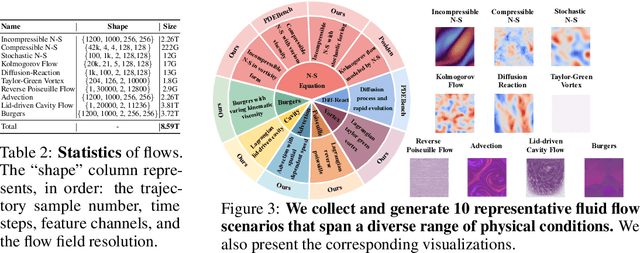
Data-driven modeling of fluid dynamics has advanced rapidly with neural PDE solvers, yet a fair and strong benchmark remains fragmented due to the absence of unified PDE datasets and standardized evaluation protocols. Although architectural innovations are abundant, fair assessment is further impeded by the lack of clear disentanglement between spatial, temporal and loss modules. In this paper, we introduce FD-Bench, the first fair, modular, comprehensive and reproducible benchmark for data-driven fluid simulation. FD-Bench systematically evaluates 85 baseline models across 10 representative flow scenarios under a unified experimental setup. It provides four key contributions: (1) a modular design enabling fair comparisons across spatial, temporal, and loss function modules; (2) the first systematic framework for direct comparison with traditional numerical solvers; (3) fine-grained generalization analysis across resolutions, initial conditions, and temporal windows; and (4) a user-friendly, extensible codebase to support future research. Through rigorous empirical studies, FD-Bench establishes the most comprehensive leaderboard to date, resolving long-standing issues in reproducibility and comparability, and laying a foundation for robust evaluation of future data-driven fluid models. The code is open-sourced at https://anonymous.4open.science/r/FD-Bench-15BC.
Guiding the Experts: Semantic Priors for Efficient and Focused MoE Routing
May 24, 2025Mixture-of-Experts (MoE) models have emerged as a promising direction for scaling vision architectures efficiently. Among them, Soft MoE improves training stability by assigning each token to all experts via continuous dispatch weights. However, current designs overlook the semantic structure which is implicitly encoded in these weights, resulting in suboptimal expert routing. In this paper, we discover that dispatch weights in Soft MoE inherently exhibit segmentation-like patterns but are not explicitly aligned with semantic regions. Motivated by this observation, we propose a foreground-guided enhancement strategy. Specifically, we introduce a spatially aware auxiliary loss that encourages expert activation to align with semantic foreground regions. To further reinforce this supervision, we integrate a lightweight LayerScale mechanism that improves information flow and stabilizes optimization in skip connections. Our method necessitates only minor architectural adjustments and can be seamlessly integrated into prevailing Soft MoE frameworks. Comprehensive experiments on ImageNet-1K and multiple smaller-scale classification benchmarks not only showcase consistent performance enhancements but also reveal more interpretable expert routing mechanisms.
Analysis on Energy Efficiency of RIS-Assisted Multiuser Downlink Near-Field Communications
May 23, 2025In this paper, we focus on the energy efficiency (EE) optimization and analysis of reconfigurable intelligent surface (RIS)-assisted multiuser downlink near-field communications. Specifically, we conduct a comprehensive study on several key factors affecting EE performance, including the number of RIS elements, the types of reconfigurable elements, reconfiguration resolutions, and the maximum transmit power. To accurately capture the power characteristics of RISs, we adopt more practical power consumption models for three commonly used reconfigurable elements in RISs: PIN diodes, varactor diodes, and radio frequency (RF) switches. These different elements may result in RIS systems exhibiting significantly different energy efficiencies (EEs), even when their spectral efficiencies (SEs) are similar. Considering discrete phases implemented at most RISs in practice, which makes their optimization NP-hard, we develop a nested alternating optimization framework to maximize EE, consisting of an outer integer-based optimization for discrete RIS phase reconfigurations and a nested non-convex optimization for continuous transmit power allocation within each iteration. Extensive comparisons with multiple benchmark schemes validate the effectiveness and efficiency of the proposed framework. Furthermore, based on the proposed optimization method, we analyze the EE performance of RISs across different key factors and identify the optimal RIS architecture yielding the highest EE.
DiffusionReward: Enhancing Blind Face Restoration through Reward Feedback Learning
May 23, 2025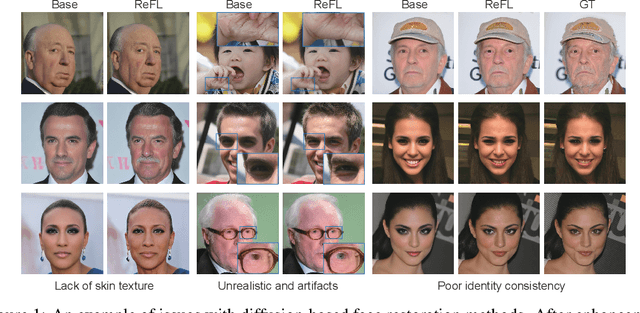
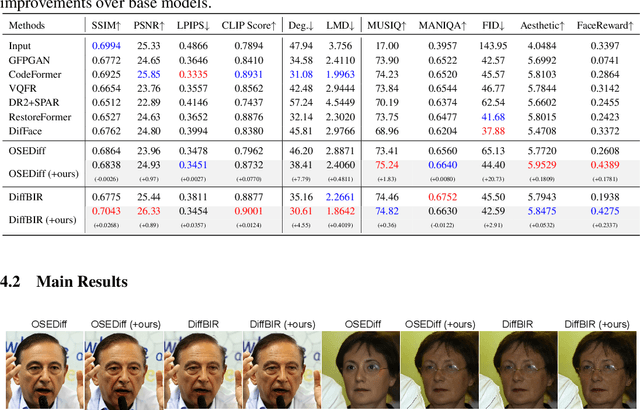
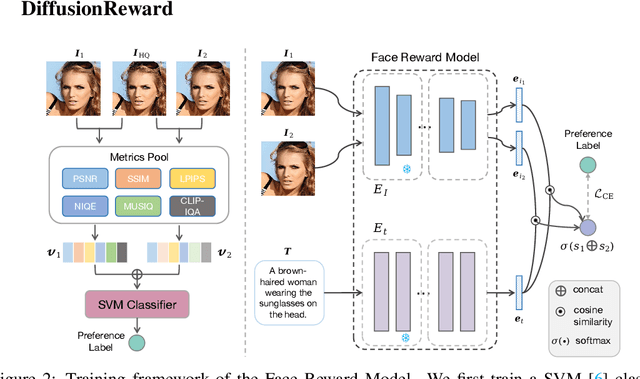

Reward Feedback Learning (ReFL) has recently shown great potential in aligning model outputs with human preferences across various generative tasks. In this work, we introduce a ReFL framework, named DiffusionReward, to the Blind Face Restoration task for the first time. DiffusionReward effectively overcomes the limitations of diffusion-based methods, which often fail to generate realistic facial details and exhibit poor identity consistency. The core of our framework is the Face Reward Model (FRM), which is trained using carefully annotated data. It provides feedback signals that play a pivotal role in steering the optimization process of the restoration network. In particular, our ReFL framework incorporates a gradient flow into the denoising process of off-the-shelf face restoration methods to guide the update of model parameters. The guiding gradient is collaboratively determined by three aspects: (i) the FRM to ensure the perceptual quality of the restored faces; (ii) a regularization term that functions as a safeguard to preserve generative diversity; and (iii) a structural consistency constraint to maintain facial fidelity. Furthermore, the FRM undergoes dynamic optimization throughout the process. It not only ensures that the restoration network stays precisely aligned with the real face manifold, but also effectively prevents reward hacking. Experiments on synthetic and wild datasets demonstrate that our method outperforms state-of-the-art methods, significantly improving identity consistency and facial details. The source codes, data, and models are available at: https://github.com/01NeuralNinja/DiffusionReward.